 Add to Chrome
 Add to Firefox
 Add to Edge
Multi-Turn On-Policy Distillation with Prefix Replay
Jul 06, 2026
We study on-policy distillation (OPD) for agentic tasks, where an LLM agent interacts with an environment over multiple turns and a student imitates a teacher over these multi-turn interaction histories. Fully online OPD is costly because each update requires fresh student rollouts through the environment and teacher queries at visited histories. We propose Replayed-Prefix On-Policy Distillation (ReOPD), an off-environment alternative that reuses pre-collected teacher trajectories as replayed prefixes: the student acts at selected steps, while the teacher provides dense per-step supervision without executing new environment interactions. We show that multi-turn OPD introduces a prefix trap: making histories more student-on-policy improves relevance to the student, but can query the teacher on histories where its target is unreliable. This creates a two-sided distribution shift between student occupancy and teacher reliability. ReOPD addresses this by treating multi-turn OPD as a reliability-aware prefix distribution design and implements it with a simple step-decaying sampling schedule that emphasizes early, lower-shift prefixes. Across mathematical reasoning with Python and search environments over multiple teacher and student model scales, ReOPD preserves or improves OPD-level accuracy, uses zero tool calls during student training, and is at least 4$\times$ faster per training step than OPD. ReOPD therefore turns expensive agent-environment interaction into a reusable offline resource, enabling scalable distillation across tools, tasks, and environments.

LiveMathematicianBench: A Live Benchmark for Mathematician-Level Reasoning with Proof Sketches
Apr 02, 2026Mathematical reasoning is a hallmark of human intelligence, and whether large language models (LLMs) can meaningfully perform it remains a central question in artificial intelligence and cognitive science. As LLMs are increasingly integrated into scientific workflows, rigorous evaluation of their mathematical capabilities becomes a practical necessity. Existing benchmarks are limited by synthetic settings and data contamination. We present LiveMathematicianBench, a dynamic multiple-choice benchmark for research-level mathematical reasoning built from recent arXiv papers published after model training cutoffs. By grounding evaluation in newly published theorems, it provides a realistic testbed beyond memorized patterns. The benchmark introduces a thirteen-category logical taxonomy of theorem types (e.g., implication, equivalence, existence, uniqueness), enabling fine-grained evaluation across reasoning forms. It employs a proof-sketch-guided distractor pipeline that uses high-level proof strategies to construct plausible but invalid answer choices reflecting misleading proof directions, increasing sensitivity to genuine understanding over surface-level matching. We also introduce a substitution-resistant mechanism to distinguish answer recognition from substantive reasoning. Evaluation shows the benchmark is far from saturated: Gemini-3.1-pro-preview, the best model, achieves only 43.5%. Under substitution-resistant evaluation, accuracy drops sharply: GPT-5.4 scores highest at 30.6%, while Gemini-3.1-pro-preview falls to 17.6%, below the 20% random baseline. A dual-mode protocol reveals that proof-sketch access yields consistent accuracy gains, suggesting models can leverage high-level proof strategies for reasoning. Overall, LiveMathematicianBench offers a scalable, contamination-resistant testbed for studying research-level mathematical reasoning in LLMs.
Self-Hinting Language Models Enhance Reinforcement Learning
Feb 03, 2026Group Relative Policy Optimization (GRPO) has recently emerged as a practical recipe for aligning large language models with verifiable objectives. However, under sparse terminal rewards, GRPO often stalls because rollouts within a group frequently receive identical rewards, causing relative advantages to collapse and updates to vanish. We propose self-hint aligned GRPO with privileged supervision (SAGE), an on-policy reinforcement learning framework that injects privileged hints during training to reshape the rollout distribution under the same terminal verifier reward. For each prompt $x$, the model samples a compact hint $h$ (e.g., a plan or decomposition) and then generates a solution $τ$ conditioned on $(x,h)$. Crucially, the task reward $R(x,τ)$ is unchanged; hints only increase within-group outcome diversity under finite sampling, preventing GRPO advantages from collapsing under sparse rewards. At test time, we set $h=\varnothing$ and deploy the no-hint policy without any privileged information. Moreover, sampling diverse self-hints serves as an adaptive curriculum that tracks the learner's bottlenecks more effectively than fixed hints from an initial policy or a stronger external model. Experiments over 6 benchmarks with 3 LLMs show that SAGE consistently outperforms GRPO, on average +2.0 on Llama-3.2-3B-Instruct, +1.2 on Qwen2.5-7B-Instruct and +1.3 on Qwen3-4B-Instruct. The code is available at https://github.com/BaohaoLiao/SAGE.
EvoClinician: A Self-Evolving Agent for Multi-Turn Medical Diagnosis via Test-Time Evolutionary Learning
Jan 30, 2026Prevailing medical AI operates on an unrealistic ''one-shot'' model, diagnosing from a complete patient file. However, real-world diagnosis is an iterative inquiry where Clinicians sequentially ask questions and order tests to strategically gather information while managing cost and time. To address this, we first propose Med-Inquire, a new benchmark designed to evaluate an agent's ability to perform multi-turn diagnosis. Built upon a dataset of real-world clinical cases, Med-Inquire simulates the diagnostic process by hiding a complete patient file behind specialized Patient and Examination agents. They force the agent to proactively ask questions and order tests to gather information piece by piece. To tackle the challenges posed by Med-Inquire, we then introduce EvoClinician, a self-evolving agent that learns efficient diagnostic strategies at test time. Its core is a ''Diagnose-Grade-Evolve'' loop: an Actor agent attempts a diagnosis; a Process Grader agent performs credit assignment by evaluating each action for both clinical yield and resource efficiency; finally, an Evolver agent uses this feedback to update the Actor's strategy by evolving its prompt and memory. Our experiments show EvoClinician outperforms continual learning baselines and other self-evolving agents like memory agents. The code is available at https://github.com/yf-he/EvoClinician
Collaborative Multi-Agent Test-Time Reinforcement Learning for Reasoning
Jan 15, 2026Multi-agent systems have evolved into practical LLM-driven collaborators for many applications, gaining robustness from diversity and cross-checking. However, multi-agent RL (MARL) training is resource-intensive and unstable: co-adapting teammates induce non-stationarity, and rewards are often sparse and high-variance. Therefore, we introduce \textbf{Multi-Agent Test-Time Reinforcement Learning (MATTRL)}, a framework that injects structured textual experience into multi-agent deliberation at inference time. MATTRL forms a multi-expert team of specialists for multi-turn discussions, retrieves and integrates test-time experiences, and reaches consensus for final decision-making. We also study credit assignment for constructing a turn-level experience pool, then reinjecting it into the dialogue. Across challenging benchmarks in medicine, math, and education, MATTRL improves accuracy by an average of 3.67\% over a multi-agent baseline, and by 8.67\% over comparable single-agent baselines. Ablation studies examine different credit-assignment schemes and provide a detailed comparison of how they affect training outcomes. MATTRL offers a stable, effective and efficient path to distribution-shift-robust multi-agent reasoning without tuning.
Reinforce-Ada: An Adaptive Sampling Framework for Reinforce-Style LLM Training
Oct 06, 2025Reinforcement learning applied to large language models (LLMs) for reasoning tasks is often bottlenecked by unstable gradient estimates due to fixed and uniform sampling of responses across prompts. Prior work such as GVM-RAFT addresses this by dynamically allocating inference budget per prompt to minimize stochastic gradient variance under a budget constraint. Inspired by this insight, we propose Reinforce-Ada, an adaptive sampling framework for online RL post-training of LLMs that continuously reallocates sampling effort to the prompts with the greatest uncertainty or learning potential. Unlike conventional two-stage allocation methods, Reinforce-Ada interleaves estimation and sampling in an online successive elimination process, and automatically stops sampling for a prompt once sufficient signal is collected. To stabilize updates, we form fixed-size groups with enforced reward diversity and compute advantage baselines using global statistics aggregated over the adaptive sampling phase. Empirical results across multiple model architectures and reasoning benchmarks show that Reinforce-Ada accelerates convergence and improves final performance compared to GRPO, especially when using the balanced sampling variant. Our work highlights the central role of variance-aware, adaptive data curation in enabling efficient and reliable reinforcement learning for reasoning-capable LLMs. Code is available at https://github.com/RLHFlow/Reinforce-Ada.
Text to Image for Multi-Label Image Recognition with Joint Prompt-Adapter Learning
Jun 12, 2025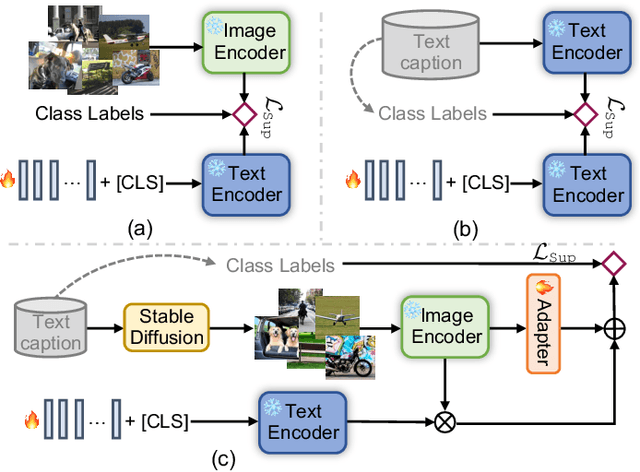
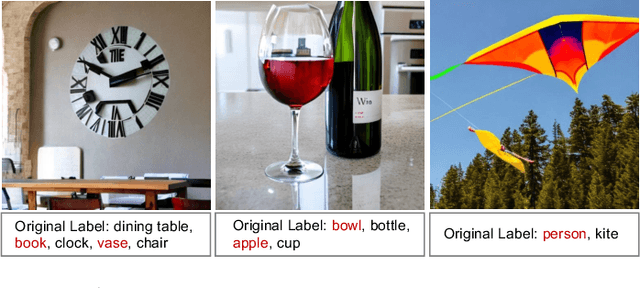
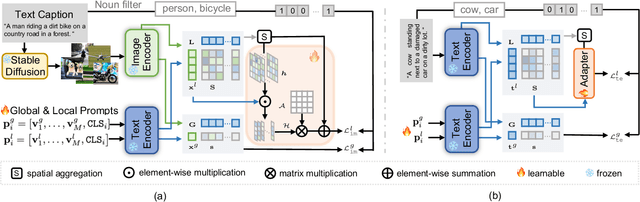
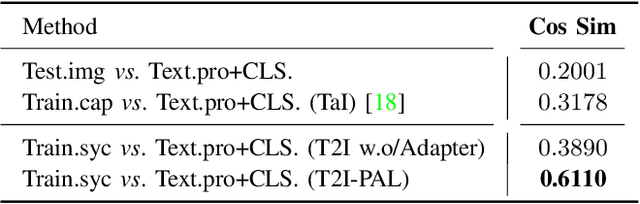
Benefited from image-text contrastive learning, pre-trained vision-language models, e.g., CLIP, allow to direct leverage texts as images (TaI) for parameter-efficient fine-tuning (PEFT). While CLIP is capable of making image features to be similar to the corresponding text features, the modality gap remains a nontrivial issue and limits image recognition performance of TaI. Using multi-label image recognition (MLR) as an example, we present a novel method, called T2I-PAL to tackle the modality gap issue when using only text captions for PEFT. The core design of T2I-PAL is to leverage pre-trained text-to-image generation models to generate photo-realistic and diverse images from text captions, thereby reducing the modality gap. To further enhance MLR, T2I-PAL incorporates a class-wise heatmap and learnable prototypes. This aggregates local similarities, making the representation of local visual features more robust and informative for multi-label recognition. For better PEFT, we further combine both prompt tuning and adapter learning to enhance classification performance. T2I-PAL offers significant advantages: it eliminates the need for fully semantically annotated training images, thereby reducing the manual annotation workload, and it preserves the intrinsic mode of the CLIP model, allowing for seamless integration with any existing CLIP framework. Extensive experiments on multiple benchmarks, including MS-COCO, VOC2007, and NUS-WIDE, show that our T2I-PAL can boost recognition performance by 3.47% in average above the top-ranked state-of-the-art methods.
An integrated language-vision foundation model for conversational diagnostics and triaging in primary eye care
May 13, 2025Current deep learning models are mostly task specific and lack a user-friendly interface to operate. We present Meta-EyeFM, a multi-function foundation model that integrates a large language model (LLM) with vision foundation models (VFMs) for ocular disease assessment. Meta-EyeFM leverages a routing mechanism to enable accurate task-specific analysis based on text queries. Using Low Rank Adaptation, we fine-tuned our VFMs to detect ocular and systemic diseases, differentiate ocular disease severity, and identify common ocular signs. The model achieved 100% accuracy in routing fundus images to appropriate VFMs, which achieved $\ge$ 82.2% accuracy in disease detection, $\ge$ 89% in severity differentiation, $\ge$ 76% in sign identification. Meta-EyeFM was 11% to 43% more accurate than Gemini-1.5-flash and ChatGPT-4o LMMs in detecting various eye diseases and comparable to an ophthalmologist. This system offers enhanced usability and diagnostic performance, making it a valuable decision support tool for primary eye care or an online LLM for fundus evaluation.
Partially Supervised Unpaired Multi-Modal Learning for Label-Efficient Medical Image Segmentation
Mar 07, 2025Unpaired Multi-Modal Learning (UMML) which leverages unpaired multi-modal data to boost model performance on each individual modality has attracted a lot of research interests in medical image analysis. However, existing UMML methods require multi-modal datasets to be fully labeled, which incurs tremendous annotation cost. In this paper, we investigate the use of partially labeled data for label-efficient unpaired multi-modal learning, which can reduce the annotation cost by up to one half. We term the new learning paradigm as Partially Supervised Unpaired Multi-Modal Learning (PSUMML) and propose a novel Decomposed partial class adaptation with snapshot Ensembled Self-Training (DEST) framework for it. Specifically, our framework consists of a compact segmentation network with modality specific normalization layers for learning with partially labeled unpaired multi-modal data. The key challenge in PSUMML lies in the complex partial class distribution discrepancy due to partial class annotation, which hinders effective knowledge transfer across modalities. We theoretically analyze this phenomenon with a decomposition theorem and propose a decomposed partial class adaptation technique to precisely align the partially labeled classes across modalities to reduce the distribution discrepancy. We further propose a snapshot ensembled self-training technique to leverage the valuable snapshot models during training to assign pseudo-labels to partially labeled pixels for self-training to boost model performance. We perform extensive experiments under different scenarios of PSUMML for two medical image segmentation tasks, namely cardiac substructure segmentation and abdominal multi-organ segmentation. Our framework outperforms existing methods significantly.
BenchX: A Unified Benchmark Framework for Medical Vision-Language Pretraining on Chest X-Rays
Oct 29, 2024


Medical Vision-Language Pretraining (MedVLP) shows promise in learning generalizable and transferable visual representations from paired and unpaired medical images and reports. MedVLP can provide useful features to downstream tasks and facilitate adapting task-specific models to new setups using fewer examples. However, existing MedVLP methods often differ in terms of datasets, preprocessing, and finetuning implementations. This pose great challenges in evaluating how well a MedVLP method generalizes to various clinically-relevant tasks due to the lack of unified, standardized, and comprehensive benchmark. To fill this gap, we propose BenchX, a unified benchmark framework that enables head-to-head comparison and systematical analysis between MedVLP methods using public chest X-ray datasets. Specifically, BenchX is composed of three components: 1) Comprehensive datasets covering nine datasets and four medical tasks; 2) Benchmark suites to standardize data preprocessing, train-test splits, and parameter selection; 3) Unified finetuning protocols that accommodate heterogeneous MedVLP methods for consistent task adaptation in classification, segmentation, and report generation, respectively. Utilizing BenchX, we establish baselines for nine state-of-the-art MedVLP methods and found that the performance of some early MedVLP methods can be enhanced to surpass more recent ones, prompting a revisiting of the developments and conclusions from prior works in MedVLP. Our code are available at https://github.com/yangzhou12/BenchX.