 Add to Chrome
 Add to Firefox
 Add to Edge
TriggerBench: Investigating Prospective Memory for Large Language Models
Jun 22, 2026
While Large Language Models (LLMs) are increasingly deployed in long interactions, existing evaluations focus predominantly on retrospective memory (RM) via explicit queries. Prospective memory (PM), the critical ability to spontaneously recall and act on latent constraints without direct prompts, remains largely unevaluated. We introduce TriggerBench, a comprehensive PM benchmark spanning five dimensions across both daily assistants and professional workflows. TriggerBench pairs scenarios with matched RM controls, contrastive positive/negative variants, and overloaded triggers, enabling fine-grained measurement of proactive recall, false-alarm rate, and attentional robustness under a single protocol. Our evaluation yields three key findings. (i) PM shows a precision-recall trade-off and attentional fragility. Though enhanced reasoning significantly improves proactive recall, models may overfit to an "always-remind" heuristic. Furthermore, PM accuracy degrades substantially under implicit constraints or triggers overloaded by concurrent user requests, indicating that robust PM remains an open challenge. (ii) PM is notably harder than RM: on identical contexts, RM near-saturates up to 100K tokens, while PM decays sharply as context length scales. (iii) PM may serve as a behavioral probe of spare reasoning capacity. Pairing PM scenarios with AIME-2025 math problems reveals that successful trajectories yield higher PM accuracy than failed ones at the same context length, showing PM tracks spare reasoning budget that token count obscures. Project page: https://github.com/KristenZHANG/TriggerBench-Official.

Smaller Models are Natural Explorers for Policy-Level Diversity in GRPO
May 29, 2026We identify a new dimension for enhancing rollout diversity in Group Relative Policy Optimization (GRPO) for LLMs. While GRPO relies on diverse rollouts, prevailing strategies primarily increase diversity by injecting more token-level randomness, which may introduce step-wise noise and lead to incoherent trajectories. We uncover that smaller models within the same model family inherently exhibit higher policy-level diversity, indicated by their superior pass@k relative to larger counterparts as sample counts increase. Unlike token-level noise, this diversity is temporally correlated, preserves logical consistency, and provides structured exploration signals for gradient estimation. We thus propose S2L-PO (Small-to-Large Policy Optimization), a framework that leverages fixed small models as natural explorers to train larger models. To balance exploration and exploitation, we design a progressive annealing strategy that transitions from offline small-model rollouts to the large learner's own sampling. This shift elegantly avoids mid-training performance drops caused by the small model's capacity limits, achieving faster convergence and unlocking a higher performance ceiling. S2L-PO improves accuracy on diverse mathematical reasoning benchmarks (e.g., +8.8% on AIME 24 using a 1.7B explorer to guide the 8B model) while reducing rollout compute.
AVBench: Human-Aligned and Automated Evaluation Benchmark for Audio-Video Generative Models
May 23, 2026Rapid advances in audio-video (AV) generation have enabled high-fidelity synthesis with synchronized sound, particularly for human-related scenarios involving speech and interactions. Yet evaluation for AV generation remains at an early stage, with only a few coarse-grained benchmarks for human-related scenarios and relying on limited preset evaluations with generic multimodal LLMs, leading to inaccurate assessments of model capabilities. To address these issues, we introduce AVBench, a fully automated benchmark tailored for human-centric AV generation. AVBench is built on two key designs for comprehensive and accurate evaluation: (i) Human-centric and fine-grained metrics. AVBench integrates ten evaluation dimensions designed for human-centered real-world scenarios, covering visual quality, audio quality, and multi-level consistency across modalities. These practical metrics capture human-related details that existing benchmarks often overlook. (ii) Specialized evaluators via preference learning. To address the lack of specialized training data, we construct large-scale supervision by transforming real-world videos into diverse training pairs with controlled perturbations. After fine-tuning on this high-quality dataset, the evaluators learn to reliably detect subtle cross-modal inconsistencies. Crucially, instead of producing discrete textual judgment, AVBench derives continuous evaluation scores from the model's prediction confidence on binary decisions. This probabilistic scoring mechanism enables a more reliable assessment than traditional VQA-style evaluation and aligns closely with human judgment. Taken together, AVBench offers automated evaluation for AV generation, demonstrates strong potential for data filtering, and serves as a differentiable reward signal for Reinforcement Learning from Human Feedback (RLHF).
A Survey of Audio Reasoning in Multimodal Foundation Models
May 20, 2026Reasoning has become a defining capability of modern foundation models, yet its development in the audio modality remains limited. Audio poses challenges that are distinct from those of text and vision. It is continuous, temporally dense, and contains linguistic, paralinguistic, and environmental information at multiple time scales. As a result, audio reasoning models must align acoustic signals with the discrete semantic space of large language models, while still preserving fine-grained information needed for reliable inference. Progress is also limited by three major obstacles: the scarcity of genuinely audio-grounded reasoning data, shortcut learning and modality hallucination, and the tension between reasoning depth and real-time latency in spoken interaction. In this paper, we present the first dedicated survey of audio reasoning. We provide a unified formulation that distinguishes direct predictive modeling from reasoning-augmented generation, review the architectural and training foundations of audio reasoning models, and systematically organize recent advances in Audio-to-Text, Audio-to-Speech, Audio-Visual Reasoning and Agentic Audio Reasoning. We further examine emerging paradigms such as Chain-of-Thought prompting, supervised fine-tuning, reinforcement learning, and latency-aware spoken interaction, and discuss evaluation practices, open challenges, and future directions. Our goal is to offer a coherent roadmap for developing robust, efficient, and natively grounded audio reasoning systems.
V2A-DPO: Omni-Preference Optimization for Video-to-Audio Generation
Mar 11, 2026This paper introduces V2A-DPO, a novel Direct Preference Optimization (DPO) framework tailored for flow-based video-to-audio generation (V2A) models, incorporating key adaptations to effectively align generated audio with human preferences. Our approach incorporates three core innovations: (1) AudioScore-a comprehensive human preference-aligned scoring system for assessing semantic consistency, temporal alignment, and perceptual quality of synthesized audio; (2) an automated AudioScore-driven pipeline for generating large-scale preference pair data for DPO optimization; (3) a curriculum learning-empowered DPO optimization strategy specifically tailored for flow-based generative models. Experiments on benchmark VGGSound dataset demonstrate that human-preference aligned Frieren and MMAudio using V2A-DPO outperform their counterparts optimized using Denoising Diffusion Policy Optimization (DDPO) as well as pre-trained baselines. Furthermore, our DPO-optimized MMAudio achieves state-of-the-art performance across multiple metrics, surpassing published V2A models.
Wan-Move: Motion-controllable Video Generation via Latent Trajectory Guidance
Dec 09, 2025We present Wan-Move, a simple and scalable framework that brings motion control to video generative models. Existing motion-controllable methods typically suffer from coarse control granularity and limited scalability, leaving their outputs insufficient for practical use. We narrow this gap by achieving precise and high-quality motion control. Our core idea is to directly make the original condition features motion-aware for guiding video synthesis. To this end, we first represent object motions with dense point trajectories, allowing fine-grained control over the scene. We then project these trajectories into latent space and propagate the first frame's features along each trajectory, producing an aligned spatiotemporal feature map that tells how each scene element should move. This feature map serves as the updated latent condition, which is naturally integrated into the off-the-shelf image-to-video model, e.g., Wan-I2V-14B, as motion guidance without any architecture change. It removes the need for auxiliary motion encoders and makes fine-tuning base models easily scalable. Through scaled training, Wan-Move generates 5-second, 480p videos whose motion controllability rivals Kling 1.5 Pro's commercial Motion Brush, as indicated by user studies. To support comprehensive evaluation, we further design MoveBench, a rigorously curated benchmark featuring diverse content categories and hybrid-verified annotations. It is distinguished by larger data volume, longer video durations, and high-quality motion annotations. Extensive experiments on MoveBench and the public dataset consistently show Wan-Move's superior motion quality. Code, models, and benchmark data are made publicly available.
Speech Discrete Tokens or Continuous Features? A Comparative Analysis for Spoken Language Understanding in SpeechLLMs
Aug 25, 2025With the rise of Speech Large Language Models (SpeechLLMs), two dominant approaches have emerged for speech processing: discrete tokens and continuous features. Each approach has demonstrated strong capabilities in audio-related processing tasks. However, the performance gap between these two paradigms has not been thoroughly explored. To address this gap, we present a fair comparison of self-supervised learning (SSL)-based discrete and continuous features under the same experimental settings. We evaluate their performance across six spoken language understanding-related tasks using both small and large-scale LLMs (Qwen1.5-0.5B and Llama3.1-8B). We further conduct in-depth analyses, including efficient comparison, SSL layer analysis, LLM layer analysis, and robustness comparison. Our findings reveal that continuous features generally outperform discrete tokens in various tasks. Each speech processing method exhibits distinct characteristics and patterns in how it learns and processes speech information. We hope our results will provide valuable insights to advance spoken language understanding in SpeechLLMs.
MMSU: A Massive Multi-task Spoken Language Understanding and Reasoning Benchmark
Jun 05, 2025Speech inherently contains rich acoustic information that extends far beyond the textual language. In real-world spoken language understanding, effective interpretation often requires integrating semantic meaning (e.g., content), paralinguistic features (e.g., emotions, speed, pitch) and phonological characteristics (e.g., prosody, intonation, rhythm), which are embedded in speech. While recent multimodal Speech Large Language Models (SpeechLLMs) have demonstrated remarkable capabilities in processing audio information, their ability to perform fine-grained perception and complex reasoning in natural speech remains largely unexplored. To address this gap, we introduce MMSU, a comprehensive benchmark designed specifically for understanding and reasoning in spoken language. MMSU comprises 5,000 meticulously curated audio-question-answer triplets across 47 distinct tasks. To ground our benchmark in linguistic theory, we systematically incorporate a wide range of linguistic phenomena, including phonetics, prosody, rhetoric, syntactics, semantics, and paralinguistics. Through a rigorous evaluation of 14 advanced SpeechLLMs, we identify substantial room for improvement in existing models, highlighting meaningful directions for future optimization. MMSU establishes a new standard for comprehensive assessment of spoken language understanding, providing valuable insights for developing more sophisticated human-AI speech interaction systems. MMSU benchmark is available at https://huggingface.co/datasets/ddwang2000/MMSU. Evaluation Code is available at https://github.com/dingdongwang/MMSU_Bench.
InSerter: Speech Instruction Following with Unsupervised Interleaved Pre-training
Mar 04, 2025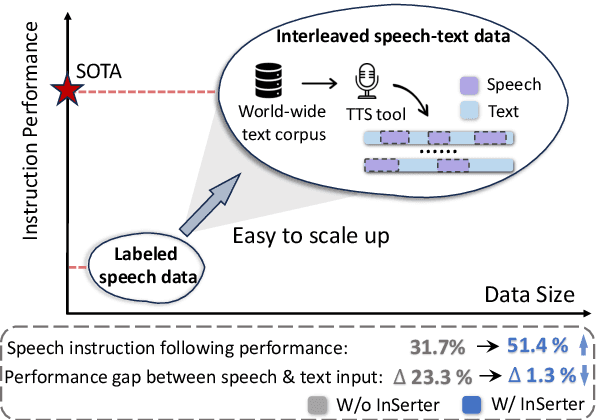
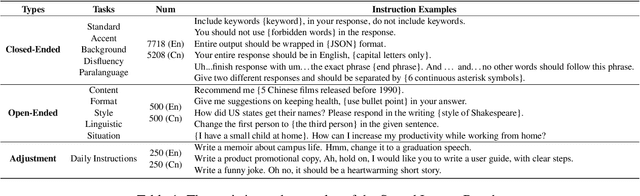
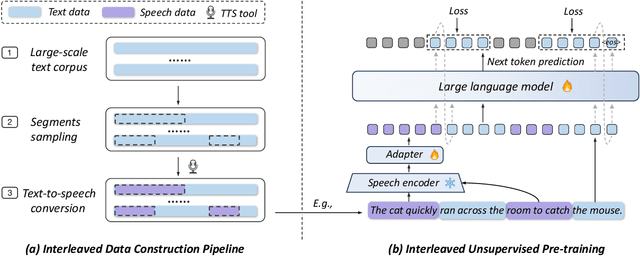
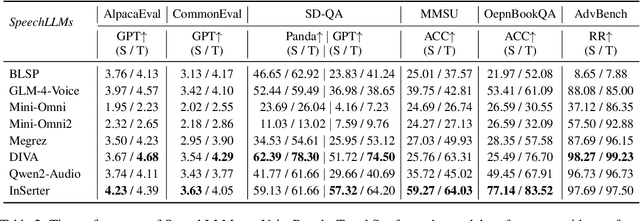
Recent advancements in speech large language models (SpeechLLMs) have attracted considerable attention. Nonetheless, current methods exhibit suboptimal performance in adhering to speech instructions. Notably, the intelligence of models significantly diminishes when processing speech-form input as compared to direct text-form input. Prior work has attempted to mitigate this semantic inconsistency between speech and text representations through techniques such as representation and behavior alignment, which involve the meticulous design of data pairs during the post-training phase. In this paper, we introduce a simple and scalable training method called InSerter, which stands for Interleaved Speech-Text Representation Pre-training. InSerter is designed to pre-train large-scale unsupervised speech-text sequences, where the speech is synthesized from randomly selected segments of an extensive text corpus using text-to-speech conversion. Consequently, the model acquires the ability to generate textual continuations corresponding to the provided speech segments, obviating the need for intensive data design endeavors. To systematically evaluate speech instruction-following capabilities, we introduce SpeechInstructBench, the first comprehensive benchmark specifically designed for speech-oriented instruction-following tasks. Our proposed InSerter achieves SOTA performance in SpeechInstructBench and demonstrates superior or competitive results across diverse speech processing tasks.
A Comparative Study of Discrete Speech Tokens for Semantic-Related Tasks with Large Language Models
Nov 13, 2024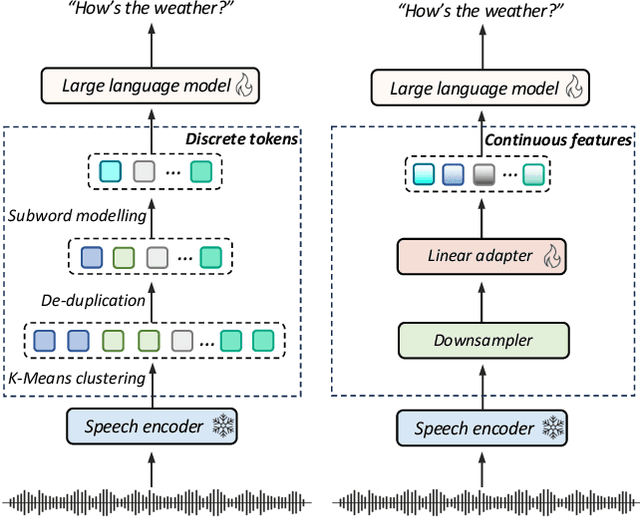
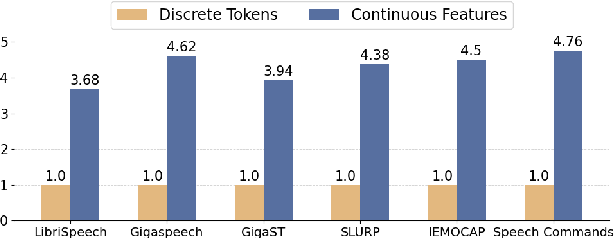
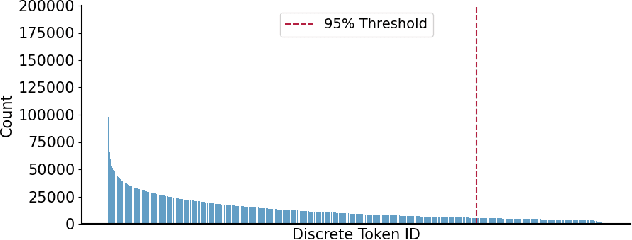
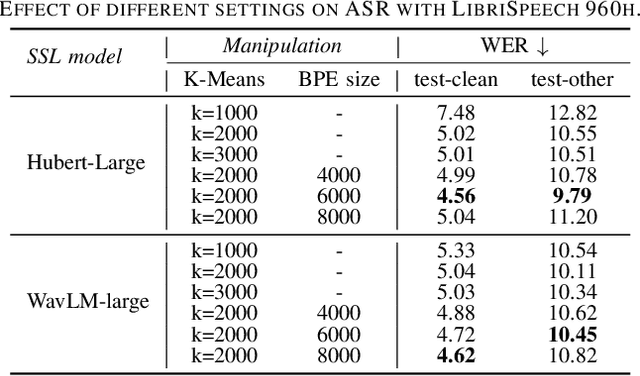
With the rise of Speech Large Language Models (Speech LLMs), there has been growing interest in discrete speech tokens for their ability to integrate with text-based tokens seamlessly. Compared to most studies that focus on continuous speech features, although discrete-token based LLMs have shown promising results on certain tasks, the performance gap between these two paradigms is rarely explored. In this paper, we present a fair and thorough comparison between discrete and continuous features across a variety of semantic-related tasks using a light-weight LLM (Qwen1.5-0.5B). Our findings reveal that continuous features generally outperform discrete tokens, particularly in tasks requiring fine-grained semantic understanding. Moreover, this study goes beyond surface-level comparison by identifying key factors behind the under-performance of discrete tokens, such as limited token granularity and inefficient information retention. To enhance the performance of discrete tokens, we explore potential aspects based on our analysis. We hope our results can offer new insights into the opportunities for advancing discrete speech tokens in Speech LLMs.