 Add to Chrome
 Add to Firefox
 Add to Edge
Spacetime Gaussian Feature Splatting for Real-Time Dynamic View Synthesis
Dec 28, 2023
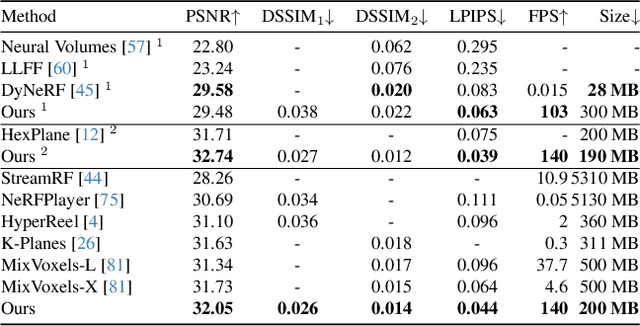
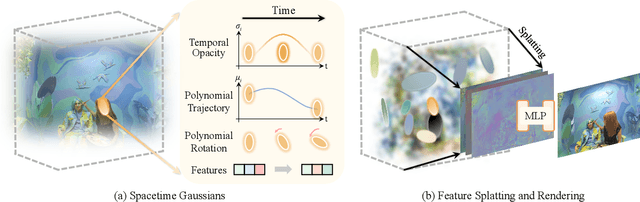
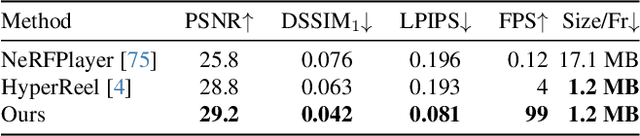
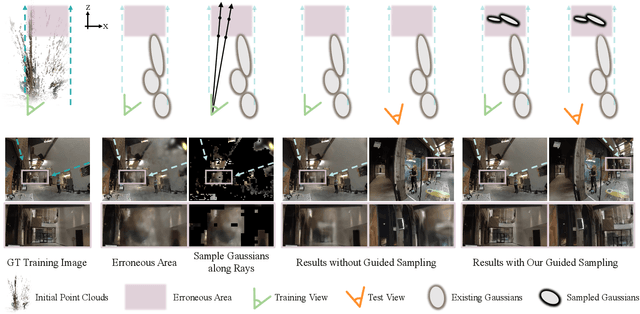
Novel view synthesis of dynamic scenes has been an intriguing yet challenging problem. Despite recent advancements, simultaneously achieving high-resolution photorealistic results, real-time rendering, and compact storage remains a formidable task. To address these challenges, we propose Spacetime Gaussian Feature Splatting as a novel dynamic scene representation, composed of three pivotal components. First, we formulate expressive Spacetime Gaussians by enhancing 3D Gaussians with temporal opacity and parametric motion/rotation. This enables Spacetime Gaussians to capture static, dynamic, as well as transient content within a scene. Second, we introduce splatted feature rendering, which replaces spherical harmonics with neural features. These features facilitate the modeling of view- and time-dependent appearance while maintaining small size. Third, we leverage the guidance of training error and coarse depth to sample new Gaussians in areas that are challenging to converge with existing pipelines. Experiments on several established real-world datasets demonstrate that our method achieves state-of-the-art rendering quality and speed, while retaining compact storage. At 8K resolution, our lite-version model can render at 60 FPS on an Nvidia RTX 4090 GPU.

Learn to Optimize Denoising Scores for 3D Generation: A Unified and Improved Diffusion Prior on NeRF and 3D Gaussian Splatting
Dec 08, 2023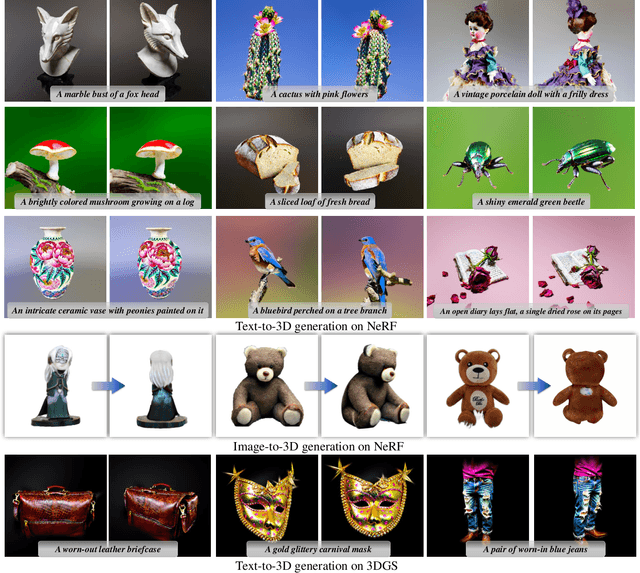
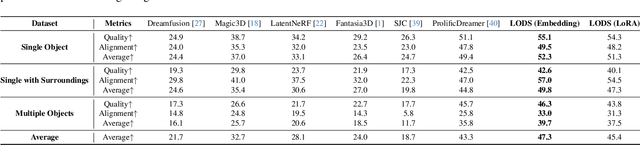
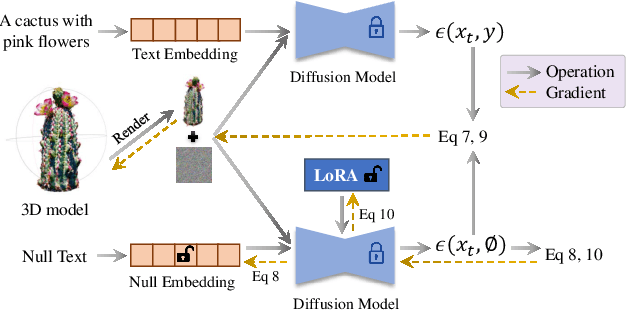

We propose a unified framework aimed at enhancing the diffusion priors for 3D generation tasks. Despite the critical importance of these tasks, existing methodologies often struggle to generate high-caliber results. We begin by examining the inherent limitations in previous diffusion priors. We identify a divergence between the diffusion priors and the training procedures of diffusion models that substantially impairs the quality of 3D generation. To address this issue, we propose a novel, unified framework that iteratively optimizes both the 3D model and the diffusion prior. Leveraging the different learnable parameters of the diffusion prior, our approach offers multiple configurations, affording various trade-offs between performance and implementation complexity. Notably, our experimental results demonstrate that our method markedly surpasses existing techniques, establishing new state-of-the-art in the realm of text-to-3D generation. Furthermore, our approach exhibits impressive performance on both NeRF and the newly introduced 3D Gaussian Splatting backbones. Additionally, our framework yields insightful contributions to the understanding of recent score distillation methods, such as the VSD and DDS loss.
Background Clustering Pre-training for Few-shot Segmentation
Dec 06, 2023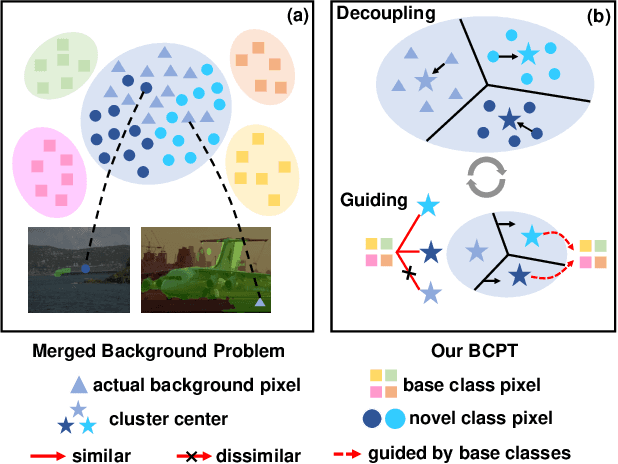
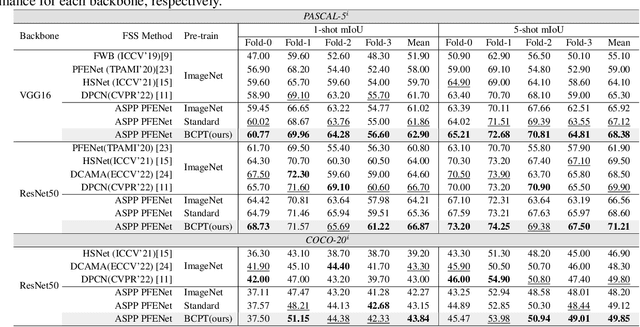
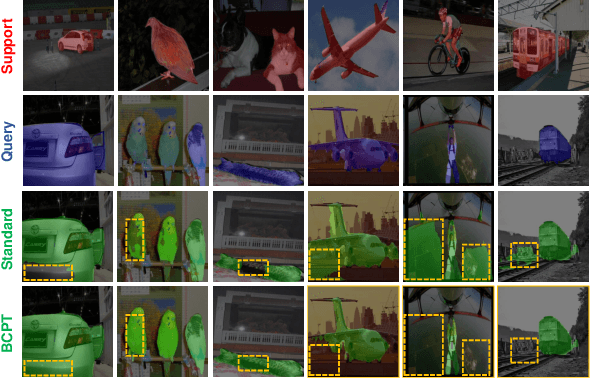
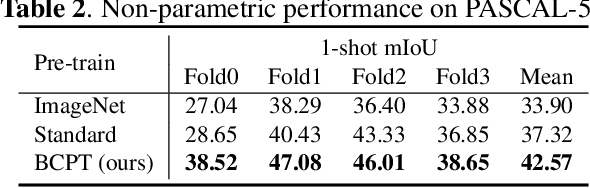
Recent few-shot segmentation (FSS) methods introduce an extra pre-training stage before meta-training to obtain a stronger backbone, which has become a standard step in few-shot learning. Despite the effectiveness, current pre-training scheme suffers from the merged background problem: only base classes are labelled as foregrounds, making it hard to distinguish between novel classes and actual background. In this paper, we propose a new pre-training scheme for FSS via decoupling the novel classes from background, called Background Clustering Pre-Training (BCPT). Specifically, we adopt online clustering to the pixel embeddings of merged background to explore the underlying semantic structures, bridging the gap between pre-training and adaptation to novel classes. Given the clustering results, we further propose the background mining loss and leverage base classes to guide the clustering process, improving the quality and stability of clustering results. Experiments on PASCAL-5i and COCO-20i show that BCPT yields advanced performance. Code will be available.
Supported Trust Region Optimization for Offline Reinforcement Learning
Nov 15, 2023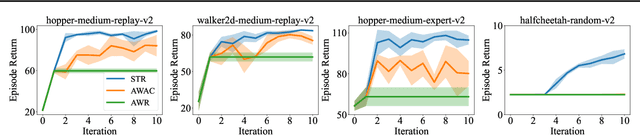
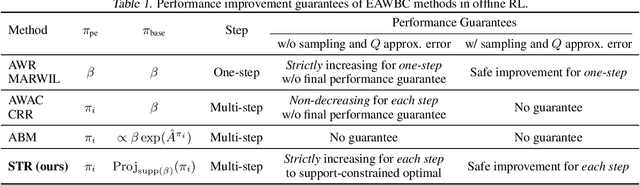
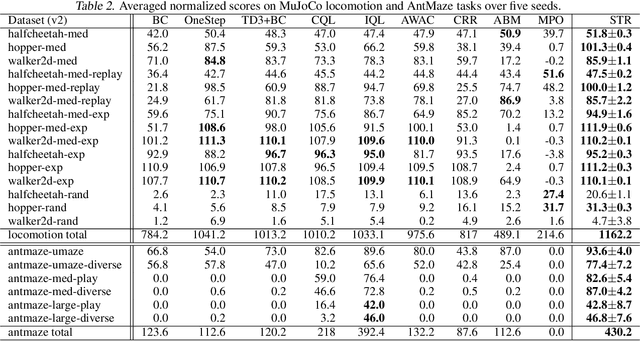
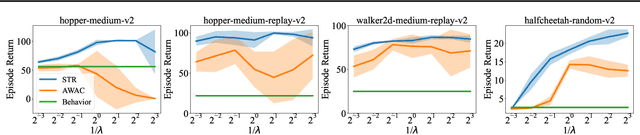
Offline reinforcement learning suffers from the out-of-distribution issue and extrapolation error. Most policy constraint methods regularize the density of the trained policy towards the behavior policy, which is too restrictive in most cases. We propose Supported Trust Region optimization (STR) which performs trust region policy optimization with the policy constrained within the support of the behavior policy, enjoying the less restrictive support constraint. We show that, when assuming no approximation and sampling error, STR guarantees strict policy improvement until convergence to the optimal support-constrained policy in the dataset. Further with both errors incorporated, STR still guarantees safe policy improvement for each step. Empirical results validate the theory of STR and demonstrate its state-of-the-art performance on MuJoCo locomotion domains and much more challenging AntMaze domains.
Relit-NeuLF: Efficient Relighting and Novel View Synthesis via Neural 4D Light Field
Oct 23, 2023


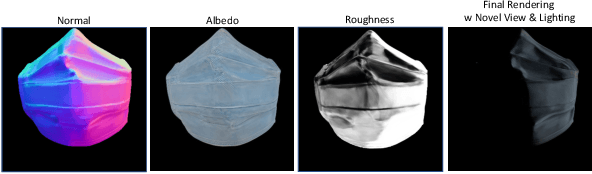
In this paper, we address the problem of simultaneous relighting and novel view synthesis of a complex scene from multi-view images with a limited number of light sources. We propose an analysis-synthesis approach called Relit-NeuLF. Following the recent neural 4D light field network (NeuLF), Relit-NeuLF first leverages a two-plane light field representation to parameterize each ray in a 4D coordinate system, enabling efficient learning and inference. Then, we recover the spatially-varying bidirectional reflectance distribution function (SVBRDF) of a 3D scene in a self-supervised manner. A DecomposeNet learns to map each ray to its SVBRDF components: albedo, normal, and roughness. Based on the decomposed BRDF components and conditioning light directions, a RenderNet learns to synthesize the color of the ray. To self-supervise the SVBRDF decomposition, we encourage the predicted ray color to be close to the physically-based rendering result using the microfacet model. Comprehensive experiments demonstrate that the proposed method is efficient and effective on both synthetic data and real-world human face data, and outperforms the state-of-the-art results. We publicly released our code on GitHub. You can find it here: https://github.com/oppo-us-research/RelitNeuLF
Layout Sequence Prediction From Noisy Mobile Modality
Oct 09, 2023Trajectory prediction plays a vital role in understanding pedestrian movement for applications such as autonomous driving and robotics. Current trajectory prediction models depend on long, complete, and accurately observed sequences from visual modalities. Nevertheless, real-world situations often involve obstructed cameras, missed objects, or objects out of sight due to environmental factors, leading to incomplete or noisy trajectories. To overcome these limitations, we propose LTrajDiff, a novel approach that treats objects obstructed or out of sight as equally important as those with fully visible trajectories. LTrajDiff utilizes sensor data from mobile phones to surmount out-of-sight constraints, albeit introducing new challenges such as modality fusion, noisy data, and the absence of spatial layout and object size information. We employ a denoising diffusion model to predict precise layout sequences from noisy mobile data using a coarse-to-fine diffusion strategy, incorporating the RMS, Siamese Masked Encoding Module, and MFM. Our model predicts layout sequences by implicitly inferring object size and projection status from a single reference timestamp or significantly obstructed sequences. Achieving SOTA results in randomly obstructed experiments and extremely short input experiments, our model illustrates the effectiveness of leveraging noisy mobile data. In summary, our approach offers a promising solution to the challenges faced by layout sequence and trajectory prediction models in real-world settings, paving the way for utilizing sensor data from mobile phones to accurately predict pedestrian bounding box trajectories. To the best of our knowledge, this is the first work that addresses severely obstructed and extremely short layout sequences by combining vision with noisy mobile modality, making it the pioneering work in the field of layout sequence trajectory prediction.
ForeSeer: Product Aspect Forecasting Using Temporal Graph Embedding
Oct 07, 2023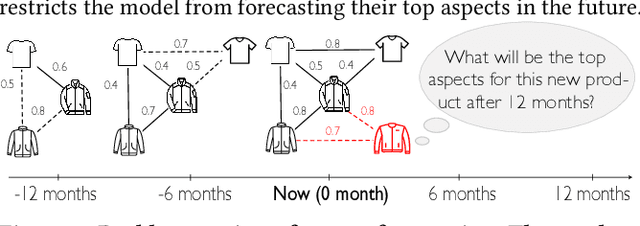
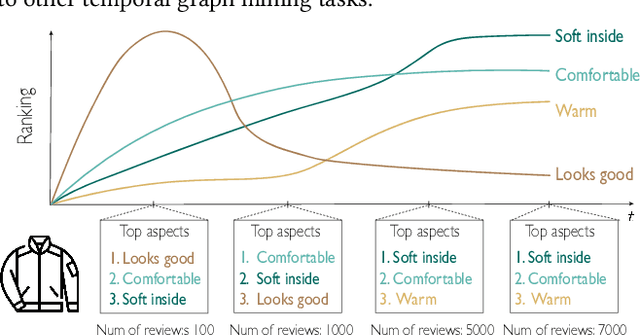
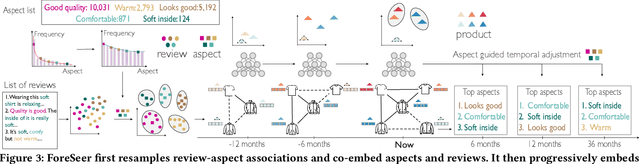

Developing text mining approaches to mine aspects from customer reviews has been well-studied due to its importance in understanding customer needs and product attributes. In contrast, it remains unclear how to predict the future emerging aspects of a new product that currently has little review information. This task, which we named product aspect forecasting, is critical for recommending new products, but also challenging because of the missing reviews. Here, we propose ForeSeer, a novel textual mining and product embedding approach progressively trained on temporal product graphs for this novel product aspect forecasting task. ForeSeer transfers reviews from similar products on a large product graph and exploits these reviews to predict aspects that might emerge in future reviews. A key novelty of our method is to jointly provide review, product, and aspect embeddings that are both time-sensitive and less affected by extremely imbalanced aspect frequencies. We evaluated ForeSeer on a real-world product review system containing 11,536,382 reviews and 11,000 products over 3 years. We observe that ForeSeer substantially outperformed existing approaches with at least 49.1\% AUPRC improvement under the real setting where aspect associations are not given. ForeSeer further improves future link prediction on the product graph and the review aspect association prediction. Collectively, Foreseer offers a novel framework for review forecasting by effectively integrating review text, product network, and temporal information, opening up new avenues for online shopping recommendation and e-commerce applications.
Latent Graph Inference with Limited Supervision
Oct 06, 2023Latent graph inference (LGI) aims to jointly learn the underlying graph structure and node representations from data features. However, existing LGI methods commonly suffer from the issue of supervision starvation, where massive edge weights are learned without semantic supervision and do not contribute to the training loss. Consequently, these supervision-starved weights, which may determine the predictions of testing samples, cannot be semantically optimal, resulting in poor generalization. In this paper, we observe that this issue is actually caused by the graph sparsification operation, which severely destroys the important connections established between pivotal nodes and labeled ones. To address this, we propose to restore the corrupted affinities and replenish the missed supervision for better LGI. The key challenge then lies in identifying the critical nodes and recovering the corrupted affinities. We begin by defining the pivotal nodes as $k$-hop starved nodes, which can be identified based on a given adjacency matrix. Considering the high computational burden, we further present a more efficient alternative inspired by CUR matrix decomposition. Subsequently, we eliminate the starved nodes by reconstructing the destroyed connections. Extensive experiments on representative benchmarks demonstrate that reducing the starved nodes consistently improves the performance of state-of-the-art LGI methods, especially under extremely limited supervision (6.12% improvement on Pubmed with a labeling rate of only 0.3%).
NeuRBF: A Neural Fields Representation with Adaptive Radial Basis Functions
Sep 27, 2023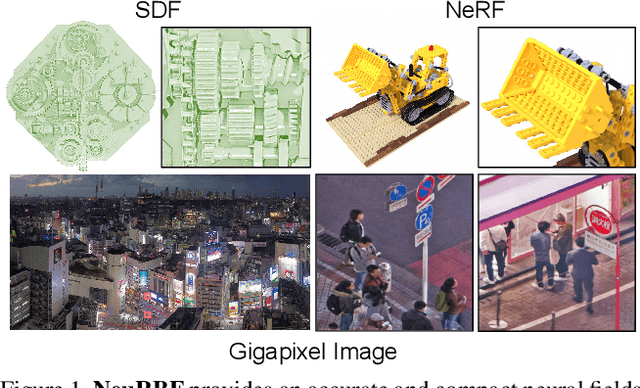
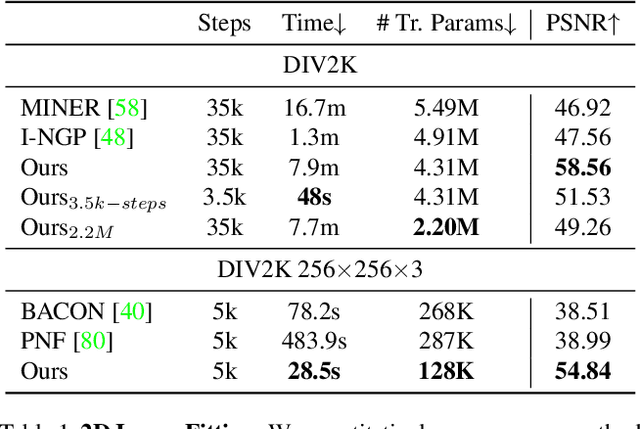
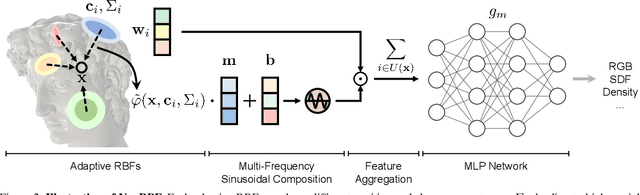
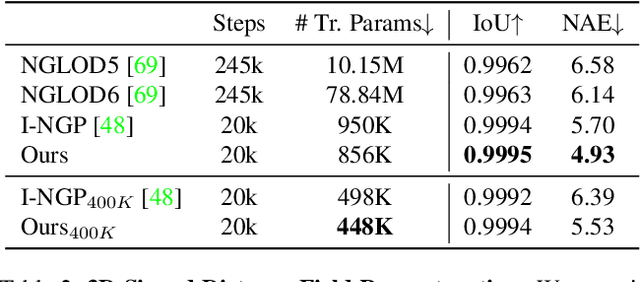
We present a novel type of neural fields that uses general radial bases for signal representation. State-of-the-art neural fields typically rely on grid-based representations for storing local neural features and N-dimensional linear kernels for interpolating features at continuous query points. The spatial positions of their neural features are fixed on grid nodes and cannot well adapt to target signals. Our method instead builds upon general radial bases with flexible kernel position and shape, which have higher spatial adaptivity and can more closely fit target signals. To further improve the channel-wise capacity of radial basis functions, we propose to compose them with multi-frequency sinusoid functions. This technique extends a radial basis to multiple Fourier radial bases of different frequency bands without requiring extra parameters, facilitating the representation of details. Moreover, by marrying adaptive radial bases with grid-based ones, our hybrid combination inherits both adaptivity and interpolation smoothness. We carefully designed weighting schemes to let radial bases adapt to different types of signals effectively. Our experiments on 2D image and 3D signed distance field representation demonstrate the higher accuracy and compactness of our method than prior arts. When applied to neural radiance field reconstruction, our method achieves state-of-the-art rendering quality, with small model size and comparable training speed.
Multi-turn Dialogue Comprehension from a Topic-aware Perspective
Sep 18, 2023Dialogue related Machine Reading Comprehension requires language models to effectively decouple and model multi-turn dialogue passages. As a dialogue development goes after the intentions of participants, its topic may not keep constant through the whole passage. Hence, it is non-trivial to detect and leverage the topic shift in dialogue modeling. Topic modeling, although has been widely studied in plain text, deserves far more utilization in dialogue reading comprehension. This paper proposes to model multi-turn dialogues from a topic-aware perspective. We start with a dialogue segmentation algorithm to split a dialogue passage into topic-concentrated fragments in an unsupervised way. Then we use these fragments as topic-aware language processing units in further dialogue comprehension. On one hand, the split segments indict specific topics rather than mixed intentions, thus showing convenient on in-domain topic detection and location. For this task, we design a clustering system with a self-training auto-encoder, and we build two constructed datasets for evaluation. On the other hand, the split segments are an appropriate element of multi-turn dialogue response selection. For this purpose, we further present a novel model, Topic-Aware Dual-Attention Matching (TADAM) Network, which takes topic segments as processing elements and matches response candidates with a dual cross-attention. Empirical studies on three public benchmarks show great improvements over baselines. Our work continues the previous studies on document topic, and brings the dialogue modeling to a novel topic-aware perspective with exhaustive experiments and analyses.