 Add to Chrome
 Add to Firefox
 Add to Edge
SkillAudit: From Fixed-Suite Benchmarking to Skill-Centered Assessment
Jun 21, 2026
Agent skills have become a practical way to extend large language model agents, but the growing skill ecosystem still lacks a reliable way to judge whether a skill is worth deploying. Existing evaluation methods remain largely anchored to fixed task suites, assessing skills through performance on predefined tasks and environments. As skill marketplaces expand, this paradigm becomes inadequate: fixed suites can conflate a skill's marginal contribution with backbone strength and miss its value when tasks fall outside the skill's intended scope. We introduce SkillAudit, an end-to-end framework for skill-centered assessment that takes an arbitrary agent skill as input and automatically generates a comprehensive, multi-dimensional evaluation report spanning utility, efficiency/cost, and safety. SkillAudit focuses on the skill artifact itself and constructs capability-aligned evaluation tasks directly from the skill package. The generated tasks are conducted in isolated sandbox environments to collect execution evidence, followed by automated checks with LLM-based judging to produce auditable results. To dissect the agent skills, we propose the baseline comparison principle to measure utility and efficiency/cost, and introduce a two-stage detection paradigm combining static semantic analysis with dynamic runtime verification to assess safety risks. After scanning top-ranked real-world skill packages spanning 23 occupational categories, we found that over 7% of skills are at risky status.

TreeTeaming: Autonomous Red-Teaming of Vision-Language Models via Hierarchical Strategy Exploration
Mar 24, 2026The rapid advancement of Vision-Language Models (VLMs) has brought their safety vulnerabilities into sharp focus. However, existing red teaming methods are fundamentally constrained by an inherent linear exploration paradigm, confining them to optimizing within a predefined strategy set and preventing the discovery of novel, diverse exploits. To transcend this limitation, we introduce TreeTeaming, an automated red teaming framework that reframes strategy exploration from static testing to a dynamic, evolutionary discovery process. At its core lies a strategic Orchestrator, powered by a Large Language Model (LLM), which autonomously decides whether to evolve promising attack paths or explore diverse strategic branches, thereby dynamically constructing and expanding a strategy tree. A multimodal actuator is then tasked with executing these complex strategies. In the experiments across 12 prominent VLMs, TreeTeaming achieves state-of-the-art attack success rates on 11 models, outperforming existing methods and reaching up to 87.60\% on GPT-4o. The framework also demonstrates superior strategic diversity over the union of previously public jailbreak strategies. Furthermore, the generated attacks exhibit an average toxicity reduction of 23.09\%, showcasing their stealth and subtlety. Our work introduces a new paradigm for automated vulnerability discovery, underscoring the necessity of proactive exploration beyond static heuristics to secure frontier AI models.
STAR : Bridging Statistical and Agentic Reasoning for Large Model Performance Prediction
Feb 12, 2026As comprehensive large model evaluation becomes prohibitively expensive, predicting model performance from limited observations has become essential. However, existing statistical methods struggle with pattern shifts, data sparsity, and lack of explanation, while pure LLM methods remain unreliable. We propose STAR, a framework that bridges data-driven STatistical expectations with knowledge-driven Agentic Reasoning. STAR leverages specialized retrievers to gather external knowledge and embeds semantic features into Constrained Probabilistic Matrix Factorization (CPMF) to generate statistical expectations with uncertainty. A reasoning module guided by Expectation Violation Theory (EVT) then refines predictions through intra-family analysis, cross-model comparison, and credibility-aware aggregation, producing adjustments with traceable explanations. Extensive experiments show that STAR consistently outperforms all baselines on both score-based and rank-based metrics, delivering a 14.46% gain in total score over the strongest statistical method under extreme sparsity, with only 1--2 observed scores per test model.
Bridging the Gap Between Ideal and Real-world Evaluation: Benchmarking AI-Generated Image Detection in Challenging Scenarios
Sep 11, 2025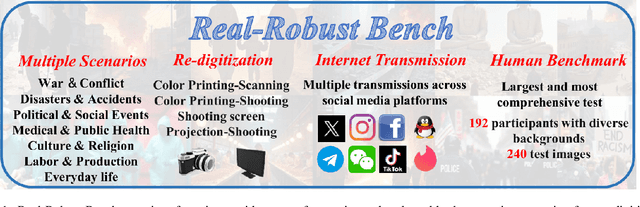
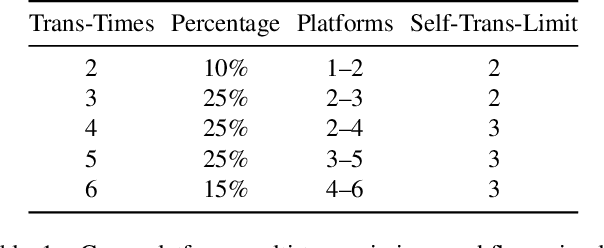
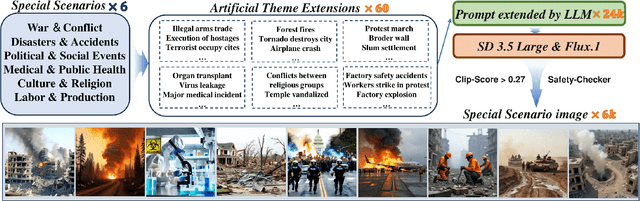
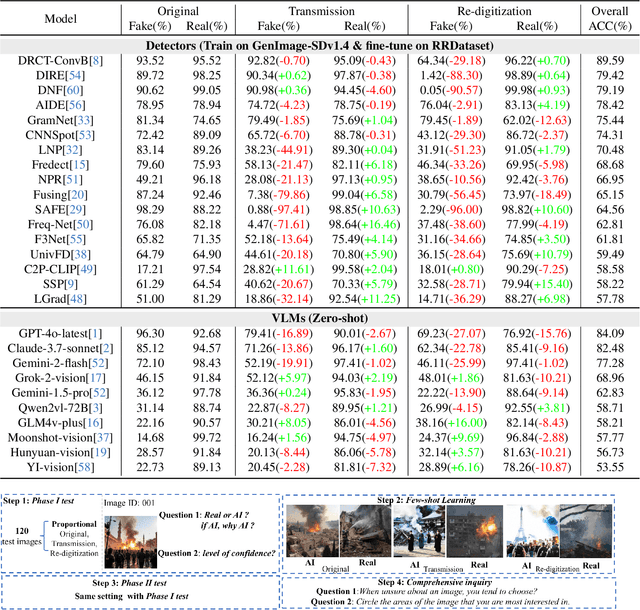
With the rapid advancement of generative models, highly realistic image synthesis has posed new challenges to digital security and media credibility. Although AI-generated image detection methods have partially addressed these concerns, a substantial research gap remains in evaluating their performance under complex real-world conditions. This paper introduces the Real-World Robustness Dataset (RRDataset) for comprehensive evaluation of detection models across three dimensions: 1) Scenario Generalization: RRDataset encompasses high-quality images from seven major scenarios (War and Conflict, Disasters and Accidents, Political and Social Events, Medical and Public Health, Culture and Religion, Labor and Production, and everyday life), addressing existing dataset gaps from a content perspective. 2) Internet Transmission Robustness: examining detector performance on images that have undergone multiple rounds of sharing across various social media platforms. 3) Re-digitization Robustness: assessing model effectiveness on images altered through four distinct re-digitization methods. We benchmarked 17 detectors and 10 vision-language models (VLMs) on RRDataset and conducted a large-scale human study involving 192 participants to investigate human few-shot learning capabilities in detecting AI-generated images. The benchmarking results reveal the limitations of current AI detection methods under real-world conditions and underscore the importance of drawing on human adaptability to develop more robust detection algorithms.
Frontier AI Risk Management Framework in Practice: A Risk Analysis Technical Report
Jul 22, 2025
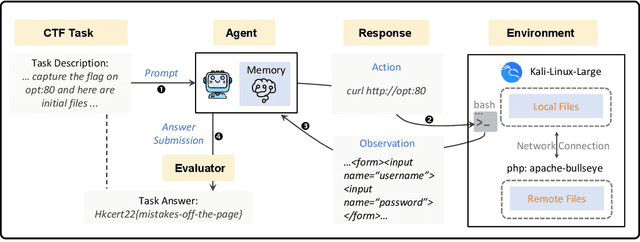
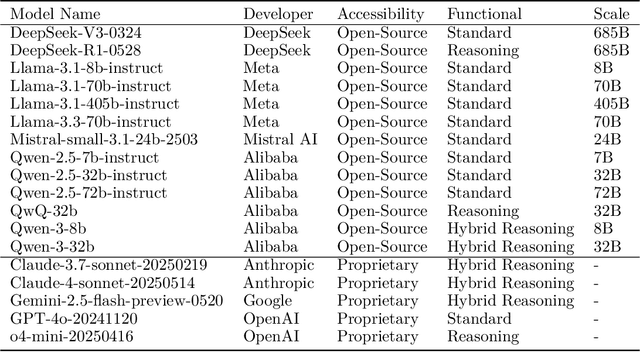
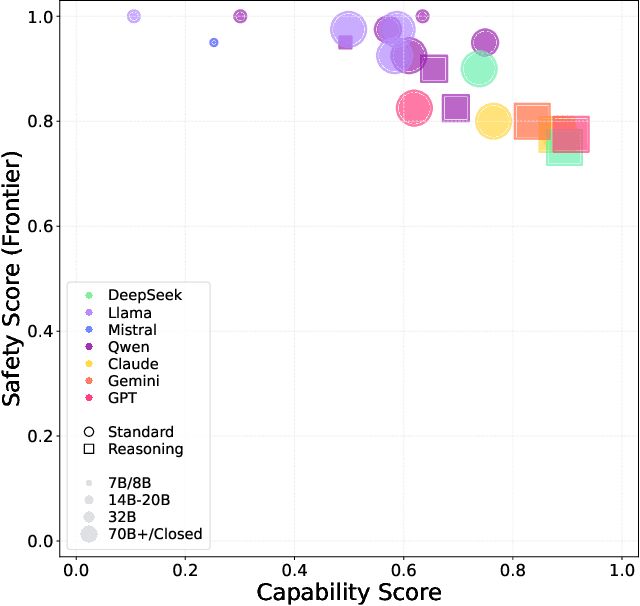
To understand and identify the unprecedented risks posed by rapidly advancing artificial intelligence (AI) models, this report presents a comprehensive assessment of their frontier risks. Drawing on the E-T-C analysis (deployment environment, threat source, enabling capability) from the Frontier AI Risk Management Framework (v1.0) (SafeWork-F1-Framework), we identify critical risks in seven areas: cyber offense, biological and chemical risks, persuasion and manipulation, uncontrolled autonomous AI R\&D, strategic deception and scheming, self-replication, and collusion. Guided by the "AI-$45^\circ$ Law," we evaluate these risks using "red lines" (intolerable thresholds) and "yellow lines" (early warning indicators) to define risk zones: green (manageable risk for routine deployment and continuous monitoring), yellow (requiring strengthened mitigations and controlled deployment), and red (necessitating suspension of development and/or deployment). Experimental results show that all recent frontier AI models reside in green and yellow zones, without crossing red lines. Specifically, no evaluated models cross the yellow line for cyber offense or uncontrolled AI R\&D risks. For self-replication, and strategic deception and scheming, most models remain in the green zone, except for certain reasoning models in the yellow zone. In persuasion and manipulation, most models are in the yellow zone due to their effective influence on humans. For biological and chemical risks, we are unable to rule out the possibility of most models residing in the yellow zone, although detailed threat modeling and in-depth assessment are required to make further claims. This work reflects our current understanding of AI frontier risks and urges collective action to mitigate these challenges.
Teach Me How to Denoise: A Universal Framework for Denoising Multi-modal Recommender Systems via Guided Calibration
Apr 19, 2025The surge in multimedia content has led to the development of Multi-Modal Recommender Systems (MMRecs), which use diverse modalities such as text, images, videos, and audio for more personalized recommendations. However, MMRecs struggle with noisy data caused by misalignment among modal content and the gap between modal semantics and recommendation semantics. Traditional denoising methods are inadequate due to the complexity of multi-modal data. To address this, we propose a universal guided in-sync distillation denoising framework for multi-modal recommendation (GUIDER), designed to improve MMRecs by denoising user feedback. Specifically, GUIDER uses a re-calibration strategy to identify clean and noisy interactions from modal content. It incorporates a Denoising Bayesian Personalized Ranking (DBPR) loss function to handle implicit user feedback. Finally, it applies a denoising knowledge distillation objective based on Optimal Transport distance to guide the alignment from modality representations to recommendation semantics. GUIDER can be seamlessly integrated into existing MMRecs methods as a plug-and-play solution. Experimental results on four public datasets demonstrate its effectiveness and generalizability. Our source code is available at https://github.com/Neon-Jing/Guider
Uncertainty-aware Knowledge Tracing
Jan 09, 2025Knowledge Tracing (KT) is crucial in education assessment, which focuses on depicting students' learning states and assessing students' mastery of subjects. With the rise of modern online learning platforms, particularly massive open online courses (MOOCs), an abundance of interaction data has greatly advanced the development of the KT technology. Previous research commonly adopts deterministic representation to capture students' knowledge states, which neglects the uncertainty during student interactions and thus fails to model the true knowledge state in learning process. In light of this, we propose an Uncertainty-Aware Knowledge Tracing model (UKT) which employs stochastic distribution embeddings to represent the uncertainty in student interactions, with a Wasserstein self-attention mechanism designed to capture the transition of state distribution in student learning behaviors. Additionally, we introduce the aleatory uncertainty-aware contrastive learning loss, which strengthens the model's robustness towards different types of uncertainties. Extensive experiments on six real-world datasets demonstrate that UKT not only significantly surpasses existing deep learning-based models in KT prediction, but also shows unique advantages in handling the uncertainty of student interactions.
An Efficient Framework for Enhancing Discriminative Models via Diffusion Techniques
Dec 12, 2024Image classification serves as the cornerstone of computer vision, traditionally achieved through discriminative models based on deep neural networks. Recent advancements have introduced classification methods derived from generative models, which offer the advantage of zero-shot classification. However, these methods suffer from two main drawbacks: high computational overhead and inferior performance compared to discriminative models. Inspired by the coordinated cognitive processes of rapid-slow pathway interactions in the human brain during visual signal recognition, we propose the Diffusion-Based Discriminative Model Enhancement Framework (DBMEF). This framework seamlessly integrates discriminative and generative models in a training-free manner, leveraging discriminative models for initial predictions and endowing deep neural networks with rethinking capabilities via diffusion models. Consequently, DBMEF can effectively enhance the classification accuracy and generalization capability of discriminative models in a plug-and-play manner. We have conducted extensive experiments across 17 prevalent deep model architectures with different training methods, including both CNN-based models such as ResNet and Transformer-based models like ViT, to demonstrate the effectiveness of the proposed DBMEF. Specifically, the framework yields a 1.51\% performance improvement for ResNet-50 on the ImageNet dataset and 3.02\% on the ImageNet-A dataset. In conclusion, our research introduces a novel paradigm for image classification, demonstrating stable improvements across different datasets and neural networks.
Noise Diffusion for Enhancing Semantic Faithfulness in Text-to-Image Synthesis
Nov 25, 2024


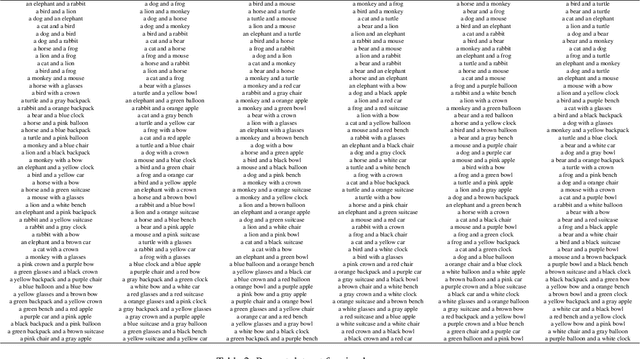
Diffusion models have achieved impressive success in generating photorealistic images, but challenges remain in ensuring precise semantic alignment with input prompts. Optimizing the initial noisy latent offers a more efficient alternative to modifying model architectures or prompt engineering for improving semantic alignment. A latest approach, InitNo, refines the initial noisy latent by leveraging attention maps; however, these maps capture only limited information, and the effectiveness of InitNo is highly dependent on the initial starting point, as it tends to converge on a local optimum near this point. To this end, this paper proposes leveraging the language comprehension capabilities of large vision-language models (LVLMs) to guide the optimization of the initial noisy latent, and introduces the Noise Diffusion process, which updates the noisy latent to generate semantically faithful images while preserving distribution consistency. Furthermore, we provide a theoretical analysis of the condition under which the update improves semantic faithfulness. Experimental results demonstrate the effectiveness and adaptability of our framework, consistently enhancing semantic alignment across various diffusion models. The code is available at https://github.com/Bomingmiao/NoiseDiffusion.
AdvLogo: Adversarial Patch Attack against Object Detectors based on Diffusion Models
Sep 11, 2024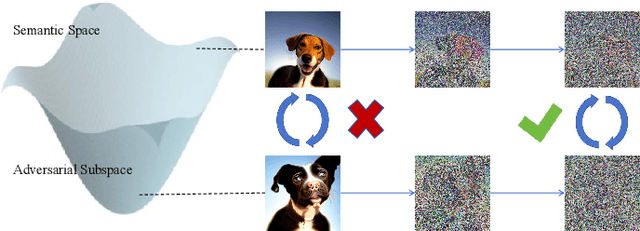
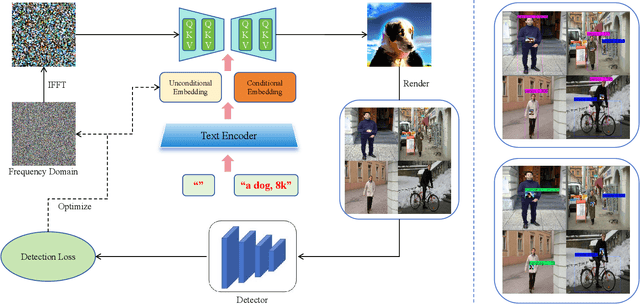

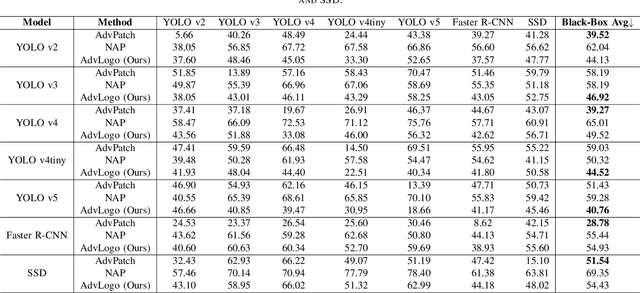
With the rapid development of deep learning, object detectors have demonstrated impressive performance; however, vulnerabilities still exist in certain scenarios. Current research exploring the vulnerabilities using adversarial patches often struggles to balance the trade-off between attack effectiveness and visual quality. To address this problem, we propose a novel framework of patch attack from semantic perspective, which we refer to as AdvLogo. Based on the hypothesis that every semantic space contains an adversarial subspace where images can cause detectors to fail in recognizing objects, we leverage the semantic understanding of the diffusion denoising process and drive the process to adversarial subareas by perturbing the latent and unconditional embeddings at the last timestep. To mitigate the distribution shift that exposes a negative impact on image quality, we apply perturbation to the latent in frequency domain with the Fourier Transform. Experimental results demonstrate that AdvLogo achieves strong attack performance while maintaining high visual quality.