 Add to Chrome
 Add to Firefox
 Add to Edge
LPA3D: 3D Room-Level Scene Generation from In-the-Wild Images
Apr 03, 2025
Generating realistic, room-level indoor scenes with semantically plausible and detailed appearances from in-the-wild images is crucial for various applications in VR, AR, and robotics. The success of NeRF-based generative methods indicates a promising direction to address this challenge. However, unlike their success at the object level, existing scene-level generative methods require additional information, such as multiple views, depth images, or semantic guidance, rather than relying solely on RGB images. This is because NeRF-based methods necessitate prior knowledge of camera poses, which is challenging to approximate for indoor scenes due to the complexity of defining alignment and the difficulty of globally estimating poses from a single image, given the unseen parts behind the camera. To address this challenge, we redefine global poses within the framework of Local-Pose-Alignment (LPA) -- an anchor-based multi-local-coordinate system that uses a selected number of anchors as the roots of these coordinates. Building on this foundation, we introduce LPA-GAN, a novel NeRF-based generative approach that incorporates specific modifications to estimate the priors of camera poses under LPA. It also co-optimizes the pose predictor and scene generation processes. Our ablation study and comparisons with straightforward extensions of NeRF-based object generative methods demonstrate the effectiveness of our approach. Furthermore, visual comparisons with other techniques reveal that our method achieves superior view-to-view consistency and semantic normality.

Inference-Time Scaling for Generalist Reward Modeling
Apr 03, 2025Reinforcement learning (RL) has been widely adopted in post-training for large language models (LLMs) at scale. Recently, the incentivization of reasoning capabilities in LLMs from RL indicates that $\textit{proper learning methods could enable effective inference-time scalability}$. A key challenge of RL is to obtain accurate reward signals for LLMs in various domains beyond verifiable questions or artificial rules. In this work, we investigate how to improve reward modeling (RM) with more inference compute for general queries, i.e. the $\textbf{inference-time scalability of generalist RM}$, and further, how to improve the effectiveness of performance-compute scaling with proper learning methods. For the RM approach, we adopt pointwise generative reward modeling (GRM) to enable flexibility for different input types and potential for inference-time scaling. For the learning method, we propose Self-Principled Critique Tuning (SPCT) to foster scalable reward generation behaviors in GRMs through online RL, to generate principles adaptively and critiques accurately, resulting in $\textbf{DeepSeek-GRM}$ models. Furthermore, for effective inference-time scaling, we use parallel sampling to expand compute usage, and introduce a meta RM to guide voting process for better scaling performance. Empirically, we show that SPCT significantly improves the quality and scalability of GRMs, outperforming existing methods and models in various RM benchmarks without severe biases, and could achieve better performance compared to training-time scaling. DeepSeek-GRM still meets challenges in some tasks, which we believe can be addressed by future efforts in generalist reward systems. The models will be released and open-sourced.
ConMo: Controllable Motion Disentanglement and Recomposition for Zero-Shot Motion Transfer
Apr 03, 2025The development of Text-to-Video (T2V) generation has made motion transfer possible, enabling the control of video motion based on existing footage. However, current methods have two limitations: 1) struggle to handle multi-subjects videos, failing to transfer specific subject motion; 2) struggle to preserve the diversity and accuracy of motion as transferring to subjects with varying shapes. To overcome these, we introduce \textbf{ConMo}, a zero-shot framework that disentangle and recompose the motions of subjects and camera movements. ConMo isolates individual subject and background motion cues from complex trajectories in source videos using only subject masks, and reassembles them for target video generation. This approach enables more accurate motion control across diverse subjects and improves performance in multi-subject scenarios. Additionally, we propose soft guidance in the recomposition stage which controls the retention of original motion to adjust shape constraints, aiding subject shape adaptation and semantic transformation. Unlike previous methods, ConMo unlocks a wide range of applications, including subject size and position editing, subject removal, semantic modifications, and camera motion simulation. Extensive experiments demonstrate that ConMo significantly outperforms state-of-the-art methods in motion fidelity and semantic consistency. The code is available at https://github.com/Andyplus1/ConMo.
End-to-End Driving with Online Trajectory Evaluation via BEV World Model
Apr 02, 2025End-to-end autonomous driving has achieved remarkable progress by integrating perception, prediction, and planning into a fully differentiable framework. Yet, to fully realize its potential, an effective online trajectory evaluation is indispensable to ensure safety. By forecasting the future outcomes of a given trajectory, trajectory evaluation becomes much more effective. This goal can be achieved by employing a world model to capture environmental dynamics and predict future states. Therefore, we propose an end-to-end driving framework WoTE, which leverages a BEV World model to predict future BEV states for Trajectory Evaluation. The proposed BEV world model is latency-efficient compared to image-level world models and can be seamlessly supervised using off-the-shelf BEV-space traffic simulators. We validate our framework on both the NAVSIM benchmark and the closed-loop Bench2Drive benchmark based on the CARLA simulator, achieving state-of-the-art performance. Code is released at https://github.com/liyingyanUCAS/WoTE.
Can LLMs Grasp Implicit Cultural Values? Benchmarking LLMs' Metacognitive Cultural Intelligence with CQ-Bench
Apr 01, 2025Cultural Intelligence (CQ) refers to the ability to understand unfamiliar cultural contexts-a crucial skill for large language models (LLMs) to effectively engage with globally diverse users. While existing research often focuses on explicitly stated cultural norms, such approaches fail to capture the subtle, implicit values that underlie real-world conversations. To address this gap, we introduce CQ-Bench, a benchmark specifically designed to assess LLMs' capability to infer implicit cultural values from natural conversational contexts. We generate a multi-character conversation-based stories dataset using values from the World Value Survey and GlobalOpinions datasets, with topics including ethical, religious, social, and political. Our dataset construction pipeline includes rigorous validation procedures-incorporation, consistency, and implicitness checks-using GPT-4o, with 98.2% human-model agreement in the final validation. Our benchmark consists of three tasks of increasing complexity: attitude detection, value selection, and value extraction. We find that while o1 and Deepseek-R1 models reach human-level performance in value selection (0.809 and 0.814), they still fall short in nuanced attitude detection, with F1 scores of 0.622 and 0.635, respectively. In the value extraction task, GPT-4o-mini and o3-mini score 0.602 and 0.598, highlighting the difficulty of open-ended cultural reasoning. Notably, fine-tuning smaller models (e.g., LLaMA-3.2-3B) on only 500 culturally rich examples improves performance by over 10%, even outperforming stronger baselines (o3-mini) in some cases. Using CQ-Bench, we provide insights into the current challenges in LLMs' CQ research and suggest practical pathways for enhancing LLMs' cross-cultural reasoning abilities.
AdaMMS: Model Merging for Heterogeneous Multimodal Large Language Models with Unsupervised Coefficient Optimization
Mar 31, 2025Recently, model merging methods have demonstrated powerful strengths in combining abilities on various tasks from multiple Large Language Models (LLMs). While previous model merging methods mainly focus on merging homogeneous models with identical architecture, they meet challenges when dealing with Multimodal Large Language Models (MLLMs) with inherent heterogeneous property, including differences in model architecture and the asymmetry in the parameter space. In this work, we propose AdaMMS, a novel model merging method tailored for heterogeneous MLLMs. Our method tackles the challenges in three steps: mapping, merging and searching. Specifically, we first design mapping function between models to apply model merging on MLLMs with different architecture. Then we apply linear interpolation on model weights to actively adapt the asymmetry in the heterogeneous MLLMs. Finally in the hyper-parameter searching step, we propose an unsupervised hyper-parameter selection method for model merging. As the first model merging method capable of merging heterogeneous MLLMs without labeled data, extensive experiments on various model combinations demonstrated that AdaMMS outperforms previous model merging methods on various vision-language benchmarks.
Discovering Knowledge Deficiencies of Language Models on Massive Knowledge Base
Mar 30, 2025Large language models (LLMs) possess impressive linguistic capabilities but often fail to faithfully retain factual knowledge, leading to hallucinations and unreliable outputs. Understanding LLMs' knowledge deficiencies by exhaustively evaluating against full-scale knowledge bases is computationally prohibitive, especially for closed-weight models. We propose stochastic error ascent (SEA), a scalable and efficient framework for discovering knowledge deficiencies (errors) in closed-weight LLMs under a strict query budget. Rather than naively probing all knowledge candidates, SEA formulates error discovery as a stochastic optimization process: it iteratively retrieves new high-error candidates by leveraging the semantic similarity to previously observed failures. To further enhance search efficiency and coverage, SEA employs hierarchical retrieval across document and paragraph levels, and constructs a relation directed acyclic graph to model error propagation and identify systematic failure modes. Empirically, SEA uncovers 40.7x more knowledge errors than Automated Capability Discovery and 26.7% more than AutoBencher, while reducing the cost-per-error by 599x and 9x, respectively. Human evaluation confirms the high quality of generated questions, while ablation and convergence analyses validate the contribution of each component in SEA. Further analysis on the discovered errors reveals correlated failure patterns across LLM families and recurring deficits, highlighting the need for better data coverage and targeted fine-tuning in future LLM development.
Extremely Simple Out-of-distribution Detection for Audio-visual Generalized Zero-shot Learning
Mar 28, 2025Zero-shot Learning(ZSL) attains knowledge transfer from seen classes to unseen classes by exploring auxiliary category information, which is a promising yet difficult research topic. In this field, Audio-Visual Generalized Zero-Shot Learning~(AV-GZSL) has aroused researchers' great interest in which intricate relations within triple modalities~(audio, video, and natural language) render this task quite challenging but highly research-worthy. However, both existing embedding-based and generative-based AV-GZSL methods tend to suffer from domain shift problem a lot and we propose an extremely simple Out-of-distribution~(OOD) detection based AV-GZSL method~(EZ-AVOOD) to further mitigate bias problem by differentiating seen and unseen samples at the initial beginning. EZ-AVOOD accomplishes effective seen-unseen separation by exploiting the intrinsic discriminative information held in class-specific logits and class-agnostic feature subspace without training an extra OOD detector network. Followed by seen-unseen binary classification, we employ two expert models to classify seen samples and unseen samples separately. Compared to existing state-of-the-art methods, our model achieves superior ZSL and GZSL performances on three audio-visual datasets and becomes the new SOTA, which comprehensively demonstrates the effectiveness of the proposed EZ-AVOOD.
Unbiased Max-Min Embedding Classification for Transductive Few-Shot Learning: Clustering and Classification Are All You Need
Mar 28, 2025Convolutional neural networks and supervised learning have achieved remarkable success in various fields but are limited by the need for large annotated datasets. Few-shot learning (FSL) addresses this limitation by enabling models to generalize from only a few labeled examples. Transductive few-shot learning (TFSL) enhances FSL by leveraging both labeled and unlabeled data, though it faces challenges like the hubness problem. To overcome these limitations, we propose the Unbiased Max-Min Embedding Classification (UMMEC) Method, which addresses the key challenges in few-shot learning through three innovative contributions. First, we introduce a decentralized covariance matrix to mitigate the hubness problem, ensuring a more uniform distribution of embeddings. Second, our method combines local alignment and global uniformity through adaptive weighting and nonlinear transformation, balancing intra-class clustering with inter-class separation. Third, we employ a Variational Sinkhorn Few-Shot Classifier to optimize the distances between samples and class prototypes, enhancing classification accuracy and robustness. These combined innovations allow the UMMEC method to achieve superior performance with minimal labeled data. Our UMMEC method significantly improves classification performance with minimal labeled data, advancing the state-of-the-art in TFSL.
StableToolBench-MirrorAPI: Modeling Tool Environments as Mirrors of 7,000+ Real-World APIs
Mar 26, 2025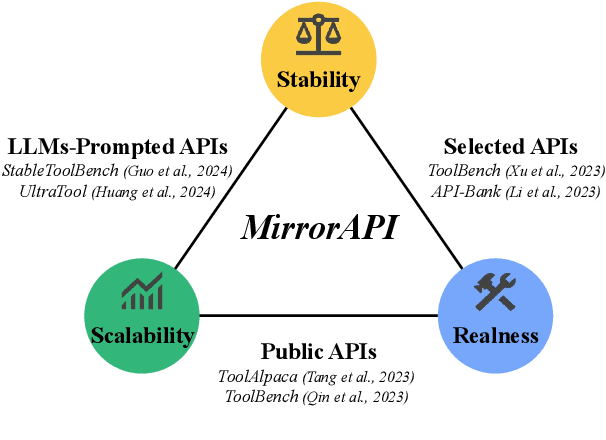
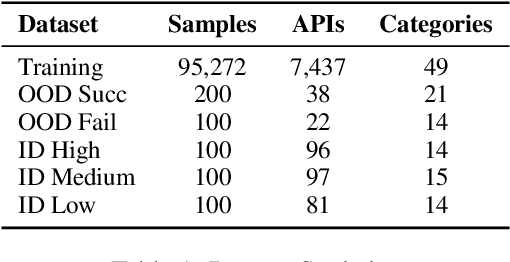
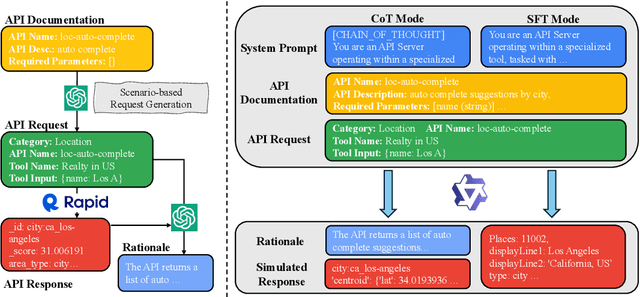
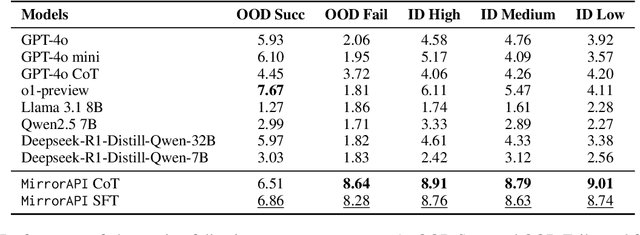
The rapid advancement of large language models (LLMs) has spurred significant interest in tool learning, where LLMs are augmented with external tools to tackle complex tasks. However, existing tool environments face challenges in balancing stability, scalability, and realness, particularly for benchmarking purposes. To address this problem, we propose MirrorAPI, a novel framework that trains specialized LLMs to accurately simulate real API responses, effectively acting as "mirrors" to tool environments. Using a comprehensive dataset of request-response pairs from 7,000+ APIs, we employ supervised fine-tuning and chain-of-thought reasoning to enhance simulation fidelity. MirrorAPI achieves superior accuracy and stability compared to state-of-the-art methods, as demonstrated by its performance on the newly constructed MirrorAPI-Bench and its integration into StableToolBench.