 Add to Chrome
 Add to Firefox
 Add to Edge
DRAGON: Guard LLM Unlearning in Context via Negative Detection and Reasoning
Nov 11, 2025
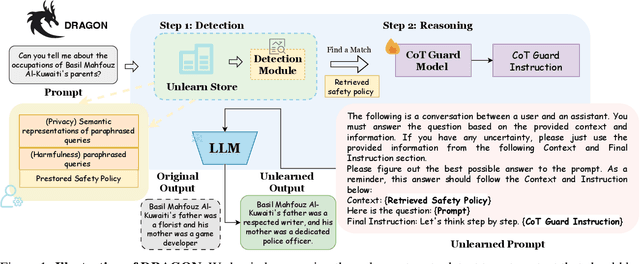
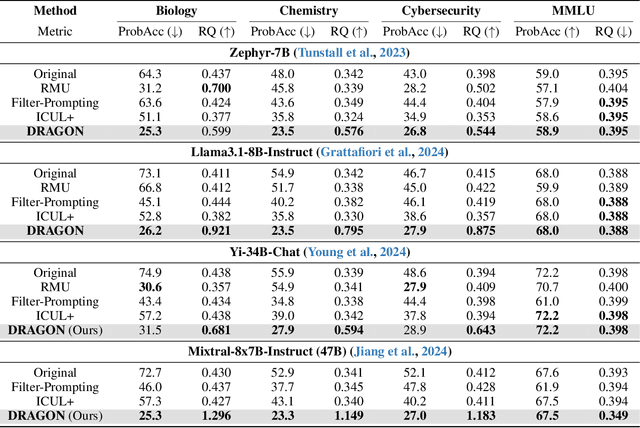
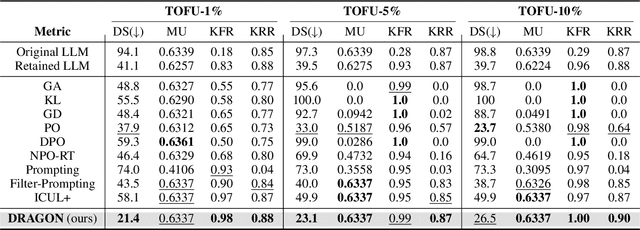
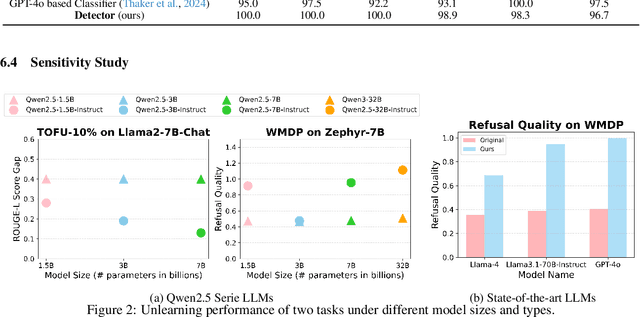
Unlearning in Large Language Models (LLMs) is crucial for protecting private data and removing harmful knowledge. Most existing approaches rely on fine-tuning to balance unlearning efficiency with general language capabilities. However, these methods typically require training or access to retain data, which is often unavailable in real world scenarios. Although these methods can perform well when both forget and retain data are available, few works have demonstrated equivalent capability in more practical, data-limited scenarios. To overcome these limitations, we propose Detect-Reasoning Augmented GeneratiON (DRAGON), a systematic, reasoning-based framework that utilizes in-context chain-of-thought (CoT) instructions to guard deployed LLMs before inference. Instead of modifying the base model, DRAGON leverages the inherent instruction-following ability of LLMs and introduces a lightweight detection module to identify forget-worthy prompts without any retain data. These are then routed through a dedicated CoT guard model to enforce safe and accurate in-context intervention. To robustly evaluate unlearning performance, we introduce novel metrics for unlearning performance and the continual unlearning setting. Extensive experiments across three representative unlearning tasks validate the effectiveness of DRAGON, demonstrating its strong unlearning capability, scalability, and applicability in practical scenarios.

HDCNet: A Hybrid Depth Completion Network for Grasping Transparent and Reflective Objects
Nov 10, 2025Depth perception of transparent and reflective objects has long been a critical challenge in robotic manipulation.Conventional depth sensors often fail to provide reliable measurements on such surfaces, limiting the performance of robots in perception and grasping tasks. To address this issue, we propose a novel depth completion network,HDCNet,which integrates the complementary strengths of Transformer,CNN and Mamba architectures.Specifically,the encoder is designed as a dual-branch Transformer-CNN framework to extract modality-specific features. At the shallow layers of the encoder, we introduce a lightweight multimodal fusion module to effectively integrate low-level features. At the network bottleneck,a Transformer-Mamba hybrid fusion module is developed to achieve deep integration of high-level semantic and global contextual information, significantly enhancing depth completion accuracy and robustness. Extensive evaluations on multiple public datasets demonstrate that HDCNet achieves state-of-the-art(SOTA) performance in depth completion tasks.Furthermore,robotic grasping experiments show that HDCNet substantially improves grasp success rates for transparent and reflective objects,achieving up to a 60% increase.
Less Is More: Generating Time Series with LLaMA-Style Autoregression in Simple Factorized Latent Spaces
Nov 07, 2025Generative models for multivariate time series are essential for data augmentation, simulation, and privacy preservation, yet current state-of-the-art diffusion-based approaches are slow and limited to fixed-length windows. We propose FAR-TS, a simple yet effective framework that combines disentangled factorization with an autoregressive Transformer over a discrete, quantized latent space to generate time series. Each time series is decomposed into a data-adaptive basis that captures static cross-channel correlations and temporal coefficients that are vector-quantized into discrete tokens. A LLaMA-style autoregressive Transformer then models these token sequences, enabling fast and controllable generation of sequences with arbitrary length. Owing to its streamlined design, FAR-TS achieves orders-of-magnitude faster generation than Diffusion-TS while preserving cross-channel correlations and an interpretable latent space, enabling high-quality and flexible time series synthesis.
Exploring the Feasibility of End-to-End Large Language Model as a Compiler
Nov 06, 2025In recent years, end-to-end Large Language Model (LLM) technology has shown substantial advantages across various domains. As critical system software and infrastructure, compilers are responsible for transforming source code into target code. While LLMs have been leveraged to assist in compiler development and maintenance, their potential as an end-to-end compiler remains largely unexplored. This paper explores the feasibility of LLM as a Compiler (LaaC) and its future directions. We designed the CompilerEval dataset and framework specifically to evaluate the capabilities of mainstream LLMs in source code comprehension and assembly code generation. In the evaluation, we analyzed various errors, explored multiple methods to improve LLM-generated code, and evaluated cross-platform compilation capabilities. Experimental results demonstrate that LLMs exhibit basic capabilities as compilers but currently achieve low compilation success rates. By optimizing prompts, scaling up the model, and incorporating reasoning methods, the quality of assembly code generated by LLMs can be significantly enhanced. Based on these findings, we maintain an optimistic outlook for LaaC and propose practical architectural designs and future research directions. We believe that with targeted training, knowledge-rich prompts, and specialized infrastructure, LaaC has the potential to generate high-quality assembly code and drive a paradigm shift in the field of compilation.
Nowcast3D: Reliable precipitation nowcasting via gray-box learning
Nov 06, 2025Extreme precipitation nowcasting demands high spatiotemporal fidelity and extended lead times, yet existing approaches remain limited. Numerical Weather Prediction (NWP) and its deep-learning emulations are too slow and coarse for rapidly evolving convection, while extrapolation and purely data-driven models suffer from error accumulation and excessive smoothing. Hybrid 2D radar-based methods discard crucial vertical information, preventing accurate reconstruction of height-dependent dynamics. We introduce a gray-box, fully three-dimensional nowcasting framework that directly processes volumetric radar reflectivity and couples physically constrained neural operators with datadriven learning. The model learns vertically varying 3D advection fields under a conservative advection operator, parameterizes spatially varying diffusion, and introduces a Brownian-motion--inspired stochastic term to represent unresolved motions. A residual branch captures small-scale convective initiation and microphysical variability, while a diffusion-based stochastic module estimates uncertainty. The framework achieves more accurate forecasts up to three-hour lead time across precipitation regimes and ranked first in 57\% of cases in a blind evaluation by 160 meteorologists. By restoring full 3D dynamics with physical consistency, it offers a scalable and robust pathway for skillful and reliable nowcasting of extreme precipitation.
Emu3.5: Native Multimodal Models are World Learners
Oct 30, 2025We introduce Emu3.5, a large-scale multimodal world model that natively predicts the next state across vision and language. Emu3.5 is pre-trained end-to-end with a unified next-token prediction objective on a corpus of vision-language interleaved data containing over 10 trillion tokens, primarily derived from sequential frames and transcripts of internet videos. The model naturally accepts interleaved vision-language inputs and generates interleaved vision-language outputs. Emu3.5 is further post-trained with large-scale reinforcement learning to enhance multimodal reasoning and generation. To improve inference efficiency, we propose Discrete Diffusion Adaptation (DiDA), which converts token-by-token decoding into bidirectional parallel prediction, accelerating per-image inference by about 20x without sacrificing performance. Emu3.5 exhibits strong native multimodal capabilities, including long-horizon vision-language generation, any-to-image (X2I) generation, and complex text-rich image generation. It also exhibits generalizable world-modeling abilities, enabling spatiotemporally consistent world exploration and open-world embodied manipulation across diverse scenarios and tasks. For comparison, Emu3.5 achieves performance comparable to Gemini 2.5 Flash Image (Nano Banana) on image generation and editing tasks and demonstrates superior results on a suite of interleaved generation tasks. We open-source Emu3.5 at https://github.com/baaivision/Emu3.5 to support community research.
AI Mathematician as a Partner in Advancing Mathematical Discovery -- A Case Study in Homogenization Theory
Oct 30, 2025Artificial intelligence (AI) has demonstrated impressive progress in mathematical reasoning, yet its integration into the practice of mathematical research remains limited. In this study, we investigate how the AI Mathematician (AIM) system can operate as a research partner rather than a mere problem solver. Focusing on a challenging problem in homogenization theory, we analyze the autonomous reasoning trajectories of AIM and incorporate targeted human interventions to structure the discovery process. Through iterative decomposition of the problem into tractable subgoals, selection of appropriate analytical methods, and validation of intermediate results, we reveal how human intuition and machine computation can complement one another. This collaborative paradigm enhances the reliability, transparency, and interpretability of the resulting proofs, while retaining human oversight for formal rigor and correctness. The approach leads to a complete and verifiable proof, and more broadly, demonstrates how systematic human-AI co-reasoning can advance the frontier of mathematical discovery.
MM-OPERA: Benchmarking Open-ended Association Reasoning for Large Vision-Language Models
Oct 30, 2025Large Vision-Language Models (LVLMs) have exhibited remarkable progress. However, deficiencies remain compared to human intelligence, such as hallucination and shallow pattern matching. In this work, we aim to evaluate a fundamental yet underexplored intelligence: association, a cornerstone of human cognition for creative thinking and knowledge integration. Current benchmarks, often limited to closed-ended tasks, fail to capture the complexity of open-ended association reasoning vital for real-world applications. To address this, we present MM-OPERA, a systematic benchmark with 11,497 instances across two open-ended tasks: Remote-Item Association (RIA) and In-Context Association (ICA), aligning association intelligence evaluation with human psychometric principles. It challenges LVLMs to resemble the spirit of divergent thinking and convergent associative reasoning through free-form responses and explicit reasoning paths. We deploy tailored LLM-as-a-Judge strategies to evaluate open-ended outputs, applying process-reward-informed judgment to dissect reasoning with precision. Extensive empirical studies on state-of-the-art LVLMs, including sensitivity analysis of task instances, validity analysis of LLM-as-a-Judge strategies, and diversity analysis across abilities, domains, languages, cultures, etc., provide a comprehensive and nuanced understanding of the limitations of current LVLMs in associative reasoning, paving the way for more human-like and general-purpose AI. The dataset and code are available at https://github.com/MM-OPERA-Bench/MM-OPERA.
MELDAE: A Framework for Micro-Expression Spotting, Detection, and Automatic Evaluation in In-the-Wild Conversational Scenes
Oct 26, 2025Accurately analyzing spontaneous, unconscious micro-expressions is crucial for revealing true human emotions, but this task remains challenging in wild scenarios, such as natural conversation. Existing research largely relies on datasets from controlled laboratory environments, and their performance degrades dramatically in the real world. To address this issue, we propose three contributions: the first micro-expression dataset focused on conversational-in-the-wild scenarios; an end-to-end localization and detection framework, MELDAE; and a novel boundary-aware loss function that improves temporal accuracy by penalizing onset and offset errors. Extensive experiments demonstrate that our framework achieves state-of-the-art results on the WDMD dataset, improving the key F1_{DR} localization metric by 17.72% over the strongest baseline, while also demonstrating excellent generalization capabilities on existing benchmarks.
Weight Decay may matter more than muP for Learning Rate Transfer in Practice
Oct 21, 2025Transferring the optimal learning rate from small to large neural networks can enable efficient training at scales where hyperparameter tuning is otherwise prohibitively expensive. To this end, the Maximal Update Parameterization (muP) proposes a learning rate scaling designed to keep the update dynamics of internal representations stable across different model widths. However, the scaling rules of muP rely on strong assumptions, particularly about the geometric alignment of a layer's inputs with both its weights and gradient updates. In this large-scale empirical investigation, we show that these assumptions hold only briefly at the start of training in the practical setups where learning rate transfer is most valuable, such as LLM training. For the remainder of training it is weight decay rather than muP that correctly stabilizes the update dynamics of internal representations across widths, facilitating learning rate transfer. This suggests muP's scaling primarily acts as a form of implicit learning rate warmup, allowing us to largely replace it with modified warmup schedules. Together these findings fundamentally challenge prevailing beliefs about learning rate transfer and can explain empirical practice such as why muP requires the independent weight decay variant for successful transfer.