 Add to Chrome
 Add to Firefox
 Add to Edge
Code-MUE: Measuring Code LLMs' Uncertainty through Execution-based Semantic Interaction Graphs
Jul 14, 2026
As Code Large Language Models (LLMs) become central to modern software engineering, their inherent stochasticity poses significant real-world risks, where even minor errors can lead to severe functional, security, or safety consequences. Reliable automation, therefore, demands the ability to distinguish between confident, well-supported predictions and stochastic guessing. However, existing uncertainty estimation methods face a critical gap: white and grey-box techniques are often inapplicable to closed-source models, while standard "black-box" text metrics fail to capture the unique fragility of code, where syntactic variation does not always imply semantic divergence. To bridge this syntax-semantics gap, we introduce Code-MUE, a purely black-box framework that measures uncertainty through execution-based Semantic Interaction Graphs. Unlike prior approaches that rely on superficial textual similarity, Code-MUE grounds uncertainty in observable runtime behavior, calculating the Von Neumann entropy of the solution space to quantify global semantic diversity. A large-scale empirical study across eight state-of-the-art LLMs demonstrates that Code-MUE achieves a strong negative correlation with functional correctness (Spearman's correlation up to -0.98), significantly outperforming lexical and embedding-based baselines while enabling robust risk detection and selective prediction in practical workflows.

Robust OOD Graph Learning via Mean Constraints and Noise Reduction
Jun 24, 2025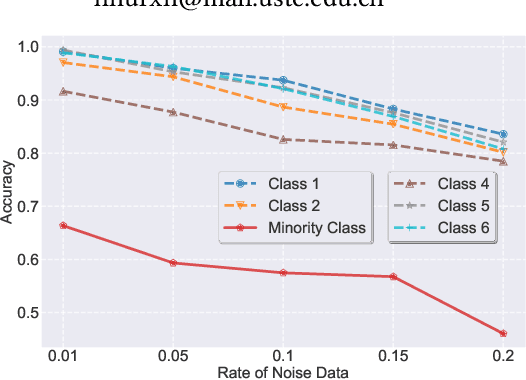
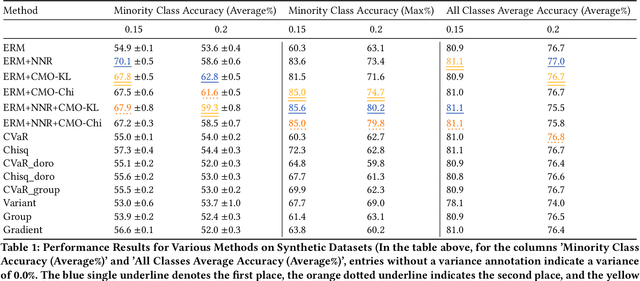
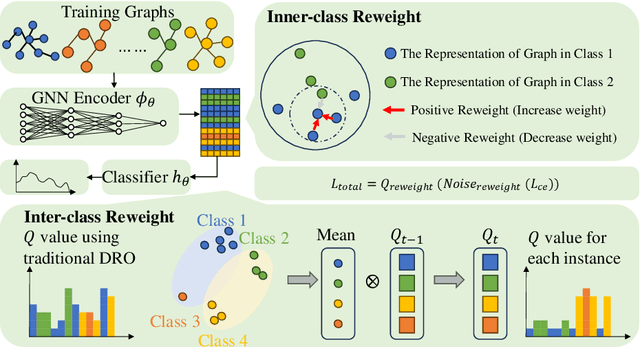
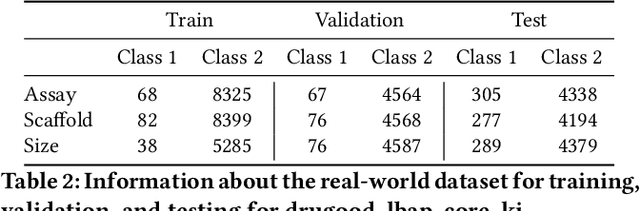
Graph Out-of-Distribution (OOD) classification often suffers from sharp performance drops, particularly under category imbalance and structural noise. This work tackles two pressing challenges in this context: (1) the underperformance of minority classes due to skewed label distributions, and (2) their heightened sensitivity to structural noise in graph data. To address these problems, we propose two complementary solutions. First, Constrained Mean Optimization (CMO) improves minority class robustness by encouraging similarity-based instance aggregation under worst-case conditions. Second, the Neighbor-Aware Noise Reweighting (NNR) mechanism assigns dynamic weights to training samples based on local structural consistency, mitigating noise influence. We provide theoretical justification for our methods, and validate their effectiveness with extensive experiments on both synthetic and real-world datasets, showing significant improvements in Graph OOD generalization and classification accuracy. The code for our method is available at: https://anonymous.4open.science/r/CMO-NNR-2F30.
A Batch-Insensitive Dynamic GNN Approach to Address Temporal Discontinuity in Graph Streams
Jun 24, 2025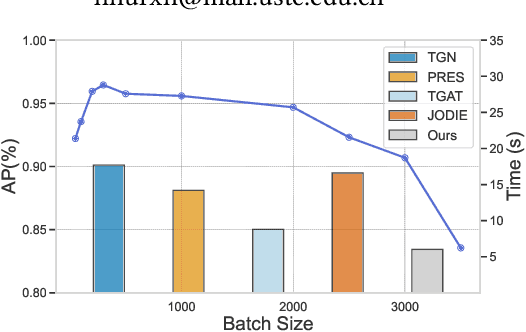
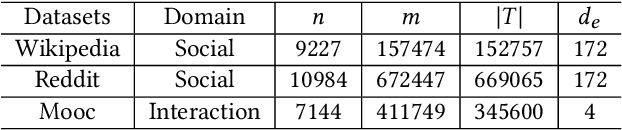
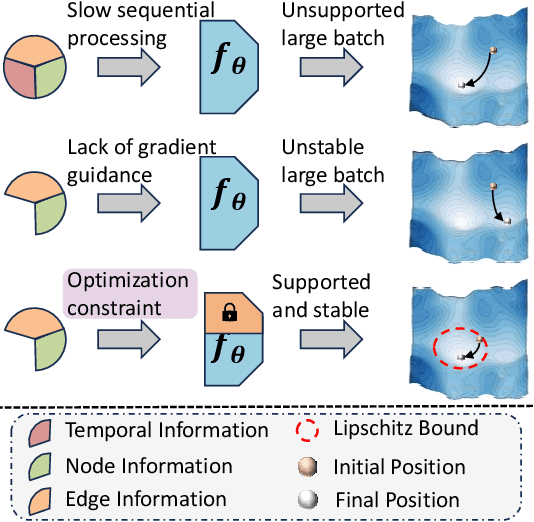
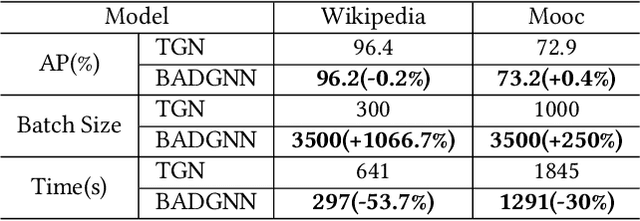
In dynamic graphs, preserving temporal continuity is critical. However, Memory-based Dynamic Graph Neural Networks (MDGNNs) trained with large batches often disrupt event sequences, leading to temporal information loss. This discontinuity not only deteriorates temporal modeling but also hinders optimization by increasing the difficulty of parameter convergence. Our theoretical study quantifies this through a Lipschitz upper bound, showing that large batch sizes enlarge the parameter search space. In response, we propose BADGNN, a novel batch-agnostic framework consisting of two core components: (1) Temporal Lipschitz Regularization (TLR) to control parameter search space expansion, and (2) Adaptive Attention Adjustment (A3) to alleviate attention distortion induced by both regularization and batching. Empirical results on three benchmark datasets show that BADGNN maintains strong performance while enabling significantly larger batch sizes and faster training compared to TGN. Our code is available at Code: https://anonymous.4open.science/r/TGN_Lipichitz-C033/.
Self and Cross-Model Distillation for LLMs: Effective Methods for Refusal Pattern Alignment
Jun 17, 2024Large Language Models (LLMs) like OpenAI's GPT series, Anthropic's Claude, and Meta's LLaMa have shown remarkable capabilities in text generation. However, their susceptibility to toxic prompts presents significant security challenges. This paper investigates alignment techniques, including Supervised Fine-Tuning (SFT) and Reinforcement Learning from Human Feedback (RLHF), to mitigate these risks. We conduct an empirical study on refusal patterns across nine LLMs, revealing that models with uniform refusal patterns, such as Claude3, exhibit higher security. Based on these findings, we propose self-distilling and cross-model distilling methods to enhance LLM security. Our results show that these methods significantly improve refusal rates and reduce unsafe content, with cross-model distilling achieving refusal rates close to Claude3's 94.51%. These findings underscore the potential of distillation-based alignment in securing LLMs against toxic prompts.
A Cross-Language Investigation into Jailbreak Attacks in Large Language Models
Jan 30, 2024Large Language Models (LLMs) have become increasingly popular for their advanced text generation capabilities across various domains. However, like any software, they face security challenges, including the risk of 'jailbreak' attacks that manipulate LLMs to produce prohibited content. A particularly underexplored area is the Multilingual Jailbreak attack, where malicious questions are translated into various languages to evade safety filters. Currently, there is a lack of comprehensive empirical studies addressing this specific threat. To address this research gap, we conducted an extensive empirical study on Multilingual Jailbreak attacks. We developed a novel semantic-preserving algorithm to create a multilingual jailbreak dataset and conducted an exhaustive evaluation on both widely-used open-source and commercial LLMs, including GPT-4 and LLaMa. Additionally, we performed interpretability analysis to uncover patterns in Multilingual Jailbreak attacks and implemented a fine-tuning mitigation method. Our findings reveal that our mitigation strategy significantly enhances model defense, reducing the attack success rate by 96.2%. This study provides valuable insights into understanding and mitigating Multilingual Jailbreak attacks.