 Add to Chrome
 Add to Firefox
 Add to Edge
From Code to Road: A Vehicle-in-the-Loop and Digital Twin-Based Framework for Central Car Server Testing in Autonomous Driving
Mar 05, 2026
Simulation is one of the most essential parts in the development stage of automotive software. However, purely virtual simulations often struggle to accurately capture all real-world factors due to limitations in modeling. To address this challenge, this work presents a test framework for automotive software on the centralized E/E architecture, which is a central car server in our case, based on Vehicle-in-the-Loop (ViL) and digital twin technology. The framework couples a physical test vehicle on a dynamometer test bench with its synchronized virtual counterpart in a simulation environment. Our approach provides a safe, reproducible, realistic, and cost-effective platform for validating autonomous driving algorithms with a centralized architecture. This test method eliminates the need to test individual physical ECUs and their communication protocols separately. In contrast to traditional ViL methods, the proposed framework runs the full autonomous driving software directly on the vehicle hardware after the simulation process, eliminating flashing and intermediate layers while enabling seamless virtual-physical integration and accurately reflecting centralized E/E behavior. In addition, incorporating mixed testing in both simulated and physical environments reduces the need for full hardware integration during the early stages of automotive development. Experimental case studies demonstrate the effectiveness of the framework in different test scenarios. These findings highlight the potential to reduce development and integration efforts for testing autonomous driving pipelines in the future.

PRAM-R: A Perception-Reasoning-Action-Memory Framework with LLM-Guided Modality Routing for Adaptive Autonomous Driving
Mar 04, 2026Multimodal perception enables robust autonomous driving but incurs unnecessary computational cost when all sensors remain active. This paper presents PRAM-R, a unified Perception-Reasoning-Action-Memory framework with LLM-Guided Modality Routing for adaptive autonomous driving. PRAM-R adopts an asynchronous dual-loop design: a fast reactive loop for perception and control, and a slow deliberative loop for reasoning-driven modality selection and memory updates. An LLM router selects and weights modalities using environmental context and sensor diagnostics, while a hierarchical memory module preserves temporal consistency and supports long-term adaptation. We conduct a two-stage evaluation: (1) synthetic stress tests for stability analysis and (2) real-world validation on the nuScenes dataset. Synthetic stress tests confirm 87.2% reduction in routing oscillations via hysteresis-based stabilization. Real-world validation on nuScenes shows 6.22% modality reduction with 20% memory recall while maintaining comparable trajectory accuracy to full-modality baselines in complex urban scenarios. Our work demonstrates that LLM-augmented architectures with hierarchical memory achieve efficient, adaptive multimodal perception in autonomous driving.
GarchingSim: An Autonomous Driving Simulator with Photorealistic Scenes and Minimalist Workflow
Jan 30, 2024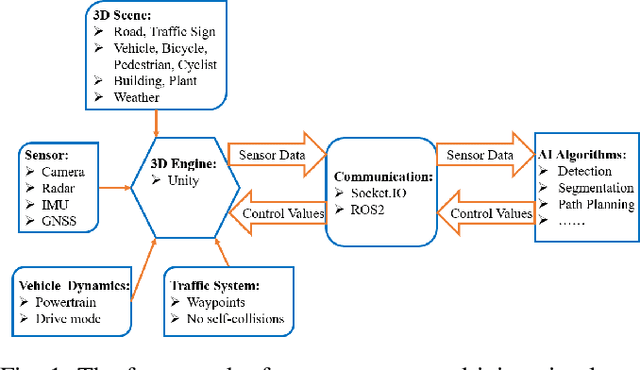
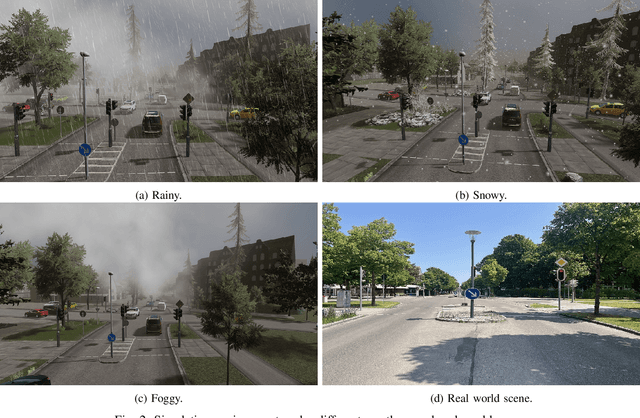
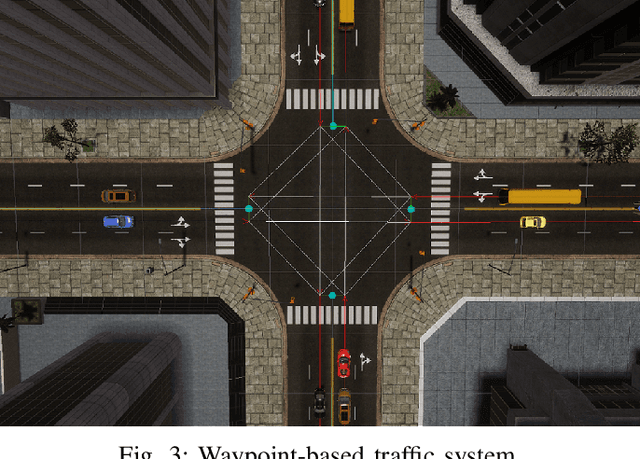
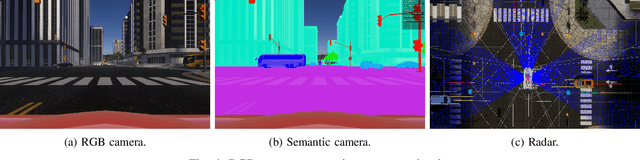
Conducting real road testing for autonomous driving algorithms can be expensive and sometimes impractical, particularly for small startups and research institutes. Thus, simulation becomes an important method for evaluating these algorithms. However, the availability of free and open-source simulators is limited, and the installation and configuration process can be daunting for beginners and interdisciplinary researchers. We introduce an autonomous driving simulator with photorealistic scenes, meanwhile keeping a user-friendly workflow. The simulator is able to communicate with external algorithms through ROS2 or Socket.IO, making it compatible with existing software stacks. Furthermore, we implement a highly accurate vehicle dynamics model within the simulator to enhance the realism of the vehicle's physical effects. The simulator is able to serve various functions, including generating synthetic data and driving with machine learning-based algorithms. Moreover, we prioritize simplicity in the deployment process, ensuring that beginners find it approachable and user-friendly.