 Add to Chrome
 Add to Firefox
 Add to Edge
CrossTune: Black-Box Few-Shot Classification with Label Enhancement
Mar 19, 2024
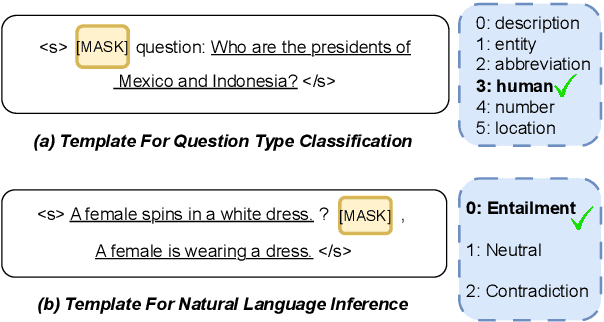
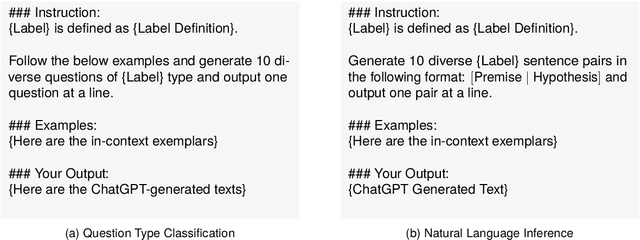
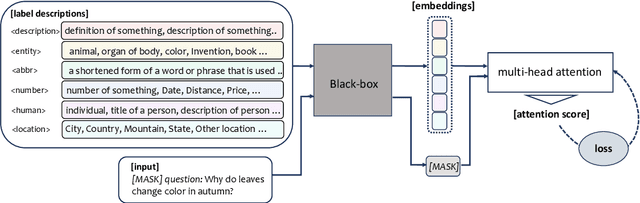
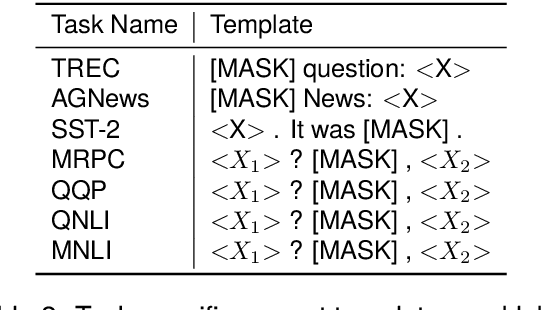
Training or finetuning large-scale language models (LLMs) requires substantial computation resources, motivating recent efforts to explore parameter-efficient adaptation to downstream tasks. One approach is to treat these models as black boxes and use forward passes (Inference APIs) to interact with them. Current research focuses on adapting these black-box models to downstream tasks using gradient-free prompt optimization, but this often involves an expensive process of searching task-specific prompts. Therefore, we are motivated to study black-box language model adaptation without prompt search. Specifically, we introduce a label-enhanced cross-attention network called CrossTune, which models the semantic relatedness between the input text sequence and task-specific label descriptions. Its effectiveness is examined in the context of few-shot text classification. To improve the generalization of CrossTune, we utilize ChatGPT to generate additional training data through in-context learning. A switch mechanism is implemented to exclude low-quality ChatGPT-generated data. Through extensive experiments on seven benchmark text classification datasets, we demonstrate that our proposed approach outperforms the previous state-of-the-art gradient-free black-box tuning method by 5.7% on average. Even without using ChatGPT-augmented data, CrossTune performs better or comparably than previous black-box tuning methods, suggesting the effectiveness of our approach.

Boosting Disfluency Detection with Large Language Model as Disfluency Generator
Mar 13, 2024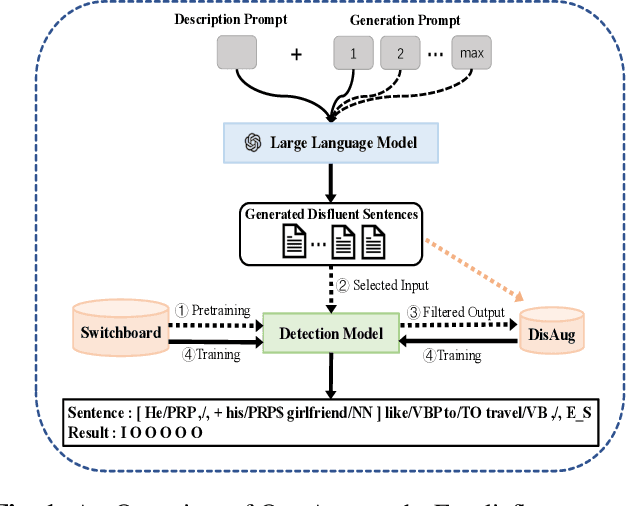
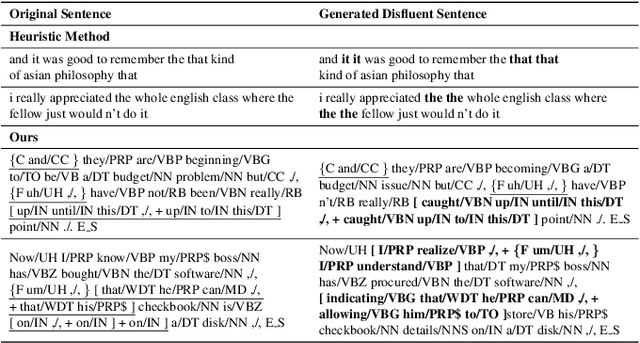
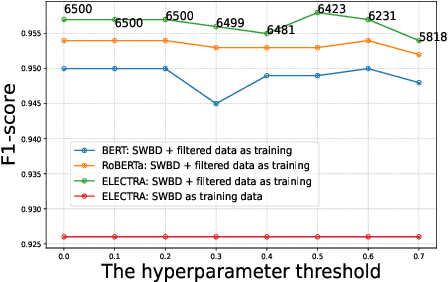
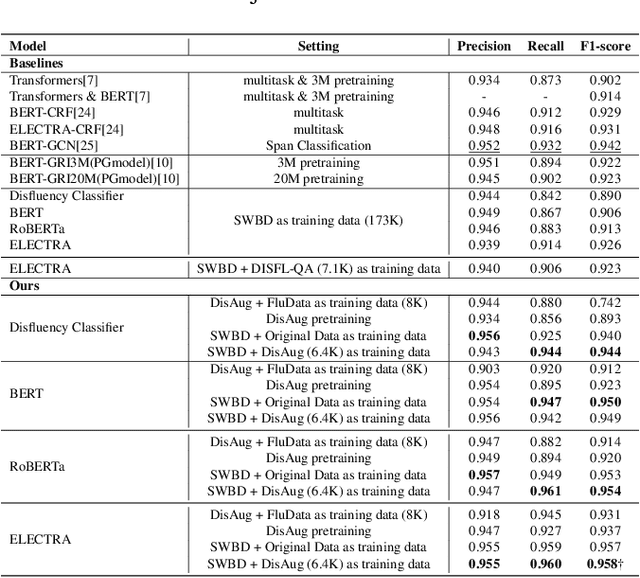
Current disfluency detection methods heavily rely on costly and scarce human-annotated data. To tackle this issue, some approaches employ heuristic or statistical features to generate disfluent sentences, partially improving detection performance. However, these sentences often deviate from real-life scenarios, constraining overall model enhancement. In this study, we propose a lightweight data augmentation approach for disfluency detection, utilizing the superior generative and semantic understanding capabilities of large language model (LLM) to generate disfluent sentences as augmentation data. We leverage LLM to generate diverse and more realistic sentences guided by specific prompts, without the need for fine-tuning the LLM. Subsequently, we apply an uncertainty-aware data filtering approach to improve the quality of the generated sentences, utilized in training a small detection model for improved performance. Experiments using enhanced data yielded state-of-the-art results. The results showed that using a small amount of LLM-generated enhanced data can significantly improve performance, thereby further enhancing cost-effectiveness.
Graph Neural Network with Two Uplift Estimators for Label-Scarcity Individual Uplift Modeling
Mar 11, 2024



Uplift modeling aims to measure the incremental effect, which we call uplift, of a strategy or action on the users from randomized experiments or observational data. Most existing uplift methods only use individual data, which are usually not informative enough to capture the unobserved and complex hidden factors regarding the uplift. Furthermore, uplift modeling scenario usually has scarce labeled data, especially for the treatment group, which also poses a great challenge for model training. Considering that the neighbors' features and the social relationships are very informative to characterize a user's uplift, we propose a graph neural network-based framework with two uplift estimators, called GNUM, to learn from the social graph for uplift estimation. Specifically, we design the first estimator based on a class-transformed target. The estimator is general for all types of outcomes, and is able to comprehensively model the treatment and control group data together to approach the uplift. When the outcome is discrete, we further design the other uplift estimator based on our defined partial labels, which is able to utilize more labeled data from both the treatment and control groups, to further alleviate the label scarcity problem. Comprehensive experiments on a public dataset and two industrial datasets show a superior performance of our proposed framework over state-of-the-art methods under various evaluation metrics. The proposed algorithms have been deployed online to serve real-world uplift estimation scenarios.
Benchmarking Micro-action Recognition: Dataset, Methods, and Applications
Mar 08, 2024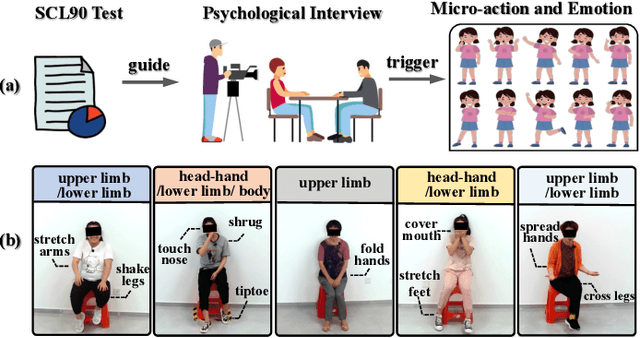
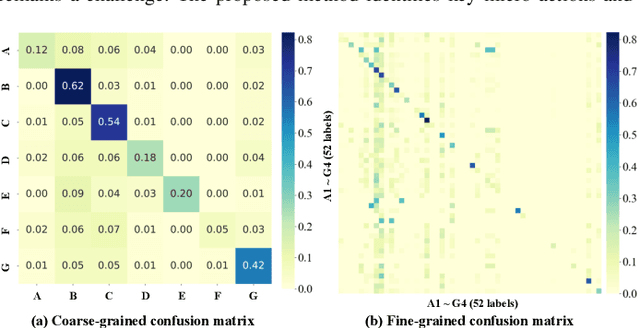
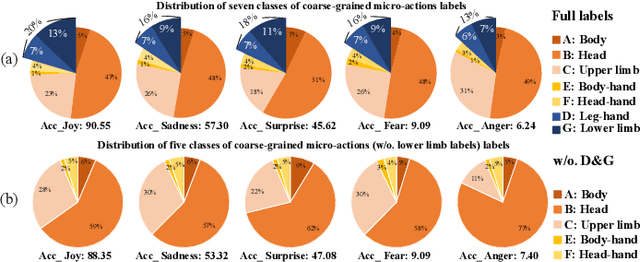
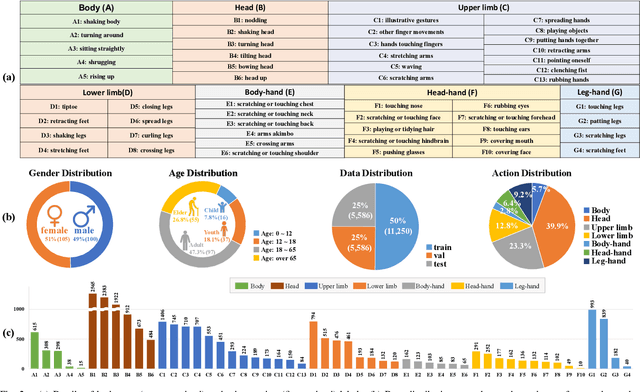
Micro-action is an imperceptible non-verbal behaviour characterised by low-intensity movement. It offers insights into the feelings and intentions of individuals and is important for human-oriented applications such as emotion recognition and psychological assessment. However, the identification, differentiation, and understanding of micro-actions pose challenges due to the imperceptible and inaccessible nature of these subtle human behaviors in everyday life. In this study, we innovatively collect a new micro-action dataset designated as Micro-action-52 (MA-52), and propose a benchmark named micro-action network (MANet) for micro-action recognition (MAR) task. Uniquely, MA-52 provides the whole-body perspective including gestures, upper- and lower-limb movements, attempting to reveal comprehensive micro-action cues. In detail, MA-52 contains 52 micro-action categories along with seven body part labels, and encompasses a full array of realistic and natural micro-actions, accounting for 205 participants and 22,422 video instances collated from the psychological interviews. Based on the proposed dataset, we assess MANet and other nine prevalent action recognition methods. MANet incorporates squeeze-and excitation (SE) and temporal shift module (TSM) into the ResNet architecture for modeling the spatiotemporal characteristics of micro-actions. Then a joint-embedding loss is designed for semantic matching between video and action labels; the loss is used to better distinguish between visually similar yet distinct micro-action categories. The extended application in emotion recognition has demonstrated one of the important values of our proposed dataset and method. In the future, further exploration of human behaviour, emotion, and psychological assessment will be conducted in depth. The dataset and source code are released at https://github.com/VUT-HFUT/Micro-Action.
Improving LLM-based Machine Translation with Systematic Self-Correction
Mar 04, 2024Large Language Models (LLMs) have achieved impressive results in Machine Translation (MT). However, careful evaluations by human reveal that the translations produced by LLMs still contain multiple errors. Importantly, feeding back such error information into the LLMs can lead to self-correction and result in improved translation performance. Motivated by these insights, we introduce a systematic LLM-based self-correcting translation framework, named TER, which stands for Translate, Estimate, and Refine, marking a significant step forward in this direction. Our findings demonstrate that 1) our self-correction framework successfully assists LLMs in improving their translation quality across a wide range of languages, whether it's from high-resource languages to low-resource ones or whether it's English-centric or centered around other languages; 2) TER exhibits superior systematicity and interpretability compared to previous methods; 3) different estimation strategies yield varied impacts on AI feedback, directly affecting the effectiveness of the final corrections. We further compare different LLMs and conduct various experiments involving self-correction and cross-model correction to investigate the potential relationship between the translation and evaluation capabilities of LLMs. Our code and data are available at https://github.com/fzp0424/self_correct_mt
More Than Routing: Joint GPS and Route Modeling for Refine Trajectory Representation Learning
Feb 25, 2024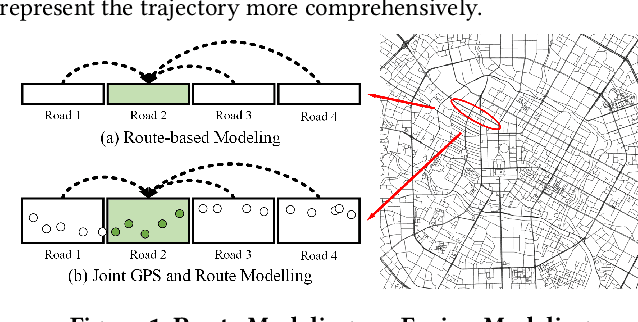
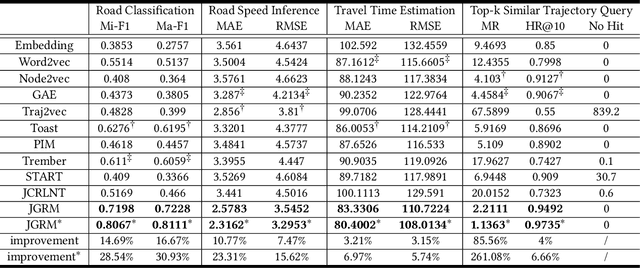
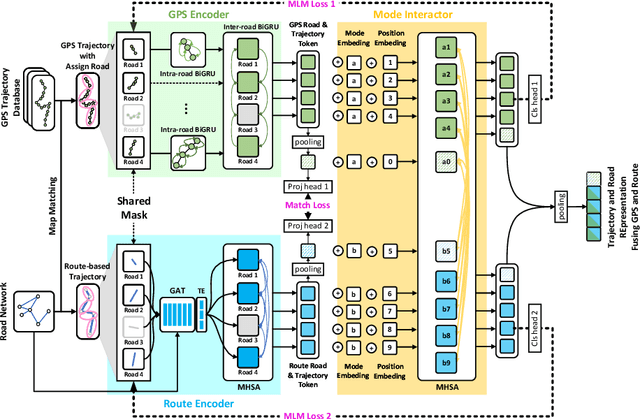
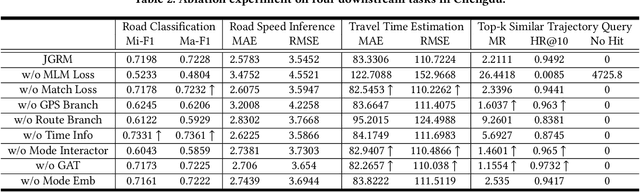
Trajectory representation learning plays a pivotal role in supporting various downstream tasks. Traditional methods in order to filter the noise in GPS trajectories tend to focus on routing-based methods used to simplify the trajectories. However, this approach ignores the motion details contained in the GPS data, limiting the representation capability of trajectory representation learning. To fill this gap, we propose a novel representation learning framework that Joint GPS and Route Modelling based on self-supervised technology, namely JGRM. We consider GPS trajectory and route as the two modes of a single movement observation and fuse information through inter-modal information interaction. Specifically, we develop two encoders, each tailored to capture representations of route and GPS trajectories respectively. The representations from the two modalities are fed into a shared transformer for inter-modal information interaction. Eventually, we design three self-supervised tasks to train the model. We validate the effectiveness of the proposed method on two real datasets based on extensive experiments. The experimental results demonstrate that JGRM outperforms existing methods in both road segment representation and trajectory representation tasks. Our source code is available at Anonymous Github.
Unsupervised Concept Discovery Mitigates Spurious Correlations
Feb 20, 2024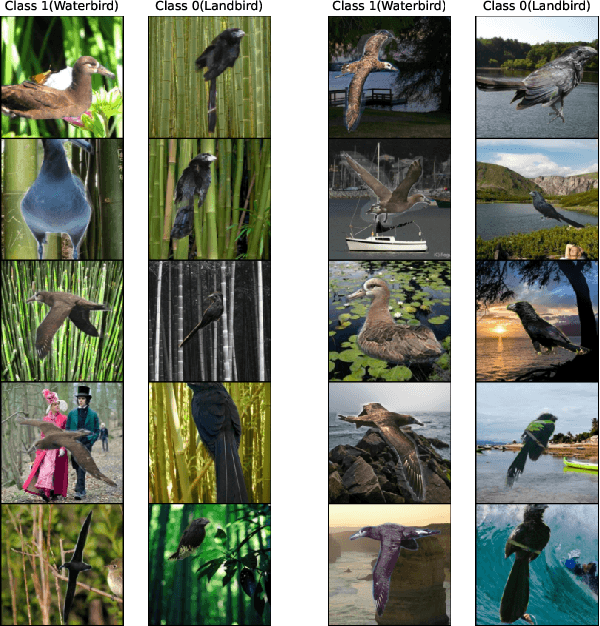
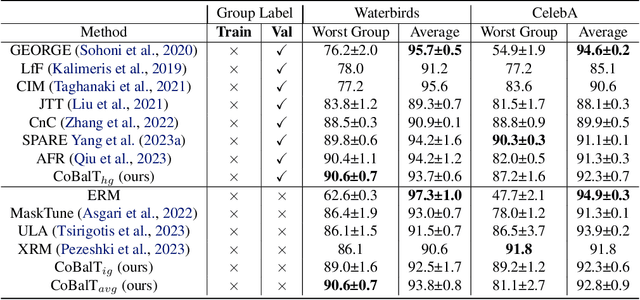
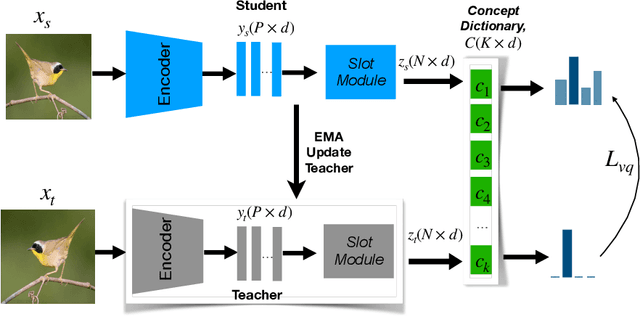
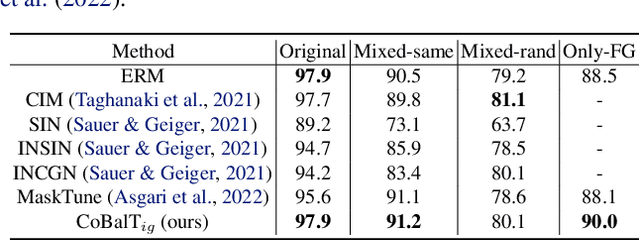
Models prone to spurious correlations in training data often produce brittle predictions and introduce unintended biases. Addressing this challenge typically involves methods relying on prior knowledge and group annotation to remove spurious correlations, which may not be readily available in many applications. In this paper, we establish a novel connection between unsupervised object-centric learning and mitigation of spurious correlations. Instead of directly inferring sub-groups with varying correlations with labels, our approach focuses on discovering concepts: discrete ideas that are shared across input samples. Leveraging existing object-centric representation learning, we introduce CoBalT: a concept balancing technique that effectively mitigates spurious correlations without requiring human labeling of subgroups. Evaluation across the Waterbirds, CelebA and ImageNet-9 benchmark datasets for subpopulation shifts demonstrate superior or competitive performance compared state-of-the-art baselines, without the need for group annotation.
Improved Generalization of Weight Space Networks via Augmentations
Feb 06, 2024Learning in deep weight spaces (DWS), where neural networks process the weights of other neural networks, is an emerging research direction, with applications to 2D and 3D neural fields (INRs, NeRFs), as well as making inferences about other types of neural networks. Unfortunately, weight space models tend to suffer from substantial overfitting. We empirically analyze the reasons for this overfitting and find that a key reason is the lack of diversity in DWS datasets. While a given object can be represented by many different weight configurations, typical INR training sets fail to capture variability across INRs that represent the same object. To address this, we explore strategies for data augmentation in weight spaces and propose a MixUp method adapted for weight spaces. We demonstrate the effectiveness of these methods in two setups. In classification, they improve performance similarly to having up to 10 times more data. In self-supervised contrastive learning, they yield substantial 5-10% gains in downstream classification.
Reconfigurable Intelligent Computational Surfaces for MEC-Assisted Autonomous Driving Networks
Feb 01, 2024In this paper, we focus on improving autonomous driving safety via task offloading from cellular vehicles (CVs), using vehicle-to-infrastructure (V2I) links, to an multi-access edge computing (MEC) server. Considering that the frequencies used for V2I links can be reused for vehicle-to-vehicle (V2V) communications to improve spectrum utilization, the receiver of each V2I link may suffer from severe interference, causing outages in the task offloading process. To tackle this issue, we propose the deployment of a reconfigurable intelligent computational surface (RICS) to enable, not only V2I reflective links, but also interference cancellation at the V2V links exploiting the computational capability of its metamaterials. We devise a joint optimization formulation for the task offloading ratio between the CVs and the MEC server, the spectrum sharing strategy between V2V and V2I communications, as well as the RICS reflection and refraction matrices, with the objective to maximize a safety-based autonomous driving task. Due to the non-convexity of the problem and the coupling among its free variables, we transform it into a more tractable equivalent form, which is then decomposed into three sub-problems and solved via an alternate approximation method. Our simulation results demonstrate the effectiveness of the proposed RICS optimization in improving the safety in autonomous driving networks.
Attention-based Efficient Classification for 3D MRI Image of Alzheimer's Disease
Jan 25, 2024Early diagnosis of Alzheimer Diagnostics (AD) is a challenging task due to its subtle and complex clinical symptoms. Deep learning-assisted medical diagnosis using image recognition techniques has become an important research topic in this field. The features have to accurately capture main variations of anatomical brain structures. However, time-consuming is expensive for feature extraction by deep learning training. This study proposes a novel Alzheimer's disease detection model based on Convolutional Neural Networks. The model utilizes a pre-trained ResNet network as the backbone, incorporating post-fusion algorithm for 3D medical images and attention mechanisms. The experimental results indicate that the employed 2D fusion algorithm effectively improves the model's training expense. And the introduced attention mechanism accurately weights important regions in images, further enhancing the model's diagnostic accuracy.