 Add to Chrome
 Add to Firefox
 Add to Edge
Memory in the Age of AI Agents
Dec 15, 2025
Memory has emerged, and will continue to remain, a core capability of foundation model-based agents. As research on agent memory rapidly expands and attracts unprecedented attention, the field has also become increasingly fragmented. Existing works that fall under the umbrella of agent memory often differ substantially in their motivations, implementations, and evaluation protocols, while the proliferation of loosely defined memory terminologies has further obscured conceptual clarity. Traditional taxonomies such as long/short-term memory have proven insufficient to capture the diversity of contemporary agent memory systems. This work aims to provide an up-to-date landscape of current agent memory research. We begin by clearly delineating the scope of agent memory and distinguishing it from related concepts such as LLM memory, retrieval augmented generation (RAG), and context engineering. We then examine agent memory through the unified lenses of forms, functions, and dynamics. From the perspective of forms, we identify three dominant realizations of agent memory, namely token-level, parametric, and latent memory. From the perspective of functions, we propose a finer-grained taxonomy that distinguishes factual, experiential, and working memory. From the perspective of dynamics, we analyze how memory is formed, evolved, and retrieved over time. To support practical development, we compile a comprehensive summary of memory benchmarks and open-source frameworks. Beyond consolidation, we articulate a forward-looking perspective on emerging research frontiers, including memory automation, reinforcement learning integration, multimodal memory, multi-agent memory, and trustworthiness issues. We hope this survey serves not only as a reference for existing work, but also as a conceptual foundation for rethinking memory as a first-class primitive in the design of future agentic intelligence.

Boosting Disfluency Detection with Large Language Model as Disfluency Generator
Mar 13, 2024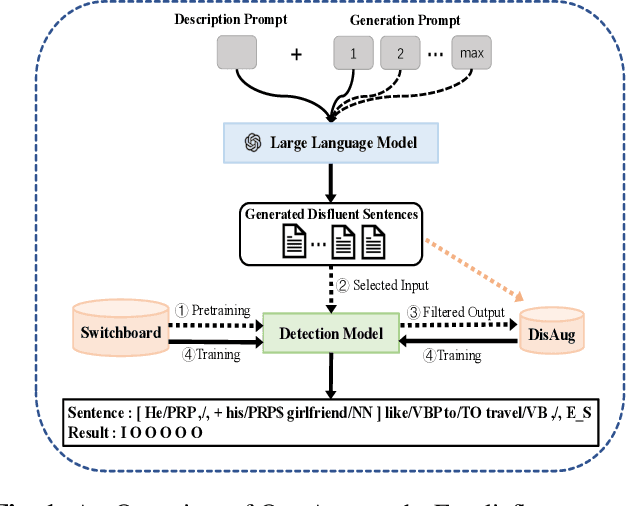
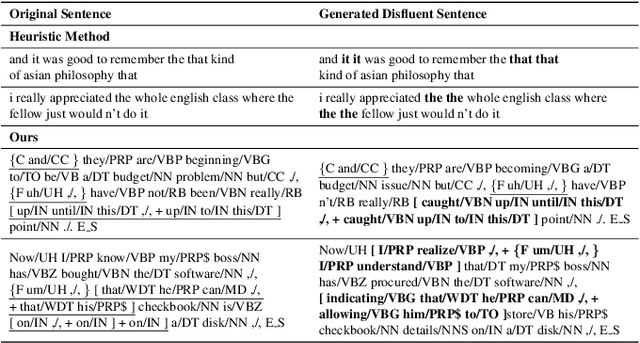
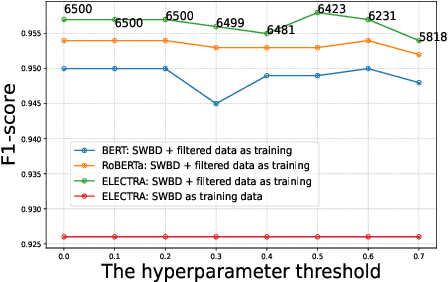
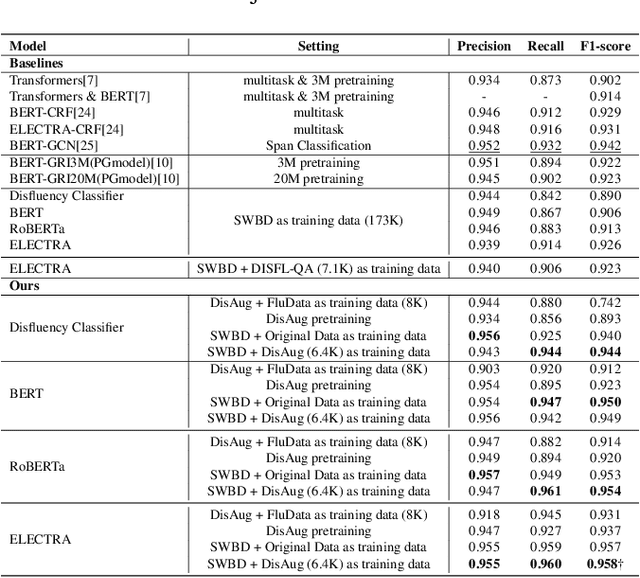
Current disfluency detection methods heavily rely on costly and scarce human-annotated data. To tackle this issue, some approaches employ heuristic or statistical features to generate disfluent sentences, partially improving detection performance. However, these sentences often deviate from real-life scenarios, constraining overall model enhancement. In this study, we propose a lightweight data augmentation approach for disfluency detection, utilizing the superior generative and semantic understanding capabilities of large language model (LLM) to generate disfluent sentences as augmentation data. We leverage LLM to generate diverse and more realistic sentences guided by specific prompts, without the need for fine-tuning the LLM. Subsequently, we apply an uncertainty-aware data filtering approach to improve the quality of the generated sentences, utilized in training a small detection model for improved performance. Experiments using enhanced data yielded state-of-the-art results. The results showed that using a small amount of LLM-generated enhanced data can significantly improve performance, thereby further enhancing cost-effectiveness.