 Add to Chrome
 Add to Firefox
 Add to Edge
Ling and Ring 2.6 Technical Report: Efficient and Instant Agentic Intelligence at Trillion-Parameter Scale
Jun 13, 2026
Efficient and scalable agentic intelligence requires models that can deliver both low-latency responses and strong reasoning capabilities while remaining practical to train, serve, and deploy. In this report, we present Ling-2.6 and Ring-2.6, a family of models designed to address this challenge at scale. Ling-2.6 is optimized for instant response generation and high capability per output token, whereas Ring-2.6 is tailored for deeper reasoning and more advanced agentic workflows. Instead of training from scratch, we upgrade the Ling-2.0 base model through architectural migration pre-training and large-scale post-training. This upgrade is guided by a unified co-design of model architecture, optimization objectives, serving systems, and agent training environments, enabling improvements in both model capability and deployment efficiency. At the architectural level, we introduce a hybrid linear attention design that integrates Lightning Attention with MLA, improving the efficiency of long-context training and decoding. To further enhance token efficiency, we optimize capability per output token through Evolutionary Chain-of-Thought, Linguistic Unit Policy Optimization, bidirectional preference alignment, and shortest-correct-response distillation. For agentic capabilities, we propose KPop, a reinforcement learning framework designed to support stable training of Ring-2.6-1T on large-scale environment-grounded data. KPop improves training efficiency through asynchronous scheduling across coding, search, tool use, and workflow execution, enabling scalable learning from complex agent-environment interactions. Together, Ling-2.6 and Ring-2.6 provide a practical pathway toward efficient, scalable, and open agentic systems. We open-source all checkpoints in the 2.6 family to support further research and development in practical agentic intelligence.

Personalized Binomial DAGs Learning with Network Structured Covariates
Jun 10, 2024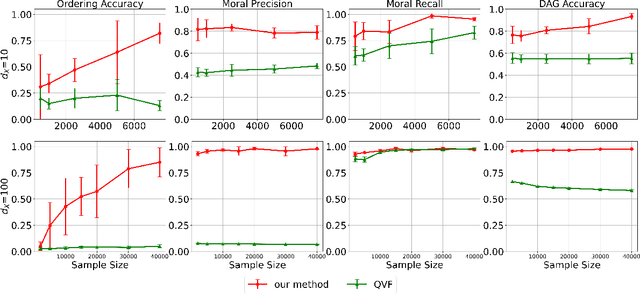
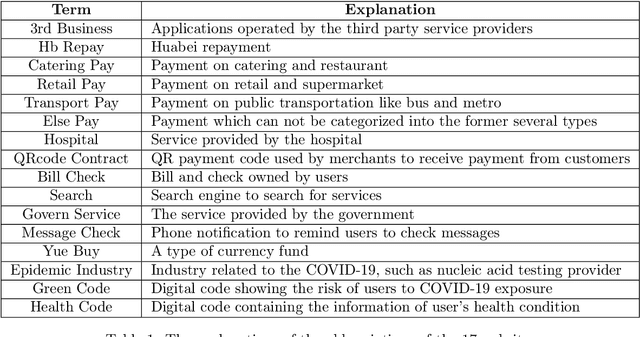
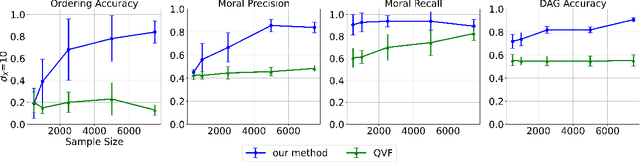
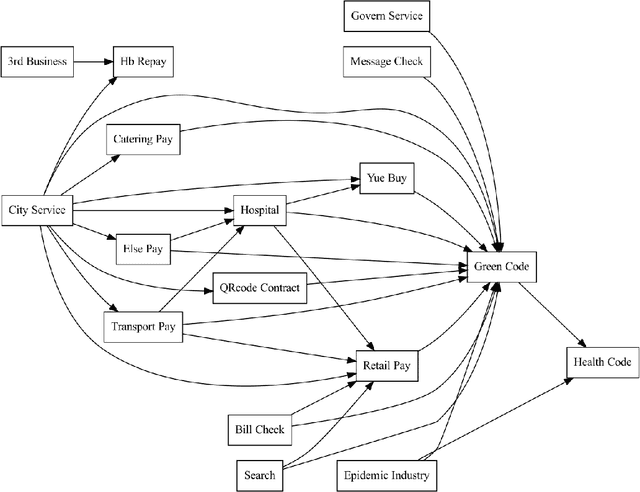
The causal dependence in data is often characterized by Directed Acyclic Graphical (DAG) models, widely used in many areas. Causal discovery aims to recover the DAG structure using observational data. This paper focuses on causal discovery with multi-variate count data. We are motivated by real-world web visit data, recording individual user visits to multiple websites. Building a causal diagram can help understand user behavior in transitioning between websites, inspiring operational strategy. A challenge in modeling is user heterogeneity, as users with different backgrounds exhibit varied behaviors. Additionally, social network connections can result in similar behaviors among friends. We introduce personalized Binomial DAG models to address heterogeneity and network dependency between observations, which are common in real-world applications. To learn the proposed DAG model, we develop an algorithm that embeds the network structure into a dimension-reduced covariate, learns each node's neighborhood to reduce the DAG search space, and explores the variance-mean relation to determine the ordering. Simulations show our algorithm outperforms state-of-the-art competitors in heterogeneous data. We demonstrate its practical usefulness on a real-world web visit dataset.
Graph Neural Network with Two Uplift Estimators for Label-Scarcity Individual Uplift Modeling
Mar 11, 2024



Uplift modeling aims to measure the incremental effect, which we call uplift, of a strategy or action on the users from randomized experiments or observational data. Most existing uplift methods only use individual data, which are usually not informative enough to capture the unobserved and complex hidden factors regarding the uplift. Furthermore, uplift modeling scenario usually has scarce labeled data, especially for the treatment group, which also poses a great challenge for model training. Considering that the neighbors' features and the social relationships are very informative to characterize a user's uplift, we propose a graph neural network-based framework with two uplift estimators, called GNUM, to learn from the social graph for uplift estimation. Specifically, we design the first estimator based on a class-transformed target. The estimator is general for all types of outcomes, and is able to comprehensively model the treatment and control group data together to approach the uplift. When the outcome is discrete, we further design the other uplift estimator based on our defined partial labels, which is able to utilize more labeled data from both the treatment and control groups, to further alleviate the label scarcity problem. Comprehensive experiments on a public dataset and two industrial datasets show a superior performance of our proposed framework over state-of-the-art methods under various evaluation metrics. The proposed algorithms have been deployed online to serve real-world uplift estimation scenarios.