 Add to Chrome
 Add to Firefox
 Add to Edge
PATS: Policy-Aware Training Scaffolding for Agentic Reinforcement Learning
Jul 23, 2026
In long-horizon LLM agent reinforcement learning, weak policies often repeat similar failures, producing uninformative rollout trajectories and limiting effective policy optimization. Existing skill-centric methods improve exploration by optimizing, filtering, or internalizing reusable skills. However, they remain centered on the skills themselves rather than being designed as adaptive training-time support for the evolving policy. To address this, we propose a policy-centric training paradigm that reframes skills as a dynamic training scaffold. Our framework, Pats, converts rollout groups from the latest policy into evidence cards and uses task-specific evaluation to adjust the context used in subsequent rollouts. Concrete guidance helps weak policies to complete challenging tasks. As policy improves, redundant context is revised or removed to reduce reliance on explicit guidance while preserving useful rollout variation. The policy is optimized with environmental rewards using standard RLVR, and the training scaffold is discarded at deployment. On ALFWorld and WebShop, Pats improves over strong baselines by up to 18.6%. Across seven search-augmented QA benchmarks, it remains competitive while using 32.1% fewer prompt tokens than the baseline.

SIRIUS-SQL: Anchoring Multi-Candidate Text-to-SQL in Execution Feedback
May 31, 2026Text-to-SQL on complex schemas is unreliable on a single pass, so recent systems generate multiple SQL candidates and let voting filter out errors. Yet voting alone is not enough, because the multi-candidate recipe has three coupled weaknesses: 1) sampling more from a single generator produces increasingly redundant candidates, 2) existing pipelines apply one generic correction to every non-clean execution result, while runtime errors, timeouts, and empty results each indicate a different distance from correctness, and 3) existing selectors rely on a single angle such as result-majority voting or pairwise SQL comparison, missing what other angles would have caught. We present SIRIUS-SQL, which addresses all three weaknesses. A difficulty-smoothing RL recipe trains SIRIUS-32B to generate diverse executable SQL candidates, paired with a generalist LLM that fills in gaps left by the specialist. An execution-grounded lifecycle classifies each outcome and applies targeted repair before candidates re-enter the pool. A confidence-gated hybrid selector combines execution-result agreement with pairwise SQL-form judgment, escalating only near-tied cases to a deterministic structural check. SIRIUS-SQL reaches 75.88% on BIRD dev and 91.20% on SPIDER test. Two of three generalist pairings surpass Agentar-Scale-SQL, the strongest published multi-candidate system on BIRD dev.
Efficient Agentic Reinforcement Learning with On-Policy Intrinsic Knowledge Boundary Enhancement
May 26, 2026Agentic reinforcement learning (RL) has proven effective for training LLM-based agents with external tool-use capabilities. However, we identify that agentic RL training induces increasing redundant tool calls and blurs the model's intrinsic knowledge boundary, where the model fails to distinguish when tools are needed versus when parametric knowledge suffices. Existing solutions based on reward shaping create coarse-grained optimization targets that tend to incentivize indiscriminate tool-call suppression, leading to reward hacking. In this paper, we propose AKBE (Agentic Knowledge Boundary Enhancement), an on-policy method that dynamically probes the model's intrinsic knowledge boundary through dual-path (with-tool and no-tool) rollouts during training. We define the knowledge boundary as the per-instance determination of whether tools are required and the minimum tool calls necessary. By comparing correctness across paths, AKBE categorizes trajectories and constructs targeted supervisory signals that guide efficient tool-use patterns for each question. These signals are integrated seamlessly into the agentic RL training loop. Experiments on seven QA benchmarks demonstrate that AKBE improves task accuracy by +1.85 on average and reduces tool calls by 18% over standard agentic RL, yielding 25% higher tool productivity without any accuracy-efficiency trade-off. Further analysis suggests its plug-and-play compatibility across different RL algorithms and the mechanism of each signal category. Our code is available at https://github.com/CuSO4-Chen/AKBE.
A$^2$TGPO: Agentic Turn-Group Policy Optimization with Adaptive Turn-level Clipping
May 07, 2026Reinforcement learning for agentic large language models (LLMs) typically relies on a sparse, trajectory-level outcome reward, making it difficult to evaluate the contribution of individual tool-calls within multi-turn interactions. Existing approaches to such process credit assignment either depend on separate external process reward models that introduce additional consumption, or tree-based structural rollout that merely redistributes the outcome signal while constraining trajectory diversity. A promising alternative leverages the per-turn change in the policy's predicted probability of the ground-truth, termed Information Gain (IG), as an intrinsic process signal without an external evaluator. However, prior work on leveraging IG signals within the RL training loop faces three systematic challenges: normalizing across turns that face heterogeneous positional contexts can distort the relative standing of individual turns, accumulating a variable number of terms causes advantage magnitudes to drift with trajectory depth, and a fixed clipping range governs policy updates identically for turns with vastly different IG signals. In this paper, we propose A$^2$TGPO (Agentic Turn-Group Policy Optimization with Adaptive Turn-level Clipping), which retains IG as the intrinsic signal but re-designs how it is normalized, accumulated, and consumed: (i) turn-group normalization: normalizes IG within each (prompt, turn-index) group so that each turn is compared only against peers at the same interaction depth; (ii) variance-rescaled discounted accumulation: divides cumulative normalized IG by square root of accumulated terms to keep advantage magnitudes comparable across turn positions; and (iii) adaptive turn-level clipping: modulates each turn's clipping range based on its normalized IG, widening the update region for informative turns and narrowing it for uninformative ones.
Uncovering Causal Drivers of Energy Efficiency for Industrial Process in Foundry via Time-Series Causal Inference
Nov 17, 2025
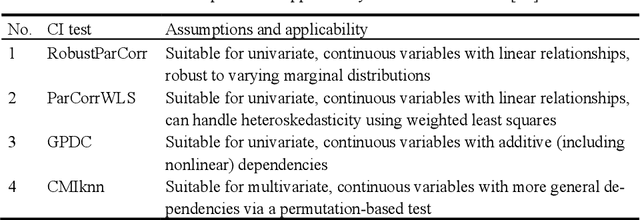
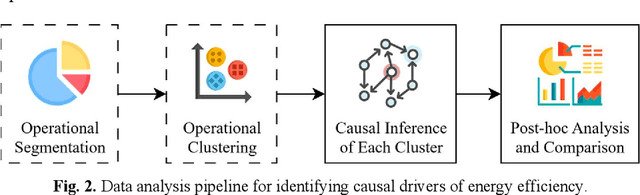
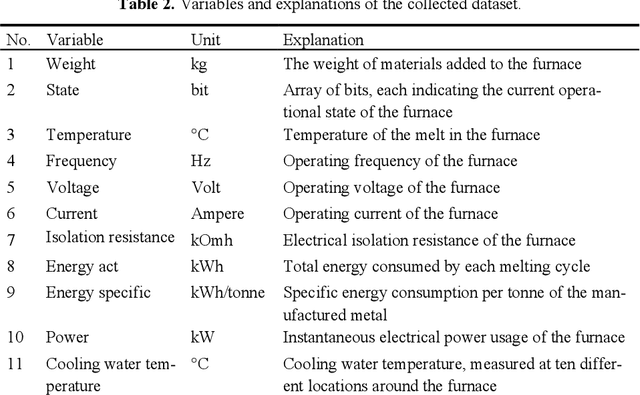
Improving energy efficiency in industrial foundry processes is a critical challenge, as these operations are highly energy-intensive and marked by complex interdependencies among process variables. Correlation-based analyses often fail to distinguish true causal drivers from spurious associations, limiting their usefulness for decision-making. This paper applies a time-series causal inference framework to identify the operational factors that directly affect energy efficiency in induction furnace melting. Using production data from a Danish foundry, the study integrates time-series clustering to segment melting cycles into distinct operational modes with the PCMCI+ algorithm, a state-of-the-art causal discovery method, to uncover cause-effect relationships within each mode. Across clusters, robust causal relations among energy consumption, furnace temperature, and material weight define the core drivers of efficiency, while voltage consistently influences cooling water temperature with a delayed response. Cluster-specific differences further distinguish operational regimes: efficient clusters are characterized by stable causal structures, whereas inefficient ones exhibit reinforcing feedback loops and atypical dependencies. The contributions of this study are twofold. First, it introduces an integrated clustering-causal inference pipeline as a methodological innovation for analyzing energy-intensive processes. Second, it provides actionable insights that enable foundry operators to optimize performance, reduce energy consumption, and lower emissions.
Discovering Operational Patterns Using Image-Based Convolutional Clustering and Composite Evaluation: A Case Study in Foundry Melting Processes
Nov 17, 2025Industrial process monitoring increasingly relies on sensor-generated time-series data, yet the lack of labels, high variability, and operational noise make it difficult to extract meaningful patterns using conventional methods. Existing clustering techniques either rely on fixed distance metrics or deep models designed for static data, limiting their ability to handle dynamic, unstructured industrial sequences. Addressing this gap, this paper proposes a novel framework for unsupervised discovery of operational modes in univariate time-series data using image-based convolutional clustering with composite internal evaluation. The proposed framework improves upon existing approaches in three ways: (1) raw time-series sequences are transformed into grayscale matrix representations via overlapping sliding windows, allowing effective feature extraction using a deep convolutional autoencoder; (2) the framework integrates both soft and hard clustering outputs and refines the selection through a two-stage strategy; and (3) clustering performance is objectively evaluated by a newly developed composite score, S_eva, which combines normalized Silhouette, Calinski-Harabasz, and Davies-Bouldin indices. Applied to over 3900 furnace melting operations from a Nordic foundry, the method identifies seven explainable operational patterns, revealing significant differences in energy consumption, thermal dynamics, and production duration. Compared to classical and deep clustering baselines, the proposed approach achieves superior overall performance, greater robustness, and domain-aligned explainability. The framework addresses key challenges in unsupervised time-series analysis, such as sequence irregularity, overlapping modes, and metric inconsistency, and provides a generalizable solution for data-driven diagnostics and energy optimization in industrial systems.
Multi-Agent Multimodal Large Language Model Framework for Automated Interpretation of Fuel Efficiency Analytics in Public Transportation
Nov 17, 2025Enhancing fuel efficiency in public transportation requires the integration of complex multimodal data into interpretable, decision-relevant insights. However, traditional analytics and visualization methods often yield fragmented outputs that demand extensive human interpretation, limiting scalability and consistency. This study presents a multi-agent framework that leverages multimodal large language models (LLMs) to automate data narration and energy insight generation. The framework coordinates three specialized agents, including a data narration agent, an LLM-as-a-judge agent, and an optional human-in-the-loop evaluator, to iteratively transform analytical artifacts into coherent, stakeholder-oriented reports. The system is validated through a real-world case study on public bus transportation in Northern Jutland, Denmark, where fuel efficiency data from 4006 trips are analyzed using Gaussian Mixture Model clustering. Comparative experiments across five state-of-the-art LLMs and three prompting paradigms identify GPT-4.1 mini with Chain-of-Thought prompting as the optimal configuration, achieving 97.3% narrative accuracy while balancing interpretability and computational cost. The findings demonstrate that multi-agent orchestration significantly enhances factual precision, coherence, and scalability in LLM-based reporting. The proposed framework establishes a replicable and domain-adaptive methodology for AI-driven narrative generation and decision support in energy informatics.
GRAIT: Gradient-Driven Refusal-Aware Instruction Tuning for Effective Hallucination Mitigation
Feb 09, 2025Refusal-Aware Instruction Tuning (RAIT) aims to enhance Large Language Models (LLMs) by improving their ability to refuse responses to questions beyond their knowledge, thereby reducing hallucinations and improving reliability. Effective RAIT must address two key challenges: firstly, effectively reject unknown questions to minimize hallucinations; secondly, avoid over-refusal to ensure questions that can be correctly answered are not rejected, thereby maintain the helpfulness of LLM outputs. In this paper, we address the two challenges by deriving insightful observations from the gradient-based perspective, and proposing the Gradient-driven Refusal Aware Instruction Tuning Framework GRAIT: (1) employs gradient-driven sample selection to effectively minimize hallucinations and (2) introduces an adaptive weighting mechanism during fine-tuning to reduce the risk of over-refusal, achieving the balance between accurate refusals and maintaining useful responses. Experimental evaluations on open-ended and multiple-choice question answering tasks demonstrate that GRAIT significantly outperforms existing RAIT methods in the overall performance. The source code and data will be available at https://github.com/opendatalab/GRAIT .
DataPro -- A Standardized Data Understanding and Processing Procedure: A Case Study of an Eco-Driving Project
Jan 21, 2025A systematic pipeline for data processing and knowledge discovery is essential to extracting knowledge from big data and making recommendations for operational decision-making. The CRISP-DM model is the de-facto standard for developing data-mining projects in practice. However, advancements in data processing technologies require enhancements to this framework. This paper presents the DataPro (a standardized data understanding and processing procedure) model, which extends CRISP-DM and emphasizes the link between data scientists and stakeholders by adding the "technical understanding" and "implementation" phases. Firstly, the "technical understanding" phase aligns business demands with technical requirements, ensuring the technical team's accurate comprehension of business goals. Next, the "implementation" phase focuses on the practical application of developed data science models, ensuring theoretical models are effectively applied in business contexts. Furthermore, clearly defining roles and responsibilities in each phase enhances management and communication among all participants. Afterward, a case study on an eco-driving data science project for fuel efficiency analysis in the Danish public transportation sector illustrates the application of the DataPro model. By following the proposed framework, the project identified key business objectives, translated them into technical requirements, and developed models that provided actionable insights for reducing fuel consumption. Finally, the model is evaluated qualitatively, demonstrating its superiority over other data science procedures.
Utilize the Flow before Stepping into the Same River Twice: Certainty Represented Knowledge Flow for Refusal-Aware Instruction Tuning
Oct 09, 2024
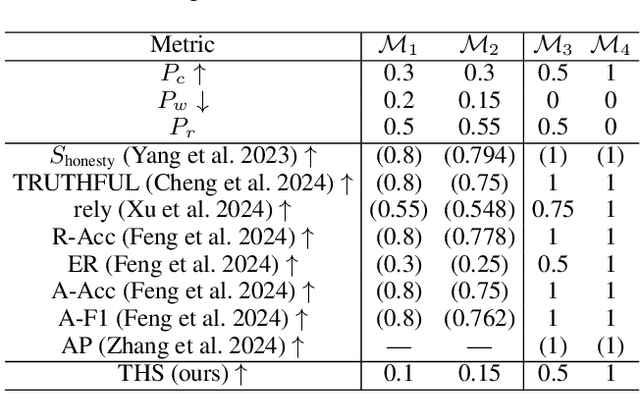


Refusal-Aware Instruction Tuning (RAIT) enables Large Language Models (LLMs) to refuse to answer unknown questions. By modifying responses of unknown questions in the training data to refusal responses such as "I don't know", RAIT enhances the reliability of LLMs and reduces their hallucination. Generally, RAIT modifies training samples based on the correctness of the initial LLM's response. However, this crude approach can cause LLMs to excessively refuse answering questions they could have correctly answered, the problem we call over-refusal. In this paper, we explore two primary causes of over-refusal: Static conflict emerges when the RAIT data is constructed solely on correctness criteria, causing similar samples in the LLM's feature space to be assigned different labels (original vs. modified "I don't know"). Dynamic conflict occurs due to the changes of LLM's knowledge state during fine-tuning, which transforms previous unknown questions into knowns, while the training data, which is constructed based on the initial LLM, remains unchanged. These conflicts cause the trained LLM to misclassify known questions as unknown, resulting in over-refusal. To address this issue, we introduce Certainty Represented Knowledge Flow for Refusal-Aware Instructions Construction (CRaFT). CRaFT centers on two main contributions: First, we additionally incorporate response certainty to selectively filter and modify data, reducing static conflicts. Second, we implement preliminary rehearsal training to characterize changes in the LLM's knowledge state, which helps mitigate dynamic conflicts during the fine-tuning process. We conducted extensive experiments on open-ended question answering and multiple-choice question task. Experiment results show that CRaFT can improve LLM's overall performance during the RAIT process. Source code and training data will be released at Github.