 Add to Chrome
 Add to Firefox
 Add to Edge
SmartSnap: Proactive Evidence Seeking for Self-Verifying Agents
Dec 26, 2025
Agentic reinforcement learning (RL) holds great promise for the development of autonomous agents under complex GUI tasks, but its scalability remains severely hampered by the verification of task completion. Existing task verification is treated as a passive, post-hoc process: a verifier (i.e., rule-based scoring script, reward or critic model, and LLM-as-a-Judge) analyzes the agent's entire interaction trajectory to determine if the agent succeeds. Such processing of verbose context that contains irrelevant, noisy history poses challenges to the verification protocols and therefore leads to prohibitive cost and low reliability. To overcome this bottleneck, we propose SmartSnap, a paradigm shift from this passive, post-hoc verification to proactive, in-situ self-verification by the agent itself. We introduce the Self-Verifying Agent, a new type of agent designed with dual missions: to not only complete a task but also to prove its accomplishment with curated snapshot evidences. Guided by our proposed 3C Principles (Completeness, Conciseness, and Creativity), the agent leverages its accessibility to the online environment to perform self-verification on a minimal, decisive set of snapshots. Such evidences are provided as the sole materials for a general LLM-as-a-Judge verifier to determine their validity and relevance. Experiments on mobile tasks across model families and scales demonstrate that our SmartSnap paradigm allows training LLM-driven agents in a scalable manner, bringing performance gains up to 26.08% and 16.66% respectively to 8B and 30B models. The synergizing between solution finding and evidence seeking facilitates the cultivation of efficient, self-verifying agents with competitive performance against DeepSeek V3.1 and Qwen3-235B-A22B.

Streaming Video Instruction Tuning
Dec 24, 2025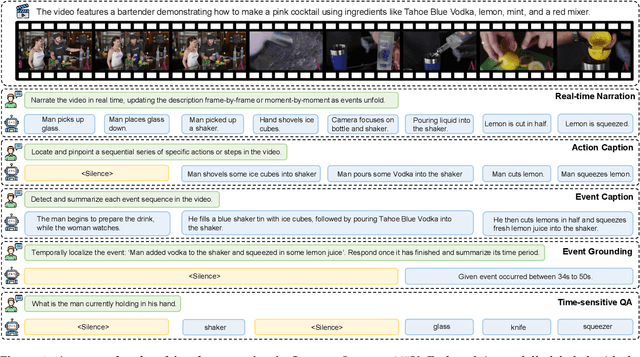
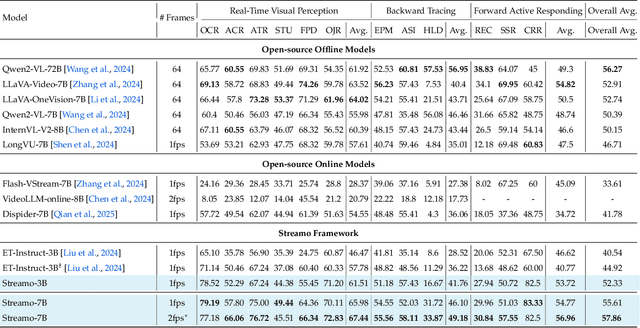
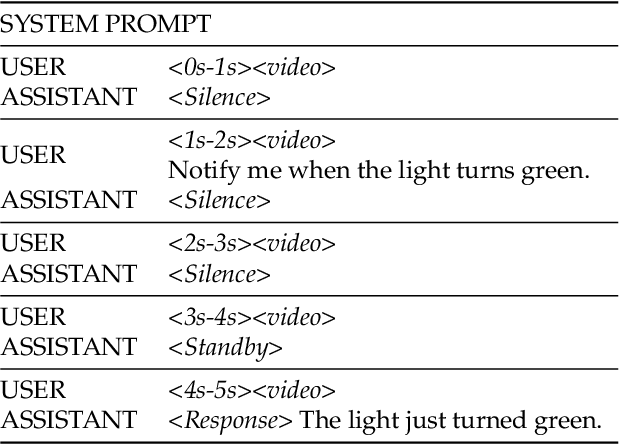
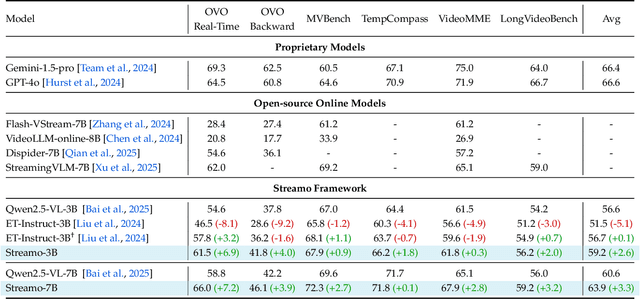
We present Streamo, a real-time streaming video LLM that serves as a general-purpose interactive assistant. Unlike existing online video models that focus narrowly on question answering or captioning, Streamo performs a broad spectrum of streaming video tasks, including real-time narration, action understanding, event captioning, temporal event grounding, and time-sensitive question answering. To develop such versatility, we construct Streamo-Instruct-465K, a large-scale instruction-following dataset tailored for streaming video understanding. The dataset covers diverse temporal contexts and multi-task supervision, enabling unified training across heterogeneous streaming tasks. After training end-to-end on the instruction-following dataset through a streamlined pipeline, Streamo exhibits strong temporal reasoning, responsive interaction, and broad generalization across a variety of streaming benchmarks. Extensive experiments show that Streamo bridges the gap between offline video perception models and real-time multimodal assistants, making a step toward unified, intelligent video understanding in continuous video streams.
VITA-VLA: Efficiently Teaching Vision-Language Models to Act via Action Expert Distillation
Oct 10, 2025Vision-Language Action (VLA) models significantly advance robotic manipulation by leveraging the strong perception capabilities of pretrained vision-language models (VLMs). By integrating action modules into these pretrained models, VLA methods exhibit improved generalization. However, training them from scratch is costly. In this work, we propose a simple yet effective distillation-based framework that equips VLMs with action-execution capability by transferring knowledge from pretrained small action models. Our architecture retains the original VLM structure, adding only an action token and a state encoder to incorporate physical inputs. To distill action knowledge, we adopt a two-stage training strategy. First, we perform lightweight alignment by mapping VLM hidden states into the action space of the small action model, enabling effective reuse of its pretrained action decoder and avoiding expensive pretraining. Second, we selectively fine-tune the language model, state encoder, and action modules, enabling the system to integrate multimodal inputs with precise action generation. Specifically, the action token provides the VLM with a direct handle for predicting future actions, while the state encoder allows the model to incorporate robot dynamics not captured by vision alone. This design yields substantial efficiency gains over training large VLA models from scratch. Compared with previous state-of-the-art methods, our method achieves 97.3% average success rate on LIBERO (11.8% improvement) and 93.5% on LIBERO-LONG (24.5% improvement). In real-world experiments across five manipulation tasks, our method consistently outperforms the teacher model, achieving 82.0% success rate (17% improvement), which demonstrate that action distillation effectively enables VLMs to generate precise actions while substantially reducing training costs.
Learn the Ropes, Then Trust the Wins: Self-imitation with Progressive Exploration for Agentic Reinforcement Learning
Sep 26, 2025
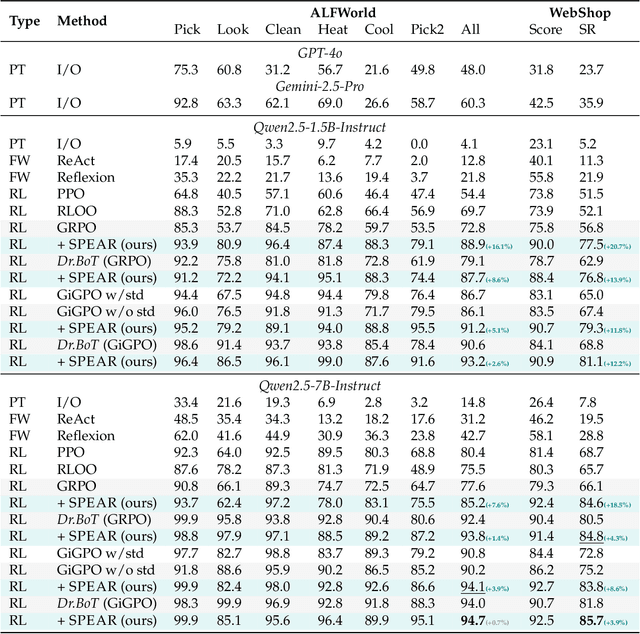
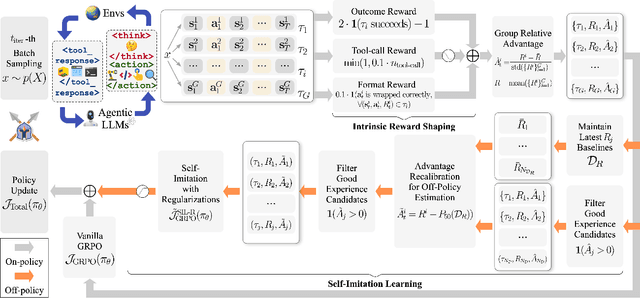
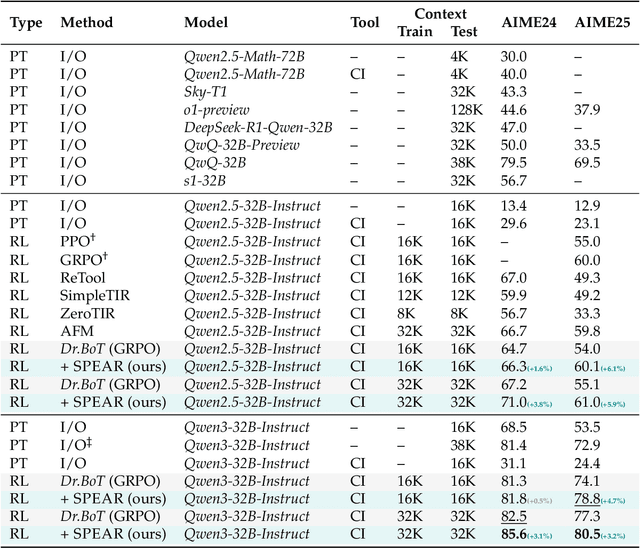
Reinforcement learning (RL) is the dominant paradigm for sharpening strategic tool use capabilities of LLMs on long-horizon, sparsely-rewarded agent tasks, yet it faces a fundamental challenge of exploration-exploitation trade-off. Existing studies stimulate exploration through the lens of policy entropy, but such mechanical entropy maximization is prone to RL training instability due to the multi-turn distribution shifting. In this paper, we target the progressive exploration-exploitation balance under the guidance of the agent own experiences without succumbing to either entropy collapsing or runaway divergence. We propose SPEAR, a curriculum-based self-imitation learning (SIL) recipe for training agentic LLMs. It extends the vanilla SIL framework, where a replay buffer stores self-generated promising trajectories for off-policy update, by gradually steering the policy evolution within a well-balanced range of entropy across stages. Specifically, our approach incorporates a curriculum to manage the exploration process, utilizing intrinsic rewards to foster skill-level exploration and facilitating action-level exploration through SIL. At first, the auxiliary tool call reward plays a critical role in the accumulation of tool-use skills, enabling broad exposure to the unfamiliar distributions of the environment feedback with an upward entropy trend. As training progresses, self-imitation gets strengthened to exploit existing successful patterns from replayed experiences for comparative action-level exploration, accelerating solution iteration without unbounded entropy growth. To further stabilize training, we recalibrate the advantages of experiences in the replay buffer to address the potential policy drift. Reugularizations such as the clipping of tokens with high covariance between probability and advantage are introduced to the trajectory-level entropy control to curb over-confidence.
ActiveVLN: Towards Active Exploration via Multi-Turn RL in Vision-and-Language Navigation
Sep 16, 2025The Vision-and-Language Navigation (VLN) task requires an agent to follow natural language instructions and navigate through complex environments. Existing MLLM-based VLN methods primarily rely on imitation learning (IL) and often use DAgger for post-training to mitigate covariate shift. While effective, these approaches incur substantial data collection and training costs. Reinforcement learning (RL) offers a promising alternative. However, prior VLN RL methods lack dynamic interaction with the environment and depend on expert trajectories for reward shaping, rather than engaging in open-ended active exploration. This restricts the agent's ability to discover diverse and plausible navigation routes. To address these limitations, we propose ActiveVLN, a VLN framework that explicitly enables active exploration through multi-turn RL. In the first stage, a small fraction of expert trajectories is used for IL to bootstrap the agent. In the second stage, the agent iteratively predicts and executes actions, automatically collects diverse trajectories, and optimizes multiple rollouts via the GRPO objective. To further improve RL efficiency, we introduce a dynamic early-stopping strategy to prune long-tail or likely failed trajectories, along with additional engineering optimizations. Experiments show that ActiveVLN achieves the largest performance gains over IL baselines compared to both DAgger-based and prior RL-based post-training methods, while reaching competitive performance with state-of-the-art approaches despite using a smaller model. Code and data will be released soon.
Youtu-GraphRAG: Vertically Unified Agents for Graph Retrieval-Augmented Complex Reasoning
Aug 27, 2025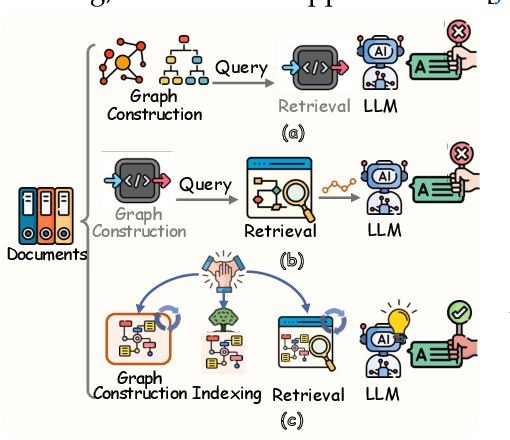
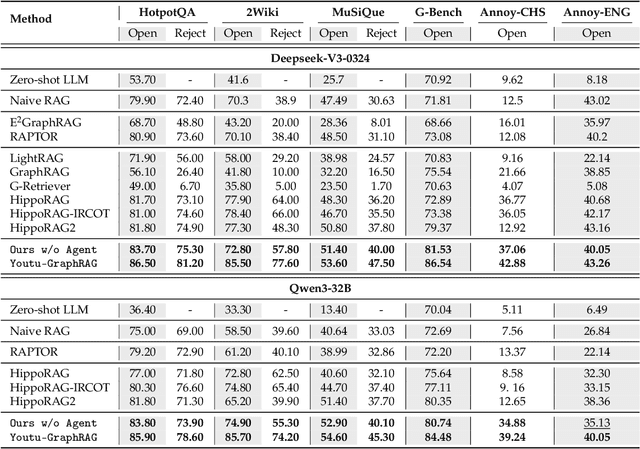

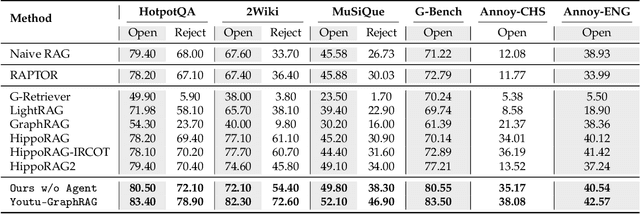
Graph retrieval-augmented generation (GraphRAG) has effectively enhanced large language models in complex reasoning by organizing fragmented knowledge into explicitly structured graphs. Prior efforts have been made to improve either graph construction or graph retrieval in isolation, yielding suboptimal performance, especially when domain shifts occur. In this paper, we propose a vertically unified agentic paradigm, Youtu-GraphRAG, to jointly connect the entire framework as an intricate integration. Specifically, (i) a seed graph schema is introduced to bound the automatic extraction agent with targeted entity types, relations and attribute types, also continuously expanded for scalability over unseen domains; (ii) To obtain higher-level knowledge upon the schema, we develop novel dually-perceived community detection, fusing structural topology with subgraph semantics for comprehensive knowledge organization. This naturally yields a hierarchical knowledge tree that supports both top-down filtering and bottom-up reasoning with community summaries; (iii) An agentic retriever is designed to interpret the same graph schema to transform complex queries into tractable and parallel sub-queries. It iteratively performs reflection for more advanced reasoning; (iv) To alleviate the knowledge leaking problem in pre-trained LLM, we propose a tailored anonymous dataset and a novel 'Anonymity Reversion' task that deeply measures the real performance of the GraphRAG frameworks. Extensive experiments across six challenging benchmarks demonstrate the robustness of Youtu-GraphRAG, remarkably moving the Pareto frontier with up to 90.71% saving of token costs and 16.62% higher accuracy over state-of-the-art baselines. The results indicate our adaptability, allowing seamless domain transfer with minimal intervention on schema.
ASPD: Unlocking Adaptive Serial-Parallel Decoding by Exploring Intrinsic Parallelism in LLMs
Aug 12, 2025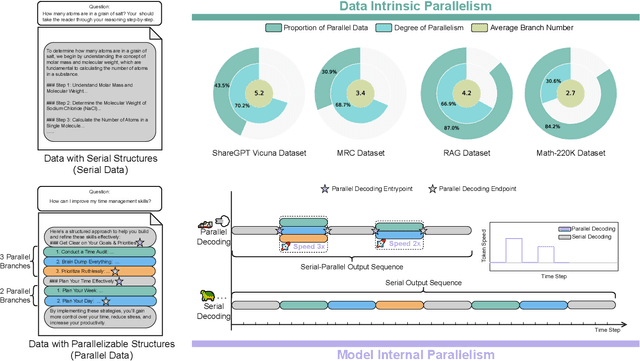
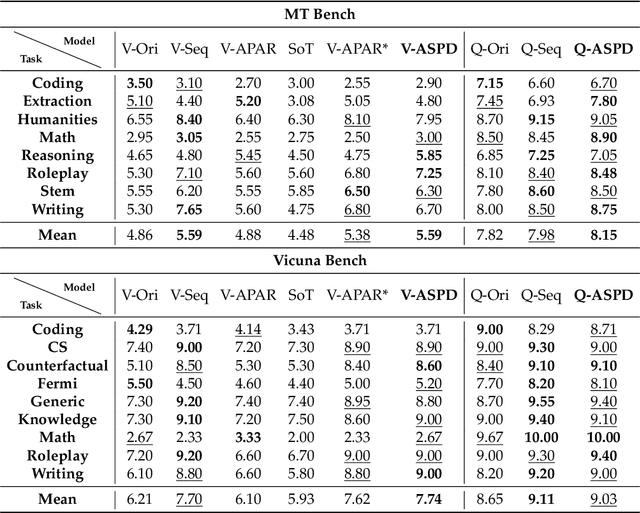
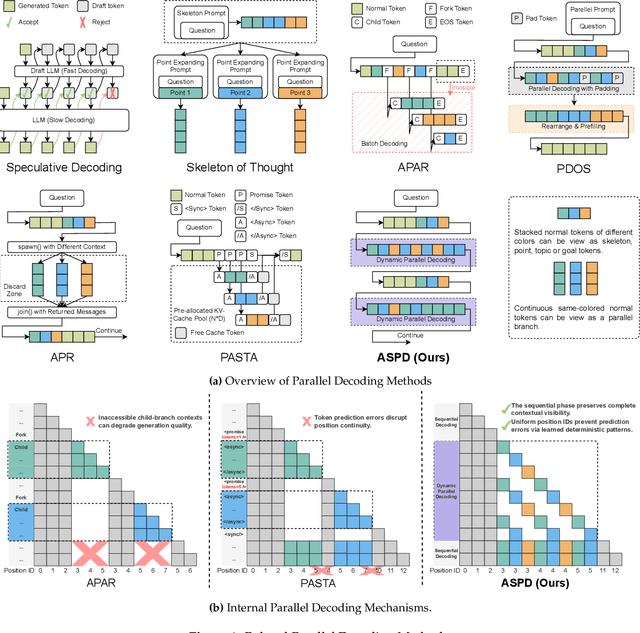
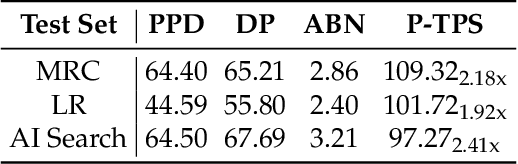
The increasing scale and complexity of large language models (LLMs) pose significant inference latency challenges, primarily due to their autoregressive decoding paradigm characterized by the sequential nature of next-token prediction. By re-examining the outputs of autoregressive models, we observed that some segments exhibit parallelizable structures, which we term intrinsic parallelism. Decoding each parallelizable branch simultaneously (i.e. parallel decoding) can significantly improve the overall inference speed of LLMs. In this paper, we propose an Adaptive Serial-Parallel Decoding (ASPD), which addresses two core challenges: automated construction of parallelizable data and efficient parallel decoding mechanism. More specifically, we introduce a non-invasive pipeline that automatically extracts and validates parallelizable structures from the responses of autoregressive models. To empower efficient adaptive serial-parallel decoding, we implement a Hybrid Decoding Engine which enables seamless transitions between serial and parallel decoding modes while maintaining a reusable KV cache, maximizing computational efficiency. Extensive evaluations across General Tasks, Retrieval-Augmented Generation, Mathematical Reasoning, demonstrate that ASPD achieves unprecedented performance in both effectiveness and efficiency. Notably, on Vicuna Bench, our method achieves up to 3.19x speedup (1.85x on average) while maintaining response quality within 1% difference compared to autoregressive models, realizing significant acceleration without compromising generation quality. Our framework sets a groundbreaking benchmark for efficient LLM parallel inference, paving the way for its deployment in latency-sensitive applications such as AI-powered customer service bots and answer retrieval engines.
Zooming from Context to Cue: Hierarchical Preference Optimization for Multi-Image MLLMs
May 28, 2025Multi-modal Large Language Models (MLLMs) excel at single-image tasks but struggle with multi-image understanding due to cross-modal misalignment, leading to hallucinations (context omission, conflation, and misinterpretation). Existing methods using Direct Preference Optimization (DPO) constrain optimization to a solitary image reference within the input sequence, neglecting holistic context modeling. We propose Context-to-Cue Direct Preference Optimization (CcDPO), a multi-level preference optimization framework that enhances per-image perception in multi-image settings by zooming into visual clues -- from sequential context to local details. It features: (i) Context-Level Optimization : Re-evaluates cognitive biases underlying MLLMs' multi-image context comprehension and integrates a spectrum of low-cost global sequence preferences for bias mitigation. (ii) Needle-Level Optimization : Directs attention to fine-grained visual details through region-targeted visual prompts and multimodal preference supervision. To support scalable optimization, we also construct MultiScope-42k, an automatically generated dataset with high-quality multi-level preference pairs. Experiments show that CcDPO significantly reduces hallucinations and yields consistent performance gains across general single- and multi-image tasks.
TACO: Think-Answer Consistency for Optimized Long-Chain Reasoning and Efficient Data Learning via Reinforcement Learning in LVLMs
May 27, 2025DeepSeek R1 has significantly advanced complex reasoning for large language models (LLMs). While recent methods have attempted to replicate R1's reasoning capabilities in multimodal settings, they face limitations, including inconsistencies between reasoning and final answers, model instability and crashes during long-chain exploration, and low data learning efficiency. To address these challenges, we propose TACO, a novel reinforcement learning algorithm for visual reasoning. Building on Generalized Reinforcement Policy Optimization (GRPO), TACO introduces Think-Answer Consistency, which tightly couples reasoning with answer consistency to ensure answers are grounded in thoughtful reasoning. We also introduce the Rollback Resample Strategy, which adaptively removes problematic samples and reintroduces them to the sampler, enabling stable long-chain exploration and future learning opportunities. Additionally, TACO employs an adaptive learning schedule that focuses on moderate difficulty samples to optimize data efficiency. Furthermore, we propose the Test-Time-Resolution-Scaling scheme to address performance degradation due to varying resolutions during reasoning while balancing computational overhead. Extensive experiments on in-distribution and out-of-distribution benchmarks for REC and VQA tasks show that fine-tuning LVLMs leads to significant performance improvements.
VITA-Audio: Fast Interleaved Cross-Modal Token Generation for Efficient Large Speech-Language Model
May 06, 2025With the growing requirement for natural human-computer interaction, speech-based systems receive increasing attention as speech is one of the most common forms of daily communication. However, the existing speech models still experience high latency when generating the first audio token during streaming, which poses a significant bottleneck for deployment. To address this issue, we propose VITA-Audio, an end-to-end large speech model with fast audio-text token generation. Specifically, we introduce a lightweight Multiple Cross-modal Token Prediction (MCTP) module that efficiently generates multiple audio tokens within a single model forward pass, which not only accelerates the inference but also significantly reduces the latency for generating the first audio in streaming scenarios. In addition, a four-stage progressive training strategy is explored to achieve model acceleration with minimal loss of speech quality. To our knowledge, VITA-Audio is the first multi-modal large language model capable of generating audio output during the first forward pass, enabling real-time conversational capabilities with minimal latency. VITA-Audio is fully reproducible and is trained on open-source data only. Experimental results demonstrate that our model achieves an inference speedup of 3~5x at the 7B parameter scale, but also significantly outperforms open-source models of similar model size on multiple benchmarks for automatic speech recognition (ASR), text-to-speech (TTS), and spoken question answering (SQA) tasks.