 Add to Chrome
 Add to Firefox
 Add to Edge
Qwen-Image-Flash: Beyond Objective Design
Jun 03, 2026
Few-step distillation has become an effective strategy for accelerating advanced visual generative models, yet prior work has largely focused on distillation objectives. In this work, we revisit few-step distillation from a complementary perspective, focusing on the training recipe that critically shapes student performance. Using Qwen-Image-2.0 as a representative case, we systematically investigate three factors in unified text-to-image generation and instruction-guided image editing distillation: data composition, teacher guidance, and task mixture. Our empirical analysis reveals several non-obvious behaviors, which motivate the development of Qwen-Image-Flash. Overall, our results suggest that effective few-step distillation requires not only carefully designed objectives, but also principled organization of the broader training pipeline.

Qwen-Image-Bench: From Generation to Creation in Text-to-Image Evaluation
May 27, 2026Text-to-Image generation has evolved from basic image synthesis into a frequently used core capability in professional creative workflows, where simple text-image alignment can no longer satisfy users' pressing demands for faithful real-world reconstruction and genuine creative expression. Existing benchmarks, however, remain anchored in these foundational criteria and do not yet capture the nuanced capabilities that matter in authentic artistic practice, making it difficult to reliably distinguish state-of-the-art T2I models. To address the gap, we introduce Qwen-Image-Bench, a creator-centric benchmark co-designed with professional artists and grounded in real-world creation scenarios. Qwen-Image-Bench enriches conventional evaluation with two application-driven dimensions: Real-world Fidelity and Creative Generation. Drawing on the staged reasoning inherent in professional artistic workflows, we organize these five pillars into a top-down hierarchical taxonomy that further decomposes into 23 second-level sub-capabilities and 56 third-level verifiable rubrics. To ensure broad coverage, we curate 1000 stratified prompts with each prompt jointly exercising more than four fine-grained facets across multiple pillars. We train a unified judge model Q-Judger based on Qwen3.6-27B, supervised by 80 professional annotators from global art academies under blind labeling and triple-review protocols, that scores every image across all 56 verifiable facets, producing fine-grained, rubric-grounded, and fully attributable diagnostics rather than a single opaque score. Empirically, Qwen-Image-Bench reliably distinguishes leading T2I models, achieving the greatest separation on the two application-driven dimensions of Real-world Fidelity and Creative Generation where existing benchmarks provide little insight, while also providing a trustworthy optimization signal for production-level T2I development.
Qwen-Image-VAE-2.0 Technical Report
May 13, 2026We present Qwen-Image-VAE-2.0, a suite of high-compression Variational Autoencoders (VAEs) that achieve significant advances in both reconstruction fidelity and diffusability. To address the reconstruction bottlenecks of high compression, we adopt an improved architecture featuring Global Skip Connections (GSC) and expanded latent channels. Moreover, we scale training to billions of images and incorporate a synthetic rendering engine to improve performance in text-rich scenarios. To tackle the convergence challenges of high-dimensional latent space, we implement an enhanced semantic alignment strategy to make the latent space highly amenable to diffusion modeling. To optimize computational efficiency, we leverage an asymmetric and attention-free encoder-decoder backbone to minimize encoding overhead. We present a comprehensive evaluation of Qwen-Image-VAE-2.0 on public reconstruction benchmarks. To evaluate performance in text-rich scenarios, we propose OmniDoc-TokenBench, a new benchmark comprising a diverse collection of real-world documents coupled with specialized OCR-based evaluation metrics. Qwen-Image-VAE-2.0 achieves state-of-the-art reconstruction performance, demonstrating exceptional capabilities in both general domains and text-rich scenarios at high compression ratio. Furthermore, downstream DiT experiments reveal our models possess superior diffusability, significantly accelerating convergence compared to existing high-compression baselines. These establish Qwen-Image-VAE-2.0 as a leading model with high compression, superior reconstruction, and exceptional diffusability.
Qwen-Image-2.0 Technical Report
May 11, 2026We present Qwen-Image-2.0, an omni-capable image generation foundation model that unifies high-fidelity generation and precise image editing within a single framework. Despite recent progress, existing models still struggle with ultra-long text rendering, multilingual typography, high-resolution photorealism, robust instruction following, and efficient deployment, especially in text-rich and compositionally complex scenarios. Qwen-Image-2.0 addresses these challenges by coupling Qwen3-VL as the condition encoder with a Multimodal Diffusion Transformer for joint condition-target modeling, supported by large-scale data curation and a customized multi-stage training pipeline. This enables strong multimodal understanding while preserving flexible generation and editing capabilities. The model supports instructions of up to 1K tokens for generating text-rich content such as slides, posters, infographics, and comics, while significantly improving multilingual text fidelity and typography. It also enhances photorealistic generation with richer details, more realistic textures, and coherent lighting, and follows complex prompts more reliably across diverse styles. Extensive human evaluations show that Qwen-Image-2.0 substantially outperforms previous Qwen-Image models in both generation and editing, marking a step toward more general, reliable, and practical image generation foundation models.
LiveVLN: Breaking the Stop-and-Go Loop in Vision-Language Navigation
Apr 21, 2026Recent navigation systems achieve strong benchmark results, yet real-world deployment often remains visibly stop-and-go. This bottleneck arises because the sense-inference-execution loop is still blocking: after each new observation, the controller must wait for sensing, transmission, and inference before motion can continue. Reducing action-generation cost alone therefore does not remove redundant waiting. To address this issue, we present LiveVLN, a training-free framework for more continuous embodied navigation by augmenting pretrained VLM navigators with multi-step action continuation. Instead of pausing for each full sense-and-inference round, LiveVLN overlaps execution with the processing of newly arrived observations, allowing refreshed future actions to be handed off before the current executable prefix is exhausted. This design keeps actions continuously available during motion, reducing idle waiting and enabling smoother online execution. The framework operates at runtime and can be integrated with compatible pretrained VLM navigators. Across R2R and RxR, LiveVLN preserves benchmark performance while reducing waiting time and improving action availability. In real-world deployments, it cuts average episode waiting time by up to $77.7\%$ and shortens wall-clock episode time by $12.6\%$ on StreamVLN and $19.6\%$ on NaVIDA, yielding more coherent execution during deployment. Code is available at https://github.com/NIneeeeeem/LiveVLN.
\textsc{NaVIDA}: Vision-Language Navigation with Inverse Dynamics Augmentation
Jan 26, 2026Vision-and-Language Navigation (VLN) requires agents to interpret natural language instructions and act coherently in visually rich environments. However, most existing methods rely on reactive state-action mappings without explicitly modeling how actions causally transform subsequent visual observations. Lacking such vision-action causality, agents cannot anticipate the visual changes induced by its own actions, leading to unstable behaviors, weak generalization, and cumulative error along trajectory. To address these issues, we introduce \textsc{NaVIDA} (\textbf{Nav}igation with \textbf{I}nverse \textbf{D}ynamics \textbf{A}ugmentation), a unified VLN framework that couples policy learning with action-grounded visual dynamics and adaptive execution. \textsc{NaVIDA} augments training with chunk-based inverse-dynamics supervision to learn causal relationship between visual changes and corresponding actions. To structure this supervision and extend the effective planning range, \textsc{NaVIDA} employs hierarchical probabilistic action chunking (HPAC), which organizes trajectories into multi-step chunks and provides discriminative, longer-range visual-change cues. To further curb error accumulation and stabilize behavior at inference, an entropy-guided mechanism adaptively sets the execution horizon of action chunks. Extensive experiments show that \textsc{NaVIDA} achieves superior navigation performance compared to state-of-the-art methods with fewer parameters (3B vs. 8B). Real-world robot evaluations further validate the practical feasibility and effectiveness of our approach. Code and data will be available upon acceptance.
Generalization of Diffusion Models Arises with a Balanced Representation Space
Dec 24, 2025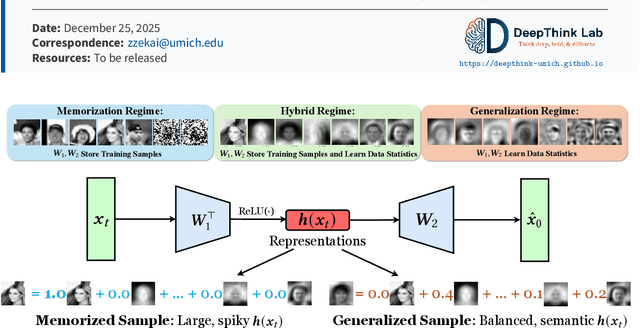
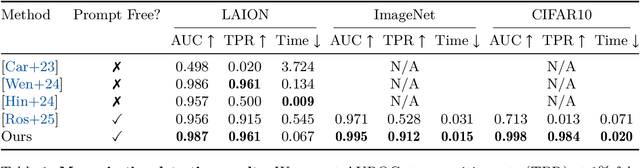
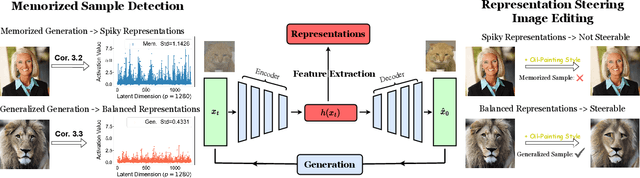
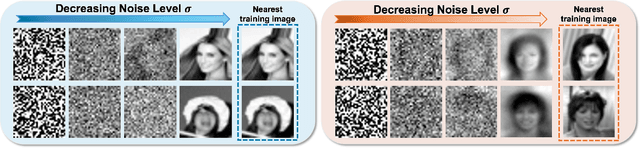
Diffusion models excel at generating high-quality, diverse samples, yet they risk memorizing training data when overfit to the training objective. We analyze the distinctions between memorization and generalization in diffusion models through the lens of representation learning. By investigating a two-layer ReLU denoising autoencoder (DAE), we prove that (i) memorization corresponds to the model storing raw training samples in the learned weights for encoding and decoding, yielding localized "spiky" representations, whereas (ii) generalization arises when the model captures local data statistics, producing "balanced" representations. Furthermore, we validate these theoretical findings on real-world unconditional and text-to-image diffusion models, demonstrating that the same representation structures emerge in deep generative models with significant practical implications. Building on these insights, we propose a representation-based method for detecting memorization and a training-free editing technique that allows precise control via representation steering. Together, our results highlight that learning good representations is central to novel and meaningful generative modeling.
Qwen-Image-Layered: Towards Inherent Editability via Layer Decomposition
Dec 17, 2025Recent visual generative models often struggle with consistency during image editing due to the entangled nature of raster images, where all visual content is fused into a single canvas. In contrast, professional design tools employ layered representations, allowing isolated edits while preserving consistency. Motivated by this, we propose \textbf{Qwen-Image-Layered}, an end-to-end diffusion model that decomposes a single RGB image into multiple semantically disentangled RGBA layers, enabling \textbf{inherent editability}, where each RGBA layer can be independently manipulated without affecting other content. To support variable-length decomposition, we introduce three key components: (1) an RGBA-VAE to unify the latent representations of RGB and RGBA images; (2) a VLD-MMDiT (Variable Layers Decomposition MMDiT) architecture capable of decomposing a variable number of image layers; and (3) a Multi-stage Training strategy to adapt a pretrained image generation model into a multilayer image decomposer. Furthermore, to address the scarcity of high-quality multilayer training images, we build a pipeline to extract and annotate multilayer images from Photoshop documents (PSD). Experiments demonstrate that our method significantly surpasses existing approaches in decomposition quality and establishes a new paradigm for consistent image editing. Our code and models are released on \href{https://github.com/QwenLM/Qwen-Image-Layered}{https://github.com/QwenLM/Qwen-Image-Layered}
ActiveVLN: Towards Active Exploration via Multi-Turn RL in Vision-and-Language Navigation
Sep 16, 2025The Vision-and-Language Navigation (VLN) task requires an agent to follow natural language instructions and navigate through complex environments. Existing MLLM-based VLN methods primarily rely on imitation learning (IL) and often use DAgger for post-training to mitigate covariate shift. While effective, these approaches incur substantial data collection and training costs. Reinforcement learning (RL) offers a promising alternative. However, prior VLN RL methods lack dynamic interaction with the environment and depend on expert trajectories for reward shaping, rather than engaging in open-ended active exploration. This restricts the agent's ability to discover diverse and plausible navigation routes. To address these limitations, we propose ActiveVLN, a VLN framework that explicitly enables active exploration through multi-turn RL. In the first stage, a small fraction of expert trajectories is used for IL to bootstrap the agent. In the second stage, the agent iteratively predicts and executes actions, automatically collects diverse trajectories, and optimizes multiple rollouts via the GRPO objective. To further improve RL efficiency, we introduce a dynamic early-stopping strategy to prune long-tail or likely failed trajectories, along with additional engineering optimizations. Experiments show that ActiveVLN achieves the largest performance gains over IL baselines compared to both DAgger-based and prior RL-based post-training methods, while reaching competitive performance with state-of-the-art approaches despite using a smaller model. Code and data will be released soon.
Understanding Generalization in Diffusion Models via Probability Flow Distance
May 26, 2025Diffusion models have emerged as a powerful class of generative models, capable of producing high-quality samples that generalize beyond the training data. However, evaluating this generalization remains challenging: theoretical metrics are often impractical for high-dimensional data, while no practical metrics rigorously measure generalization. In this work, we bridge this gap by introducing probability flow distance ($\texttt{PFD}$), a theoretically grounded and computationally efficient metric to measure distributional generalization. Specifically, $\texttt{PFD}$ quantifies the distance between distributions by comparing their noise-to-data mappings induced by the probability flow ODE. Moreover, by using $\texttt{PFD}$ under a teacher-student evaluation protocol, we empirically uncover several key generalization behaviors in diffusion models, including: (1) scaling behavior from memorization to generalization, (2) early learning and double descent training dynamics, and (3) bias-variance decomposition. Beyond these insights, our work lays a foundation for future empirical and theoretical studies on generalization in diffusion models.