 Add to Chrome
 Add to Firefox
 Add to Edge
From Chatbot to Digital Colleague: The Paradigm Shift Toward Persistent Autonomous AI
Jun 12, 2026
Large Language Models (LLMs) are undergoing a fundamental transformation from conversational generators into integrated AI systems capable of reasoning, action, memory, and self-improvement. We conceptualize this transition as a shift from Chatbot to Digital Colleague: from conversational answers to persistent work. We organize this transition along two tightly coupled dimensions. First, at the cognitive core level, LLMs are advancing from Chatbot-era "fast thinking" systems driven by next-token prediction toward Thinking LLMs that leverage inference-time computation, Chain-of-Thought reasoning, reflection, process supervision, and reinforcement learning to support more deliberate and reliable cognition. Second, at the tool-augmented task execution level, LLMs are progressing from tool-calling Agents that invoke external resources in an ad hoc manner toward OpenClaw-style workstation systems (OpenClaw) equipped with persistent Workspaces, skills, verification loops, and governance. The "Workspace + Skill" paradigm makes episodic tool use colleague-like via state persistence, reusable procedures, task closure, and experience reuse. We examine data construction shifts from instruction-response pairs to State-Action-Observation trajectories and evaluation from static benchmarks to sandboxed, auditable, self-evolving AI ecosystems.

MoG: Mixture of Experts for Graph-based Retrieval-Augmented Generation
May 29, 2026Retrieval-augmented generation is intensively studied to ground large language models on external evidence. However, retrieving from a unified knowledge base could inevitably introduce irrelevant information that may mislead generation for complex reasoning. Inspired by the conditional computation of mixture of experts (MoE), where a router sparsely selects specialized experts alongside shared ones for each input, we propose \textbf{M}ixture \textbf{o}f experts for \textbf{G}raph-based Retrieval-Augmented Generation, i.e., \textbf{MoG}. It organizes knowledge into two core components: (i) diverse, always-accessible hub graphs that encode semantically and structurally central knowledge and provide contextual clues for expert activation, and (ii) sparsely activated expert graphs that contain domain-specific evidence. MoG first accesses hub graphs to identify general evidence and derive contextual clues. Then, a topology-aware router dynamically activates a limited set of expert graphs conditioned on the query, thereby confining retrieval to a focused evidence subspace. Extensive experiments on challenging benchmarks show that MoG consistently outperforms strong baselines, with over 20\% relative improvement on MuSiQue. Our code is available in https://github.com/DEEP-PolyU/MoG.
Toward Native Multimodal Modeling: A Roadmap
May 25, 2026Multimodal modeling represents a vital step from modality-agnostic reasoning toward world modeling. While early approaches predominantly rely on late-fusion that assembles encoders and frozen language backbones with output heads, recent efforts have shifted the paradigm toward native multimodal modeling (NMM) with the intrinsic integration of modalities for superior multimodal performance. Despite its potential, the design space of native architectures remains insufficiently defined. In this paper, we present the community with a formalized roadmap for this transition. Specifically, we formally define the architectural nativity, distinguishing mid-fusion and early-fusion from non-native paradigms. We further organize the existing native models through the lens of input-output duality into three categories: (i) Multi-to-Text for cross-modal comprehension with text-only output; (ii) Multi-to-Target for scenario-oriented generation, e.g., image, audio and video generation, and (iii) Multi-to-Multi for unified modeling with symmetric input-output. We deliver a comprehensive and industrial-grade investigation into the transition toward the definitive NMM framework, where understanding and generation seamlessly coexist within a unified transformer paradigm. We systematically unpack the end-to-end pipeline from industrial perspectives from architectural coordination, massive data curation, to full-stack training recipes, inference & deployment, and the comprehensive evaluation for truly native modeling.
Deep Tabular Research via Continual Experience-Driven Execution
Mar 12, 2026Large language models often struggle with complex long-horizon analytical tasks over unstructured tables, which typically feature hierarchical and bidirectional headers and non-canonical layouts. We formalize this challenge as Deep Tabular Research (DTR), requiring multi-step reasoning over interdependent table regions. To address DTR, we propose a novel agentic framework that treats tabular reasoning as a closed-loop decision-making process. We carefully design a coupled query and table comprehension for path decision making and operational execution. Specifically, (i) DTR first constructs a hierarchical meta graph to capture bidirectional semantics, mapping natural language queries into an operation-level search space; (ii) To navigate this space, we introduce an expectation-aware selection policy that prioritizes high-utility execution paths; (iii) Crucially, historical execution outcomes are synthesized into a siamese structured memory, i.e., parameterized updates and abstracted texts, enabling continual refinement. Extensive experiments on challenging unstructured tabular benchmarks verify the effectiveness and highlight the necessity of separating strategic planning from low-level execution for long-horizon tabular reasoning.
ReMiT: RL-Guided Mid-Training for Iterative LLM Evolution
Feb 03, 2026Standard training pipelines for large language models (LLMs) are typically unidirectional, progressing from pre-training to post-training. However, the potential for a bidirectional process--where insights from post-training retroactively improve the pre-trained foundation--remains unexplored. We aim to establish a self-reinforcing flywheel: a cycle in which reinforcement learning (RL)-tuned model strengthens the base model, which in turn enhances subsequent post-training performance, requiring no specially trained teacher or reference model. To realize this, we analyze training dynamics and identify the mid-training (annealing) phase as a critical turning point for model capabilities. This phase typically occurs at the end of pre-training, utilizing high-quality corpora under a rapidly decaying learning rate. Building upon this insight, we introduce ReMiT (Reinforcement Learning-Guided Mid-Training). Specifically, ReMiT leverages the reasoning priors of RL-tuned models to dynamically reweight tokens during the mid-training phase, prioritizing those pivotal for reasoning. Empirically, ReMiT achieves an average improvement of 3\% on 10 pre-training benchmarks, spanning math, code, and general reasoning, and sustains these gains by over 2\% throughout the post-training pipeline. These results validate an iterative feedback loop, enabling continuous and self-reinforcing evolution of LLMs.
Youtu-VL: Unleashing Visual Potential via Unified Vision-Language Supervision
Jan 27, 2026Despite the significant advancements represented by Vision-Language Models (VLMs), current architectures often exhibit limitations in retaining fine-grained visual information, leading to coarse-grained multimodal comprehension. We attribute this deficiency to a suboptimal training paradigm inherent in prevailing VLMs, which exhibits a text-dominant optimization bias by conceptualizing visual signals merely as passive conditional inputs rather than supervisory targets. To mitigate this, we introduce Youtu-VL, a framework leveraging the Vision-Language Unified Autoregressive Supervision (VLUAS) paradigm, which fundamentally shifts the optimization objective from ``vision-as-input'' to ``vision-as-target.'' By integrating visual tokens directly into the prediction stream, Youtu-VL applies unified autoregressive supervision to both visual details and linguistic content. Furthermore, we extend this paradigm to encompass vision-centric tasks, enabling a standard VLM to perform vision-centric tasks without task-specific additions. Extensive empirical evaluations demonstrate that Youtu-VL achieves competitive performance on both general multimodal tasks and vision-centric tasks, establishing a robust foundation for the development of comprehensive generalist visual agents.
EvoConfig: Self-Evolving Multi-Agent Systems for Efficient Autonomous Environment Configuration
Jan 23, 2026A reliable executable environment is the foundation for ensuring that large language models solve software engineering tasks. Due to the complex and tedious construction process, large-scale configuration is relatively inefficient. However, most methods always overlook fine-grained analysis of the actions performed by the agent, making it difficult to handle complex errors and resulting in configuration failures. To address this bottleneck, we propose EvoConfig, an efficient environment configuration framework that optimizes multi-agent collaboration to build correct runtime environments. EvoConfig features an expert diagnosis module for fine-grained post-execution analysis, and a self-evolving mechanism that lets expert agents self-feedback and dynamically adjust error-fixing priorities in real time. Empirically, EvoConfig matches the previous state-of-the-art Repo2Run on Repo2Run's 420 repositories, while delivering clear gains on harder cases: on the more challenging Envbench, EvoConfig achieves a 78.1% success rate, outperforming Repo2Run by 7.1%. Beyond end-to-end success, EvoConfig also demonstrates stronger debugging competence, achieving higher accuracy in error identification and producing more effective repair recommendations than existing methods.
TangramPuzzle: Evaluating Multimodal Large Language Models with Compositional Spatial Reasoning
Jan 23, 2026Multimodal Large Language Models (MLLMs) have achieved remarkable progress in visual recognition and semantic understanding. Nevertheless, their ability to perform precise compositional spatial reasoning remains largely unexplored. Existing benchmarks often involve relatively simple tasks and rely on semantic approximations or coarse relative positioning, while their evaluation metrics are typically limited and lack rigorous mathematical formulations. To bridge this gap, we introduce TangramPuzzle, a geometry-grounded benchmark designed to evaluate compositional spatial reasoning through the lens of the classic Tangram game. We propose the Tangram Construction Expression (TCE), a symbolic geometric framework that grounds tangram assemblies in exact, machine-verifiable coordinate specifications, to mitigate the ambiguity of visual approximation. We design two complementary tasks: Outline Prediction, which demands inferring global shapes from local components, and End-to-End Code Generation, which requires solving inverse geometric assembly problems. We conduct extensive evaluation experiments on advanced open-source and proprietary models, revealing an interesting insight: MLLMs tend to prioritize matching the target silhouette while neglecting geometric constraints, leading to distortions or deformations of the pieces.
Youtu-LLM: Unlocking the Native Agentic Potential for Lightweight Large Language Models
Dec 31, 2025We introduce Youtu-LLM, a lightweight yet powerful language model that harmonizes high computational efficiency with native agentic intelligence. Unlike typical small models that rely on distillation, Youtu-LLM (1.96B) is pre-trained from scratch to systematically cultivate reasoning and planning capabilities. The key technical advancements are as follows: (1) Compact Architecture with Long-Context Support: Built on a dense Multi-Latent Attention (MLA) architecture with a novel STEM-oriented vocabulary, Youtu-LLM supports a 128k context window. This design enables robust long-context reasoning and state tracking within a minimal memory footprint, making it ideal for long-horizon agent and reasoning tasks. (2) Principled "Commonsense-STEM-Agent" Curriculum: We curated a massive corpus of approximately 11T tokens and implemented a multi-stage training strategy. By progressively shifting the pre-training data distribution from general commonsense to complex STEM and agentic tasks, we ensure the model acquires deep cognitive abilities rather than superficial alignment. (3) Scalable Agentic Mid-training: Specifically for the agentic mid-training, we employ diverse data construction schemes to synthesize rich and varied trajectories across math, coding, and tool-use domains. This high-quality data enables the model to internalize planning and reflection behaviors effectively. Extensive evaluations show that Youtu-LLM sets a new state-of-the-art for sub-2B LLMs. On general benchmarks, it achieves competitive performance against larger models, while on agent-specific tasks, it significantly surpasses existing SOTA baselines, demonstrating that lightweight models can possess strong intrinsic agentic capabilities.
Youtu-GraphRAG: Vertically Unified Agents for Graph Retrieval-Augmented Complex Reasoning
Aug 27, 2025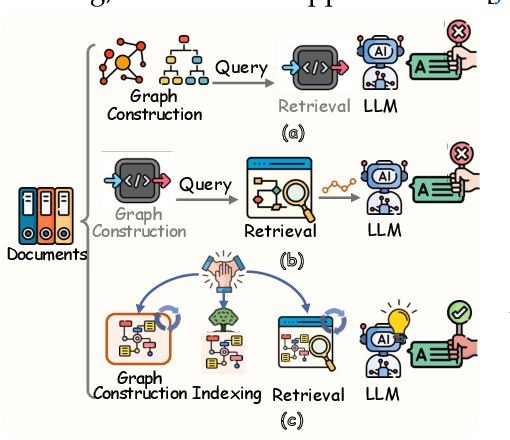
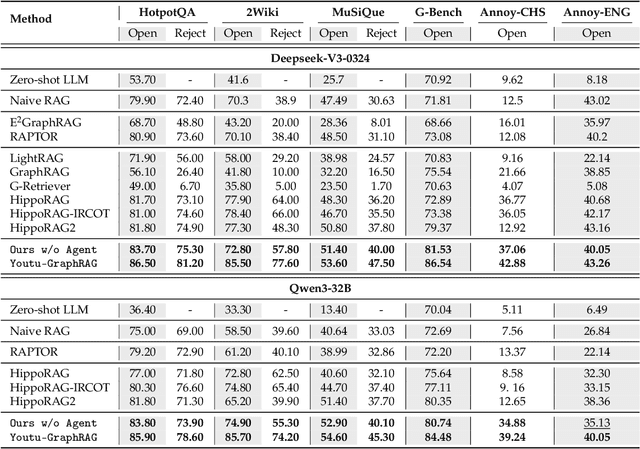

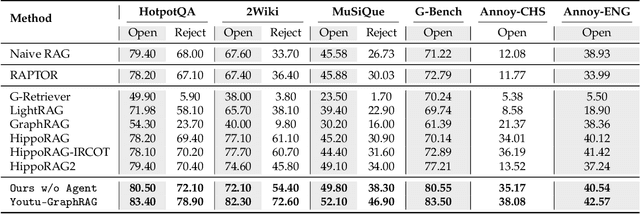
Graph retrieval-augmented generation (GraphRAG) has effectively enhanced large language models in complex reasoning by organizing fragmented knowledge into explicitly structured graphs. Prior efforts have been made to improve either graph construction or graph retrieval in isolation, yielding suboptimal performance, especially when domain shifts occur. In this paper, we propose a vertically unified agentic paradigm, Youtu-GraphRAG, to jointly connect the entire framework as an intricate integration. Specifically, (i) a seed graph schema is introduced to bound the automatic extraction agent with targeted entity types, relations and attribute types, also continuously expanded for scalability over unseen domains; (ii) To obtain higher-level knowledge upon the schema, we develop novel dually-perceived community detection, fusing structural topology with subgraph semantics for comprehensive knowledge organization. This naturally yields a hierarchical knowledge tree that supports both top-down filtering and bottom-up reasoning with community summaries; (iii) An agentic retriever is designed to interpret the same graph schema to transform complex queries into tractable and parallel sub-queries. It iteratively performs reflection for more advanced reasoning; (iv) To alleviate the knowledge leaking problem in pre-trained LLM, we propose a tailored anonymous dataset and a novel 'Anonymity Reversion' task that deeply measures the real performance of the GraphRAG frameworks. Extensive experiments across six challenging benchmarks demonstrate the robustness of Youtu-GraphRAG, remarkably moving the Pareto frontier with up to 90.71% saving of token costs and 16.62% higher accuracy over state-of-the-art baselines. The results indicate our adaptability, allowing seamless domain transfer with minimal intervention on schema.