 Add to Chrome
 Add to Firefox
 Add to Edge
EASy: Towards Efficient LLM-Based Agentic System
Aug 05, 2026
Agentic systems have emerged as a promising paradigm for solving complex tasks by coordinating specialized LLM-based agents. However, most existing systems primarily optimize task success while giving limited consideration to execution efficiency under practical constraints such as executor capability and computational cost. Existing router-based methods have limited ability to reason over rich, evolving task contexts, multi-step dependencies, and intermediate execution feedback, and often generalize poorly to unseen executors. We propose EASy, a trainable agentic framework that jointly optimizes task performance and computational efficiency through reinforcement learning. EASy equips an LLM-based orchestrator with explicit knowledge of the capability and cost profiles of heterogeneous executors, enabling context-sensitive coordination beyond performance-only routing. It further introduces a milestone-plan-act workflow that decomposes complex tasks into manageable milestones, constructs dependency-aware execution graphs, assigns suitable executors, and parallelizes independent steps while adapting subsequent decisions to intermediate outcomes. To train the orchestrator, we develop a tree-structured rollout procedure that explores alternative milestone decompositions and execution plans, together with multi-component rewards that capture task correctness, execution efficiency, and trajectory completeness. Extensive experiments on mathematical reasoning, embodied decision-making, and deep research benchmarks show that EASy consistently achieves stronger performance-efficiency trade-offs than strong agentic baselines.

TriAlign: Towards Universal Truth Consistency in Personalized LLM Alignment
Jun 01, 2026Personalized large language models adapt responses to users' preferences and social attributes, but can introduce substantial universal truth inconsistencies across social groups, where some groups systematically receive less accurate responses on objective tasks. Existing alignment methods either ignore personalization or mainly focus on subjective preference alignment, largely overlooking fairness and consistency in universal truths. To address this gap, we study Truth-Invariant Alignment (TIA), an alignment problem for personalized LLMs that aims to ensure universal truths remain consistent across social groups while preserving personalization. We propose TriAlign, the first offline multi-agent reinforcement learning (MARL) framework for TIA, where each social group is modeled as an agent interacting. TriAlign jointly optimizes universal truth accuracy, cross-group truth consistency, and personalization through a fairness-aware objective and an explicit inconsistency penalty. Experiments across diverse benchmarks demonstrate that TriAlign achieves a stronger balance among these three objectives than strong baselines, reducing universal truth disparities across social groups while improving both objective task performance and personalization quality.
MoG: Mixture of Experts for Graph-based Retrieval-Augmented Generation
May 29, 2026Retrieval-augmented generation is intensively studied to ground large language models on external evidence. However, retrieving from a unified knowledge base could inevitably introduce irrelevant information that may mislead generation for complex reasoning. Inspired by the conditional computation of mixture of experts (MoE), where a router sparsely selects specialized experts alongside shared ones for each input, we propose \textbf{M}ixture \textbf{o}f experts for \textbf{G}raph-based Retrieval-Augmented Generation, i.e., \textbf{MoG}. It organizes knowledge into two core components: (i) diverse, always-accessible hub graphs that encode semantically and structurally central knowledge and provide contextual clues for expert activation, and (ii) sparsely activated expert graphs that contain domain-specific evidence. MoG first accesses hub graphs to identify general evidence and derive contextual clues. Then, a topology-aware router dynamically activates a limited set of expert graphs conditioned on the query, thereby confining retrieval to a focused evidence subspace. Extensive experiments on challenging benchmarks show that MoG consistently outperforms strong baselines, with over 20\% relative improvement on MuSiQue. Our code is available in https://github.com/DEEP-PolyU/MoG.
MATO: Multi-objective Personalized Alignment with Test-time Optimization for Large Language Models
May 25, 2026Aligning large language models (LLMs) with diverse and multifaceted user preferences is a fundamental challenge in personalized AI systems. Existing multi-objective alignment methods either rely on costly training or require pre-trained reward models for each preference, making it difficult for them to adapt to evolving preferences. Prompt-based personalization offers a training-free alternative, but prompting alone often provides limited steerability, as LLMs may overemphasize or overlook certain preferences and fail to give users reliable control over the relative importance of different objectives when conflicts arise, leading to suboptimal alignment. In this paper, we introduce MATO, a training-free framework for Multi-objective personalized Alignment with Test-time Optimization. MATO formulates personalization as a test-time optimization problem that steers the relative importance of multiple objectives through controllable weights during decoding, without modifying model parameters or requiring external reward models. Specifically, a reward discovery module recovers preference rewards directly from the backbone LLM for diverse objectives specified in natural language, while a weight optimization module dynamically adjusts objective weights based on the user's initial preferences and the partially generated response to balance competing objectives during generation. The resulting rewards and weights jointly guide an online optimization procedure over the token distribution, enabling better alignment with the target objectives. Extensive experiments across multiple datasets and backbone LLMs show that MATO consistently outperforms strong baselines, achieving Pareto-improving multi-objective alignment and stronger steerability. These results highlight test-time optimization as a promising direction for scalable, controllable, and model-agnostic personalized alignment.
Toward Native Multimodal Modeling: A Roadmap
May 25, 2026Multimodal modeling represents a vital step from modality-agnostic reasoning toward world modeling. While early approaches predominantly rely on late-fusion that assembles encoders and frozen language backbones with output heads, recent efforts have shifted the paradigm toward native multimodal modeling (NMM) with the intrinsic integration of modalities for superior multimodal performance. Despite its potential, the design space of native architectures remains insufficiently defined. In this paper, we present the community with a formalized roadmap for this transition. Specifically, we formally define the architectural nativity, distinguishing mid-fusion and early-fusion from non-native paradigms. We further organize the existing native models through the lens of input-output duality into three categories: (i) Multi-to-Text for cross-modal comprehension with text-only output; (ii) Multi-to-Target for scenario-oriented generation, e.g., image, audio and video generation, and (iii) Multi-to-Multi for unified modeling with symmetric input-output. We deliver a comprehensive and industrial-grade investigation into the transition toward the definitive NMM framework, where understanding and generation seamlessly coexist within a unified transformer paradigm. We systematically unpack the end-to-end pipeline from industrial perspectives from architectural coordination, massive data curation, to full-stack training recipes, inference & deployment, and the comprehensive evaluation for truly native modeling.
EviCare: Enhancing Diagnosis Prediction with Deep Model-Guided Evidence for In-Context Reasoning
Apr 12, 2026Recent advances in large language models (LLMs) have enabled promising progress in diagnosis prediction from electronic health records (EHRs). However, existing LLM-based approaches tend to overfit to historically observed diagnoses, often overlooking novel yet clinically important conditions that are critical for early intervention. To address this, we propose EviCare, an in-context reasoning framework that integrates deep model guidance into LLM-based diagnosis prediction. Rather than prompting LLMs directly with raw EHR inputs, EviCare performs (1) deep model inference for candidate selection, (2) evidential prioritization for set-based EHRs, and (3) relational evidence construction for novel diagnosis prediction. These signals are then composed into an adaptive in-context prompt to guide LLM reasoning in an accurate and interpretable manner. Extensive experiments on two real-world EHR benchmarks (MIMIC-III and MIMIC-IV) demonstrate that EviCare achieves significant performance gains, which consistently outperforms both LLM-only and deep model-only baselines by an average of 20.65\% across precision and accuracy metrics. The improvements are particularly notable in challenging novel diagnosis prediction, yielding average improvements of 30.97\%.
CARD: Towards Conditional Design of Multi-agent Topological Structures
Mar 01, 2026Large language model (LLM)-based multi-agent systems have shown strong capabilities in tasks such as code generation and collaborative reasoning. However, the effectiveness and robustness of these systems critically depend on their communication topology, which is often fixed or statically learned, ignoring real-world dynamics such as model upgrades, API (or tool) changes, or knowledge source variability. To address this limitation, we propose CARD (Conditional Agentic Graph Designer), a conditional graph-generation framework that instantiates AMACP, a protocol for adaptive multi-agent communication. CARD explicitly incorporates dynamic environmental signals into graph construction, enabling topology adaptation at both training and runtime. Through a conditional variational graph encoder and environment-aware optimization, CARD produces communication structures that are both effective and resilient to shifts in model capability or resource availability. Empirical results on HumanEval, MATH, and MMLU demonstrate that CARD consistently outperforms static and prompt-based baselines, achieving higher accuracy and robustness across diverse conditions. The source code is available at: https://github.com/Warma10032/CARD.
Youtu-GraphRAG: Vertically Unified Agents for Graph Retrieval-Augmented Complex Reasoning
Aug 27, 2025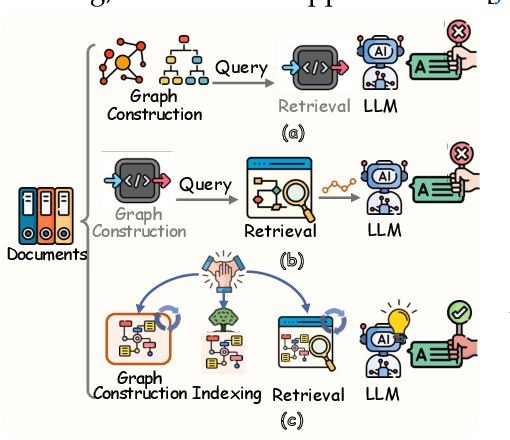
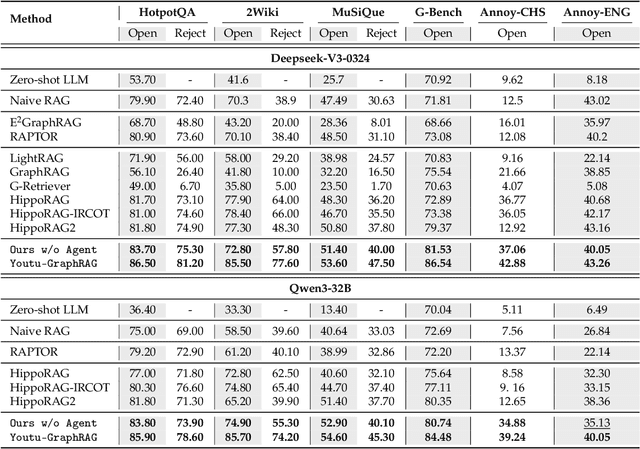

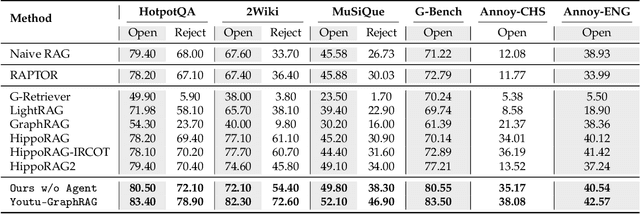
Graph retrieval-augmented generation (GraphRAG) has effectively enhanced large language models in complex reasoning by organizing fragmented knowledge into explicitly structured graphs. Prior efforts have been made to improve either graph construction or graph retrieval in isolation, yielding suboptimal performance, especially when domain shifts occur. In this paper, we propose a vertically unified agentic paradigm, Youtu-GraphRAG, to jointly connect the entire framework as an intricate integration. Specifically, (i) a seed graph schema is introduced to bound the automatic extraction agent with targeted entity types, relations and attribute types, also continuously expanded for scalability over unseen domains; (ii) To obtain higher-level knowledge upon the schema, we develop novel dually-perceived community detection, fusing structural topology with subgraph semantics for comprehensive knowledge organization. This naturally yields a hierarchical knowledge tree that supports both top-down filtering and bottom-up reasoning with community summaries; (iii) An agentic retriever is designed to interpret the same graph schema to transform complex queries into tractable and parallel sub-queries. It iteratively performs reflection for more advanced reasoning; (iv) To alleviate the knowledge leaking problem in pre-trained LLM, we propose a tailored anonymous dataset and a novel 'Anonymity Reversion' task that deeply measures the real performance of the GraphRAG frameworks. Extensive experiments across six challenging benchmarks demonstrate the robustness of Youtu-GraphRAG, remarkably moving the Pareto frontier with up to 90.71% saving of token costs and 16.62% higher accuracy over state-of-the-art baselines. The results indicate our adaptability, allowing seamless domain transfer with minimal intervention on schema.
SituatedThinker: Grounding LLM Reasoning with Real-World through Situated Thinking
May 25, 2025Recent advances in large language models (LLMs) demonstrate their impressive reasoning capabilities. However, the reasoning confined to internal parametric space limits LLMs' access to real-time information and understanding of the physical world. To overcome this constraint, we introduce SituatedThinker, a novel framework that enables LLMs to ground their reasoning in real-world contexts through situated thinking, which adaptively combines both internal knowledge and external information with predefined interfaces. By utilizing reinforcement learning, SituatedThinker incentivizes deliberate reasoning with the real world to acquire information and feedback, allowing LLMs to surpass their knowledge boundaries and enhance reasoning. Experimental results demonstrate significant performance improvements on multi-hop question-answering and mathematical reasoning benchmarks. Furthermore, SituatedThinker demonstrates strong performance on unseen tasks, such as KBQA, TableQA, and text-based games, showcasing the generalizable real-world grounded reasoning capability. Our codes are available at https://github.com/jnanliu/SituatedThinker.
Graph Retrieval-Augmented LLM for Conversational Recommendation Systems
Mar 09, 2025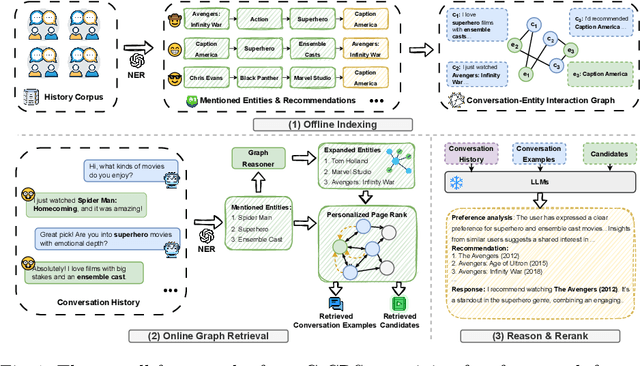
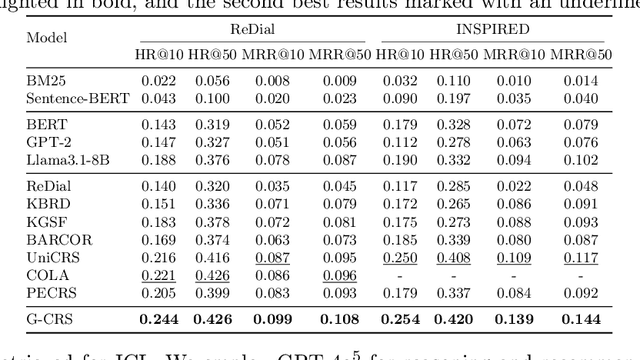
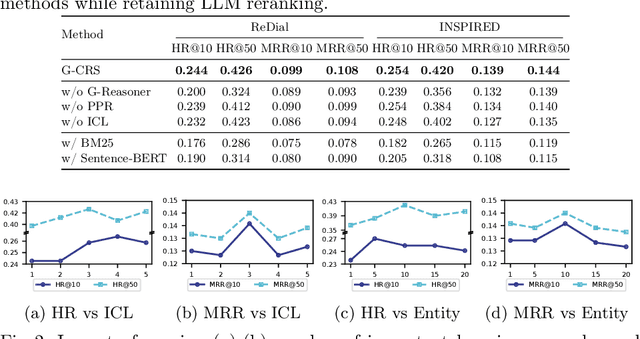
Conversational Recommender Systems (CRSs) have emerged as a transformative paradigm for offering personalized recommendations through natural language dialogue. However, they face challenges with knowledge sparsity, as users often provide brief, incomplete preference statements. While recent methods have integrated external knowledge sources to mitigate this, they still struggle with semantic understanding and complex preference reasoning. Recent Large Language Models (LLMs) demonstrate promising capabilities in natural language understanding and reasoning, showing significant potential for CRSs. Nevertheless, due to the lack of domain knowledge, existing LLM-based CRSs either produce hallucinated recommendations or demand expensive domain-specific training, which largely limits their applicability. In this work, we present G-CRS (Graph Retrieval-Augmented Large Language Model for Conversational Recommender Systems), a novel training-free framework that combines graph retrieval-augmented generation and in-context learning to enhance LLMs' recommendation capabilities. Specifically, G-CRS employs a two-stage retrieve-and-recommend architecture, where a GNN-based graph reasoner first identifies candidate items, followed by Personalized PageRank exploration to jointly discover potential items and similar user interactions. These retrieved contexts are then transformed into structured prompts for LLM reasoning, enabling contextually grounded recommendations without task-specific training. Extensive experiments on two public datasets show that G-CRS achieves superior recommendation performance compared to existing methods without requiring task-specific training.