 Add to Chrome
 Add to Firefox
 Add to Edge
VideoRefer Suite: Advancing Spatial-Temporal Object Understanding with Video LLM
Jan 08, 2025
Video Large Language Models (Video LLMs) have recently exhibited remarkable capabilities in general video understanding. However, they mainly focus on holistic comprehension and struggle with capturing fine-grained spatial and temporal details. Besides, the lack of high-quality object-level video instruction data and a comprehensive benchmark further hinders their advancements. To tackle these challenges, we introduce the VideoRefer Suite to empower Video LLM for finer-level spatial-temporal video understanding, i.e., enabling perception and reasoning on any objects throughout the video. Specially, we thoroughly develop VideoRefer Suite across three essential aspects: dataset, model, and benchmark. Firstly, we introduce a multi-agent data engine to meticulously curate a large-scale, high-quality object-level video instruction dataset, termed VideoRefer-700K. Next, we present the VideoRefer model, which equips a versatile spatial-temporal object encoder to capture precise regional and sequential representations. Finally, we meticulously create a VideoRefer-Bench to comprehensively assess the spatial-temporal understanding capability of a Video LLM, evaluating it across various aspects. Extensive experiments and analyses demonstrate that our VideoRefer model not only achieves promising performance on video referring benchmarks but also facilitates general video understanding capabilities.

Enhancing LLM Reasoning with Multi-Path Collaborative Reactive and Reflection agents
Jan 03, 2025


Agents have demonstrated their potential in scientific reasoning tasks through large language models. However, they often face challenges such as insufficient accuracy and degeneration of thought when handling complex reasoning tasks, which impede their performance. To overcome these issues, we propose the Reactive and Reflection agents with Multi-Path Reasoning (RR-MP) Framework, aimed at enhancing the reasoning capabilities of LLMs. Our approach improves scientific reasoning accuracy by employing a multi-path reasoning mechanism where each path consists of a reactive agent and a reflection agent that collaborate to prevent degeneration of thought inherent in single-agent reliance. Additionally, the RR-MP framework does not require additional training; it utilizes multiple dialogue instances for each reasoning path and a separate summarizer to consolidate insights from all paths. This design integrates diverse perspectives and strengthens reasoning across each path. We conducted zero-shot and few-shot evaluations on tasks involving moral scenarios, college-level physics, and mathematics. Experimental results demonstrate that our method outperforms baseline approaches, highlighting the effectiveness and advantages of the RR-MP framework in managing complex scientific reasoning tasks.
2.5 Years in Class: A Multimodal Textbook for Vision-Language Pretraining
Jan 03, 2025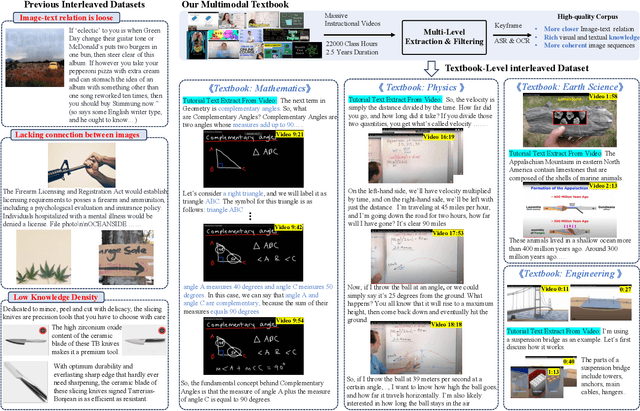
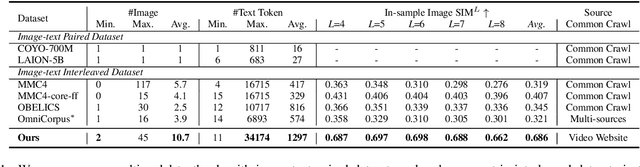
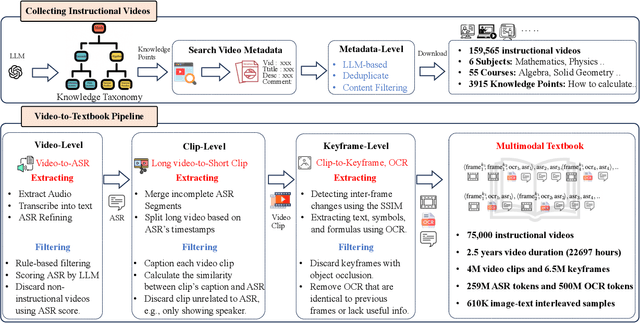

Compared to image-text pair data, interleaved corpora enable Vision-Language Models (VLMs) to understand the world more naturally like humans. However, such existing datasets are crawled from webpage, facing challenges like low knowledge density, loose image-text relations, and poor logical coherence between images. On the other hand, the internet hosts vast instructional videos (e.g., online geometry courses) that are widely used by humans to learn foundational subjects, yet these valuable resources remain underexplored in VLM training. In this paper, we introduce a high-quality \textbf{multimodal textbook} corpus with richer foundational knowledge for VLM pretraining. It collects over 2.5 years of instructional videos, totaling 22,000 class hours. We first use an LLM-proposed taxonomy to systematically gather instructional videos. Then we progressively extract and refine visual (keyframes), audio (ASR), and textual knowledge (OCR) from the videos, and organize as an image-text interleaved corpus based on temporal order. Compared to its counterparts, our video-centric textbook offers more coherent context, richer knowledge, and better image-text alignment. Experiments demonstrate its superb pretraining performance, particularly in knowledge- and reasoning-intensive tasks like ScienceQA and MathVista. Moreover, VLMs pre-trained on our textbook exhibit outstanding interleaved context awareness, leveraging visual and textual cues in their few-shot context for task solving~\footnote{Our code are available at \url{https://github.com/DAMO-NLP-SG/multimodal_textbook}}.
Enhancing Table Recognition with Vision LLMs: A Benchmark and Neighbor-Guided Toolchain Reasoner
Dec 30, 2024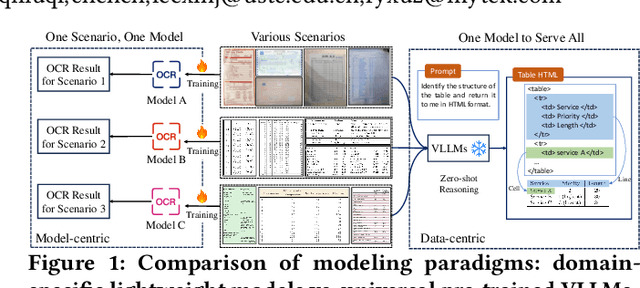


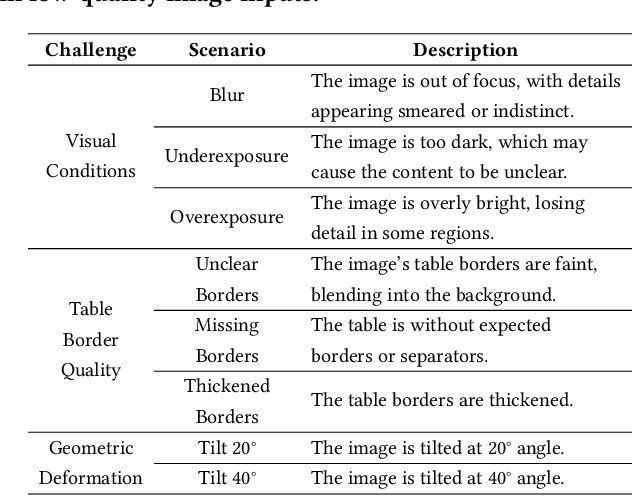
Pre-trained foundation models have recently significantly progressed in structured table understanding and reasoning. However, despite advancements in areas such as table semantic understanding and table question answering, recognizing the structure and content of unstructured tables using Vision Large Language Models (VLLMs) remains under-explored. In this work, we address this research gap by employing VLLMs in a training-free reasoning paradigm. First, we design a benchmark with various hierarchical dimensions relevant to table recognition. Subsequently, we conduct in-depth evaluations using pre-trained VLLMs, finding that low-quality image input is a significant bottleneck in the recognition process. Drawing inspiration from these findings, we propose the Neighbor-Guided Toolchain Reasoner (NGTR) framework, which is characterized by integrating multiple lightweight models for low-level visual processing operations aimed at mitigating issues with low-quality input images. Specifically, we utilize a neighbor retrieval mechanism to guide the generation of multiple tool invocation plans, transferring tool selection experiences from similar neighbors to the given input, thereby facilitating suitable tool selection. Additionally, we introduce a reflection module to supervise the tool invocation process. Extensive experiments on public table recognition datasets demonstrate that our approach significantly enhances the recognition capabilities of the vanilla VLLMs. We believe that the designed benchmark and the proposed NGTR framework could provide an alternative solution in table recognition.
ERVD: An Efficient and Robust ViT-Based Distillation Framework for Remote Sensing Image Retrieval
Dec 24, 2024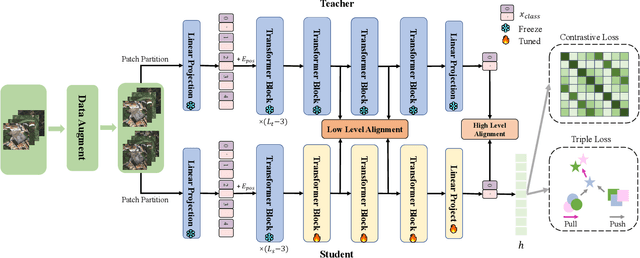
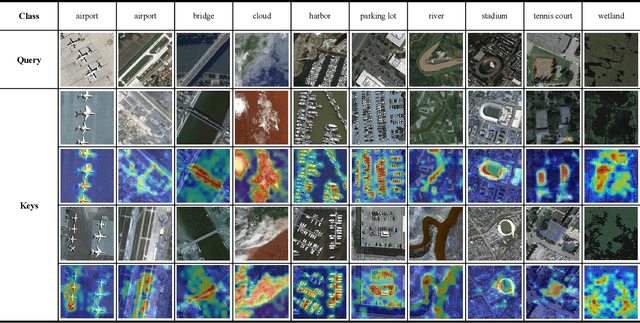
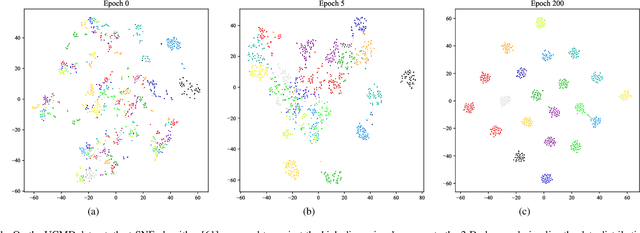
ERVD: An Efficient and Robust ViT-Based Distillation Framework for Remote Sensing Image Retrieval
SolidGS: Consolidating Gaussian Surfel Splatting for Sparse-View Surface Reconstruction
Dec 19, 2024

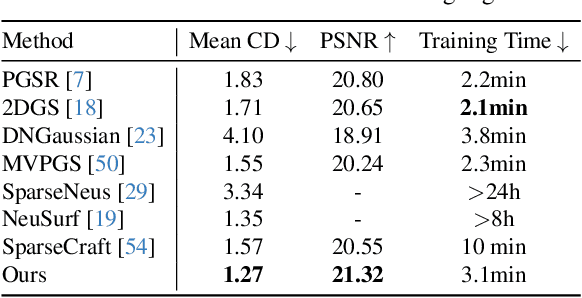
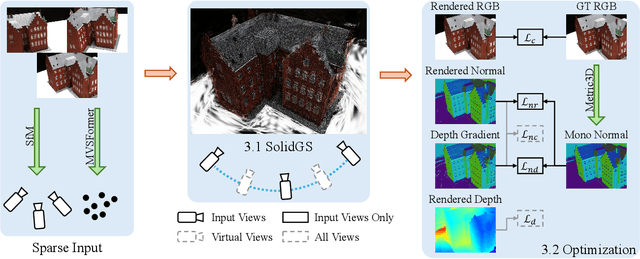
Gaussian splatting has achieved impressive improvements for both novel-view synthesis and surface reconstruction from multi-view images. However, current methods still struggle to reconstruct high-quality surfaces from only sparse view input images using Gaussian splatting. In this paper, we propose a novel method called SolidGS to address this problem. We observed that the reconstructed geometry can be severely inconsistent across multi-views, due to the property of Gaussian function in geometry rendering. This motivates us to consolidate all Gaussians by adopting a more solid kernel function, which effectively improves the surface reconstruction quality. With the additional help of geometrical regularization and monocular normal estimation, our method achieves superior performance on the sparse view surface reconstruction than all the Gaussian splatting methods and neural field methods on the widely used DTU, Tanks-and-Temples, and LLFF datasets.
Adversarially robust generalization theory via Jacobian regularization for deep neural networks
Dec 17, 2024Powerful deep neural networks are vulnerable to adversarial attacks. To obtain adversarially robust models, researchers have separately developed adversarial training and Jacobian regularization techniques. There are abundant theoretical and empirical studies for adversarial training, but theoretical foundations for Jacobian regularization are still lacking. In this study, we show that Jacobian regularization is closely related to adversarial training in that $\ell_{2}$ or $\ell_{1}$ Jacobian regularized loss serves as an approximate upper bound on the adversarially robust loss under $\ell_{2}$ or $\ell_{\infty}$ adversarial attack respectively. Further, we establish the robust generalization gap for Jacobian regularized risk minimizer via bounding the Rademacher complexity of both the standard loss function class and Jacobian regularization function class. Our theoretical results indicate that the norms of Jacobian are related to both standard and robust generalization. We also perform experiments on MNIST data classification to demonstrate that Jacobian regularized risk minimization indeed serves as a surrogate for adversarially robust risk minimization, and that reducing the norms of Jacobian can improve both standard and robust generalization. This study promotes both theoretical and empirical understandings to adversarially robust generalization via Jacobian regularization.
RemoteTrimmer: Adaptive Structural Pruning for Remote Sensing Image Classification
Dec 17, 2024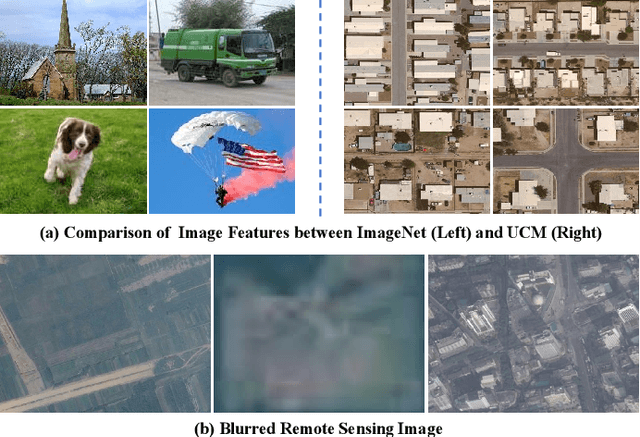
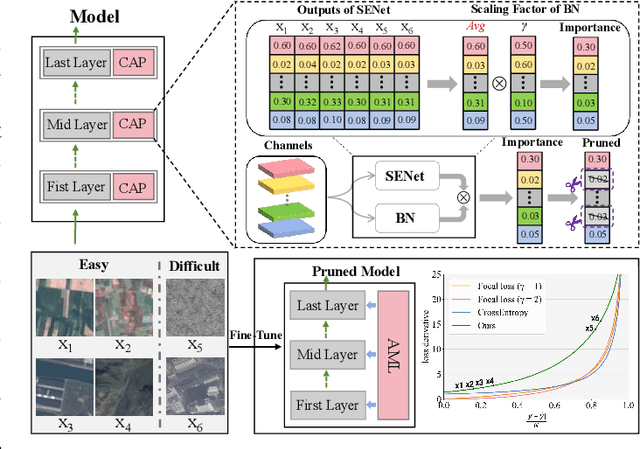
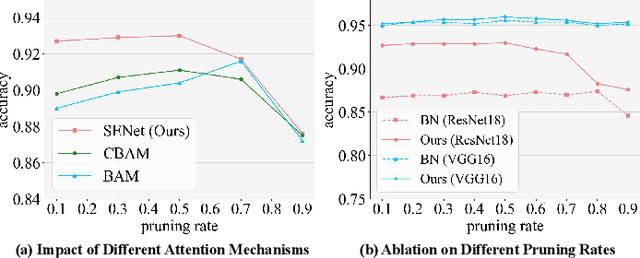
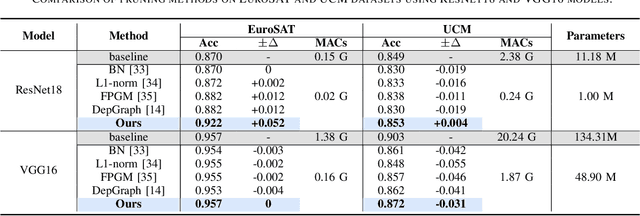
Since high resolution remote sensing image classification often requires a relatively high computation complexity, lightweight models tend to be practical and efficient. Model pruning is an effective method for model compression. However, existing methods rarely take into account the specificity of remote sensing images, resulting in significant accuracy loss after pruning. To this end, we propose an effective structural pruning approach for remote sensing image classification. Specifically, a pruning strategy that amplifies the differences in channel importance of the model is introduced. Then an adaptive mining loss function is designed for the fine-tuning process of the pruned model. Finally, we conducted experiments on two remote sensing classification datasets. The experimental results demonstrate that our method achieves minimal accuracy loss after compressing remote sensing classification models, achieving state-of-the-art (SoTA) performance.
Look Ahead Text Understanding and LLM Stitching
Dec 16, 2024This paper proposes a look ahead text understanding problem with look ahead section identification (LASI) as an example. This problem may appear in generative AI as well as human interactions, where we want to understand the direction of a developing text or conversation. We tackle the problem using transformer-based LLMs. We show that LASI is more challenging than classic section identification (SI). We argue that both bidirectional contextual information (e.g., BERT) and unidirectional predictive ability (e.g., GPT) will benefit the task. We propose two approaches to stitch together BERT and GPT. Experiments show that our approach outperforms the established models, especially when there is noise in the text (which is often the case for developing text in generative AI). Our paper sheds light on other look ahead text understanding tasks that are important to social media, such as look ahead sentiment classification, and points out the opportunities to leverage pre-trained LLMs through stitching.
* 9 pages, 6 figures, 4 tables, published in Vol. 18 (2024): Proceedings of the Eighteenth International AAAI Conference on Web and Social Media
AURORA: Automated Unleash of 3D Room Outlines for VR Applications
Dec 15, 2024Creating realistic VR experiences is challenging due to the labor-intensive process of accurately replicating real-world details into virtual scenes, highlighting the need for automated methods that maintain spatial accuracy and provide design flexibility. In this paper, we propose AURORA, a novel method that leverages RGB-D images to automatically generate both purely virtual reality (VR) scenes and VR scenes combined with real-world elements. This approach can benefit designers by streamlining the process of converting real-world details into virtual scenes. AURORA integrates advanced techniques in image processing, segmentation, and 3D reconstruction to efficiently create realistic and detailed interior designs from real-world environments. The design of this integration ensures optimal performance and precision, addressing key challenges in automated indoor design generation by uniquely combining and leveraging the strengths of foundation models. We demonstrate the effectiveness of our approach through experiments, both on self-captured data and public datasets, showcasing its potential to enhance virtual reality (VR) applications by providing interior designs that conform to real-world positioning.