 Add to Chrome
 Add to Firefox
 Add to Edge
Generative Embedding Benchmark: How Much Information Survives in a Dense Embedding?
Aug 07, 2026
Embeddings have emerged as a standard representational interface linking foundation models with downstream systems. Most embedding benchmarks assess representations through discriminative tasks or geometric criteria centered on separability in embedding space. However, strong performance on such evaluations does not establish whether content compressed into an embedding remains accessible to a downstream generator. To address this gap, we introduce the Generative Embedding Benchmark (GEB), in which a decoder answers questions using only a frozen embedding and question text, without access to the original image or intermediate visual features. Answer quality under this readout measures generative information: the answer-relevant content recoverable from an embedding. GEB includes a curated visual-question-answering dataset with a 1,800-item development split and a held-out 900-item test split covering natural images, scene text, and visual documents. Using a common decoder and training recipe, we evaluate seven public embedding models in visual-only and vision-language joint modes. On the test set, visual-only scores range from 28.25 to 33.21; with image-question joint encoding, all five VLM-based embedding models score higher, and the best reaches 65.56. Matched embeddings also outperform text-only inputs, zero embeddings, and shuffled embeddings. Natural-image information is much easier to recover than scene text or visual-document information, while a Qwen3-VL-2B reference with access to the original image reaches 84.30. Together, these results show that generative readout exposes information bottlenecks that separability-based evaluation does not capture.

LaME: Learning to Think in Latent Space for Multimodal Embedding via Information Bottleneck
Jun 11, 2026Reasoning-driven universal multimodal embedding has advanced rapidly by introducing Chain-of-Thought (CoT) reasoning into the embedding pipeline. Despite the strong performance across both general and complex tasks, this paradigm suffers from two core limitations: (i) autoregressive CoT reasoning incurs high computational cost, making it impractical for low-latency retrieval; and (ii) embedding performance is heavily coupled with CoT annotation quality, making large-scale training unreliable. These raise fundamental questions: Is textual CoT the optimal form of reasoning for embedding, and can effective embedding reasoning be accomplished in latent space? To this end, we propose LaME (Latent Reasoning Multimodal Embedding), which formulates embedding-oriented latent reasoning as a weakly supervised information bottleneck. LaME employs K learnable reason tokens as a fixed-capacity bottleneck, completing all reasoning within a single forward pass. The two weak supervision signals structurally decouple contrastive from autoregressive objectives and eliminate dependence on CoT annotations, while a two-stage training pipeline ensures stable convergence. Experiments on MMEB-v2 and MRMR show that LaME achieves competitive performance, surpassing some explicit CoT-based models, while delivering 60x faster inference than explicit CoT methods and 2x faster than latent baselines with throughput comparable to discriminative embedding models. Code will be released.
Beyond Chain-of-Thought: Rewrite as a Universal Interface for Generative Multimodal Embeddings
Apr 24, 2026Multimodal Large Language Models (MLLMs) have emerged as a promising foundation for universal multimodal embeddings. Recent studies have shown that reasoning-driven generative multimodal embeddings can outperform discriminative embeddings on several embedding tasks. However, Chain-of-Thought (CoT) reasoning tends to generate redundant thinking steps and introduce semantic ambiguity in the summarized answers in broader retrieval scenarios. To address this limitation, we propose Rewrite-driven Multimodal Embedding (RIME), a unified framework that jointly optimizes generation and embedding through a retrieval-friendly rewrite. Meanwhile, we present the Cross-Mode Alignment (CMA) to bridge the generative and discriminative embedding spaces, enabling flexible mutual retrieval to trade off efficiency and accuracy. Based on this, we also introduce Refine Reinforcement Learning (Refine-RL) that treats discriminative embeddings as stable semantic anchors to guide the rewrite optimization. Extensive experiments on MMEB-V2, MRMR and UVRB demonstrate that RIME substantially outperforms prior generative embedding models while significantly reducing the length of thinking.
AdaMem: Adaptive User-Centric Memory for Long-Horizon Dialogue Agents
Mar 17, 2026Large language model (LLM) agents increasingly rely on external memory to support long-horizon interaction, personalized assistance, and multi-step reasoning. However, existing memory systems still face three core challenges: they often rely too heavily on semantic similarity, which can miss evidence crucial for user-centric understanding; they frequently store related experiences as isolated fragments, weakening temporal and causal coherence; and they typically use static memory granularities that do not adapt well to the requirements of different questions. We propose AdaMem, an adaptive user-centric memory framework for long-horizon dialogue agents. AdaMem organizes dialogue history into working, episodic, persona, and graph memories, enabling the system to preserve recent context, structured long-term experiences, stable user traits, and relation-aware connections within a unified framework. At inference time, AdaMem first resolves the target participant, then builds a question-conditioned retrieval route that combines semantic retrieval with relation-aware graph expansion only when needed, and finally produces the answer through a role-specialized pipeline for evidence synthesis and response generation. We evaluate AdaMem on the LoCoMo and PERSONAMEM benchmarks for long-horizon reasoning and user modeling. Experimental results show that AdaMem achieves state-of-the-art performance on both benchmarks. The code will be released upon acceptance.
RiO-DETR: DETR for Real-time Oriented Object Detection
Mar 10, 2026We present RiO-DETR: DETR for Real-time Oriented Object Detection, the first real-time oriented detection transformer to the best of our knowledge. Adapting DETR to oriented bounding boxes (OBBs) poses three challenges: semantics-dependent orientation, angle periodicity that breaks standard Euclidean refinement, and an enlarged search space that slows convergence. RiO-DETR resolves these issues with task-native designs while preserving real-time efficiency. First, we propose Content-Driven Angle Estimation by decoupling angle from positional queries, together with Rotation-Rectified Orthogonal Attention to capture complementary cues for reliable orientation. Second, Decoupled Periodic Refinement combines bounded coarse-to-fine updates with a Shortest-Path Periodic Loss for stable learning across angular seams. Third, Oriented Dense O2O injects angular diversity into dense supervision to speed up angle convergence at no extra cost. Extensive experiments on DOTA-1.0, DIOR-R, and FAIR-1M-2.0 demonstrate RiO-DETR establishes a new speed--accuracy trade-off for real-time oriented detection. Code will be made publicly available.
SVL: Spike-based Vision-language Pretraining for Efficient 3D Open-world Understanding
May 23, 2025Spiking Neural Networks (SNNs) provide an energy-efficient way to extract 3D spatio-temporal features. However, existing SNNs still exhibit a significant performance gap compared to Artificial Neural Networks (ANNs) due to inadequate pre-training strategies. These limitations manifest as restricted generalization ability, task specificity, and a lack of multimodal understanding, particularly in challenging tasks such as multimodal question answering and zero-shot 3D classification. To overcome these challenges, we propose a Spike-based Vision-Language (SVL) pretraining framework that empowers SNNs with open-world 3D understanding while maintaining spike-driven efficiency. SVL introduces two key components: (i) Multi-scale Triple Alignment (MTA) for label-free triplet-based contrastive learning across 3D, image, and text modalities, and (ii) Re-parameterizable Vision-Language Integration (Rep-VLI) to enable lightweight inference without relying on large text encoders. Extensive experiments show that SVL achieves a top-1 accuracy of 85.4% in zero-shot 3D classification, surpassing advanced ANN models, and consistently outperforms prior SNNs on downstream tasks, including 3D classification (+6.1%), DVS action recognition (+2.1%), 3D detection (+1.1%), and 3D segmentation (+2.1%) with remarkable efficiency. Moreover, SVL enables SNNs to perform open-world 3D question answering, sometimes outperforming ANNs. To the best of our knowledge, SVL represents the first scalable, generalizable, and hardware-friendly paradigm for 3D open-world understanding, effectively bridging the gap between SNNs and ANNs in complex open-world understanding tasks. Code is available https://github.com/bollossom/SVL.
Dome-DETR: DETR with Density-Oriented Feature-Query Manipulation for Efficient Tiny Object Detection
May 09, 2025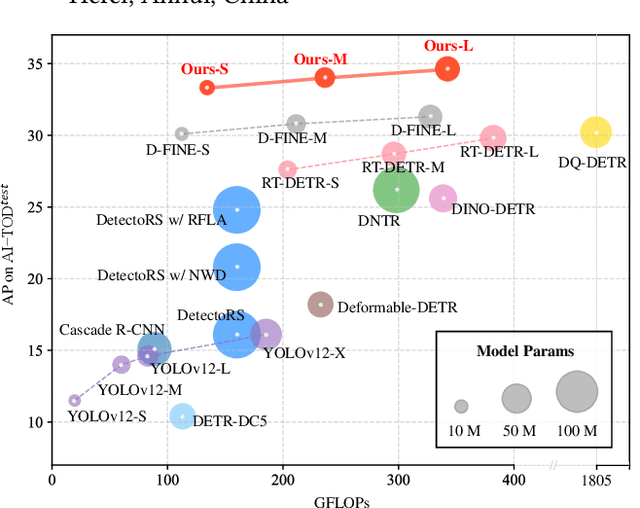
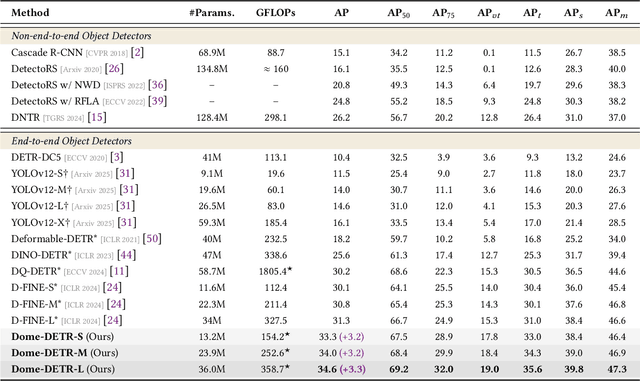
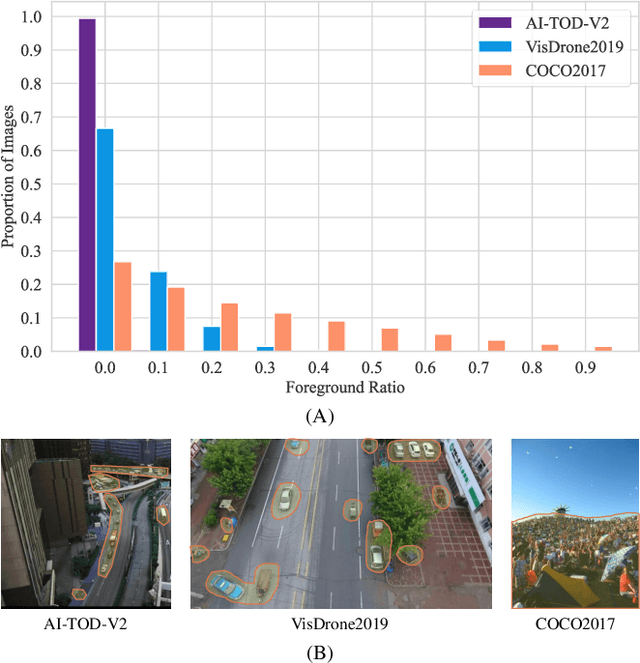
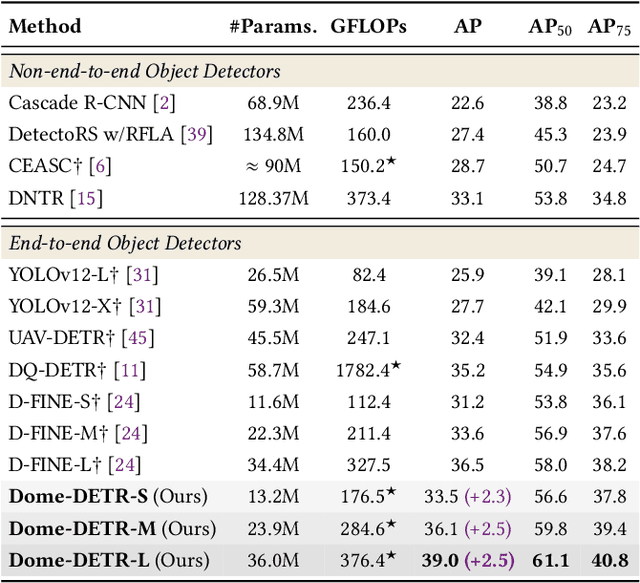
Tiny object detection plays a vital role in drone surveillance, remote sensing, and autonomous systems, enabling the identification of small targets across vast landscapes. However, existing methods suffer from inefficient feature leverage and high computational costs due to redundant feature processing and rigid query allocation. To address these challenges, we propose Dome-DETR, a novel framework with Density-Oriented Feature-Query Manipulation for Efficient Tiny Object Detection. To reduce feature redundancies, we introduce a lightweight Density-Focal Extractor (DeFE) to produce clustered compact foreground masks. Leveraging these masks, we incorporate Masked Window Attention Sparsification (MWAS) to focus computational resources on the most informative regions via sparse attention. Besides, we propose Progressive Adaptive Query Initialization (PAQI), which adaptively modulates query density across spatial areas for better query allocation. Extensive experiments demonstrate that Dome-DETR achieves state-of-the-art performance (+3.3 AP on AI-TOD-V2 and +2.5 AP on VisDrone) while maintaining low computational complexity and a compact model size. Code will be released upon acceptance.
Efficient Spiking Point Mamba for Point Cloud Analysis
Apr 19, 2025
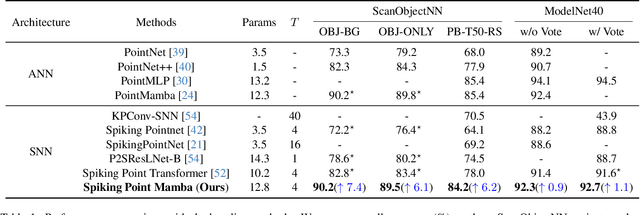
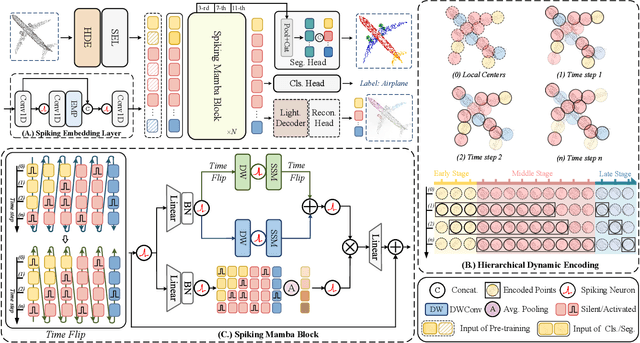
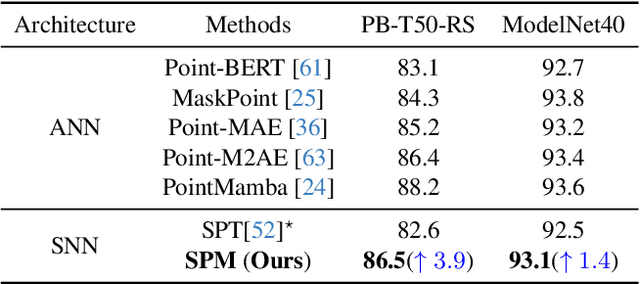
Bio-inspired Spiking Neural Networks (SNNs) provide an energy-efficient way to extract 3D spatio-temporal features. However, existing 3D SNNs have struggled with long-range dependencies until the recent emergence of Mamba, which offers superior computational efficiency and sequence modeling capability. In this work, we propose Spiking Point Mamba (SPM), the first Mamba-based SNN in the 3D domain. Due to the poor performance of simply transferring Mamba to 3D SNNs, SPM is designed to utilize both the sequence modeling capabilities of Mamba and the temporal feature extraction of SNNs. Specifically, we first introduce Hierarchical Dynamic Encoding (HDE), an improved direct encoding method that effectively introduces dynamic temporal mechanism, thereby facilitating temporal interactions. Then, we propose a Spiking Mamba Block (SMB), which builds upon Mamba while learning inter-time-step features and minimizing information loss caused by spikes. Finally, to further enhance model performance, we adopt an asymmetric SNN-ANN architecture for spike-based pre-training and finetune. Compared with the previous state-of-the-art SNN models, SPM improves OA by +6.2%, +6.1%, and +7.4% on three variants of ScanObjectNN, and boosts instance mIOU by +1.9% on ShapeNetPart. Meanwhile, its energy consumption is at least 3.5x lower than that of its ANN counterpart. The code will be made publicly available.
Spiking Point Transformer for Point Cloud Classification
Feb 19, 2025Spiking Neural Networks (SNNs) offer an attractive and energy-efficient alternative to conventional Artificial Neural Networks (ANNs) due to their sparse binary activation. When SNN meets Transformer, it shows great potential in 2D image processing. However, their application for 3D point cloud remains underexplored. To this end, we present Spiking Point Transformer (SPT), the first transformer-based SNN framework for point cloud classification. Specifically, we first design Queue-Driven Sampling Direct Encoding for point cloud to reduce computational costs while retaining the most effective support points at each time step. We introduce the Hybrid Dynamics Integrate-and-Fire Neuron (HD-IF), designed to simulate selective neuron activation and reduce over-reliance on specific artificial neurons. SPT attains state-of-the-art results on three benchmark datasets that span both real-world and synthetic datasets in the SNN domain. Meanwhile, the theoretical energy consumption of SPT is at least 6.4$\times$ less than its ANN counterpart.
D-FINE: Redefine Regression Task in DETRs as Fine-grained Distribution Refinement
Oct 17, 2024


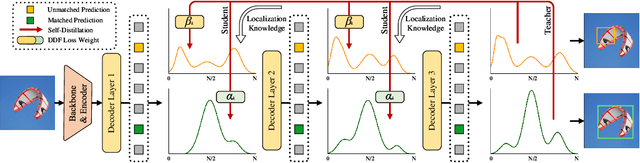
We introduce D-FINE, a powerful real-time object detector that achieves outstanding localization precision by redefining the bounding box regression task in DETR models. D-FINE comprises two key components: Fine-grained Distribution Refinement (FDR) and Global Optimal Localization Self-Distillation (GO-LSD). FDR transforms the regression process from predicting fixed coordinates to iteratively refining probability distributions, providing a fine-grained intermediate representation that significantly enhances localization accuracy. GO-LSD is a bidirectional optimization strategy that transfers localization knowledge from refined distributions to shallower layers through self-distillation, while also simplifying the residual prediction tasks for deeper layers. Additionally, D-FINE incorporates lightweight optimizations in computationally intensive modules and operations, achieving a better balance between speed and accuracy. Specifically, D-FINE-L / X achieves 54.0% / 55.8% AP on the COCO dataset at 124 / 78 FPS on an NVIDIA T4 GPU. When pretrained on Objects365, D-FINE-L / X attains 57.1% / 59.3% AP, surpassing all existing real-time detectors. Furthermore, our method significantly enhances the performance of a wide range of DETR models by up to 5.3% AP with negligible extra parameters and training costs. Our code and pretrained models: https://github.com/Peterande/D-FINE.