 Add to Chrome
 Add to Firefox
 Add to Edge
Dion3: Full-Stack Orthogonal Updates
Aug 12, 2026
The Muon optimizer incurs a significant overhead cost due to its cubic-time Newton-Schulz orthogonalization step. When weights are sharded, communication overhead compounds this computational cost, eroding the benefits of Muon in many settings. We present Dion3, a revision of Muon that targets this overhead at every level of the stack. Our Gram Newton-Schulz algorithm reduces the FLOP cost of orthogonalization, our CuteDSL kernels accelerate it by exploiting symmetry, and our megabatching strategy reduces communication overhead. Moreover, we propose a simple change to the update rule that cuts costs even further: selecting only a fraction of the momentum matrix's rows to orthogonalize at each step. This update rule improves on Dion (another "compressed" version of Muon), in both speed and performance. Overall, Dion3 matches or improves on the loss achieved by Muon but reduces optimizer step time by up to 6x. Dion3 is available via the dion package (https://github.com/microsoft/dion) as a drop-in replacement for Muon.

Full-bandwidth transformer
Aug 09, 2026Autoregressive transformers compute along two axes: horizontally across generated tokens, and vertically through model depth. Dense attention gives each token broad horizontal access to the past, but the vertical feedback channel between decoding steps remains narrow: only the sampled token returns to the bottom of the stack, while the top-layer hidden state is discarded. We introduce the \emph{full-bandwidth transformer}, which widens this channel with \emph{latent feedback}: at each decoding step, the previous top-layer hidden state is fused with the sampled token embedding through a gated linear unit and fed back as the next input. Latent feedback lets non-verbalized computation re-enter the stack with a renewed depth budget, while preserving the standard transformer architecture, KV cache, and language-modeling objective. To train full-bandwidth transformers without losing parallel teacher forcing, we use a scheduled multi-pass objective that introduces latent feedback late in pretraining and mixes a small fraction of deeper feedback passes for stability. We train 1B-parameter full-bandwidth transformers up to 400B tokens and find that latent feedback improves validation loss, 5-shot language-model evaluation, math and coding generation, and instruction-tuned performance. With negligible per-token decoding overhead, full-bandwidth transformers match or approach standard transformers trained with roughly $1.5\times$ more tokens, and manage to produce shorter reasoning traces at equal or better accuracy.
Hierarchical Latent Prediction for Language Models
Aug 06, 2026While standard Next-Token Prediction (NTP) lays the foundation of language model pre- training, its teacher-forced training paradigm may not be optimal for long-horizon reasoning and planning. Recent works such as Multi-Token Prediction (MTP) and Next-Latent prediction (NextLat) try to mitigate the problem through predicting multiple future tokens and self-supervised prediction in the latent space. However, those auxiliary objectives either have a limited horizon or suffer from compounding error from multi-step rollout. We introduce Hierarchical Latent Prediction (HiLP), which introduces an auxiliary higher-level abstract latent to help reduce the error accumulation effect in latent-space rollouts. Experiments show that HiLP can lead to longer-horizon coherent belief state representation and demonstrate the effectiveness of our method across coding and multi-step reasoning benchmarks, and offers more speculative decoding efficiency.
MEMENTO: Teaching LLMs to Manage Their Own Context
Apr 10, 2026Reasoning models think in long, unstructured streams with no mechanism for compressing or organizing their own intermediate state. We introduce MEMENTO: a method that teaches models to segment reasoning into blocks, compress each block into a memento, i.e., a dense state summary, and reason forward by attending only to mementos, reducing context, KV cache, and compute. To train MEMENTO models, we release OpenMementos, a public dataset of 228K reasoning traces derived from OpenThoughts-v3, segmented and annotated with intermediate summaries. We show that a two-stage SFT recipe on OpenMementos is effective across different model families (Qwen3, Phi-4, Olmo 3) and scales (8B--32B parameters). Trained models maintain strong accuracy on math, science, and coding benchmarks while achieving ${\sim}2.5\times$ peak KV cache reduction. We extend vLLM to support our inference method, achieving ${\sim}1.75\times$ throughput improvement while also enabling us to perform RL and further improve accuracy. Finally, we identify a dual information stream: information from each reasoning block is carried both by the memento text and by the corresponding KV states, which retain implicit information from the original block. Removing this channel drops accuracy by 15\,pp on AIME24.
Phi-4-reasoning-vision-15B Technical Report
Mar 04, 2026We present Phi-4-reasoning-vision-15B, a compact open-weight multimodal reasoning model, and share the motivations, design choices, experiments, and learnings that informed its development. Our goal is to contribute practical insight to the research community on building smaller, efficient multimodal reasoning models and to share the result of these learnings as an open-weight model that is good at common vision and language tasks and excels at scientific and mathematical reasoning and understanding user interfaces. Our contributions include demonstrating that careful architecture choices and rigorous data curation enable smaller, open-weight multimodal models to achieve competitive performance with significantly less training and inference-time compute and tokens. The most substantial improvements come from systematic filtering, error correction, and synthetic augmentation -- reinforcing that data quality remains the primary lever for model performance. Systematic ablations show that high-resolution, dynamic-resolution encoders yield consistent improvements, as accurate perception is a prerequisite for high-quality reasoning. Finally, a hybrid mix of reasoning and non-reasoning data with explicit mode tokens allows a single model to deliver fast direct answers for simpler tasks and chain-of-thought reasoning for complex problems.
When does predictive inverse dynamics outperform behavior cloning?
Jan 29, 2026Behavior cloning (BC) is a practical offline imitation learning method, but it often fails when expert demonstrations are limited. Recent works have introduced a class of architectures named predictive inverse dynamics models (PIDM) that combine a future state predictor with an inverse dynamics model (IDM). While PIDM often outperforms BC, the reasons behind its benefits remain unclear. In this paper, we provide a theoretical explanation: PIDM introduces a bias-variance tradeoff. While predicting the future state introduces bias, conditioning the IDM on the prediction can significantly reduce variance. We establish conditions on the state predictor bias for PIDM to achieve lower prediction error and higher sample efficiency than BC, with the gap widening when additional data sources are available. We validate the theoretical insights empirically in 2D navigation tasks, where BC requires up to five times (three times on average) more demonstrations than PIDM to reach comparable performance; and in a complex 3D environment in a modern video game with high-dimensional visual inputs and stochastic transitions, where BC requires over 66\% more samples than PIDM.
Next-Latent Prediction Transformers Learn Compact World Models
Nov 08, 2025Transformers replace recurrence with a memory that grows with sequence length and self-attention that enables ad-hoc look ups over past tokens. Consequently, they lack an inherent incentive to compress history into compact latent states with consistent transition rules. This often leads to learning solutions that generalize poorly. We introduce Next-Latent Prediction (NextLat), which extends standard next-token training with self-supervised predictions in the latent space. Specifically, NextLat trains a transformer to learn latent representations that are predictive of its next latent state given the next output token. Theoretically, we show that these latents provably converge to belief states, compressed information of the history necessary to predict the future. This simple auxiliary objective also injects a recurrent inductive bias into transformers, while leaving their architecture, parallel training, and inference unchanged. NextLat effectively encourages the transformer to form compact internal world models with its own belief states and transition dynamics -- a crucial property absent in standard next-token prediction transformers. Empirically, across benchmarks targeting core sequence modeling competencies -- world modeling, reasoning, planning, and language modeling -- NextLat demonstrates significant gains over standard next-token training in downstream accuracy, representation compression, and lookahead planning. NextLat stands as a simple and efficient paradigm for shaping transformer representations toward stronger generalization.
EnsemW2S: Enhancing Weak-to-Strong Generalization with Large Language Model Ensembles
May 28, 2025With Large Language Models (LLMs) rapidly approaching and potentially surpassing human-level performance, it has become imperative to develop approaches capable of effectively supervising and enhancing these powerful models using smaller, human-level models exposed to only human-level data. We address this critical weak-to-strong (W2S) generalization challenge by proposing a novel method aimed at improving weak experts, by training on the same limited human-level data, enabling them to generalize to complex, super-human-level tasks. Our approach, called \textbf{EnsemW2S}, employs a token-level ensemble strategy that iteratively combines multiple weak experts, systematically addressing the shortcomings identified in preceding iterations. By continuously refining these weak models, we significantly enhance their collective ability to supervise stronger student models. We extensively evaluate the generalization performance of both the ensemble of weak experts and the subsequent strong student model across in-distribution (ID) and out-of-distribution (OOD) datasets. For OOD, we specifically introduce question difficulty as an additional dimension for defining distributional shifts. Our empirical results demonstrate notable improvements, achieving 4\%, and 3.2\% improvements on ID datasets and, upto 6\% and 2.28\% on OOD datasets for experts and student models respectively, underscoring the effectiveness of our proposed method in advancing W2S generalization.
Inference-Time Scaling for Complex Tasks: Where We Stand and What Lies Ahead
Mar 31, 2025Inference-time scaling can enhance the reasoning capabilities of large language models (LLMs) on complex problems that benefit from step-by-step problem solving. Although lengthening generated scratchpads has proven effective for mathematical tasks, the broader impact of this approach on other tasks remains less clear. In this work, we investigate the benefits and limitations of scaling methods across nine state-of-the-art models and eight challenging tasks, including math and STEM reasoning, calendar planning, NP-hard problems, navigation, and spatial reasoning. We compare conventional models (e.g., GPT-4o) with models fine-tuned for inference-time scaling (e.g., o1) through evaluation protocols that involve repeated model calls, either independently or sequentially with feedback. These evaluations approximate lower and upper performance bounds and potential for future performance improvements for each model, whether through enhanced training or multi-model inference systems. Our extensive empirical analysis reveals that the advantages of inference-time scaling vary across tasks and diminish as problem complexity increases. In addition, simply using more tokens does not necessarily translate to higher accuracy in these challenging regimes. Results from multiple independent runs with conventional models using perfect verifiers show that, for some tasks, these models can achieve performance close to the average performance of today's most advanced reasoning models. However, for other tasks, a significant performance gap remains, even in very high scaling regimes. Encouragingly, all models demonstrate significant gains when inference is further scaled with perfect verifiers or strong feedback, suggesting ample potential for future improvements.
Learning to Achieve Goals with Belief State Transformers
Oct 30, 2024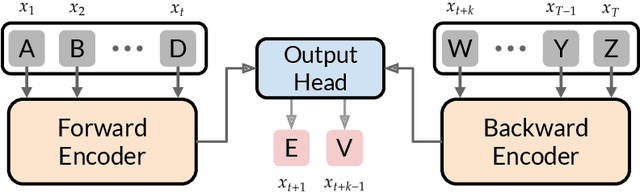
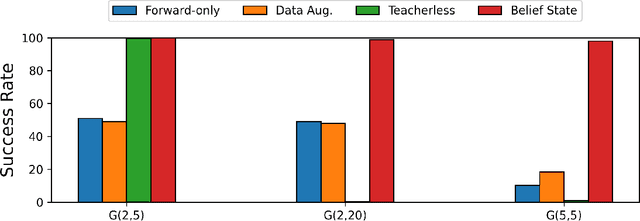

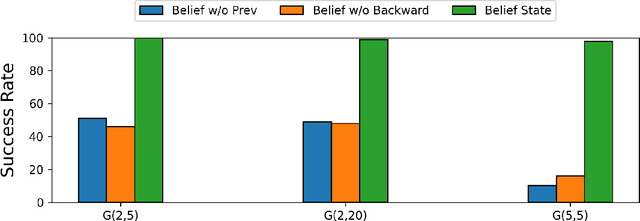
We introduce the "Belief State Transformer", a next-token predictor that takes both a prefix and suffix as inputs, with a novel objective of predicting both the next token for the prefix and the previous token for the suffix. The Belief State Transformer effectively learns to solve challenging problems that conventional forward-only transformers struggle with, in a domain-independent fashion. Key to this success is learning a compact belief state that captures all relevant information necessary for accurate predictions. Empirical ablations show that each component of the model is essential in difficult scenarios where standard Transformers fall short. For the task of story writing with known prefixes and suffixes, our approach outperforms the Fill-in-the-Middle method for reaching known goals and demonstrates improved performance even when the goals are unknown. Altogether, the Belief State Transformer enables more efficient goal-conditioned decoding, better test-time inference, and high-quality text representations on small scale problems.