 Add to Chrome
 Add to Firefox
 Add to Edge
CORE: In-Context Reconstruction for Unified Tabular Anomaly Detection
Jul 30, 2026
Tabular anomaly detection (TAD), which focuses on identifying abnormal samples that deviate from the majority in tabular data, has received growing attention. Recently, there has been an emerging trend towards unified TAD, which seeks to detect anomalies across different datasets using a single generalizable model. In unified TAD, aligning heterogeneous data remains challenging. While existing methods often rely on distance-based unified feature construction, they may obscure the semantics of the original features. Moreover, existing approaches typically formulate anomaly detection as a binary classification task, which may overlook diverse anomaly patterns from various datasets and be misled by unrepresentative synthetic anomalies. To address these challenges, we propose an in-COntext REconstruction approach for unified TAD (CORE for short). It introduces a decorrelated feature alignment module to directly align heterogeneous features into a unified representation space, which retains their semantic information. Meanwhile, CORE formulates unified TAD as an in-context reconstruction problem, eliminating the need for labeled or synthesized anomalies. Specifically, the in-context reconstruction module reconstructs each sample by leveraging contextual normal samples to capture dataset-specific distributions, such that reconstruction errors reflect its deviation from normality, facilitating unified TAD on arbitrary unseen datasets.

HVM-GraphRAG: Holistic-View Multimodal Graph Retrieval-Augmented Generation on Complex Document
Jul 26, 2026Question answering (QA) over complex documents requires models to retrieve and integrate evidence distributed across distant document regions and modalities. Multimodal GraphRAG provides a promising direction by organizing document evidence with graph structures. However, existing methods often suffer from unreliable cross-modal evidence indexing and expensive graph traversal. To address these issues, we propose HVM-GraphRAG, a holistic-view multimodal GraphRAG framework on complex document. HVM-GraphRAG uses a holistic view to guide graph construction, thereby reducing noisy and conflicting graph updates and building reliable indices between concept-level graph nodes and supporting multimodal chunks. During retrieval, HVM-GraphRAG searches over a compact concept-level graph and directly accesses supporting evidence through the constructed index, avoiding costly traversal over dense entity-level graphs. After obtaining the retrieved evidence, HVM-GraphRAG further reorganizes chunks into modality-specific groups, enabling the answering model to better integrate heterogeneous evidence. Experiments on three datasets show that HVM-GraphRAG achieves the best answer performance in most evaluated settings while substantially improving online retrieval efficiency over representative graph-based baselines.
UNIT: Unleash Large Language Models Potential for Graph Continual Learning
Jul 11, 2026In real-world multimodal web scenarios, graph-structured data often arrives in a streaming manner, making graph continual learning a crucial paradigm for continuously modeling such evolving structures. However, existing graph continual learning methods still face two fundamental challenges. 1) semantic-structural separation, where the graph-based methods excel at modeling topological relationships but neglect deep semantics. 2) imbalanced knowledge transfer, where existing models fail to effectively leverage general knowledge gained from early tasks to benefit subsequent new tasks. To address above issues, we propose a novel framework, \textbf{UN}leash Large Language Models PotentIal for Graph ConTinual Learning (UNIT). By fine-tuning large language model only on the first task, we bridge the distributional gap between the pre-trained LLM corpus and the target task dataset to enhance the adaptability of LLMs for graph-structured tasks. Meanwhile, we propose an uncertain-aware anchor generation mechanism to effectively preserve representative knowledge across tasks, avoiding the neglect of universal knowledge learned from previous tasks. Additionally, we introduce structural confluence modeling to explicitly integrates graph topology information into semantic information, enhancing the collaborative capabilities between semantic understanding and structural modeling. Extensive experiments demonstrate that our proposed method achieves state-of-the-art performance in the graph continual learning task.
Towards Mechanistically Understanding Why Memorized Knowledge Fails to Generalize in Large Language Model Finetuning
Jul 09, 2026Fine-tuning LLMs to inject new knowledge faces a critical challenge: LLMs can quickly memorize new facts, yet fail to use them for downstream reasoning tasks. We formalize this failure as the \textit{\textbf{Knowing--Using Gap}}, characterized by an accuracy gap and a temporal lag between memorization and generalization. To understand this phenomenon, we fine-tune LLMs with unseen knowledge and monitor the spatial permeation dynamics of the knowledge internally using a novel intervention technique called self-patching. Self-patching identifies activation locations where relocating representations substantially improves failed generalization cases. These results are consistent with a knowledge-circuit misalignment hypothesis: memorized representations can exist internally but may not be routed to computation-effective layers. To demonstrate the practicality of this diagnostic finding, we design a simple heuristic strategy which recovers 58--75\% of the oracle headroom in generalization failure. Experiments are done cross-domain for the robustness of this finding.
TAROT: Task-Adaptive Refinement of LLM-prior Graphs for Few-shot Tabular Learning
Jun 10, 2026Few-shot tabular learning provides a cost-effective approach for real-world applications where annotation is costly and collecting sufficient samples for new tasks is difficult. Existing Traditional and LLM-based methods have demonstrated effectiveness in few-shot scenarios. However, traditional methods need additional training on unlabeled or generated data, which incur significant computational overhead. In addition, LLM-based methods that directly feed raw tabular data into LLMs raise privacy and compliance concerns. More importantly, both paradigms largely overlook the semantic relationships between features, which provide structural and semantic prior for constructing a semantic graph. Semantic graph is essential for modeling meaningful feature interactions in few-shot scenarios. In this paper, we propose TAROT, a GNN-based framework that encodes the structural and semantic prior by constructing and refining a task-adaptive semantic graph from this prior, thereby improving predictive performance in few-shot tabular learning. TAROT first encodes heterogeneous tabular data into unified node semantic representations via a Unified Semantic Tabular Node Encoder (USTNE). Then, it prompts LLMs to infer the semantic relationship between features based on the task description and feature names to construct a semantic graph. To mitigate structural noise introduced by the hallucination of LLMs, TAROT introduces Task-adaptive Semantic Graph Refinement that prunes spurious or task-unrelated edges and adds missing task-related ones, aligning the graph structure with the downstream objective. Finally, a GNN performs message passing over the refined graph to capture task-related semantic dependencies for prediction. Extensive experiments on various few-shot tabular learning benchmarks demonstrate the superior performance of TAROT, establishing it as a state-of-the-art approach in this domain.
SAIGuard: Communication-State Simulation for Proactive Defense of LLM Multi-Agent Systems
Jun 10, 2026LLM-based multi-agent systems (MAS) solve complex tasks through inter-agent collaboration, but their communication-driven nature also allows security risks to spread across agents and trigger system-wide failures. Existing MAS defenses mainly follow a reactive paradigm after execution by detecting and isolating harmful agents, which may cause irreversible damage and degrade collaborative utility. To address this, we propose a proactive defense framework for MAS security, namely a Simulation-aware Interception Guard (SAIGuard). SAIGuard performs communication-state simulation over the MAS interaction graph, estimates the impact of incoming messages on local agent states and the global MAS state, and detects risky messages via reconstruction deviations from benign communication patterns. Instead of isolating agents, SAIGuard sanitizes or regenerates suspicious messages before it propagation into system. Experiments across diverse topologies and attack scenarios show that SAIGuard reduces attack success rates while maintaining MAS utility, outperforming reactive defenses.
Detect by Yourself: Self-Designing Agentic Workflows for Few-Shot Graph Anomaly Detection
May 26, 2026Graph anomaly detection aims to identify anomaly nodes in attributed graphs and plays an important role in real-world applications. However, existing graph anomaly detection methods still face two key challenges: 1) fixed pipelines, which restrict their adaptability across different graph tasks under limited supervision; 2) weak evidence, which prevents them from explicitly incorporating contextual and structural anomaly signals into the detection process. In this paper, we propose a novel framework, self-designing agentic workflows for few-shot graph anomaly detection (SignGAD). Specifically, we propose a novel paradigm that reformulates graph anomaly detection task from training a fixed anomaly detector to designing task-conditioned detection workflows. By constructing detection workflows, SignGAD selects suitable graph encodings and detector designs to exploit task-specific anomaly evidence. Meanwhile, we introduce a guarded final refit strategy to refine the selected workflow by calibrating refit acceptance, enhancing reliability under limited supervision. Extensive experiments conducted on several real-world datasets demonstrate that SignGAD achieves strong performance against state-of-the-art methods, highlighting its effectiveness on graph anomaly detection tasks.
PRBench: End-to-end Paper Reproduction in Physics Research
Mar 29, 2026AI agents powered by large language models exhibit strong reasoning and problem-solving capabilities, enabling them to assist scientific research tasks such as formula derivation and code generation. However, whether these agents can reliably perform end-to-end reproduction from real scientific papers remains an open question. We introduce PRBench, a benchmark of 30 expert-curated tasks spanning 11 subfields of physics. Each task requires an agent to comprehend the methodology of a published paper, implement the corresponding algorithms from scratch, and produce quantitative results matching the original publication. Agents are provided only with the task instruction and paper content, and operate in a sandboxed execution environment. All tasks are contributed by domain experts from over 20 research groups at the School of Physics, Peking University, each grounded in a real published paper and validated through end-to-end reproduction with verified ground-truth results and detailed scoring rubrics. Using an agentified assessment pipeline, we evaluate a set of coding agents on PRBench and analyze their capabilities across key dimensions of scientific reasoning and execution. The best-performing agent, OpenAI Codex powered by GPT-5.3-Codex, achieves a mean overall score of 34%. All agents exhibit a zero end-to-end callback success rate, with particularly poor performance in data accuracy and code correctness. We further identify systematic failure modes, including errors in formula implementation, inability to debug numerical simulations, and fabrication of output data. Overall, PRBench provides a rigorous benchmark for evaluating progress toward autonomous scientific research.
HyperD: Hybrid Periodicity Decoupling Framework for Traffic Forecasting
Nov 16, 2025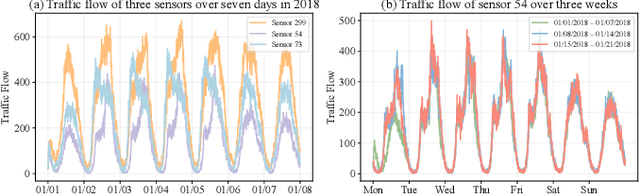
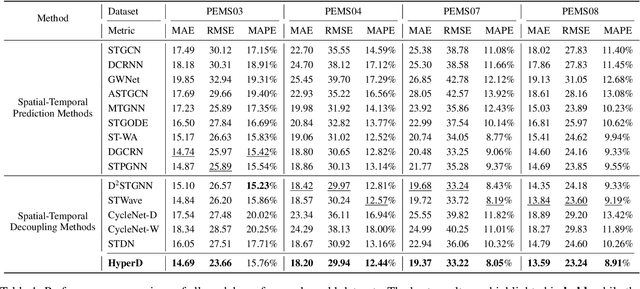
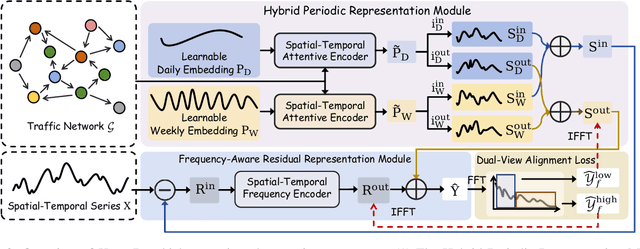
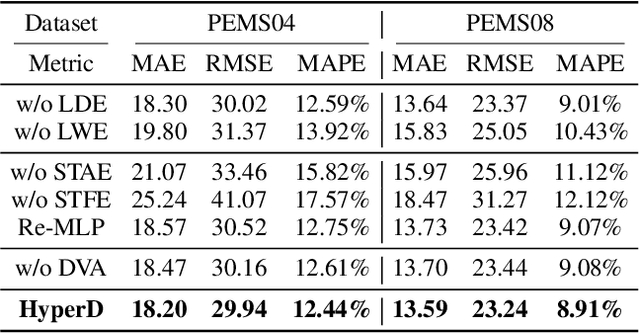
Accurate traffic forecasting plays a vital role in intelligent transportation systems, enabling applications such as congestion control, route planning, and urban mobility optimization. However, traffic forecasting remains challenging due to two key factors: (1) complex spatial dependencies arising from dynamic interactions between road segments and traffic sensors across the network, and (2) the coexistence of multi-scale periodic patterns (e.g., daily and weekly periodic patterns driven by human routines) with irregular fluctuations caused by unpredictable events (e.g., accidents, weather, or construction). To tackle these challenges, we propose HyperD (Hybrid Periodic Decoupling), a novel framework that decouples traffic data into periodic and residual components. The periodic component is handled by the Hybrid Periodic Representation Module, which extracts fine-grained daily and weekly patterns using learnable periodic embeddings and spatial-temporal attention. The residual component, which captures non-periodic, high-frequency fluctuations, is modeled by the Frequency-Aware Residual Representation Module, leveraging complex-valued MLP in frequency domain. To enforce semantic separation between the two components, we further introduce a Dual-View Alignment Loss, which aligns low-frequency information with the periodic branch and high-frequency information with the residual branch. Extensive experiments on four real-world traffic datasets demonstrate that HyperD achieves state-of-the-art prediction accuracy, while offering superior robustness under disturbances and improved computational efficiency compared to existing methods.
Dual Mamba for Node-Specific Representation Learning: Tackling Over-Smoothing with Selective State Space Modeling
Nov 11, 2025Over-smoothing remains a fundamental challenge in deep Graph Neural Networks (GNNs), where repeated message passing causes node representations to become indistinguishable. While existing solutions, such as residual connections and skip layers, alleviate this issue to some extent, they fail to explicitly model how node representations evolve in a node-specific and progressive manner across layers. Moreover, these methods do not take global information into account, which is also crucial for mitigating the over-smoothing problem. To address the aforementioned issues, in this work, we propose a Dual Mamba-enhanced Graph Convolutional Network (DMbaGCN), which is a novel framework that integrates Mamba into GNNs to address over-smoothing from both local and global perspectives. DMbaGCN consists of two modules: the Local State-Evolution Mamba (LSEMba) for local neighborhood aggregation and utilizing Mamba's selective state space modeling to capture node-specific representation dynamics across layers, and the Global Context-Aware Mamba (GCAMba) that leverages Mamba's global attention capabilities to incorporate global context for each node. By combining these components, DMbaGCN enhances node discriminability in deep GNNs, thereby mitigating over-smoothing. Extensive experiments on multiple benchmarks demonstrate the effectiveness and efficiency of our method.