 Add to Chrome
 Add to Firefox
 Add to Edge
GaMi: Geometry-Agnostic Material Identification via Cross-Modal Subtractive Disentanglement
May 29, 2026
Non-contact material identification enables adaptive interaction for embodied intelligence yet faces challenges from geometry-induced variations (e.g., orientation, shape, distance) and single-modality ambiguities. In this paper, we present GaMi, a multimodal material identification system integrating mmWave and acoustic sensing to robustly operate under unconstrained geometric conditions. By leveraging the insight of shared geometric consistency between co-located bimodal sensors, GaMi employs an intra-sample cross-modal subtractive disentanglement framework. By semantically aligning modalities and subtracting the shared geometric context, it isolates intrinsic material features. Furthermore, GaMi incorporates inter-sample contrastive learning to correct the residual interference caused by cross-modal misalignment. Additionally, a pairing-based adaptation strategy between two modalities enables few-shot generalization across devices. Extensive evaluations on 20 materials show that GaMi achieves 95.2% accuracy, outperforming single-modality baselines across unseen geometric conditions.

NTIRE 2026 Challenge on Robust AI-Generated Image Detection in the Wild
Apr 13, 2026This paper presents an overview of the NTIRE 2026 Challenge on Robust AI-Generated Image Detection in the Wild, held in conjunction with the NTIRE workshop at CVPR 2026. The goal of this challenge was to develop detection models capable of distinguishing real images from generated ones in realistic scenarios: the images are often transformed (cropped, resized, compressed, blurred) for practical usage, and therefore, the detection models should be robust to such transformations. The challenge is based on a novel dataset consisting of 108,750 real and 185,750 AI-generated images from 42 generators comprising a large variety of open-source and closed-source models of various architectures, augmented with 36 image transformations. Methods were evaluated using ROC AUC on the full test set, including both transformed and untransformed images. A total of 511 participants registered, with 20 teams submitting valid final solutions. This report provides a comprehensive overview of the challenge, describes the proposed solutions, and can be used as a valuable reference for researchers and practitioners in increasing the robustness of the detection models to real-world transformations.
$k$NNProxy: Efficient Training-Free Proxy Alignment for Black-Box Zero-Shot LLM-Generated Text Detection
Apr 02, 2026LLM-generated text (LGT) detection is essential for reliable forensic analysis and for mitigating LLM misuse. Existing LGT detectors can generally be categorized into two broad classes: learning-based approaches and zero-shot methods. Compared with learning-based detectors, zero-shot methods are particularly promising because they eliminate the need to train task-specific classifiers. However, the reliability of zero-shot methods fundamentally relies on the assumption that an off-the-shelf proxy LLM is well aligned with the often unknown source LLM, a premise that rarely holds in real-world black-box scenarios. To address this discrepancy, existing proxy alignment methods typically rely on supervised fine-tuning of the proxy or repeated interactions with commercial APIs, thereby increasing deployment costs, exposing detectors to silent API changes, and limiting robustness under domain shift. Motivated by these limitations, we propose the $k$-nearest neighbor proxy ($k$NNProxy), a training-free and query-efficient proxy alignment framework that repurposes the $k$NN language model ($k$NN-LM) retrieval mechanism as a domain adapter for a fixed proxy LLM. Specifically, a lightweight datastore is constructed once from a target-reflective LGT corpus, either via fixed-budget querying or from existing datasets. During inference, nearest-neighbor evidence induces a token-level predictive distribution that is interpolated with the proxy output, yielding an aligned prediction without proxy fine-tuning or per-token API outputs. To improve robustness under domain shift, we extend $k$NNProxy into a mixture of proxies (MoP) that routes each input to a domain-specific datastore for domain-consistent retrieval. Extensive experiments demonstrate strong detection performance of our method.
FeatDistill: A Feature Distillation Enhanced Multi-Expert Ensemble Framework for Robust AI-generated Image Detection
Mar 23, 2026The rapid iteration and widespread dissemination of deepfake technology have posed severe challenges to information security, making robust and generalizable detection of AI-generated forged images increasingly important. In this paper, we propose FeatDistill, an AI-generated image detection framework that integrates feature distillation with a multi-expert ensemble, developed for the NTIRE Challenge on Robust AI-Generated Image Detection in the Wild. The framework explicitly targets three practical bottlenecks in real-world forensics: degradation interference, insufficient feature representation, and limited generalization. Concretely, we build a four-backbone Vision Transformer (ViT) ensemble composed of CLIP and SigLIP variants to capture complementary forensic cues. To improve data coverage, we expand the training set and introduce comprehensive degradation modeling, which exposes the detector to diverse quality variations and synthesis artifacts commonly encountered in unconstrained scenarios. We further adopt a two-stage training paradigm: the model is first optimized with a standard binary classification objective, then refined by dense feature-level self-distillation for representation alignment. This design effectively mitigates overfitting and enhances semantic consistency of learned features. At inference time, the final prediction is obtained by averaging the probabilities from four independently trained experts, yielding stable and reliable decisions across unseen generators and complex degradations. Despite the ensemble design, the framework remains efficient, requiring only about 10 GB peak GPU memory. Extensive evaluations in the NTIRE challenge setting demonstrate that FeatDistill achieves strong robustness and generalization under diverse ``in-the-wild'' conditions, offering an effective and practical solution for real-world deepfake image detection.
ADCD-Net: Robust Document Image Forgery Localization via Adaptive DCT Feature and Hierarchical Content Disentanglement
Jul 22, 2025The advancement of image editing tools has enabled malicious manipulation of sensitive document images, underscoring the need for robust document image forgery detection.Though forgery detectors for natural images have been extensively studied, they struggle with document images, as the tampered regions can be seamlessly blended into the uniform document background (BG) and structured text. On the other hand, existing document-specific methods lack sufficient robustness against various degradations, which limits their practical deployment. This paper presents ADCD-Net, a robust document forgery localization model that adaptively leverages the RGB/DCT forensic traces and integrates key characteristics of document images. Specifically, to address the DCT traces' sensitivity to block misalignment, we adaptively modulate the DCT feature contribution based on a predicted alignment score, resulting in much improved resilience to various distortions, including resizing and cropping. Also, a hierarchical content disentanglement approach is proposed to boost the localization performance via mitigating the text-BG disparities. Furthermore, noticing the predominantly pristine nature of BG regions, we construct a pristine prototype capturing traces of untampered regions, and eventually enhance both the localization accuracy and robustness. Our proposed ADCD-Net demonstrates superior forgery localization performance, consistently outperforming state-of-the-art methods by 20.79\% averaged over 5 types of distortions. The code is available at https://github.com/KAHIMWONG/ACDC-Net.
Structure Disruption: Subverting Malicious Diffusion-Based Inpainting via Self-Attention Query Perturbation
May 26, 2025The rapid advancement of diffusion models has enhanced their image inpainting and editing capabilities but also introduced significant societal risks. Adversaries can exploit user images from social media to generate misleading or harmful content. While adversarial perturbations can disrupt inpainting, global perturbation-based methods fail in mask-guided editing tasks due to spatial constraints. To address these challenges, we propose Structure Disruption Attack (SDA), a powerful protection framework for safeguarding sensitive image regions against inpainting-based editing. Building upon the contour-focused nature of self-attention mechanisms of diffusion models, SDA optimizes perturbations by disrupting queries in self-attention during the initial denoising step to destroy the contour generation process. This targeted interference directly disrupts the structural generation capability of diffusion models, effectively preventing them from producing coherent images. We validate our motivation through visualization techniques and extensive experiments on public datasets, demonstrating that SDA achieves state-of-the-art (SOTA) protection performance while maintaining strong robustness.
Anti-Diffusion: Preventing Abuse of Modifications of Diffusion-Based Models
Mar 07, 2025Although diffusion-based techniques have shown remarkable success in image generation and editing tasks, their abuse can lead to severe negative social impacts. Recently, some works have been proposed to provide defense against the abuse of diffusion-based methods. However, their protection may be limited in specific scenarios by manually defined prompts or the stable diffusion (SD) version. Furthermore, these methods solely focus on tuning methods, overlooking editing methods that could also pose a significant threat. In this work, we propose Anti-Diffusion, a privacy protection system designed for general diffusion-based methods, applicable to both tuning and editing techniques. To mitigate the limitations of manually defined prompts on defense performance, we introduce the prompt tuning (PT) strategy that enables precise expression of original images. To provide defense against both tuning and editing methods, we propose the semantic disturbance loss (SDL) to disrupt the semantic information of protected images. Given the limited research on the defense against editing methods, we develop a dataset named Defense-Edit to assess the defense performance of various methods. Experiments demonstrate that our Anti-Diffusion achieves superior defense performance across a wide range of diffusion-based techniques in different scenarios.
DAT: Improving Adversarial Robustness via Generative Amplitude Mix-up in Frequency Domain
Oct 16, 2024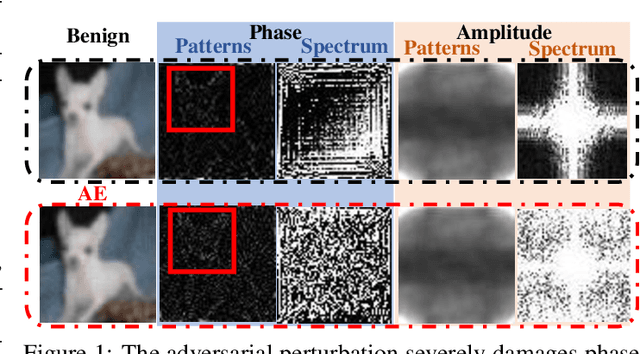

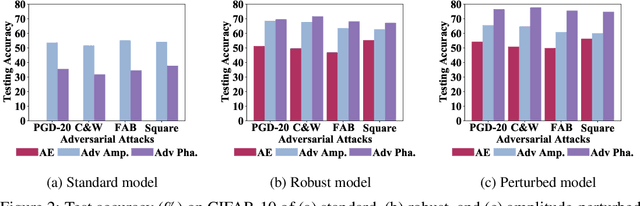
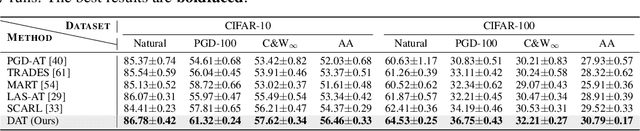
To protect deep neural networks (DNNs) from adversarial attacks, adversarial training (AT) is developed by incorporating adversarial examples (AEs) into model training. Recent studies show that adversarial attacks disproportionately impact the patterns within the phase of the sample's frequency spectrum -- typically containing crucial semantic information -- more than those in the amplitude, resulting in the model's erroneous categorization of AEs. We find that, by mixing the amplitude of training samples' frequency spectrum with those of distractor images for AT, the model can be guided to focus on phase patterns unaffected by adversarial perturbations. As a result, the model's robustness can be improved. Unfortunately, it is still challenging to select appropriate distractor images, which should mix the amplitude without affecting the phase patterns. To this end, in this paper, we propose an optimized Adversarial Amplitude Generator (AAG) to achieve a better tradeoff between improving the model's robustness and retaining phase patterns. Based on this generator, together with an efficient AE production procedure, we design a new Dual Adversarial Training (DAT) strategy. Experiments on various datasets show that our proposed DAT leads to significantly improved robustness against diverse adversarial attacks.
Progressive Poisoned Data Isolation for Training-time Backdoor Defense
Dec 20, 2023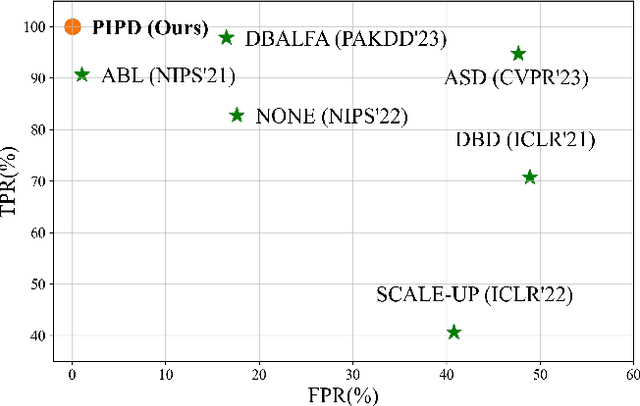
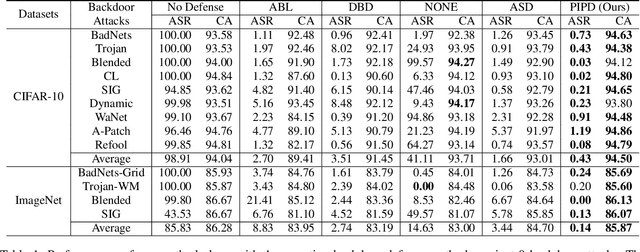
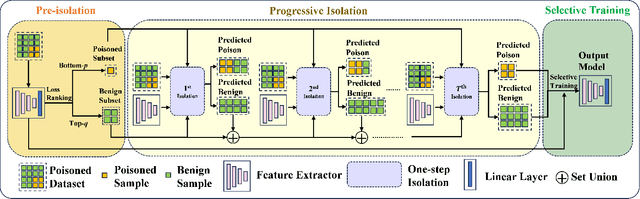

Deep Neural Networks (DNN) are susceptible to backdoor attacks where malicious attackers manipulate the model's predictions via data poisoning. It is hence imperative to develop a strategy for training a clean model using a potentially poisoned dataset. Previous training-time defense mechanisms typically employ an one-time isolation process, often leading to suboptimal isolation outcomes. In this study, we present a novel and efficacious defense method, termed Progressive Isolation of Poisoned Data (PIPD), that progressively isolates poisoned data to enhance the isolation accuracy and mitigate the risk of benign samples being misclassified as poisoned ones. Once the poisoned portion of the dataset has been identified, we introduce a selective training process to train a clean model. Through the implementation of these techniques, we ensure that the trained model manifests a significantly diminished attack success rate against the poisoned data. Extensive experiments on multiple benchmark datasets and DNN models, assessed against nine state-of-the-art backdoor attacks, demonstrate the superior performance of our PIPD method for backdoor defense. For instance, our PIPD achieves an average True Positive Rate (TPR) of 99.95% and an average False Positive Rate (FPR) of 0.06% for diverse attacks over CIFAR-10 dataset, markedly surpassing the performance of state-of-the-art methods.
Generating Robust Adversarial Examples against Online Social Networks (OSNs)
Oct 19, 2023Online Social Networks (OSNs) have blossomed into prevailing transmission channels for images in the modern era. Adversarial examples (AEs) deliberately designed to mislead deep neural networks (DNNs) are found to be fragile against the inevitable lossy operations conducted by OSNs. As a result, the AEs would lose their attack capabilities after being transmitted over OSNs. In this work, we aim to design a new framework for generating robust AEs that can survive the OSN transmission; namely, the AEs before and after the OSN transmission both possess strong attack capabilities. To this end, we first propose a differentiable network termed SImulated OSN (SIO) to simulate the various operations conducted by an OSN. Specifically, the SIO network consists of two modules: 1) a differentiable JPEG layer for approximating the ubiquitous JPEG compression and 2) an encoder-decoder subnetwork for mimicking the remaining operations. Based upon the SIO network, we then formulate an optimization framework to generate robust AEs by enforcing model outputs with and without passing through the SIO to be both misled. Extensive experiments conducted over Facebook, WeChat and QQ demonstrate that our attack methods produce more robust AEs than existing approaches, especially under small distortion constraints; the performance gain in terms of Attack Success Rate (ASR) could be more than 60%. Furthermore, we build a public dataset containing more than 10,000 pairs of AEs processed by Facebook, WeChat or QQ, facilitating future research in the robust AEs generation. The dataset and code are available at https://github.com/csjunjun/RobustOSNAttack.git.