 Add to Chrome
 Add to Firefox
 Add to Edge
Case-Based Calibration of Adaptive Reasoning and Execution for LLM Tool Use
May 14, 2026
Tool use extends large language models beyond parametric knowledge, but reliable execution requires balancing appropriate reasoning depth with strict structural validity. We approach this problem from a case-based perspective to present CAST, a case-driven framework that treats historical execution trajectories as structured cases. Instead of reusing raw exemplar outputs, CAST extracts case-derived signals to identify complexity profiles for estimating optimal reasoning strategies, alongside failure profiles to map likely structural breakdowns. The framework translates this knowledge into a fine-grained reward design and adaptive reasoning, enabling the model to autonomously internalize case-based strategies during reinforcement learning. Experiments on BFCLv2 and ToolBench demonstrate that CAST improves both schema-faithful execution and task-level tool-use success while reducing unnecessary deliberation. The approach achieves up to 5.85 percentage points gain in overall execution accuracy and reduces average reasoning length by 26%, significantly mitigating high-impact structural errors. Ultimately, this demonstrates how historical execution cases can provide reusable adaptation knowledge for calibrated tool use.

Improving Multi-turn Dialogue Consistency with Self-Recall Thinking
May 14, 2026Large language model (LLM) based multi-turn dialogue systems often struggle to track dependencies across non-adjacent turns, undermining both consistency and scalability. As conversations lengthen, essential information becomes sparse and is buried in irrelevant context, while processing the entire dialogue history incurs severe efficiency bottlenecks. Existing solutions either rely on high latency external memory or lose fine-grained details through iterative summarization. In this paper, we propose Self-Recall Thinking (SRT), a framework designed to address long-range contextual dependency and sparse informative signals in multi-turn dialogue. SRT identifies helpful historical turns and uses them to generate contextually appropriate responses, enabling the model to selectively recall and reason over context during inference. This process yields an endogenous reasoning process that integrates interpretable recall steps without external modules. SRT incorporates: (1) Dependency Construction: Generating and converting it into self-recall chains; (2)Capability Initialization: Training to enable reasoning chains with recall tokens capability; (3)Reasoning Improvement: Refining accuracy via verifiable rewards to optimize recall and reasoning for correct answers. Experiments on multiple datasets demonstrate that SRT improves F1 score by 4.7% and reduces end-to-end latency by 14.7% over prior methods, achieving a balance between reasoning latency and accuracy, and outperforming state-of-the-art baselines.
Language-Enhanced Session-Based Recommendation with Decoupled Contrastive Learning
Jul 20, 2023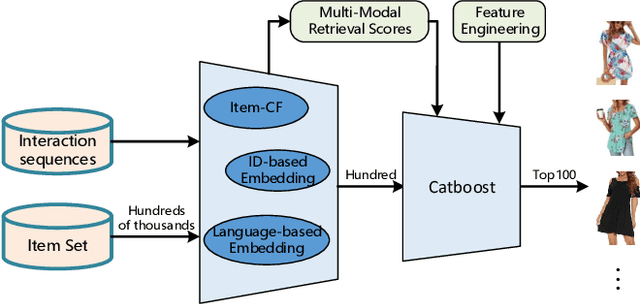

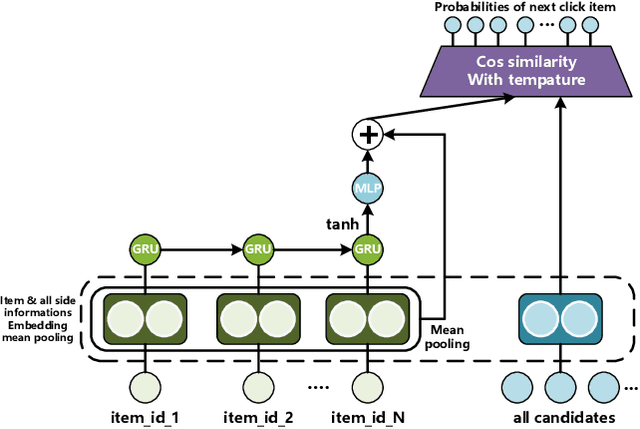

Session-based recommendation techniques aim to capture dynamic user behavior by analyzing past interactions. However, existing methods heavily rely on historical item ID sequences to extract user preferences, leading to challenges such as popular bias and cold-start problems. In this paper, we propose a hybrid multimodal approach for session-based recommendation to address these challenges. Our approach combines different modalities, including textual content and item IDs, leveraging the complementary nature of these modalities using CatBoost. To learn universal item representations, we design a language representation-based item retrieval architecture that extracts features from the textual content utilizing pre-trained language models. Furthermore, we introduce a novel Decoupled Contrastive Learning method to enhance the effectiveness of the language representation. This technique decouples the sequence representation and item representation space, facilitating bidirectional alignment through dual-queue contrastive learning. Simultaneously, the momentum queue provides a large number of negative samples, effectively enhancing the effectiveness of contrastive learning. Our approach yielded competitive results, securing a 5th place ranking in KDD CUP 2023 Task 1. We have released the source code and pre-trained models associated with this work.