 Add to Chrome
 Add to Firefox
 Add to Edge
DPEPO: Diverse Parallel Exploration Policy Optimization for LLM-based Agents
Apr 27, 2026
Large language model (LLM) agents that follow the sequential "reason-then-act" paradigm have achieved superior performance in many complex tasks.However, these methods suffer from limited exploration and incomplete environmental understanding, as they interact with only a single environment per step. In this paper, we first introduce a novel paradigm that enables an agent to interact with multiple environments simultaneously and share cross-trajectory experiences. Building upon this paradigm, we further propose DPEPO, a reinforcement learning (RL) algorithm that encourages the agent to perform diverse parallel exploration. There are two stages in DPEPO: initial supervised fine-tuning (SFT) imparts basic parallel reasoning and action generation, followed by reinforcement learning stage with a hierarchical reward scheme. We design a parallel trajectory-level success reward and two step-level rewards: Diverse Action Reward and Diverse State Transition Reward, which actively penalize behavioral redundancy and promote broad exploration. Extensive experiments on ALFWorld and ScienceWorld show that DPEPO achieves state-of-the-art (SOTA) success rates, while maintaining comparable efficiency to strong sequential baselines. (Code is available at https://github.com/LePanda026/Code-for-DPEPO)

Towards Performance-Enhanced Model-Contrastive Federated Learning using Historical Information in Heterogeneous Scenarios
Feb 12, 2026Federated Learning (FL) enables multiple nodes to collaboratively train a model without sharing raw data. However, FL systems are usually deployed in heterogeneous scenarios, where nodes differ in both data distributions and participation frequencies, which undermines the FL performance. To tackle the above issue, this paper proposes PMFL, a performance-enhanced model-contrastive federated learning framework using historical training information. Specifically, on the node side, we design a novel model-contrastive term into the node optimization objective by incorporating historical local models to capture stable contrastive points, thereby improving the consistency of model updates in heterogeneous data distributions. On the server side, we utilize the cumulative participation count of each node to adaptively adjust its aggregation weight, thereby correcting the bias in the global objective caused by different node participation frequencies. Furthermore, the updated global model incorporates historical global models to reduce its fluctuations in performance between adjacent rounds. Extensive experiments demonstrate that PMFL achieves superior performance compared with existing FL methods in heterogeneous scenarios.
A Distributed Privacy-Preserving Learning Dynamics in General Social Networks
Nov 15, 2020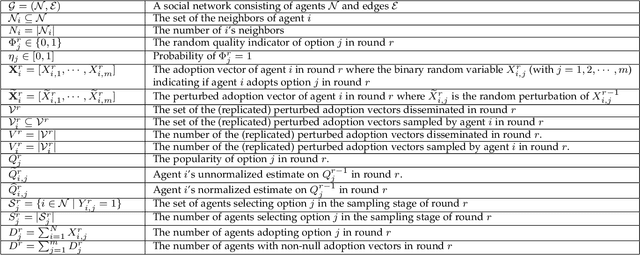
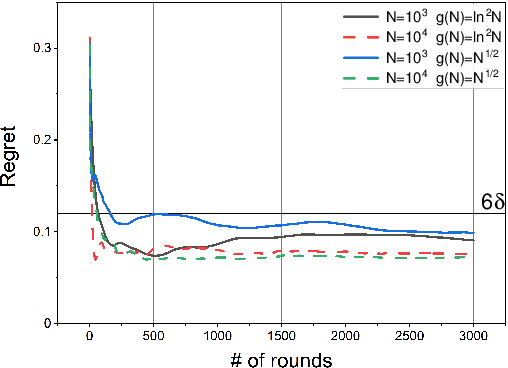
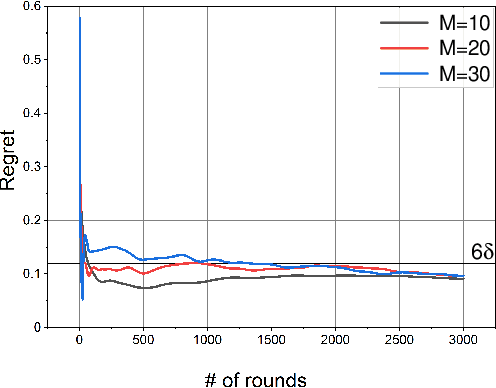
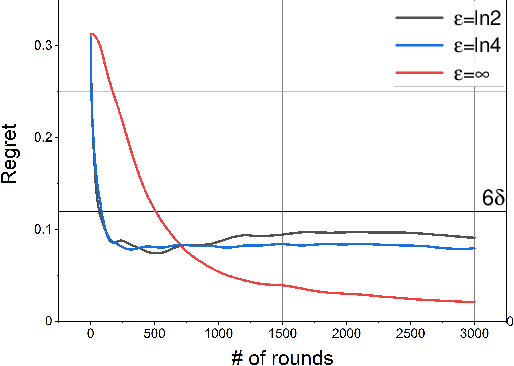
In this paper, we study a distributed privacy-preserving learning problem in general social networks. Specifically, we consider a very general problem setting where the agents in a given multi-hop social network are required to make sequential decisions to choose among a set of options featured by unknown stochastic quality signals. Each agent is allowed to interact with its peers through multi-hop communications but with its privacy preserved. To serve the above goals, we propose a four-staged distributed social learning algorithm. In a nutshell, our algorithm proceeds iteratively, and in every round, each agent i) randomly perturbs its adoption for privacy-preserving purpose, ii) disseminates the perturbed adoption over the social network in a nearly uniform manner through random walking, iii) selects an option by referring to its peers' perturbed latest adoptions, and iv) decides whether or not to adopt the selected option according to its latest quality signal. By our solid theoretical analysis, we provide answers to two fundamental algorithmic questions about the performance of our four-staged algorithm: on one hand, we illustrate the convergence of our algorithm when there are a sufficient number of agents in the social network, each of which are with incomplete and perturbed knowledge as input; on the other hand, we reveal the quantitative trade-off between the privacy loss and the communication overhead towards the convergence. We also perform extensive simulations to validate our theoretical analysis and to verify the efficacy of our algorithm.