 Add to Chrome
 Add to Firefox
 Add to Edge
Step 3.5 Flash: Open Frontier-Level Intelligence with 11B Active Parameters
Feb 11, 2026
We introduce Step 3.5 Flash, a sparse Mixture-of-Experts (MoE) model that bridges frontier-level agentic intelligence and computational efficiency. We focus on what matters most when building agents: sharp reasoning and fast, reliable execution. Step 3.5 Flash pairs a 196B-parameter foundation with 11B active parameters for efficient inference. It is optimized with interleaved 3:1 sliding-window/full attention and Multi-Token Prediction (MTP-3) to reduce the latency and cost of multi-round agentic interactions. To reach frontier-level intelligence, we design a scalable reinforcement learning framework that combines verifiable signals with preference feedback, while remaining stable under large-scale off-policy training, enabling consistent self-improvement across mathematics, code, and tool use. Step 3.5 Flash demonstrates strong performance across agent, coding, and math tasks, achieving 85.4% on IMO-AnswerBench, 86.4% on LiveCodeBench-v6 (2024.08-2025.05), 88.2% on tau2-Bench, 69.0% on BrowseComp (with context management), and 51.0% on Terminal-Bench 2.0, comparable to frontier models such as GPT-5.2 xHigh and Gemini 3.0 Pro. By redefining the efficiency frontier, Step 3.5 Flash provides a high-density foundation for deploying sophisticated agents in real-world industrial environments.

GEBench: Benchmarking Image Generation Models as GUI Environments
Feb 09, 2026Recent advancements in image generation models have enabled the prediction of future Graphical User Interface (GUI) states based on user instructions. However, existing benchmarks primarily focus on general domain visual fidelity, leaving the evaluation of state transitions and temporal coherence in GUI-specific contexts underexplored. To address this gap, we introduce GEBench, a comprehensive benchmark for evaluating dynamic interaction and temporal coherence in GUI generation. GEBench comprises 700 carefully curated samples spanning five task categories, covering both single-step interactions and multi-step trajectories across real-world and fictional scenarios, as well as grounding point localization. To support systematic evaluation, we propose GE-Score, a novel five-dimensional metric that assesses Goal Achievement, Interaction Logic, Content Consistency, UI Plausibility, and Visual Quality. Extensive evaluations on current models indicate that while they perform well on single-step transitions, they struggle significantly with maintaining temporal coherence and spatial grounding over longer interaction sequences. Our findings identify icon interpretation, text rendering, and localization precision as critical bottlenecks. This work provides a foundation for systematic assessment and suggests promising directions for future research toward building high-fidelity generative GUI environments. The code is available at: https://github.com/stepfun-ai/GEBench.
STEP3-VL-10B Technical Report
Jan 15, 2026We present STEP3-VL-10B, a lightweight open-source foundation model designed to redefine the trade-off between compact efficiency and frontier-level multimodal intelligence. STEP3-VL-10B is realized through two strategic shifts: first, a unified, fully unfrozen pre-training strategy on 1.2T multimodal tokens that integrates a language-aligned Perception Encoder with a Qwen3-8B decoder to establish intrinsic vision-language synergy; and second, a scaled post-training pipeline featuring over 1k iterations of reinforcement learning. Crucially, we implement Parallel Coordinated Reasoning (PaCoRe) to scale test-time compute, allocating resources to scalable perceptual reasoning that explores and synthesizes diverse visual hypotheses. Consequently, despite its compact 10B footprint, STEP3-VL-10B rivals or surpasses models 10$\times$-20$\times$ larger (e.g., GLM-4.6V-106B, Qwen3-VL-235B) and top-tier proprietary flagships like Gemini 2.5 Pro and Seed-1.5-VL. Delivering best-in-class performance, it records 92.2% on MMBench and 80.11% on MMMU, while excelling in complex reasoning with 94.43% on AIME2025 and 75.95% on MathVision. We release the full model suite to provide the community with a powerful, efficient, and reproducible baseline.
The FM Agent
Oct 30, 2025Large language models (LLMs) are catalyzing the development of autonomous AI research agents for scientific and engineering discovery. We present FM Agent, a novel and general-purpose multi-agent framework that leverages a synergistic combination of LLM-based reasoning and large-scale evolutionary search to address complex real-world challenges. The core of FM Agent integrates several key innovations: 1) a cold-start initialization phase incorporating expert guidance, 2) a novel evolutionary sampling strategy for iterative optimization, 3) domain-specific evaluators that combine correctness, effectiveness, and LLM-supervised feedback, and 4) a distributed, asynchronous execution infrastructure built on Ray. Demonstrating broad applicability, our system has been evaluated across diverse domains, including operations research, machine learning, GPU kernel optimization, and classical mathematical problems. FM Agent reaches state-of-the-art results autonomously, without human interpretation or tuning -- 1976.3 on ALE-Bench (+5.2\%), 43.56\% on MLE-Bench (+4.0pp), up to 20x speedups on KernelBench, and establishes new state-of-the-art(SOTA) results on several classical mathematical problems. Beyond academic benchmarks, FM Agent shows considerable promise for both large-scale enterprise R\&D workflows and fundamental scientific research, where it can accelerate innovation, automate complex discovery processes, and deliver substantial engineering and scientific advances with broader societal impact.
Step1X-Edit: A Practical Framework for General Image Editing
Apr 24, 2025In recent years, image editing models have witnessed remarkable and rapid development. The recent unveiling of cutting-edge multimodal models such as GPT-4o and Gemini2 Flash has introduced highly promising image editing capabilities. These models demonstrate an impressive aptitude for fulfilling a vast majority of user-driven editing requirements, marking a significant advancement in the field of image manipulation. However, there is still a large gap between the open-source algorithm with these closed-source models. Thus, in this paper, we aim to release a state-of-the-art image editing model, called Step1X-Edit, which can provide comparable performance against the closed-source models like GPT-4o and Gemini2 Flash. More specifically, we adopt the Multimodal LLM to process the reference image and the user's editing instruction. A latent embedding has been extracted and integrated with a diffusion image decoder to obtain the target image. To train the model, we build a data generation pipeline to produce a high-quality dataset. For evaluation, we develop the GEdit-Bench, a novel benchmark rooted in real-world user instructions. Experimental results on GEdit-Bench demonstrate that Step1X-Edit outperforms existing open-source baselines by a substantial margin and approaches the performance of leading proprietary models, thereby making significant contributions to the field of image editing.
Taming Teacher Forcing for Masked Autoregressive Video Generation
Jan 21, 2025
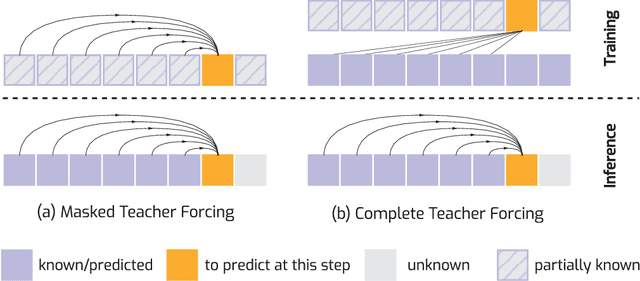
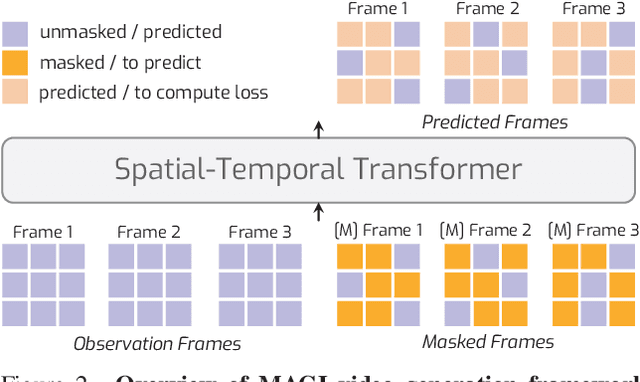
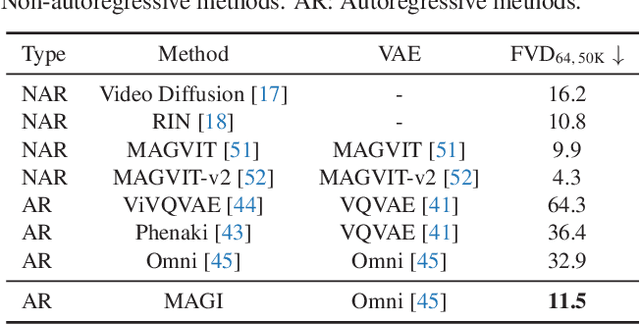
We introduce MAGI, a hybrid video generation framework that combines masked modeling for intra-frame generation with causal modeling for next-frame generation. Our key innovation, Complete Teacher Forcing (CTF), conditions masked frames on complete observation frames rather than masked ones (namely Masked Teacher Forcing, MTF), enabling a smooth transition from token-level (patch-level) to frame-level autoregressive generation. CTF significantly outperforms MTF, achieving a +23% improvement in FVD scores on first-frame conditioned video prediction. To address issues like exposure bias, we employ targeted training strategies, setting a new benchmark in autoregressive video generation. Experiments show that MAGI can generate long, coherent video sequences exceeding 100 frames, even when trained on as few as 16 frames, highlighting its potential for scalable, high-quality video generation.
Emu3: Next-Token Prediction is All You Need
Sep 27, 2024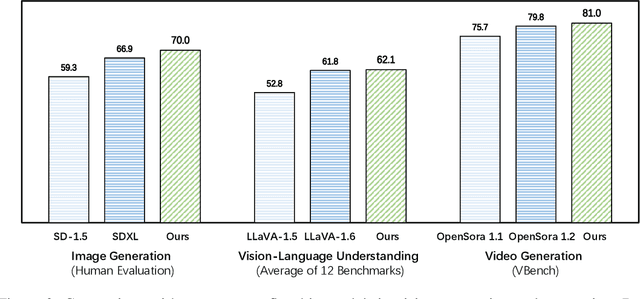

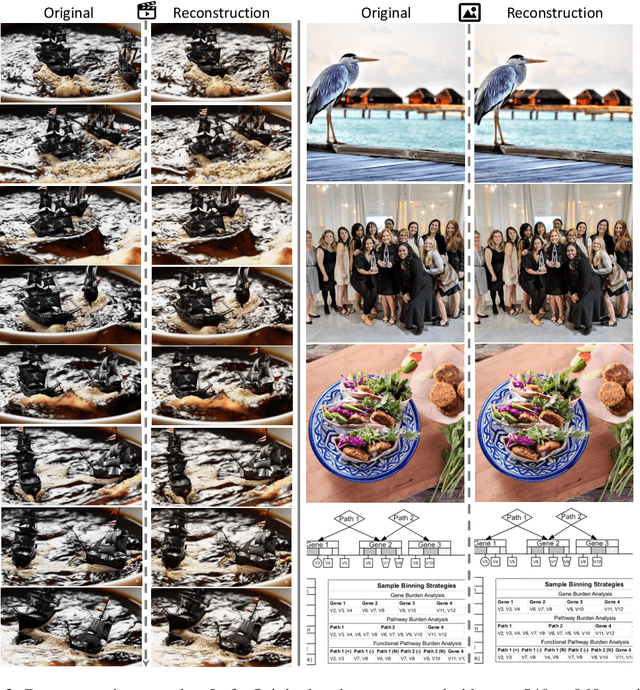
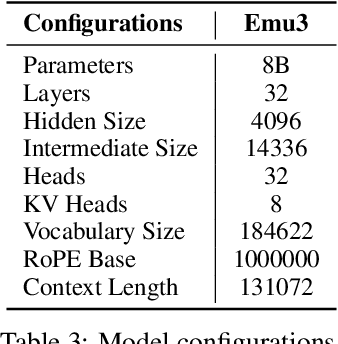
While next-token prediction is considered a promising path towards artificial general intelligence, it has struggled to excel in multimodal tasks, which are still dominated by diffusion models (e.g., Stable Diffusion) and compositional approaches (e.g., CLIP combined with LLMs). In this paper, we introduce Emu3, a new suite of state-of-the-art multimodal models trained solely with next-token prediction. By tokenizing images, text, and videos into a discrete space, we train a single transformer from scratch on a mixture of multimodal sequences. Emu3 outperforms several well-established task-specific models in both generation and perception tasks, surpassing flagship models such as SDXL and LLaVA-1.6, while eliminating the need for diffusion or compositional architectures. Emu3 is also capable of generating high-fidelity video via predicting the next token in a video sequence. We simplify complex multimodal model designs by converging on a singular focus: tokens, unlocking great potential for scaling both during training and inference. Our results demonstrate that next-token prediction is a promising path towards building general multimodal intelligence beyond language. We open-source key techniques and models to support further research in this direction.
Diffusion Feedback Helps CLIP See Better
Jul 29, 2024Contrastive Language-Image Pre-training (CLIP), which excels at abstracting open-world representations across domains and modalities, has become a foundation for a variety of vision and multimodal tasks. However, recent studies reveal that CLIP has severe visual shortcomings, such as which can hardly distinguish orientation, quantity, color, structure, etc. These visual shortcomings also limit the perception capabilities of multimodal large language models (MLLMs) built on CLIP. The main reason could be that the image-text pairs used to train CLIP are inherently biased, due to the lack of the distinctiveness of the text and the diversity of images. In this work, we present a simple post-training approach for CLIP models, which largely overcomes its visual shortcomings via a self-supervised diffusion process. We introduce DIVA, which uses the DIffusion model as a Visual Assistant for CLIP. Specifically, DIVA leverages generative feedback from text-to-image diffusion models to optimize CLIP representations, with only images (without corresponding text). We demonstrate that DIVA improves CLIP's performance on the challenging MMVP-VLM benchmark which assesses fine-grained visual abilities to a large extent (e.g., 3-7%), and enhances the performance of MLLMs and vision models on multimodal understanding and segmentation tasks. Extensive evaluation on 29 image classification and retrieval benchmarks confirms that our framework preserves CLIP's strong zero-shot capabilities. The code will be available at https://github.com/baaivision/DIVA.
EVA-CLIP-18B: Scaling CLIP to 18 Billion Parameters
Feb 06, 2024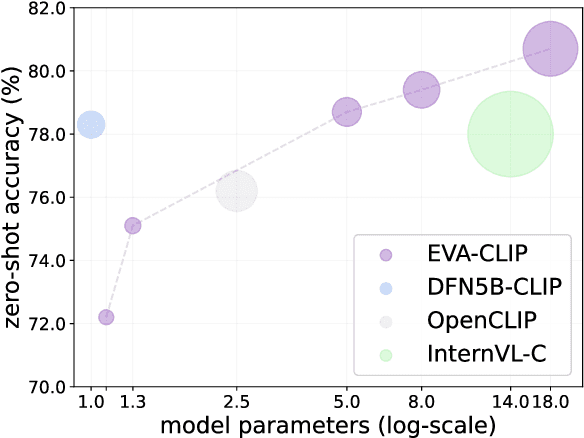
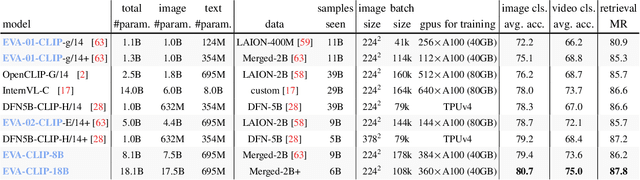
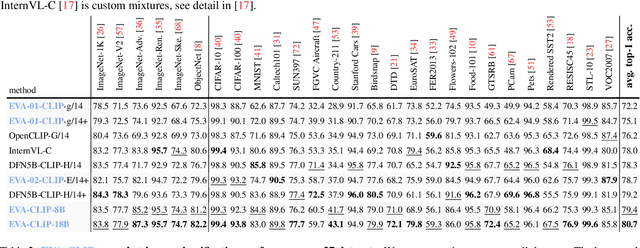
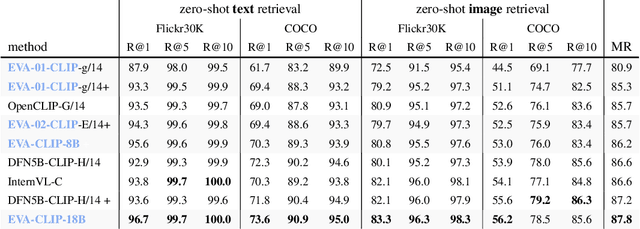
Scaling up contrastive language-image pretraining (CLIP) is critical for empowering both vision and multimodal models. We present EVA-CLIP-18B, the largest and most powerful open-source CLIP model to date, with 18-billion parameters. With only 6-billion training samples seen, EVA-CLIP-18B achieves an exceptional 80.7% zero-shot top-1 accuracy averaged across 27 widely recognized image classification benchmarks, outperforming its forerunner EVA-CLIP (5-billion parameters) and other open-source CLIP models by a large margin. Remarkably, we observe a consistent performance improvement with the model size scaling of EVA-CLIP, despite maintaining a constant training dataset of 2-billion image-text pairs from LAION-2B and COYO-700M. This dataset is openly available and much smaller than the in-house datasets (e.g., DFN-5B, WebLI-10B) employed in other state-of-the-art CLIP models. EVA-CLIP-18B demonstrates the potential of EVA-style weak-to-strong visual model scaling. With our model weights made publicly available, we hope to facilitate future research in vision and multimodal foundation models.
Generative Multimodal Models are In-Context Learners
Dec 20, 2023The human ability to easily solve multimodal tasks in context (i.e., with only a few demonstrations or simple instructions), is what current multimodal systems have largely struggled to imitate. In this work, we demonstrate that the task-agnostic in-context learning capabilities of large multimodal models can be significantly enhanced by effective scaling-up. We introduce Emu2, a generative multimodal model with 37 billion parameters, trained on large-scale multimodal sequences with a unified autoregressive objective. Emu2 exhibits strong multimodal in-context learning abilities, even emerging to solve tasks that require on-the-fly reasoning, such as visual prompting and object-grounded generation. The model sets a new record on multiple multimodal understanding tasks in few-shot settings. When instruction-tuned to follow specific instructions, Emu2 further achieves new state-of-the-art on challenging tasks such as question answering benchmarks for large multimodal models and open-ended subject-driven generation. These achievements demonstrate that Emu2 can serve as a base model and general-purpose interface for a wide range of multimodal tasks. Code and models are publicly available to facilitate future research.