 Add to Chrome
 Add to Firefox
 Add to Edge
SkillJect: Automating Stealthy Skill-Based Prompt Injection for Coding Agents with Trace-Driven Closed-Loop Refinement
Feb 15, 2026
Agent skills are becoming a core abstraction in coding agents, packaging long-form instructions and auxiliary scripts to extend tool-augmented behaviors. This abstraction introduces an under-measured attack surface: skill-based prompt injection, where poisoned skills can steer agents away from user intent and safety policies. In practice, naive injections often fail because the malicious intent is too explicit or drifts too far from the original skill, leading agents to ignore or refuse them; existing attacks are also largely hand-crafted. We propose the first automated framework for stealthy prompt injection tailored to agent skills. The framework forms a closed loop with three agents: an Attack Agent that synthesizes injection skills under explicit stealth constraints, a Code Agent that executes tasks using the injected skills in a realistic tool environment, and an Evaluate Agent that logs action traces (e.g., tool calls and file operations) and verifies whether targeted malicious behaviors occurred. We also propose a malicious payload hiding strategy that conceals adversarial operations in auxiliary scripts while injecting optimized inducement prompts to trigger tool execution. Extensive experiments across diverse coding-agent settings and real-world software engineering tasks show that our method consistently achieves high attack success rates under realistic settings.

Reason-IAD: Knowledge-Guided Dynamic Latent Reasoning for Explainable Industrial Anomaly Detection
Feb 10, 2026Industrial anomaly detection demands precise reasoning over fine-grained defect patterns. However, existing multimodal large language models (MLLMs), pretrained on general-domain data, often struggle to capture category-specific anomalies, thereby limiting both detection accuracy and interpretability. To address these limitations, we propose Reason-IAD, a knowledge-guided dynamic latent reasoning framework for explainable industrial anomaly detection. Reason-IAD comprises two core components. First, a retrieval-augmented knowledge module incorporates category-specific textual descriptions into the model input, enabling context-aware reasoning over domain-specific defects. Second, an entropy-driven latent reasoning mechanism conducts iterative exploration within a compact latent space using optimizable latent think tokens, guided by an entropy-based reward that encourages confident and stable predictions. Furthermore, a dynamic visual injection strategy selectively incorporates the most informative image patches into the latent sequence, directing the reasoning process toward regions critical for anomaly detection. Extensive experimental results demonstrate that Reason-IAD consistently outperforms state-of-the-art methods. The code will be publicly available at https://github.com/chenpeng052/Reason-IAD.
Sparse Layer Sharpness-Aware Minimization for Efficient Fine-Tuning
Feb 10, 2026Sharpness-aware minimization (SAM) seeks the minima with a flat loss landscape to improve the generalization performance in machine learning tasks, including fine-tuning. However, its extra parameter perturbation step doubles the computation cost, which becomes the bottleneck of SAM in the practical implementation. In this work, we propose an approach SL-SAM to break this bottleneck by introducing the sparse technique to layers. Our key innovation is to frame the dynamic selection of layers for both the gradient ascent (perturbation) and descent (update) steps as a multi-armed bandit problem. At the beginning of each iteration, SL-SAM samples a part of the layers of the model according to the gradient norm to participate in the backpropagation of the following parameter perturbation and update steps, thereby reducing the computation complexity. We then provide the analysis to guarantee the convergence of SL-SAM. In the experiments of fine-tuning models in several tasks, SL-SAM achieves the performances comparable to the state-of-the-art baselines, including a \#1 rank on LLM fine-tuning. Meanwhile, SL-SAM significantly reduces the ratio of active parameters in backpropagation compared to vanilla SAM (SL-SAM activates 47\%, 22\% and 21\% parameters on the vision, moderate and large language model respectively while vanilla SAM always activates 100\%), verifying the efficiency of our proposed algorithm.
SGHA-Attack: Semantic-Guided Hierarchical Alignment for Transferable Targeted Attacks on Vision-Language Models
Feb 02, 2026Large vision-language models (VLMs) are vulnerable to transfer-based adversarial perturbations, enabling attackers to optimize on surrogate models and manipulate black-box VLM outputs. Prior targeted transfer attacks often overfit surrogate-specific embedding space by relying on a single reference and emphasizing final-layer alignment, which underutilizes intermediate semantics and degrades transfer across heterogeneous VLMs. To address this, we propose SGHA-Attack, a Semantic-Guided Hierarchical Alignment framework that adopts multiple target references and enforces intermediate-layer consistency. Concretely, we generate a visually grounded reference pool by sampling a frozen text-to-image model conditioned on the target prompt, and then carefully select the Top-K most semantically relevant anchors under the surrogate to form a weighted mixture for stable optimization guidance. Building on these anchors, SGHA-Attack injects target semantics throughout the feature hierarchy by aligning intermediate visual representations at both global and spatial granularities across multiple depths, and by synchronizing intermediate visual and textual features in a shared latent subspace to provide early cross-modal supervision before the final projection. Extensive experiments on open-source and commercial black-box VLMs show that SGHA-Attack achieves stronger targeted transferability than prior methods and remains robust under preprocessing and purification defenses.
Mitigating Safety Tax via Distribution-Grounded Refinement in Large Reasoning Models
Feb 02, 2026Safety alignment incurs safety tax that perturbs a large reasoning model's (LRM) general reasoning ability. Existing datasets used for safety alignment for an LRM are usually constructed by distilling safety reasoning traces and answers from an external LRM or human labeler. However, such reasoning traces and answers exhibit a distributional gap with the target LRM that needs alignment, and we conjecture such distributional gap is the culprit leading to significant degradation of reasoning ability of the target LRM. Driven by this hypothesis, we propose a safety alignment dataset construction method, dubbed DGR. DGR transforms and refines an existing out-of-distributional safety reasoning dataset to be aligned with the target's LLM inner distribution. Experimental results demonstrate that i) DGR effectively mitigates the safety tax while maintaining safety performance across all baselines, i.e., achieving \textbf{+30.2\%} on DirectRefusal and \textbf{+21.2\%} on R1-ACT improvement in average reasoning accuracy compared to Vanilla SFT; ii) the degree of reasoning degradation correlates with the extent of distribution shift, suggesting that bridging this gap is central to preserving capabilities. Furthermore, we find that safety alignment in LRMs may primarily function as a mechanism to activate latent knowledge, as a mere \textbf{10} samples are sufficient for activating effective refusal behaviors. These findings not only emphasize the importance of distributional consistency but also provide insights into the activation mechanism of safety in reasoning models.
Where Not to Learn: Prior-Aligned Training with Subset-based Attribution Constraints for Reliable Decision-Making
Jan 30, 2026Reliable models should not only predict correctly, but also justify decisions with acceptable evidence. Yet conventional supervised learning typically provides only class-level labels, allowing models to achieve high accuracy through shortcut correlations rather than the intended evidence. Human priors can help constrain such behavior, but aligning models to these priors remains challenging because learned representations often diverge from human perception. To address this challenge, we propose an attribution-based human prior alignment method. We encode human priors as input regions that the model is expected to rely on (e.g., bounding boxes), and leverage a highly faithful subset-selection-based attribution approach to expose the model's decision evidence during training. When the attribution region deviates substantially from the prior regions, we penalize reliance on off-prior evidence, encouraging the model to shift its attribution toward the intended regions. This is achieved through a training objective that imposes attribution constraints induced by the human prior. We validate our method on both image classification and click decision tasks in MLLM-based GUI agent models. Across conventional classification and autoregressive generation settings, human prior alignment consistently improves task accuracy while also enhancing the model's decision reasonability.
Advancing Adaptive Multi-Stage Video Anomaly Reasoning: A Benchmark Dataset and Method
Jan 15, 2026Recent progress in reasoning capabilities of Multimodal Large Language Models(MLLMs) has highlighted their potential for performing complex video understanding tasks. However, in the domain of Video Anomaly Detection and Understanding (VAD&U), existing MLLM-based methods are largely limited to anomaly localization or post-hoc description, lacking explicit reasoning processes, risk awareness, and decision-oriented interpretation. To address this gap, we define a new task termed Video Anomaly Reasoning (VAR), which elevates video anomaly analysis from descriptive understanding to structured, multi-stage reasoning. VAR explicitly requires models to perform progressive reasoning over anomalous events before answering anomaly-related questions, encompassing visual perception, causal interpretation, and risk-aware decision making. To support this task, we present a new dataset with 8,641 videos, where each video is annotated with diverse question types corresponding to different reasoning depths, totaling more than 50,000 samples, making it one of the largest datasets for video anomaly. The annotations are based on a structured Perception-Cognition-Action Chain-of-Thought (PerCoAct-CoT), which formalizes domain-specific reasoning priors for video anomaly understanding. This design enables systematic evaluation of multi-stage and adaptive anomaly reasoning. In addition, we propose Anomaly-Aware Group Relative Policy Optimization to further enhance reasoning reliability under weak supervision. Building upon the proposed task and dataset, we develop an end-to-end MLLM-based VAR model termed Vad-R1-Plus, which supports adaptive hierarchical reasoning and risk-aware decision making. Extensive experiments demonstrate that the proposed benchmark and method effectively advance the reasoning capabilities of MLLMs on VAR tasks, outperforming both open-source and proprietary baselines.
UAGLNet: Uncertainty-Aggregated Global-Local Fusion Network with Cooperative CNN-Transformer for Building Extraction
Dec 15, 2025Building extraction from remote sensing images is a challenging task due to the complex structure variations of the buildings. Existing methods employ convolutional or self-attention blocks to capture the multi-scale features in the segmentation models, while the inherent gap of the feature pyramids and insufficient global-local feature integration leads to inaccurate, ambiguous extraction results. To address this issue, in this paper, we present an Uncertainty-Aggregated Global-Local Fusion Network (UAGLNet), which is capable to exploit high-quality global-local visual semantics under the guidance of uncertainty modeling. Specifically, we propose a novel cooperative encoder, which adopts hybrid CNN and transformer layers at different stages to capture the local and global visual semantics, respectively. An intermediate cooperative interaction block (CIB) is designed to narrow the gap between the local and global features when the network becomes deeper. Afterwards, we propose a Global-Local Fusion (GLF) module to complementarily fuse the global and local representations. Moreover, to mitigate the segmentation ambiguity in uncertain regions, we propose an Uncertainty-Aggregated Decoder (UAD) to explicitly estimate the pixel-wise uncertainty to enhance the segmentation accuracy. Extensive experiments demonstrate that our method achieves superior performance to other state-of-the-art methods. Our code is available at https://github.com/Dstate/UAGLNet
CODE ACROSTIC: Robust Watermarking for Code Generation
Dec 14, 2025Watermarking large language models (LLMs) is vital for preventing their misuse, including the fabrication of fake news, plagiarism, and spam. It is especially important to watermark LLM-generated code, as it often contains intellectual property.However, we found that existing methods for watermarking LLM-generated code fail to address comment removal attack.In such cases, an attacker can simply remove the comments from the generated code without affecting its functionality, significantly reducing the effectiveness of current code-watermarking techniques.On the other hand, injecting a watermark into code is challenging because, as previous works have noted, most code represents a low-entropy scenario compared to natural language. Our approach to addressing this issue involves leveraging prior knowledge to distinguish between low-entropy and high-entropy parts of the code, as indicated by a Cue List of words.We then inject the watermark guided by this Cue List, achieving higher detectability and usability than existing methods.We evaluated our proposed method on HumanEvaland compared our method with three state-of-the-art code watermarking techniques. The results demonstrate the effectiveness of our approach.
Learning Representation and Synergy Invariances: A Povable Framework for Generalized Multimodal Face Anti-Spoofing
Nov 18, 2025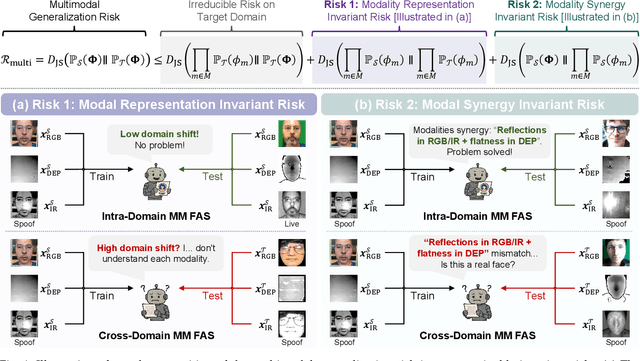
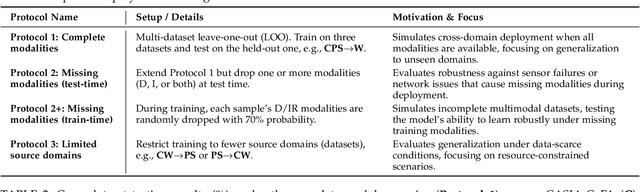
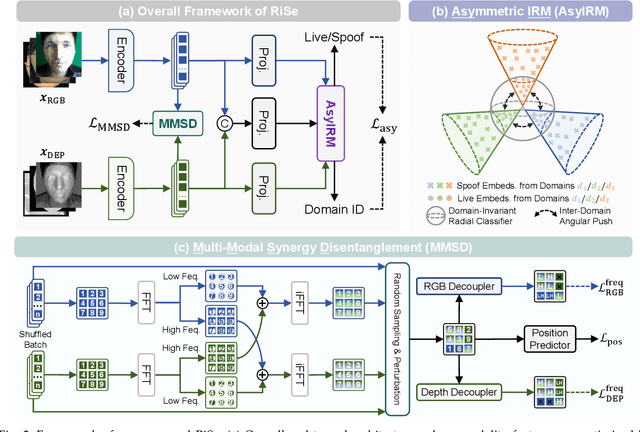
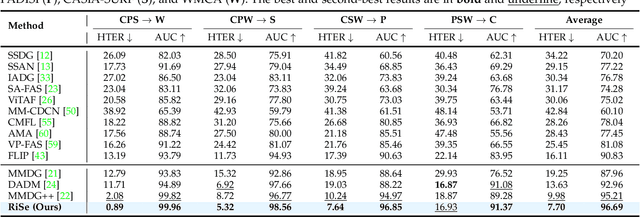
Multimodal Face Anti-Spoofing (FAS) methods, which integrate multiple visual modalities, often suffer even more severe performance degradation than unimodal FAS when deployed in unseen domains. This is mainly due to two overlooked risks that affect cross-domain multimodal generalization. The first is the modal representation invariant risk, i.e., whether representations remain generalizable under domain shift. We theoretically show that the inherent class asymmetry in FAS (diverse spoofs vs. compact reals) enlarges the upper bound of generalization error, and this effect is further amplified in multimodal settings. The second is the modal synergy invariant risk, where models overfit to domain-specific inter-modal correlations. Such spurious synergy cannot generalize to unseen attacks in target domains, leading to performance drops. To solve these issues, we propose a provable framework, namely Multimodal Representation and Synergy Invariance Learning (RiSe). For representation risk, RiSe introduces Asymmetric Invariant Risk Minimization (AsyIRM), which learns an invariant spherical decision boundary in radial space to fit asymmetric distributions, while preserving domain cues in angular space. For synergy risk, RiSe employs Multimodal Synergy Disentanglement (MMSD), a self-supervised task enhancing intrinsic, generalizable modal features via cross-sample mixing and disentanglement. Theoretical analysis and experiments verify RiSe, which achieves state-of-the-art cross-domain performance.