 Add to Chrome
 Add to Firefox
 Add to Edge
Render-in-the-Loop: Vector Graphics Generation via Visual Self-Feedback
Apr 22, 2026
Multimodal Large Language Models (MLLMs) have shown promising capabilities in generating Scalable Vector Graphics (SVG) via direct code synthesis. However, existing paradigms typically adopt an open-loop "blind drawing" approach, where models generate symbolic code sequences without perceiving intermediate visual outcomes. This methodology severely underutilizes the powerful visual priors embedded in MLLMs vision encoders, treating SVG generation as a disjointed textual sequence modeling task rather than an integrated visuo-spatial one. Consequently, models struggle to reason about partial canvas states and implicit occlusion relationships, which are visually explicit but textually ambiguous. To bridge this gap, we propose Render-in-the-Loop, a novel generation paradigm that reformulates SVG synthesis as a step-wise, visual-context-aware process. By rendering intermediate code states into a cumulative canvas, the model explicitly observes the evolving visual context at each step, leveraging on-the-fly feedback to guide subsequent generation. However, we demonstrate that applying this visual loop naively to off-the-shelf models is suboptimal due to their inability to leverage incremental visual-code mappings. To address this, we first utilize fine-grained path decomposition to construct dense multi-step visual trajectories, and then introduce a Visual Self-Feedback (VSF) training strategy to condition the next primitive generation on intermediate visual states. Furthermore, a Render-and-Verify (RaV) inference mechanism is proposed to effectively filter degenerate and redundant primitives. Our framework, instantiated on a multimodal foundation model, outperforms strong open-weight baselines on the standard MMSVGBench. This result highlights the remarkable data efficiency and generalization capability of our Render-in-the-Loop paradigm for both Text-to-SVG and Image-to-SVG tasks.

EventMemAgent: Hierarchical Event-Centric Memory for Online Video Understanding with Adaptive Tool Use
Feb 17, 2026Online video understanding requires models to perform continuous perception and long-range reasoning within potentially infinite visual streams. Its fundamental challenge lies in the conflict between the unbounded nature of streaming media input and the limited context window of Multimodal Large Language Models (MLLMs). Current methods primarily rely on passive processing, which often face a trade-off between maintaining long-range context and capturing the fine-grained details necessary for complex tasks. To address this, we introduce EventMemAgent, an active online video agent framework based on a hierarchical memory module. Our framework employs a dual-layer strategy for online videos: short-term memory detects event boundaries and utilizes event-granular reservoir sampling to process streaming video frames within a fixed-length buffer dynamically; long-term memory structuredly archives past observations on an event-by-event basis. Furthermore, we integrate a multi-granular perception toolkit for active, iterative evidence capture and employ Agentic Reinforcement Learning (Agentic RL) to end-to-end internalize reasoning and tool-use strategies into the agent's intrinsic capabilities. Experiments show that EventMemAgent achieves competitive results on online video benchmarks. The code will be released here: https://github.com/lingcco/EventMemAgent.
TwiFF (Think With Future Frames): A Large-Scale Dataset for Dynamic Visual Reasoning
Feb 11, 2026Visual Chain-of-Thought (VCoT) has emerged as a promising paradigm for enhancing multimodal reasoning by integrating visual perception into intermediate reasoning steps. However, existing VCoT approaches are largely confined to static scenarios and struggle to capture the temporal dynamics essential for tasks such as instruction, prediction, and camera motion. To bridge this gap, we propose TwiFF-2.7M, the first large-scale, temporally grounded VCoT dataset derived from $2.7$ million video clips, explicitly designed for dynamic visual question and answer. Accompanying this, we introduce TwiFF-Bench, a high-quality evaluation benchmark of $1,078$ samples that assesses both the plausibility of reasoning trajectories and the correctness of final answers in open-ended dynamic settings. Building on these foundations, we propose the TwiFF model, a unified modal that synergistically leverages pre-trained video generation and image comprehension capabilities to produce temporally coherent visual reasoning cues-iteratively generating future action frames and textual reasoning. Extensive experiments demonstrate that TwiFF significantly outperforms existing VCoT methods and Textual Chain-of-Thought baselines on dynamic reasoning tasks, which fully validates the effectiveness for visual question answering in dynamic scenarios. Our code and data is available at https://github.com/LiuJunhua02/TwiFF.
Where Not to Learn: Prior-Aligned Training with Subset-based Attribution Constraints for Reliable Decision-Making
Jan 30, 2026Reliable models should not only predict correctly, but also justify decisions with acceptable evidence. Yet conventional supervised learning typically provides only class-level labels, allowing models to achieve high accuracy through shortcut correlations rather than the intended evidence. Human priors can help constrain such behavior, but aligning models to these priors remains challenging because learned representations often diverge from human perception. To address this challenge, we propose an attribution-based human prior alignment method. We encode human priors as input regions that the model is expected to rely on (e.g., bounding boxes), and leverage a highly faithful subset-selection-based attribution approach to expose the model's decision evidence during training. When the attribution region deviates substantially from the prior regions, we penalize reliance on off-prior evidence, encouraging the model to shift its attribution toward the intended regions. This is achieved through a training objective that imposes attribution constraints induced by the human prior. We validate our method on both image classification and click decision tasks in MLLM-based GUI agent models. Across conventional classification and autoregressive generation settings, human prior alignment consistently improves task accuracy while also enhancing the model's decision reasonability.
TimeLoc: A Unified End-to-End Framework for Precise Timestamp Localization in Long Videos
Mar 09, 2025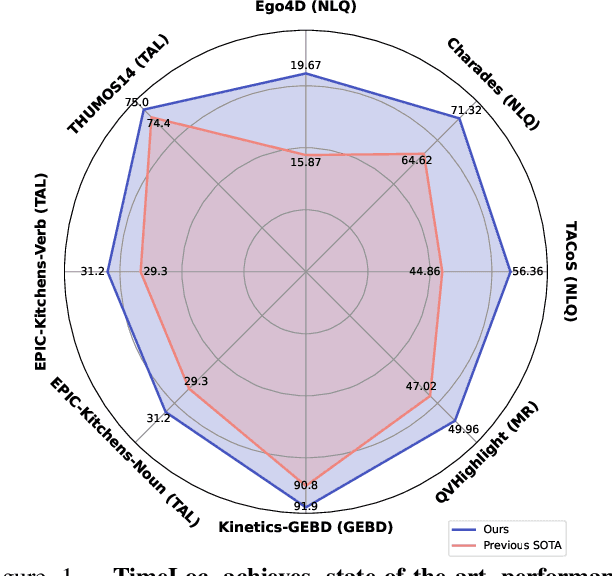
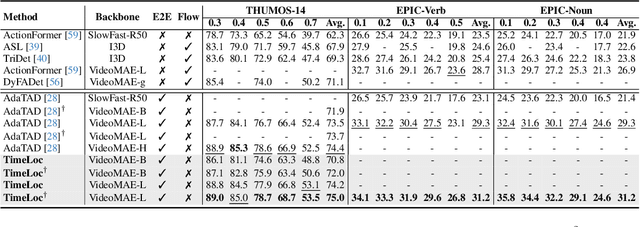
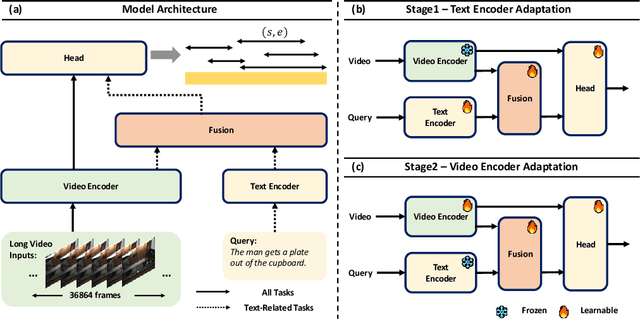
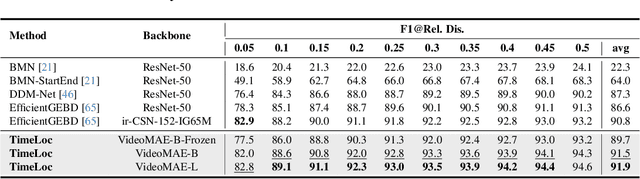
Temporal localization in untrimmed videos, which aims to identify specific timestamps, is crucial for video understanding but remains challenging. This task encompasses several subtasks, including temporal action localization, temporal video grounding, moment retrieval, and generic event boundary detection. Existing methods in each subfield are typically designed for specific tasks and lack generalizability across domains. In this paper, we propose TimeLoc, a unified end-to-end framework for timestamp localization that can handle multiple tasks. First, our approach employs a simple yet effective one-stage localization model that supports text queries as input and multiple actions as output. Second, we jointly train the video encoder and localization model in an end-to-end manner. To efficiently process long videos, we introduce temporal chunking, enabling the handling of videos with over 30k frames. Third, we find that fine-tuning pre-trained text encoders with a multi-stage training strategy further enhances text-conditioned localization. TimeLoc achieves state-of-the-art results across multiple benchmarks: +1.3% and +1.9% mAP over previous best methods on THUMOS14 and EPIC-Kitchens-100, +1.1% on Kinetics-GEBD, +2.94% mAP on QVHighlights, and significant improvements in temporal video grounding (+11.5% on TACoS and +6.7% on Charades-STA under R1@0.5). Our code and checkpoints will be released at https://github.com/sming256/TimeLoc.