 Add to Chrome
 Add to Firefox
 Add to Edge
ElasticBack: Stealthy Conditional Backdoor in LLM-Agent Skills via Coupled Trigger-Rule Optimization
Aug 10, 2026
Agent skills, bundles of instructions and resources that an LLM agent loads on demand, form an emerging supply chain where a single poisoned skill can persistently compromise every agent that installs it. However, existing skill attacks either fire on every request or rely on fine-tuned weights or multiple skills, leaving a conditional and low-cost backdoor unexplored. In this work, we present ElasticBack, an effective conditional single-skill backdoor that plants a rule R in the skill document and a benign-looking trigger T in the user query, so the malicious payload fires only when both co-occur. ElasticBack binds the two sides through a trigger-as-switch construction, generating R via semantic-anchored rule injection. It then freezes R and evolves T against it with a stealth-constrained genetic search, so that effectiveness and stealth are optimized, keeping the backdoor weight-free and dormant on benign inputs. Extensive experiments across three target behaviors (50 skills each) and four agent LLMs show that ElasticBack attains a high attack success rate at a near-zero false-positive rate with preserved clean accuracy, transfers across models, and evades deployment-time defenses. These results motivate stronger defenses for the skill supply chain.

ColluSkill: Adversarial Cross-Skill Composition for Evading Agent Skill Scanners
Aug 10, 2026Agent skills are emerging as an important attack surface in LLM-based agent systems. Through an empirical study of existing skill scanners, we find that current defenses mainly inspect individual skills, leaving risks from cross-skill composition insufficiently examined. This creates a practical blind spot: multiple locally plausible skills may pass security checks while collectively forming a harmful workflow during agent execution. To investigate this threat, we propose ColluSkill, a collusive multi-skill-chain attack framework that decomposes a complete malicious intent into interdependent sub-payloads embedded in independently packaged skills. The attack does not rely on any single malicious skill, but emerges from the ordered composition of locally plausible behaviors through contextual dependencies, artifact passing, and execution handoffs. ColluSkill further employs LLM-based chain planning and scanner-feedback refinement to preserve chain-level attack semantics while reducing suspicious signals in individual sub-skills. To defend against such attacks, we propose ChainGuard, a context-aware skill-chain scanner that jointly analyzes a candidate skill and the skills already installed in the agent environment. ChainGuard reconstructs cross-skill dependencies, artifact flows, capability compositions, and downstream behaviors to identify risks that emerge only at the workflow level. Experiments on six representative skill scanners show that ColluSkill achieves an average attack success rate of 96.0% and consistently outperforms the evaluated single-skill and multi-skill attack baselines. Meanwhile, ChainGuard reduces the attack success rate to 22.5% while allowing 99.5% of benign workflows to pass, highlighting the importance of chain-level security analysis for agent skill ecosystems.
ICO: Enhancing Semantic-Shift Jailbreaks via Iterative Context Optimization
Aug 04, 2026Foundation models have achieved remarkable success across diverse tasks, but they remain vulnerable. To investigate such vulnerabilities, semantic-shift jailbreaks have recently emerged as a promising attack paradigm. They bypass explicit safety mechanisms by replacing harmful terms in original harmful questions with benign alternatives and leveraging contextual information to induce the target model to reinterpret these alternatives as their corresponding harmful concepts. However, existing semantic-shift jailbreaks often achieve limited effectiveness. In this work, we reveal that this limitation arises from overlooking the semantic-shift capability of contexts. Through systematic analysis, we find that contexts exhibit substantially different abilities in inducing semantic shifts: contexts with stronger semantic-shift capabilities are more likely to guide models toward recovering harmful meanings and achieving successful jailbreaks. Based on this finding, we systematically identify and distill the characteristics of effective contexts and propose a black-box context-aware semantic-shift jailbreak framework with Iterative Context Optimization (ICO). In each iteration, ICO leverages these characteristics and feedback from the target model to optimize contexts. Extensive experiments on three datasets and eight target foundation models demonstrate that ICO consistently outperforms eight state-of-the-art baselines, achieving an average attack success rate of 74.6%.
Seeing Is Not Screening: Multimodal Hidden Instruction Attacks on Agent Skill Scanners
Jun 16, 2026Agent skills are emerging as an important attack surface in LLM-based systems. Through an empirical study of existing skill scanners, we find that current defenses primarily rely on textual descriptions, manifests, and source code as the main signals for security analysis, which can leave visually conveyed malicious intent insufficiently examined. This creates a practical blind spot: harmful operational instructions hidden in images may bypass scanning while still being recoverable by multimodal agents during deployment. To systematically investigate this threat, we propose SkillCamo, a document-mediated multimodal instruction attack that conceals malicious instructions within images bundled with a skill while rewriting the surrounding documentation to naturally reference those images as part of the normal workflow. Thus, the attack does not rely on the image alone, but on the joint interpretation of textual guidance and visual payload at execution time. To defend against such attacks, we further propose ExecScan, an execution-grounded multimodal scanning module that performs intent extraction, behavior reconstruction, abuse assessment, and deliberative execution simulation over skill artifacts. ExecScan jointly analyzes documentation, code, referenced resources, and visual content to recover hidden instructions, reconstruct executable behavior chains, and identify downstream risks such as exfiltration, destruction, persistence, deception, and privilege escalation. Extensive experiments show that image-hidden malicious instructions challenge existing skill scanners, while ExecScan can improve the skill scanning performance.
Reasoning as an Attack Surface: Adaptive Evolutionary CoT Jailbreaks for LLMs
May 23, 2026Large Reasoning Models (LRMs) have demonstrated remarkable capabilities in reasoning and generation tasks and are increasingly deployed in real-world applications. However, their explicit chain-of-thought (CoT) mechanism introduces new security risks, making them particularly vulnerable to jailbreak attacks. Existing approaches often rely on static CoT templates to elicit harmful outputs, but such fixed designs suffer from limited diversity, adaptability, and effectiveness. To overcome these limitations, we propose an adaptive evolutionary CoT jailbreak framework, called AE-CoT. Specifically, the method first rewrites harmful goals into mild prompts with teacher role-play and decomposes them into semantically coherent reasoning fragments to construct a pool of CoT jailbreak candidates. Then, within a structured representation space, we perform multi-generation evolutionary search, where candidate diversity is expanded through fragment-level crossover and a mutation strategy with an adaptive mutation-rate control mechanism. An independent scoring model provides graded harmfulness evaluations, and high-scoring candidates are further enhanced with a harmful CoT template to induce more destructive generations. Extensive experiments across multiple models and datasets demonstrate the effectiveness of the proposed AE-CoT, consistently outperforming state-of-the-art jailbreak methods.
ODAR: Principled Adaptive Routing for LLM Reasoning via Active Inference
Feb 27, 2026The paradigm of large language model (LLM) reasoning is shifting from parameter scaling to test-time compute scaling, yet many existing approaches still rely on uniform brute-force sampling (for example, fixed best-of-N or self-consistency) that is costly, hard to attribute, and can trigger overthinking with diminishing returns. We propose ODAR-Expert, an adaptive routing framework that optimizes the accuracy-efficiency trade-off via principled resource allocation. ODAR uses a difficulty estimator grounded in amortized active inference to dynamically route queries between a heuristic Fast Agent and a deliberative Slow Agent. We further introduce a free-energy-principled, risk-sensitive fusion mechanism that selects answers by minimizing a variational free energy objective, balancing log-likelihood with epistemic uncertainty (varentropy) as a principled alternative to ad hoc voting over heterogeneous candidates. Extensive evaluation across 23 benchmarks shows strong and consistent gains, including 98.2% accuracy on MATH and 54.8% on Humanity's Last Exam (HLE), while improving the compute-accuracy frontier under compute-matched settings. We also validate reproducibility on a fully open-source stack (Llama 4 + DeepSeek), where ODAR surpasses homogeneous sampling strategies while reducing computational costs by 82%. Overall, our results suggest that thinking-optimal scaling requires adaptive resource allocation with free-energy-based decision-making rather than simply increasing test-time compute.
Obscure but Effective: Classical Chinese Jailbreak Prompt Optimization via Bio-Inspired Search
Feb 26, 2026As Large Language Models (LLMs) are increasingly used, their security risks have drawn increasing attention. Existing research reveals that LLMs are highly susceptible to jailbreak attacks, with effectiveness varying across language contexts. This paper investigates the role of classical Chinese in jailbreak attacks. Owing to its conciseness and obscurity, classical Chinese can partially bypass existing safety constraints, exposing notable vulnerabilities in LLMs. Based on this observation, this paper proposes a framework, CC-BOS, for the automatic generation of classical Chinese adversarial prompts based on multi-dimensional fruit fly optimization, facilitating efficient and automated jailbreak attacks in black-box settings. Prompts are encoded into eight policy dimensions-covering role, behavior, mechanism, metaphor, expression, knowledge, trigger pattern and context; and iteratively refined via smell search, visual search, and cauchy mutation. This design enables efficient exploration of the search space, thereby enhancing the effectiveness of black-box jailbreak attacks. To enhance readability and evaluation accuracy, we further design a classical Chinese to English translation module. Extensive experiments demonstrate that effectiveness of the proposed CC-BOS, consistently outperforming state-of-the-art jailbreak attack methods.
SkillJect: Automating Stealthy Skill-Based Prompt Injection for Coding Agents with Trace-Driven Closed-Loop Refinement
Feb 15, 2026Agent skills are becoming a core abstraction in coding agents, packaging long-form instructions and auxiliary scripts to extend tool-augmented behaviors. This abstraction introduces an under-measured attack surface: skill-based prompt injection, where poisoned skills can steer agents away from user intent and safety policies. In practice, naive injections often fail because the malicious intent is too explicit or drifts too far from the original skill, leading agents to ignore or refuse them; existing attacks are also largely hand-crafted. We propose the first automated framework for stealthy prompt injection tailored to agent skills. The framework forms a closed loop with three agents: an Attack Agent that synthesizes injection skills under explicit stealth constraints, a Code Agent that executes tasks using the injected skills in a realistic tool environment, and an Evaluate Agent that logs action traces (e.g., tool calls and file operations) and verifies whether targeted malicious behaviors occurred. We also propose a malicious payload hiding strategy that conceals adversarial operations in auxiliary scripts while injecting optimized inducement prompts to trigger tool execution. Extensive experiments across diverse coding-agent settings and real-world software engineering tasks show that our method consistently achieves high attack success rates under realistic settings.
Advances and Innovations in the Multi-Agent Robotic System (MARS) Challenge
Jan 26, 2026Recent advancements in multimodal large language models and vision-languageaction models have significantly driven progress in Embodied AI. As the field transitions toward more complex task scenarios, multi-agent system frameworks are becoming essential for achieving scalable, efficient, and collaborative solutions. This shift is fueled by three primary factors: increasing agent capabilities, enhancing system efficiency through task delegation, and enabling advanced human-agent interactions. To address the challenges posed by multi-agent collaboration, we propose the Multi-Agent Robotic System (MARS) Challenge, held at the NeurIPS 2025 Workshop on SpaVLE. The competition focuses on two critical areas: planning and control, where participants explore multi-agent embodied planning using vision-language models (VLMs) to coordinate tasks and policy execution to perform robotic manipulation in dynamic environments. By evaluating solutions submitted by participants, the challenge provides valuable insights into the design and coordination of embodied multi-agent systems, contributing to the future development of advanced collaborative AI systems.
SugarTextNet: A Transformer-Based Framework for Detecting Sugar Dating-Related Content on Social Media with Context-Aware Focal Loss
Nov 11, 2025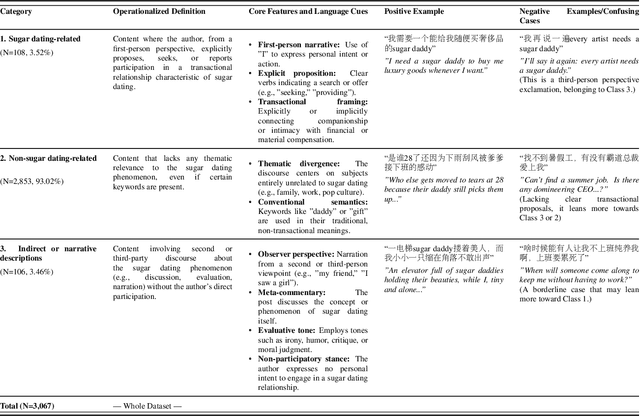
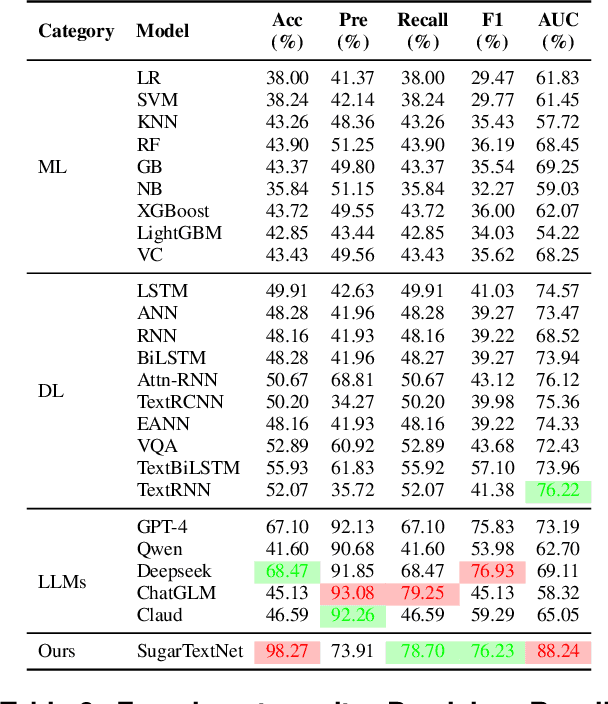
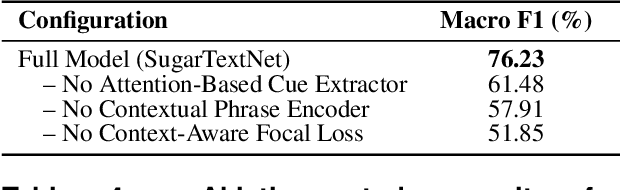
Sugar dating-related content has rapidly proliferated on mainstream social media platforms, giving rise to serious societal and regulatory concerns, including commercialization of intimate relationships and the normalization of transactional relationships.~Detecting such content is highly challenging due to the prevalence of subtle euphemisms, ambiguous linguistic cues, and extreme class imbalance in real-world data.~In this work, we present SugarTextNet, a novel transformer-based framework specifically designed to identify sugar dating-related posts on social media.~SugarTextNet integrates a pretrained transformer encoder, an attention-based cue extractor, and a contextual phrase encoder to capture both salient and nuanced features in user-generated text.~To address class imbalance and enhance minority-class detection, we introduce Context-Aware Focal Loss, a tailored loss function that combines focal loss scaling with contextual weighting.~We evaluate SugarTextNet on a newly curated, manually annotated dataset of 3,067 Chinese social media posts from Sina Weibo, demonstrating that our approach substantially outperforms traditional machine learning models, deep learning baselines, and large language models across multiple metrics.~Comprehensive ablation studies confirm the indispensable role of each component.~Our findings highlight the importance of domain-specific, context-aware modeling for sensitive content detection, and provide a robust solution for content moderation in complex, real-world scenarios.