 Add to Chrome
 Add to Firefox
 Add to Edge
Open-H-Embodiment: A Large-Scale Dataset for Enabling Foundation Models in Medical Robotics
Apr 22, 2026
Autonomous medical robots hold promise to improve patient outcomes, reduce provider workload, democratize access to care, and enable superhuman precision. However, autonomous medical robotics has been limited by a fundamental data problem: existing medical robotic datasets are small, single-embodiment, and rarely shared openly, restricting the development of foundation models that the field needs to advance. We introduce Open-H-Embodiment, the largest open dataset of medical robotic video with synchronized kinematics to date, spanning more than 49 institutions and multiple robotic platforms including the CMR Versius, Intuitive Surgical's da Vinci, da Vinci Research Kit (dVRK), Rob Surgical BiTrack, Virtual Incision's MIRA, Moon Surgical Maestro, and a variety of custom systems, spanning surgical manipulation, robotic ultrasound, and endoscopy procedures. We demonstrate the research enabled by this dataset through two foundation models. GR00T-H is the first open foundation vision-language-action model for medical robotics, which is the only evaluated model to achieve full end-to-end task completion on a structured suturing benchmark (25% of trials vs. 0% for all others) and achieves 64% average success across a 29-step ex vivo suturing sequence. We also train Cosmos-H-Surgical-Simulator, the first action-conditioned world model to enable multi-embodiment surgical simulation from a single checkpoint, spanning nine robotic platforms and supporting in silico policy evaluation and synthetic data generation for the medical domain. These results suggest that open, large-scale medical robot data collection can serve as critical infrastructure for the research community, enabling advances in robot learning, world modeling, and beyond.

Ultrasound-CLIP: Semantic-Aware Contrastive Pre-training for Ultrasound Image-Text Understanding
Apr 02, 2026Ultrasound imaging is widely used in clinical diagnostics due to its real-time capability and radiation-free nature. However, existing vision-language pre-training models, such as CLIP, are primarily designed for other modalities, and are difficult to directly apply to ultrasound data, which exhibit heterogeneous anatomical structures and diverse diagnostic attributes. To bridge this gap, we construct US-365K, a large-scale ultrasound image-text dataset containing 365k paired samples across 52 anatomical categories. We establish Ultrasonographic Diagnostic Taxonomy (UDT) containing two hierarchical knowledge frameworks. Ultrasonographic Hierarchical Anatomical Taxonomy standardizes anatomical organization, and Ultrasonographic Diagnostic Attribute Framework formalizes nine diagnostic dimensions, including body system, organ, diagnosis, shape, margins, echogenicity, internal characteristics, posterior acoustic phenomena, and vascularity. Building upon these foundations, we propose Ultrasound-CLIP, a semantic-aware contrastive learning framework that introduces semantic soft labels and semantic loss to refine sample discrimination. Moreover, we construct a heterogeneous graph modality derived from UDAF's textual representations, enabling structured reasoning over lesion-attribute relations. Extensive experiments with patient-level data splitting demonstrate that our approach achieves state-of-the-art performance on classification and retrieval benchmarks, while also delivering strong generalization to zero-shot, linear probing, and fine-tuning tasks.
Where Not to Learn: Prior-Aligned Training with Subset-based Attribution Constraints for Reliable Decision-Making
Jan 30, 2026Reliable models should not only predict correctly, but also justify decisions with acceptable evidence. Yet conventional supervised learning typically provides only class-level labels, allowing models to achieve high accuracy through shortcut correlations rather than the intended evidence. Human priors can help constrain such behavior, but aligning models to these priors remains challenging because learned representations often diverge from human perception. To address this challenge, we propose an attribution-based human prior alignment method. We encode human priors as input regions that the model is expected to rely on (e.g., bounding boxes), and leverage a highly faithful subset-selection-based attribution approach to expose the model's decision evidence during training. When the attribution region deviates substantially from the prior regions, we penalize reliance on off-prior evidence, encouraging the model to shift its attribution toward the intended regions. This is achieved through a training objective that imposes attribution constraints induced by the human prior. We validate our method on both image classification and click decision tasks in MLLM-based GUI agent models. Across conventional classification and autoregressive generation settings, human prior alignment consistently improves task accuracy while also enhancing the model's decision reasonability.
Where MLLMs Attend and What They Rely On: Explaining Autoregressive Token Generation
Sep 26, 2025Multimodal large language models (MLLMs) have demonstrated remarkable capabilities in aligning visual inputs with natural language outputs. Yet, the extent to which generated tokens depend on visual modalities remains poorly understood, limiting interpretability and reliability. In this work, we present EAGLE, a lightweight black-box framework for explaining autoregressive token generation in MLLMs. EAGLE attributes any selected tokens to compact perceptual regions while quantifying the relative influence of language priors and perceptual evidence. The framework introduces an objective function that unifies sufficiency (insight score) and indispensability (necessity score), optimized via greedy search over sparsified image regions for faithful and efficient attribution. Beyond spatial attribution, EAGLE performs modality-aware analysis that disentangles what tokens rely on, providing fine-grained interpretability of model decisions. Extensive experiments across open-source MLLMs show that EAGLE consistently outperforms existing methods in faithfulness, localization, and hallucination diagnosis, while requiring substantially less GPU memory. These results highlight its effectiveness and practicality for advancing the interpretability of MLLMs. The code is available at https://github.com/RuoyuChen10/EAGLE.
U2-BENCH: Benchmarking Large Vision-Language Models on Ultrasound Understanding
May 23, 2025Ultrasound is a widely-used imaging modality critical to global healthcare, yet its interpretation remains challenging due to its varying image quality on operators, noises, and anatomical structures. Although large vision-language models (LVLMs) have demonstrated impressive multimodal capabilities across natural and medical domains, their performance on ultrasound remains largely unexplored. We introduce U2-BENCH, the first comprehensive benchmark to evaluate LVLMs on ultrasound understanding across classification, detection, regression, and text generation tasks. U2-BENCH aggregates 7,241 cases spanning 15 anatomical regions and defines 8 clinically inspired tasks, such as diagnosis, view recognition, lesion localization, clinical value estimation, and report generation, across 50 ultrasound application scenarios. We evaluate 20 state-of-the-art LVLMs, both open- and closed-source, general-purpose and medical-specific. Our results reveal strong performance on image-level classification, but persistent challenges in spatial reasoning and clinical language generation. U2-BENCH establishes a rigorous and unified testbed to assess and accelerate LVLM research in the uniquely multimodal domain of medical ultrasound imaging.
IterMask3D: Unsupervised Anomaly Detection and Segmentation with Test-Time Iterative Mask Refinement in 3D Brain MR
Apr 07, 2025Unsupervised anomaly detection and segmentation methods train a model to learn the training distribution as 'normal'. In the testing phase, they identify patterns that deviate from this normal distribution as 'anomalies'. To learn the `normal' distribution, prevailing methods corrupt the images and train a model to reconstruct them. During testing, the model attempts to reconstruct corrupted inputs based on the learned 'normal' distribution. Deviations from this distribution lead to high reconstruction errors, which indicate potential anomalies. However, corrupting an input image inevitably causes information loss even in normal regions, leading to suboptimal reconstruction and an increased risk of false positives. To alleviate this, we propose IterMask3D, an iterative spatial mask-refining strategy designed for 3D brain MRI. We iteratively spatially mask areas of the image as corruption and reconstruct them, then shrink the mask based on reconstruction error. This process iteratively unmasks 'normal' areas to the model, whose information further guides reconstruction of 'normal' patterns under the mask to be reconstructed accurately, reducing false positives. In addition, to achieve better reconstruction performance, we also propose using high-frequency image content as additional structural information to guide the reconstruction of the masked area. Extensive experiments on the detection of both synthetic and real-world imaging artifacts, as well as segmentation of various pathological lesions across multiple MRI sequences, consistently demonstrate the effectiveness of our proposed method.
Bridge the Gap Between Visual and Linguistic Comprehension for Generalized Zero-shot Semantic Segmentation
Mar 31, 2025Generalized zero-shot semantic segmentation (GZS3) aims to achieve the human-level capability of segmenting not only seen classes but also novel class regions unseen in the training data through introducing the bridge of semantic representations, e.g., word vector. While effective, the way of utilizing one semantic representation to associate the corresponding class and to enable the knowledge transfer from seen to unseen classes is insufficient as well as incompatible with human cognition. Inspired by the observation that humans often use some `part' and `state' information to comprehend the seen objects and imagine unseen classes, we decouple each class into detailed descriptions, including object parts and states. Based on the decoupling formulation, we propose a Decoupled Vision-Language Matching (DeVLMatch) framework, composed of spatial-part (SPMatch) and channel-state (CSMatch) matching modules, for GZS3. In SPMatch, we comprehend objects with spatial part information from both visual and linguistic perspectives and perform graph matching to bridge the gap. In CSMatch, states of objects from the linguistic perspective are matched to compatible channel information from the visual perspective. By decoupling and matching objects across visual and linguistic comprehension, we can explicitly introspect the relationship between seen and unseen classes in fine-grained object part and state levels, thereby facilitating the knowledge transfer from seen to unseen classes in visual space. The proposed DeVLMatch framework surpasses the previous GZS3 methods on standard benchmarks, including PASCAL VOC, COCO-Stuff, and CATARACTS, demonstrating its effectiveness.
Pose-GuideNet: Automatic Scanning Guidance for Fetal Head Ultrasound from Pose Estimation
Aug 19, 2024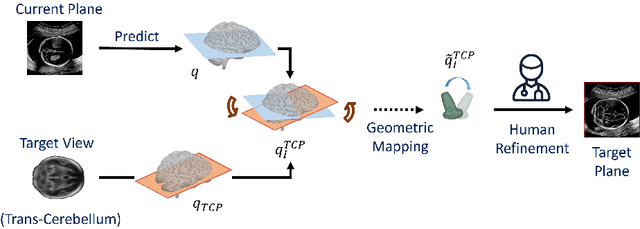

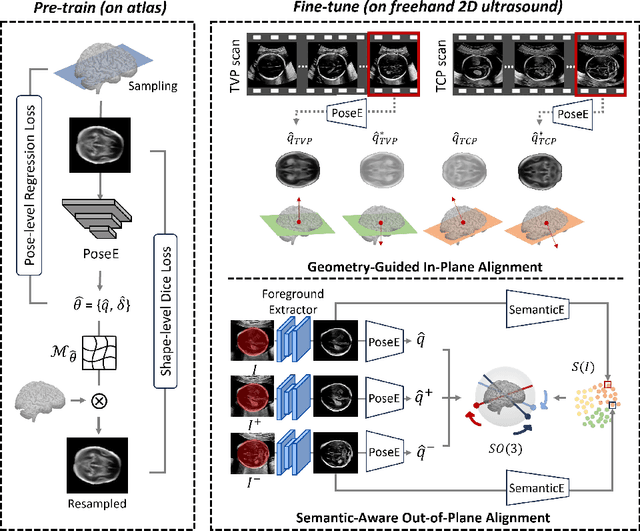
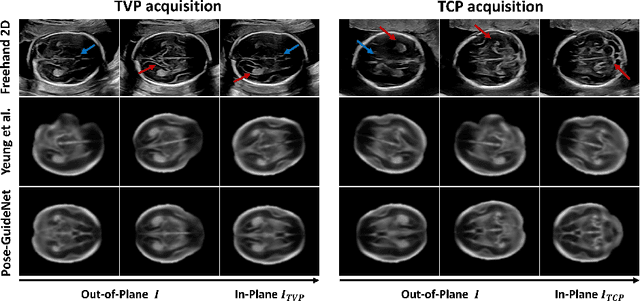
3D pose estimation from a 2D cross-sectional view enables healthcare professionals to navigate through the 3D space, and such techniques initiate automatic guidance in many image-guided radiology applications. In this work, we investigate how estimating 3D fetal pose from freehand 2D ultrasound scanning can guide a sonographer to locate a head standard plane. Fetal head pose is estimated by the proposed Pose-GuideNet, a novel 2D/3D registration approach to align freehand 2D ultrasound to a 3D anatomical atlas without the acquisition of 3D ultrasound. To facilitate the 2D to 3D cross-dimensional projection, we exploit the prior knowledge in the atlas to align the standard plane frame in a freehand scan. A semantic-aware contrastive-based approach is further proposed to align the frames that are off standard planes based on their anatomical similarity. In the experiment, we enhance the existing assessment of freehand image localization by comparing the transformation of its estimated pose towards standard plane with the corresponding probe motion, which reflects the actual view change in 3D anatomy. Extensive results on two clinical head biometry tasks show that Pose-GuideNet not only accurately predicts pose but also successfully predicts the direction of the fetal head. Evaluations with probe motions further demonstrate the feasibility of adopting Pose-GuideNet for freehand ultrasound-assisted navigation in a sensor-free environment.
MMSummary: Multimodal Summary Generation for Fetal Ultrasound Video
Aug 07, 2024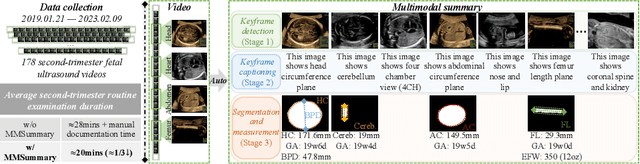

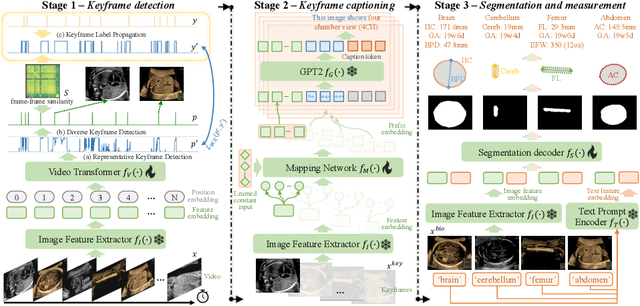
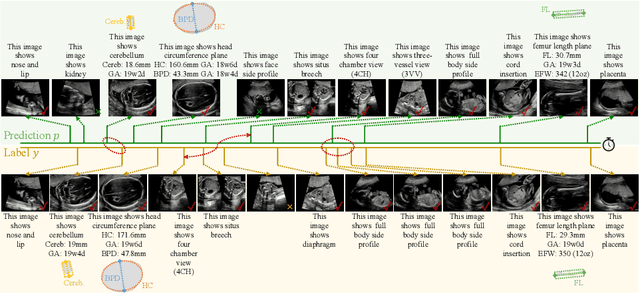
We present the first automated multimodal summary generation system, MMSummary, for medical imaging video, particularly with a focus on fetal ultrasound analysis. Imitating the examination process performed by a human sonographer, MMSummary is designed as a three-stage pipeline, progressing from keyframe detection to keyframe captioning and finally anatomy segmentation and measurement. In the keyframe detection stage, an innovative automated workflow is proposed to progressively select a concise set of keyframes, preserving sufficient video information without redundancy. Subsequently, we adapt a large language model to generate meaningful captions for fetal ultrasound keyframes in the keyframe captioning stage. If a keyframe is captioned as fetal biometry, the segmentation and measurement stage estimates biometric parameters by segmenting the region of interest according to the textual prior. The MMSummary system provides comprehensive summaries for fetal ultrasound examinations and based on reported experiments is estimated to reduce scanning time by approximately 31.5%, thereby suggesting the potential to enhance clinical workflow efficiency.
IterMask2: Iterative Unsupervised Anomaly Segmentation via Spatial and Frequency Masking for Brain Lesions in MRI
Jun 04, 2024Unsupervised anomaly segmentation approaches to pathology segmentation train a model on images of healthy subjects, that they define as the 'normal' data distribution. At inference, they aim to segment any pathologies in new images as 'anomalies', as they exhibit patterns that deviate from those in 'normal' training data. Prevailing methods follow the 'corrupt-and-reconstruct' paradigm. They intentionally corrupt an input image, reconstruct it to follow the learned 'normal' distribution, and subsequently segment anomalies based on reconstruction error. Corrupting an input image, however, inevitably leads to suboptimal reconstruction even of normal regions, causing false positives. To alleviate this, we propose a novel iterative spatial mask-refining strategy IterMask2. We iteratively mask areas of the image, reconstruct them, and update the mask based on reconstruction error. This iterative process progressively adds information about areas that are confidently normal as per the model. The increasing content guides reconstruction of nearby masked areas, improving reconstruction of normal tissue under these areas, reducing false positives. We also use high-frequency image content as an auxiliary input to provide additional structural information for masked areas. This further improves reconstruction error of normal in comparison to anomalous areas, facilitating segmentation of the latter. We conduct experiments on several brain lesion datasets and demonstrate effectiveness of our method. Code is available at: https://github.com/ZiyunLiang/IterMasks2