 Add to Chrome
 Add to Firefox
 Add to Edge
DyFrDet: Towards Accurate Small Object Detection via Dynamic Frequency Suppression with Label Disambiguation
Aug 03, 2026
Despite the remarkable progress over the past decades, accurately identifying small objects remains challenging because of their insufficient visual cues. Previous works typically attempt to construct discriminative representation of the small objects. However, the wide range frequency domain noises and label ambiguities have been greatly overlooked, which significantly hinders the accurate localization. To address these issues, we propose a novel small object detection (SOD) detector termed DyFrDet, which is able to precisely localize the small object by dynamically suppressing the background distractions in frequency domain. Specifically, we propose a Dynamic Frequency-aware Feature Pyramid Network (DyFrFPN) to adaptively suppress low-frequency redundancy and excessive high-frequency noises. The DyFrFPN transforms the hierarchical features into frequency domain representation, and introduces a Dynamic Band Predictor (DBP) to preserve the discriminative components for small object identification. Afterwards, we present a novel Label Disambiguation Module (LDM), which leverages probabilistic distributions to explicitly model and alleviate the inherent ambiguity of target labels, yielding efficient improvement in localization precision of the small objects with low-resolution. Extensive experiments demonstrate that DyFrDet achieves state-of-the-art performance across multiple benchmarks, indicating its effectiveness and robustness in various challenging scenarios. Our code is available at https://github.com/ManOfStory/DyFrDet.

MoCRA: Mixture of Compositional Rank-1 Atoms for 4K All-in-One Video Restoration
Aug 03, 2026Real-world video arrives hazy, rainy, dark, or noisy, and a deployable restorer faces three demands at once: no degradation label, native 4K output, and stability in playback. Existing methods answer them separately and break on the joint problem, because per-frame degradation readings flip between frames, downsampled proxies erase the rain and noise they are meant to remove, and dense temporal alignment does not fit 4K memory. No paired benchmark even poses that problem, so we build one. UHV-4K-AIO renders physically modeled haze, rain, sensor noise, and low light over the same 100 clean 4K clips with shared depth and motion, and its construction exposes the split MoCRA is built on: haze and low light survive aggressive downsampling, while rain and noise exist only at native scale. Band-matched compositional conditioning follows, spending conditioning capacity, computation, and supervision in the band where each degradation lives. One dictionary of rank-1 atoms, recomposed sparsely per frame, conditions both a once-per-clip coarse branch and a shallow native-resolution refiner, in 3.6M parameters and with no optical flow. Trained once for all four tasks, MoCRA takes the best task-mean PSNR of eleven retrained image and video baselines, holds warping error at the level of the flow-based video models while never estimating motion, and restores native 4K in under half a second, against 1.7 seconds for the fastest baseline.
Loop-Mamba: A Loop Mamba with Degradation-Aware and Shared Memory for Old Photo Restoration
Aug 03, 2026Old photographs often suffer from multiple coupled degradations, including scratches, cracks, fading, blur, noise, and missing regions, severely degrading both visual quality and semantic content. We propose Loop-Mamba, a lightweight loop-based state-space framework that formulates old photo restoration as progressive state evolution, where a persis- tent restoration state is continuously propagated and refined through iterative computation. Specifically, we introduce a Semantic-Guided Degradation Estimator (SGDE) to explicitly model heterogeneous degradations by jointly predicting local degradation maps and global degradation scores, providing degradation-aware guidance for state evolution. We further develop a Shared Structural Memory Mamba (S$^2$M- Mamba), which maintains a persistent restoration state across iterations, enabling persistent state evolution through shared structural memory for robust long-range structural reconstruction. Benefiting from first-order state recursion, Loop-Mamba propagates latent restoration states through recurrent tran- sitions instead of repeatedly stacking deep feature transformations, thereby alleviating gradient dilution while avoiding the computational overhead inherent in iterative CNN- and Transformer-based restoration frameworks. A lightweight multi-directional scanning strategy further enhances direc- tional information aggregation and preserves structural continuity. To better evaluate restoration quality, we introduce the task-oriented Old Photo Damage Recovery Score (ODRS), which jointly measures degradation recovery and structural reconstruction fidelity. Experimental results on the public SynOld benchmark demonstrate that Loop-Mamba consistently outperforms previous state-of-the-art methods across both conventional restoration metrics and the proposed ODRS.
SFDATrack: Generalized Source-Free Domain Adaptive Tracking Under Adverse Weather Conditions
Jul 01, 2026Domain adaptive visual object tracking under adverse weather conditions has garnered significant attention in recent years. Despite the impressive performance, existing methods heavily rely on the large-scale video frames from both source and target domains, which is impractical under rigid resource constraints where source data is unavailable. To overcome this limitation, we propose SFDATrack, a generalized source-free domain adaptive tracker that merely leverages adverse weather samples from the target domain for robust state estimation. Specifically, SFDATrack first employs a mean-teacher backbone with Dual Interactive Mamba (DIM) blocks to distill the candidate target tokens that are resilient to weather variations from classified, augmented samples. Afterwards, we introduce a hyperspherical prototype projection (HPP) module to project these tokens onto multi-domain prototypes within a latent hyperspherical space. By enforcing both domain-specific and domain-invariant properties of the multi-domain prototypes, SFDATrack can be seamlessly adapted to diverse weather conditions with powerful generalizability. Extensive experiments evaluated on various benchmarks demonstrate that SFDATrack achieves superior performance compared to state-of-the-art approaches. The code is available at https://github.com/watcherBR0/sfdatrack.
Adaptive Spectrum-Aware Feature Disentangled Network for Small Object Detection
Jun 27, 2026Small Object Detection (SOD) is a fundamental yet challenging problem in computer vision due to its limited spatial resolution and weak visual cues. Although recent approaches have achieved remarkable advances, the background distractors in different frequency spectra still degrade the performance. In this paper, we propose a novel small object detection framework termed SFDNet, which is capable of detecting small objects via efficient spectrum-aware feature disentanglement. Specifically, we propose an Adaptive Spectrum Disentanglement (ASD) module that decomposes backbone features into multiple complementary spectral components, aiming to construct discriminative object-relevant representations by discarding the background distractors for each component. Afterwards, to strengthen the semantic consistency of the similar objects in the same class, we propose a Class-Wise Prototype Distillation (CPD) procedure, which establishes class prototypes for the object instances and enforces the compact representation by efficient prototype distillation. Extensive experiments on multiple challenging benchmarks show that SFDNet outperforms existing state-of-the-art methods by a large margin. Our code is available at https://github.com/ManOfStory/SFDNet.
Leveraging Multimodal LLMs for Built Environment and Housing Attribute Assessment from Street-View Imagery
Apr 22, 2026We present a novel framework for automatically evaluating building conditions nationwide in the United States by leveraging large language models (LLMs) and Google Street View (GSV) imagery. By fine-tuning Gemma 3 27B on a modest human-labeled dataset, our approach achieves strong alignment with human mean opinion scores (MOS), outperforming even individual raters on SRCC and PLCC relative to the MOS benchmark. To enhance efficiency, we apply knowledge distillation, transferring the capabilities of Gemma 3 27B to a smaller Gemma 3 4B model that achieves comparable performance with a 3x speedup. Further, we distill the knowledge into a CNN-based model (EfficientNetV2-M) and a transformer (SwinV2-B), delivering close performance while achieving a 30x speed gain. Furthermore, we investigate LLMs' capabilities for assessing an extensive list of built environment and housing attributes through a human-AI alignment study and develop a visualization dashboard that integrates LLM assessment outcomes for downstream analysis by homeowners. Our framework offers a flexible and efficient solution for large-scale building condition assessment, enabling high accuracy with minimal human labeling effort.
CAMotion: A High-Quality Benchmark for Camouflaged Moving Object Detection in the Wild
Apr 09, 2026Discovering camouflaged objects is a challenging task in computer vision due to the high similarity between camouflaged objects and their surroundings. While the problem of camouflaged object detection over sequential video frames has received increasing attention, the scale and diversity of existing video camouflaged object detection (VCOD) datasets are greatly limited, which hinders the deeper analysis and broader evaluation of recent deep learning-based algorithms with data-hungry training strategy. To break this bottleneck, in this paper, we construct CAMotion, a high-quality benchmark covers a wide range of species for camouflaged moving object detection in the wild. CAMotion comprises various sequences with multiple challenging attributes such as uncertain edge, occlusion, motion blur, and shape complexity, etc. The sequence annotation details and statistical distribution are presented from various perspectives, allowing CAMotion to provide in-depth analyses on the camouflaged object's motion characteristics in different challenging scenarios. Additionally, we conduct a comprehensive evaluation of existing SOTA models on CAMotion, and discuss the major challenges in VCOD task. The benchmark is available at https://www.camotion.focuslab.net.cn, we hope that our CAMotion can lead to further advancements in the research community.
UAGLNet: Uncertainty-Aggregated Global-Local Fusion Network with Cooperative CNN-Transformer for Building Extraction
Dec 15, 2025Building extraction from remote sensing images is a challenging task due to the complex structure variations of the buildings. Existing methods employ convolutional or self-attention blocks to capture the multi-scale features in the segmentation models, while the inherent gap of the feature pyramids and insufficient global-local feature integration leads to inaccurate, ambiguous extraction results. To address this issue, in this paper, we present an Uncertainty-Aggregated Global-Local Fusion Network (UAGLNet), which is capable to exploit high-quality global-local visual semantics under the guidance of uncertainty modeling. Specifically, we propose a novel cooperative encoder, which adopts hybrid CNN and transformer layers at different stages to capture the local and global visual semantics, respectively. An intermediate cooperative interaction block (CIB) is designed to narrow the gap between the local and global features when the network becomes deeper. Afterwards, we propose a Global-Local Fusion (GLF) module to complementarily fuse the global and local representations. Moreover, to mitigate the segmentation ambiguity in uncertain regions, we propose an Uncertainty-Aggregated Decoder (UAD) to explicitly estimate the pixel-wise uncertainty to enhance the segmentation accuracy. Extensive experiments demonstrate that our method achieves superior performance to other state-of-the-art methods. Our code is available at https://github.com/Dstate/UAGLNet
iVR-GS: Inverse Volume Rendering for Explorable Visualization via Editable 3D Gaussian Splatting
Apr 24, 2025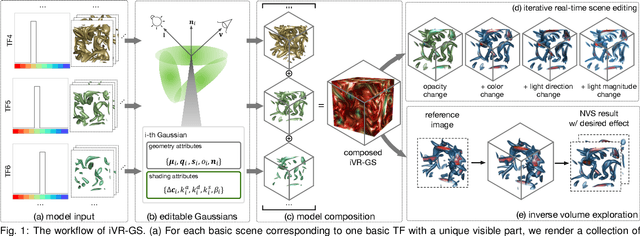
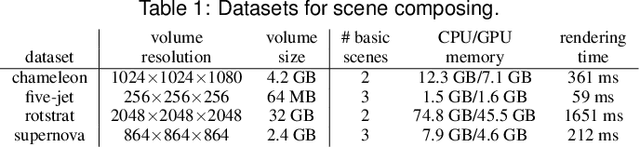
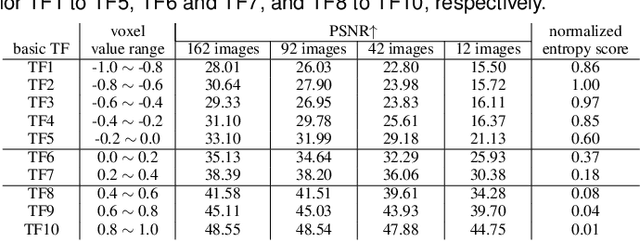
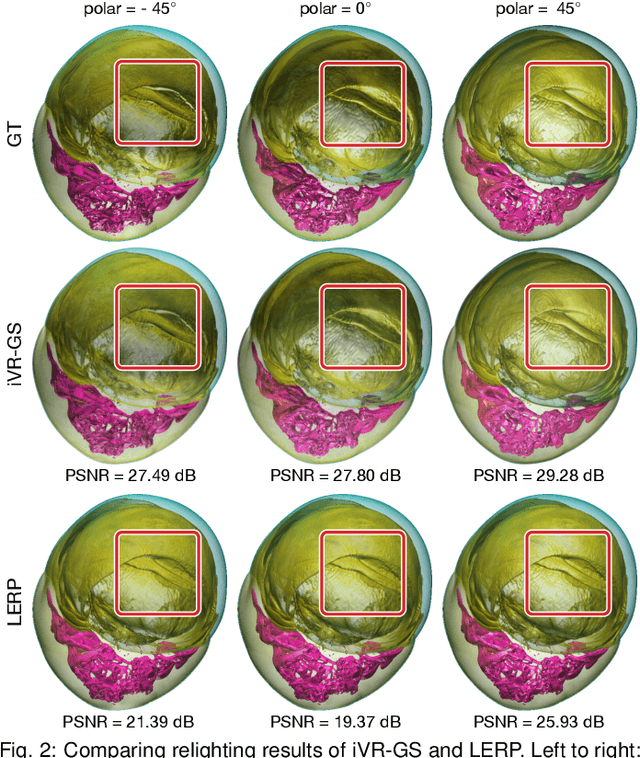
In volume visualization, users can interactively explore the three-dimensional data by specifying color and opacity mappings in the transfer function (TF) or adjusting lighting parameters, facilitating meaningful interpretation of the underlying structure. However, rendering large-scale volumes demands powerful GPUs and high-speed memory access for real-time performance. While existing novel view synthesis (NVS) methods offer faster rendering speeds with lower hardware requirements, the visible parts of a reconstructed scene are fixed and constrained by preset TF settings, significantly limiting user exploration. This paper introduces inverse volume rendering via Gaussian splatting (iVR-GS), an innovative NVS method that reduces the rendering cost while enabling scene editing for interactive volume exploration. Specifically, we compose multiple iVR-GS models associated with basic TFs covering disjoint visible parts to make the entire volumetric scene visible. Each basic model contains a collection of 3D editable Gaussians, where each Gaussian is a 3D spatial point that supports real-time scene rendering and editing. We demonstrate the superior reconstruction quality and composability of iVR-GS against other NVS solutions (Plenoxels, CCNeRF, and base 3DGS) on various volume datasets. The code is available at https://github.com/TouKaienn/iVR-GS.
UncTrack: Reliable Visual Object Tracking with Uncertainty-Aware Prototype Memory Network
Mar 17, 2025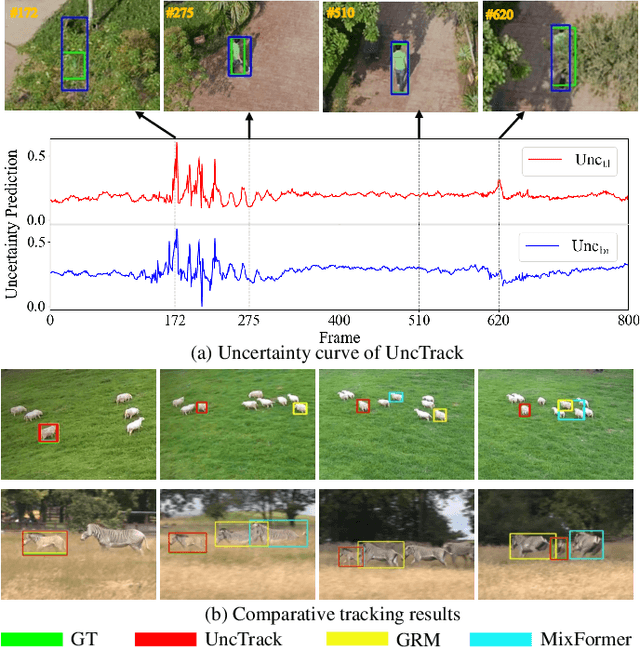
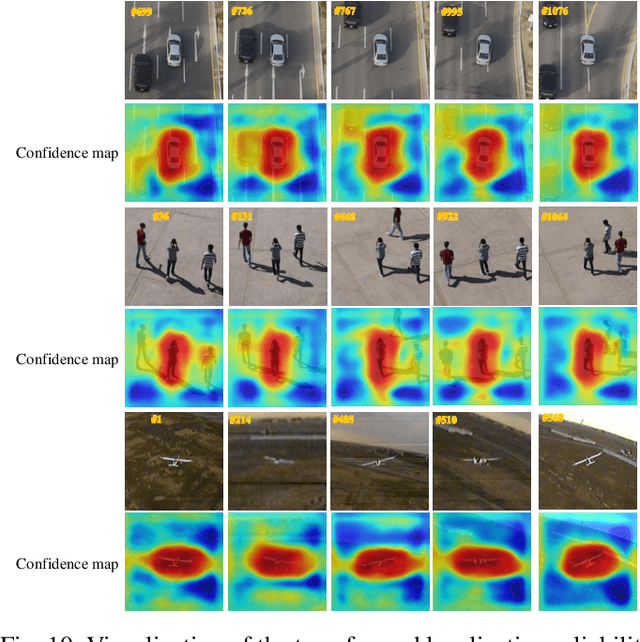
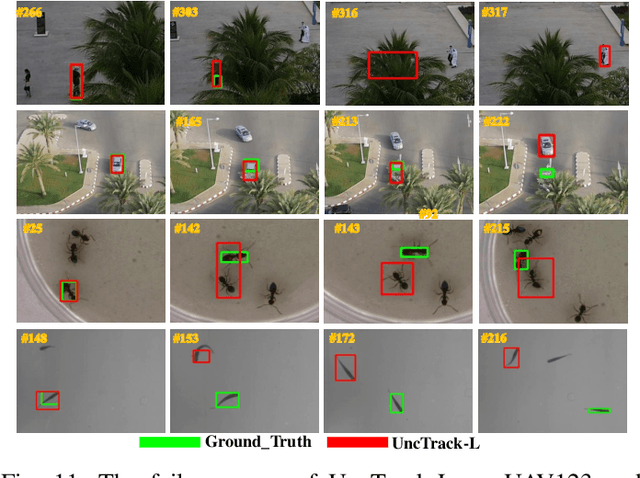
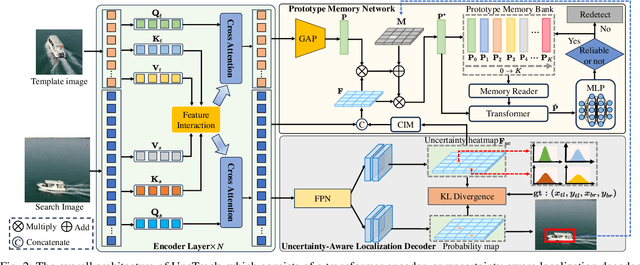
Transformer-based trackers have achieved promising success and become the dominant tracking paradigm due to their accuracy and efficiency. Despite the substantial progress, most of the existing approaches tackle object tracking as a deterministic coordinate regression problem, while the target localization uncertainty has been greatly overlooked, which hampers trackers' ability to maintain reliable target state prediction in challenging scenarios. To address this issue, we propose UncTrack, a novel uncertainty-aware transformer tracker that predicts the target localization uncertainty and incorporates this uncertainty information for accurate target state inference. Specifically, UncTrack utilizes a transformer encoder to perform feature interaction between template and search images. The output features are passed into an uncertainty-aware localization decoder (ULD) to coarsely predict the corner-based localization and the corresponding localization uncertainty. Then the localization uncertainty is sent into a prototype memory network (PMN) to excavate valuable historical information to identify whether the target state prediction is reliable or not. To enhance the template representation, the samples with high confidence are fed back into the prototype memory bank for memory updating, making the tracker more robust to challenging appearance variations. Extensive experiments demonstrate that our method outperforms other state-of-the-art methods. Our code is available at https://github.com/ManOfStory/UncTrack.