 Add to Chrome
 Add to Firefox
 Add to Edge
Evolving Language Models without Labels: Majority Drives Selection, Novelty Promotes Variation
Sep 18, 2025
Large language models (LLMs) are increasingly trained with reinforcement learning from verifiable rewards (RLVR), yet real-world deployment demands models that can self-improve without labels or external judges. Existing label-free methods, confidence minimization, self-consistency, or majority-vote objectives, stabilize learning but steadily shrink exploration, causing an entropy collapse: generations become shorter, less diverse, and brittle. Unlike prior approaches such as Test-Time Reinforcement Learning (TTRL), which primarily adapt models to the immediate unlabeled dataset at hand, our goal is broader: to enable general improvements without sacrificing the model's inherent exploration capacity and generalization ability, i.e., evolving. We formalize this issue and propose EVolution-Oriented and Label-free Reinforcement Learning (EVOL-RL), a simple rule that couples stability with variation under a label-free setting. EVOL-RL keeps the majority-voted answer as a stable anchor (selection) while adding a novelty-aware reward that favors responses whose reasoning differs from what has already been produced (variation), measured in semantic space. Implemented with GRPO, EVOL-RL also uses asymmetric clipping to preserve strong signals and an entropy regularizer to sustain search. This majority-for-selection + novelty-for-variation design prevents collapse, maintains longer and more informative chains of thought, and improves both pass@1 and pass@n. EVOL-RL consistently outperforms the majority-only TTRL baseline; e.g., training on label-free AIME24 lifts Qwen3-4B-Base AIME25 pass@1 from TTRL's 4.6% to 16.4%, and pass@16 from 18.5% to 37.9%. EVOL-RL not only prevents diversity collapse but also unlocks stronger generalization across domains (e.g., GPQA). Furthermore, we demonstrate that EVOL-RL also boosts performance in the RLVR setting, highlighting its broad applicability.

Generative Models for Synthetic Data: Transforming Data Mining in the GenAI Era
Aug 27, 2025Generative models such as Large Language Models, Diffusion Models, and generative adversarial networks have recently revolutionized the creation of synthetic data, offering scalable solutions to data scarcity, privacy, and annotation challenges in data mining. This tutorial introduces the foundations and latest advances in synthetic data generation, covers key methodologies and practical frameworks, and discusses evaluation strategies and applications. Attendees will gain actionable insights into leveraging generative synthetic data to enhance data mining research and practice. More information can be found on our website: https://syndata4dm.github.io/.
Seeing the Invisible: Machine learning-Based QPI Kernel Extraction via Latent Alignment
Jun 05, 2025Quasiparticle interference (QPI) imaging is a powerful tool for probing electronic structures in quantum materials, but extracting the single-scatterer QPI pattern (i.e., the kernel) from a multi-scatterer image remains a fundamentally ill-posed inverse problem. In this work, we propose the first AI-based framework for QPI kernel extraction. We introduce a two-step learning strategy that decouples kernel representation learning from observation-to-kernel inference. In the first step, we train a variational autoencoder to learn a compact latent space of scattering kernels. In the second step, we align the latent representation of QPI observations with those of the pre-learned kernels using a dedicated encoder. This design enables the model to infer kernels robustly even under complex, entangled scattering conditions. We construct a diverse and physically realistic QPI dataset comprising 100 unique kernels and evaluate our method against a direct one-step baseline. Experimental results demonstrate that our approach achieves significantly higher extraction accuracy, and improved generalization to unseen kernels.
Dissecting Logical Reasoning in LLMs: A Fine-Grained Evaluation and Supervision Study
Jun 05, 2025Logical reasoning is a core capability for many applications of large language models (LLMs), yet existing benchmarks often rely solely on final-answer accuracy, failing to capture the quality and structure of the reasoning process. We propose FineLogic, a fine-grained evaluation framework that assesses logical reasoning across three dimensions: overall benchmark accuracy, stepwise soundness, and representation-level alignment. In addition, to better understand how reasoning capabilities emerge, we conduct a comprehensive study on the effects of supervision format during fine-tuning. We construct four supervision styles (one natural language and three symbolic variants) and train LLMs under each. Our findings reveal that natural language supervision yields strong generalization even on out-of-distribution and long-context tasks, while symbolic reasoning styles promote more structurally sound and atomic inference chains. Further, our representation-level probing shows that fine-tuning primarily improves reasoning behaviors through step-by-step generation, rather than enhancing shortcut prediction or internalized correctness. Together, our framework and analysis provide a more rigorous and interpretable lens for evaluating and improving logical reasoning in LLMs.
SocialMaze: A Benchmark for Evaluating Social Reasoning in Large Language Models
May 29, 2025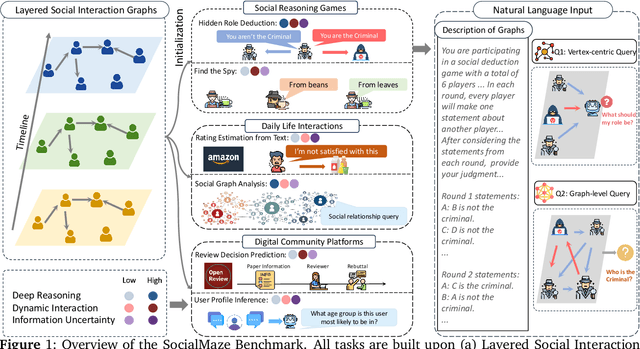
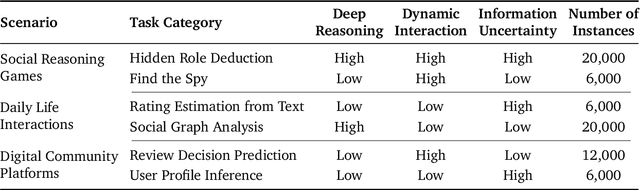
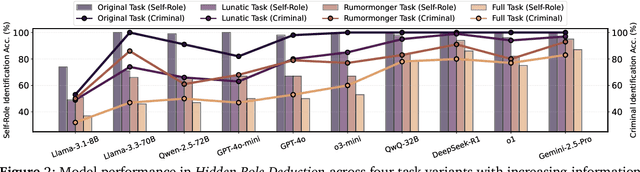
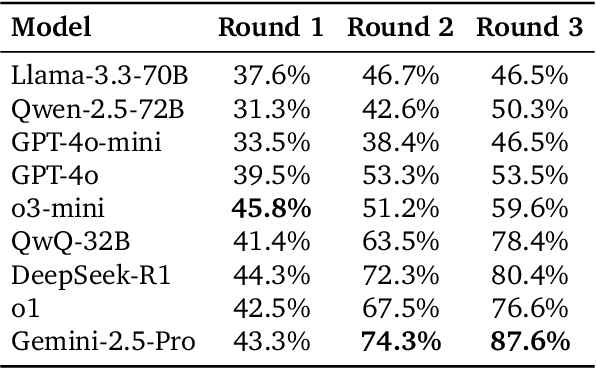
Large language models (LLMs) are increasingly applied to socially grounded tasks, such as online community moderation, media content analysis, and social reasoning games. Success in these contexts depends on a model's social reasoning ability - the capacity to interpret social contexts, infer others' mental states, and assess the truthfulness of presented information. However, there is currently no systematic evaluation framework that comprehensively assesses the social reasoning capabilities of LLMs. Existing efforts often oversimplify real-world scenarios and consist of tasks that are too basic to challenge advanced models. To address this gap, we introduce SocialMaze, a new benchmark specifically designed to evaluate social reasoning. SocialMaze systematically incorporates three core challenges: deep reasoning, dynamic interaction, and information uncertainty. It provides six diverse tasks across three key settings: social reasoning games, daily-life interactions, and digital community platforms. Both automated and human validation are used to ensure data quality. Our evaluation reveals several key insights: models vary substantially in their ability to handle dynamic interactions and integrate temporally evolving information; models with strong chain-of-thought reasoning perform better on tasks requiring deeper inference beyond surface-level cues; and model reasoning degrades significantly under uncertainty. Furthermore, we show that targeted fine-tuning on curated reasoning examples can greatly improve model performance in complex social scenarios. The dataset is publicly available at: https://huggingface.co/datasets/MBZUAI/SocialMaze
Cross-Lingual Pitfalls: Automatic Probing Cross-Lingual Weakness of Multilingual Large Language Models
May 24, 2025Large Language Models (LLMs) have achieved remarkable success in Natural Language Processing (NLP), yet their cross-lingual performance consistency remains a significant challenge. This paper introduces a novel methodology for efficiently identifying inherent cross-lingual weaknesses in LLMs. Our approach leverages beam search and LLM-based simulation to generate bilingual question pairs that expose performance discrepancies between English and target languages. We construct a new dataset of over 6,000 bilingual pairs across 16 languages using this methodology, demonstrating its effectiveness in revealing weaknesses even in state-of-the-art models. The extensive experiments demonstrate that our method precisely and cost-effectively pinpoints cross-lingual weaknesses, consistently revealing over 50\% accuracy drops in target languages across a wide range of models. Moreover, further experiments investigate the relationship between linguistic similarity and cross-lingual weaknesses, revealing that linguistically related languages share similar performance patterns and benefit from targeted post-training. Code is available at https://github.com/xzx34/Cross-Lingual-Pitfalls.
AdaReasoner: Adaptive Reasoning Enables More Flexible Thinking
May 22, 2025LLMs often need effective configurations, like temperature and reasoning steps, to handle tasks requiring sophisticated reasoning and problem-solving, ranging from joke generation to mathematical reasoning. Existing prompting approaches usually adopt general-purpose, fixed configurations that work 'well enough' across tasks but seldom achieve task-specific optimality. To address this gap, we introduce AdaReasoner, an LLM-agnostic plugin designed for any LLM to automate adaptive reasoning configurations for tasks requiring different types of thinking. AdaReasoner is trained using a reinforcement learning (RL) framework, combining a factorized action space with a targeted exploration strategy, along with a pretrained reward model to optimize the policy model for reasoning configurations with only a few-shot guide. AdaReasoner is backed by theoretical guarantees and experiments of fast convergence and a sublinear policy gap. Across six different LLMs and a variety of reasoning tasks, it consistently outperforms standard baselines, preserves out-of-distribution robustness, and yield gains on knowledge-intensive tasks through tailored prompts.
Invisible Entropy: Towards Safe and Efficient Low-Entropy LLM Watermarking
May 20, 2025Logit-based LLM watermarking traces and verifies AI-generated content by maintaining green and red token lists and increasing the likelihood of green tokens during generation. However, it fails in low-entropy scenarios, where predictable outputs make green token selection difficult without disrupting natural text flow. Existing approaches address this by assuming access to the original LLM to calculate entropy and selectively watermark high-entropy tokens. However, these methods face two major challenges: (1) high computational costs and detection delays due to reliance on the original LLM, and (2) potential risks of model leakage. To address these limitations, we propose Invisible Entropy (IE), a watermarking paradigm designed to enhance both safety and efficiency. Instead of relying on the original LLM, IE introduces a lightweight feature extractor and an entropy tagger to predict whether the entropy of the next token is high or low. Furthermore, based on theoretical analysis, we develop a threshold navigator that adaptively sets entropy thresholds. It identifies a threshold where the watermark ratio decreases as the green token count increases, enhancing the naturalness of the watermarked text and improving detection robustness. Experiments on HumanEval and MBPP datasets demonstrate that IE reduces parameter size by 99\% while achieving performance on par with state-of-the-art methods. Our work introduces a safe and efficient paradigm for low-entropy watermarking. https://github.com/Carol-gutianle/IE https://huggingface.co/datasets/Carol0110/IE-Tagger
A Personalized Conversational Benchmark: Towards Simulating Personalized Conversations
May 20, 2025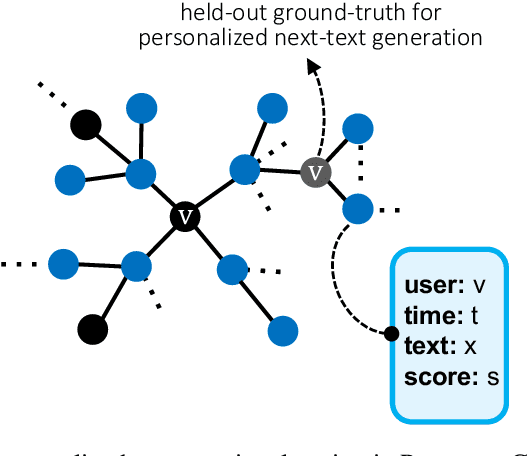
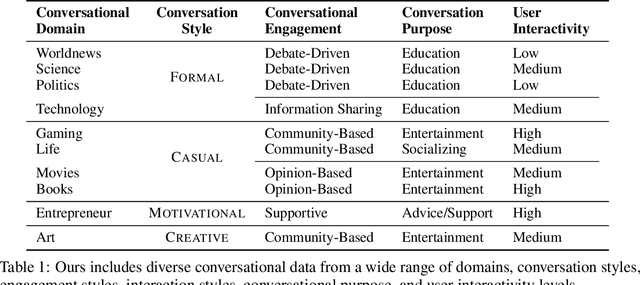
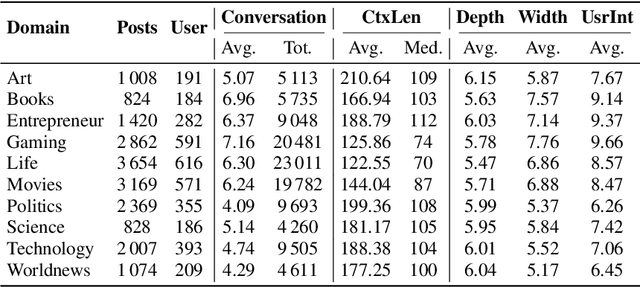
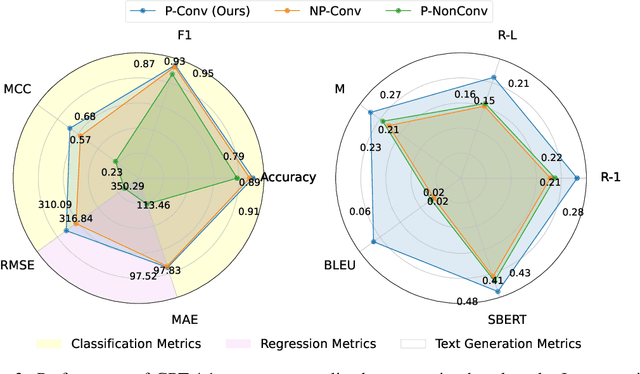
We present PersonaConvBench, a large-scale benchmark for evaluating personalized reasoning and generation in multi-turn conversations with large language models (LLMs). Unlike existing work that focuses on either personalization or conversational structure in isolation, PersonaConvBench integrates both, offering three core tasks: sentence classification, impact regression, and user-centric text generation across ten diverse Reddit-based domains. This design enables systematic analysis of how personalized conversational context shapes LLM outputs in realistic multi-user scenarios. We benchmark several commercial and open-source LLMs under a unified prompting setup and observe that incorporating personalized history yields substantial performance improvements, including a 198 percent relative gain over the best non-conversational baseline in sentiment classification. By releasing PersonaConvBench with evaluations and code, we aim to support research on LLMs that adapt to individual styles, track long-term context, and produce contextually rich, engaging responses.
Evaluating and Mitigating Bias in AI-Based Medical Text Generation
Apr 24, 2025Artificial intelligence (AI) systems, particularly those based on deep learning models, have increasingly achieved expert-level performance in medical applications. However, there is growing concern that such AI systems may reflect and amplify human bias, and reduce the quality of their performance in historically under-served populations. The fairness issue has attracted considerable research interest in the medical imaging classification field, yet it remains understudied in the text generation domain. In this study, we investigate the fairness problem in text generation within the medical field and observe significant performance discrepancies across different races, sexes, and age groups, including intersectional groups, various model scales, and different evaluation metrics. To mitigate this fairness issue, we propose an algorithm that selectively optimizes those underperformed groups to reduce bias. The selection rules take into account not only word-level accuracy but also the pathology accuracy to the target reference, while ensuring that the entire process remains fully differentiable for effective model training. Our evaluations across multiple backbones, datasets, and modalities demonstrate that our proposed algorithm enhances fairness in text generation without compromising overall performance. Specifically, the disparities among various groups across different metrics were diminished by more than 30% with our algorithm, while the relative change in text generation accuracy was typically within 2%. By reducing the bias generated by deep learning models, our proposed approach can potentially alleviate concerns about the fairness and reliability of text generation diagnosis in medical domain. Our code is publicly available to facilitate further research at https://github.com/iriscxy/GenFair.
* 12 pages, 8 figures, published in Nature Computational Science