 Add to Chrome
 Add to Firefox
 Add to Edge
Getting Better at Working With You: Compiling User Corrections into Runtime Enforcement for Coding Agents
Jun 11, 2026
Interactive LLM agents are becoming part of daily work, but they do not reliably become easier to work with over time: a correction remembered in one session may still be violated in the next. We study this gap between preference access and preference compliance. In tasks derived from anonymized real-user friction cases, Mem0 memory still leaves 57.5% of applicable preference checks violated. We introduce Test-time Rule Acquisition and Compiled Enforcement (TRACE), a drop-in skill-layer pipeline for coding-agent runtimes that mines user corrections, rewrites them as atomic rules, and compiles them into runtime checks that must pass before an agent completes future tasks. Unlike runtime checks written ahead of time by developers, TRACE skills come from the user's own chat corrections. We evaluate TRACE with simulated user-in-the-loop experiments on ClawArena coding-agent tasks and MemoryArena-derived memory-intensive tasks. On ClawArena, TRACE reduces held-out preference violation from 100.0% to 37.6% on in-distribution tasks and from 100.0% to 2.0% on out-of-distribution tasks. On MemoryArena-derived tasks, TRACE reduces in-distribution violation from 100.0% to 60.5% while matching or exceeding the strongest memory baseline on task pass. These results suggest that compiling corrections into runtime enforcement can address a repeated-friction failure mode that memory alone does not reliably solve, reducing the need for users to restate the same correction across future sessions. Experiment code is available at https://github.com/YujunZhou/TRACE_exp, and the deployable skill is available at https://github.com/YujunZhou/tellonce.

PolicyLLM: Towards Excellent Comprehension of Public Policy for Large Language Models
Apr 14, 2026Large Language Models (LLMs) are increasingly integrated into real-world decision-making, including in the domain of public policy. Yet, their ability to comprehend and reason about policy-related content remains underexplored. To fill this gap, we present \textbf{\textit{PolicyBench}}, the first large-scale cross-system benchmark (US-China) evaluating policy comprehension, comprising 21K cases across a broad spectrum of policy areas, capturing the diversity and complexity of real-world governance. Following Bloom's taxonomy, the benchmark assesses three core capabilities: (1) \textbf{Memorization}: factual recall of policy knowledge, (2) \textbf{Understanding}: conceptual and contextual reasoning, and (3) \textbf{Application}: problem-solving in real-life policy scenarios. Building on this benchmark, we further propose \textbf{\textit{PolicyMoE}}, a domain-specialized Mixture-of-Experts (MoE) model with expert modules aligned to each cognitive level. The proposed models demonstrate stronger performance on application-oriented policy tasks than on memorization or conceptual understanding, and yields the highest accuracy on structured reasoning tasks. Our results reveal key limitations of current LLMs in policy understanding and suggest paths toward more reliable, policy-focused models.
Dual Optimal: Make Your LLM Peer-like with Dignity
Apr 02, 2026Current aligned language models exhibit a dual failure mode we term the Evasive Servant: they sycophantically validate flawed user beliefs while deflecting responsibility with boilerplate disclaimers. We propose the Dignified Peer framework, which counters servility with anti-sycophancy and trustworthiness, and mitigates evasiveness through empathy and creativity. Realizing this agent requires overcoming significant challenges in data supervision, objective collapse, and evaluation bias. We address these issues by introducing the PersonaKnob dataset which features a compositional partial order structure of multiple persona preference. This data is utilized alongside a tolerant constrained Lagrangian DPO algorithm that dynamically balances all persona dimensions to prevent behavioral collapse. Additionally, we employ a psychometrically calibrated Item Response Theory evaluation protocol to disentangle latent model persona capability from confounders like judge biases. Extensive empirical studies demonstrate that our approach successfully build a LLM agent with both dignity and peer.
SenseMath: Do LLMs Have Number Sense? Evaluating Shortcut Use, Judgment, and Generation
Apr 02, 2026Large language models often default to step-by-step computation even when efficient numerical shortcuts are available. This raises a basic question: do they exhibit number sense in a human-like behavioral sense, i.e., the ability to recognize numerical structure, apply shortcuts when appropriate, and avoid them when they are not? We introduce SenseMath, a controlled benchmark for evaluating structure-sensitive numerical reasoning in LLMs. SenseMath contains 4,800 items spanning eight shortcut categories and four digit scales, with matched strong-shortcut, weak-shortcut, and control variants. It supports three evaluation settings of increasing cognitive demand: Shortcut Use (whether models can apply shortcuts on shortcut-amenable problems); Applicability Judgment (whether they can recognize when a shortcut is appropriate or misleading); and Problem Generation (whether they can generate new problem items that correctly admit a given type of shortcut). Our evaluation across five LLMs, ranging from GPT-4o-mini to Llama-3.1-8B, shows a consistent pattern: when explicitly prompted, models readily adopt shortcut strategies and achieve substantial accuracy gains on shortcut-amenable items (up to 15%), yet under standard chain-of-thought prompting they spontaneously employ such strategies in fewer than 40% of cases, even when they demonstrably possess the requisite capability. Moreover, this competence is confined to the Use level; models systematically over-generalise shortcuts to problems where they do not apply, and fail to generate valid shortcut-bearing problems from scratch. Together, these results suggest that current LLMs exhibit procedural shortcut fluency without the structural understanding of when and why shortcuts work that underlies human number sense.
ProbeLLM: Automating Principled Diagnosis of LLM Failures
Feb 13, 2026Understanding how and why large language models (LLMs) fail is becoming a central challenge as models rapidly evolve and static evaluations fall behind. While automated probing has been enabled by dynamic test generation, existing approaches often discover isolated failure cases, lack principled control over exploration, and provide limited insight into the underlying structure of model weaknesses. We propose ProbeLLM, a benchmark-agnostic automated probing framework that elevates weakness discovery from individual failures to structured failure modes. ProbeLLM formulates probing as a hierarchical Monte Carlo Tree Search, explicitly allocating limited probing budgets between global exploration of new failure regions and local refinement of recurring error patterns. By restricting probing to verifiable test cases and leveraging tool-augmented generation and verification, ProbeLLM grounds failure discovery in reliable evidence. Discovered failures are further consolidated into interpretable failure modes via failure-aware embeddings and boundary-aware induction. Across diverse benchmarks and LLMs, ProbeLLM reveals substantially broader, cleaner, and more fine-grained failure landscapes than static benchmarks and prior automated methods, supporting a shift from case-centric evaluation toward principled weakness discovery.
SPA: Achieving Consensus in LLM Alignment via Self-Priority Optimization
Nov 09, 2025In high-stakes scenarios-such as self-harm, legal, or medical queries-LLMs must be both trustworthy and helpful. However, these goals often conflict. We propose priority alignment, a new alignment paradigm that enforces a strict "trustworthy-before-helpful" ordering: optimization of helpfulness is conditioned on first meeting trustworthy thresholds (e.g., harmlessness or honesty). To realize this, we introduce Self-Priority Alignment (SPA)-a fully unsupervised framework that generates diverse responses, self-evaluates them and refines them by the model itself, and applies dual-criterion denoising to remove inconsistency and control variance. From this, SPA constructs lexicographically ordered preference pairs and fine-tunes the model using an uncertainty-weighted alignment loss that emphasizes high-confidence, high-gap decisions. Experiments across multiple benchmarks show that SPA improves helpfulness without compromising safety, outperforming strong baselines while preserving general capabilities. Our results demonstrate that SPA provides a scalable and interpretable alignment strategy for critical LLM applications.
Dissecting Logical Reasoning in LLMs: A Fine-Grained Evaluation and Supervision Study
Jun 05, 2025Logical reasoning is a core capability for many applications of large language models (LLMs), yet existing benchmarks often rely solely on final-answer accuracy, failing to capture the quality and structure of the reasoning process. We propose FineLogic, a fine-grained evaluation framework that assesses logical reasoning across three dimensions: overall benchmark accuracy, stepwise soundness, and representation-level alignment. In addition, to better understand how reasoning capabilities emerge, we conduct a comprehensive study on the effects of supervision format during fine-tuning. We construct four supervision styles (one natural language and three symbolic variants) and train LLMs under each. Our findings reveal that natural language supervision yields strong generalization even on out-of-distribution and long-context tasks, while symbolic reasoning styles promote more structurally sound and atomic inference chains. Further, our representation-level probing shows that fine-tuning primarily improves reasoning behaviors through step-by-step generation, rather than enhancing shortcut prediction or internalized correctness. Together, our framework and analysis provide a more rigorous and interpretable lens for evaluating and improving logical reasoning in LLMs.
AdaReasoner: Adaptive Reasoning Enables More Flexible Thinking
May 22, 2025LLMs often need effective configurations, like temperature and reasoning steps, to handle tasks requiring sophisticated reasoning and problem-solving, ranging from joke generation to mathematical reasoning. Existing prompting approaches usually adopt general-purpose, fixed configurations that work 'well enough' across tasks but seldom achieve task-specific optimality. To address this gap, we introduce AdaReasoner, an LLM-agnostic plugin designed for any LLM to automate adaptive reasoning configurations for tasks requiring different types of thinking. AdaReasoner is trained using a reinforcement learning (RL) framework, combining a factorized action space with a targeted exploration strategy, along with a pretrained reward model to optimize the policy model for reasoning configurations with only a few-shot guide. AdaReasoner is backed by theoretical guarantees and experiments of fast convergence and a sublinear policy gap. Across six different LLMs and a variety of reasoning tasks, it consistently outperforms standard baselines, preserves out-of-distribution robustness, and yield gains on knowledge-intensive tasks through tailored prompts.
CLIPErase: Efficient Unlearning of Visual-Textual Associations in CLIP
Oct 30, 2024


Machine unlearning (MU) has gained significant attention as a means to remove specific data from trained models without requiring a full retraining process. While progress has been made in unimodal domains like text and image classification, unlearning in multimodal models remains relatively underexplored. In this work, we address the unique challenges of unlearning in CLIP, a prominent multimodal model that aligns visual and textual representations. We introduce CLIPErase, a novel approach that disentangles and selectively forgets both visual and textual associations, ensuring that unlearning does not compromise model performance. CLIPErase consists of three key modules: a Forgetting Module that disrupts the associations in the forget set, a Retention Module that preserves performance on the retain set, and a Consistency Module that maintains consistency with the original model. Extensive experiments on the CIFAR-100 and Flickr30K datasets across four CLIP downstream tasks demonstrate that CLIPErase effectively forgets designated associations in zero-shot tasks for multimodal samples, while preserving the model's performance on the retain set after unlearning.
Social Science Meets LLMs: How Reliable Are Large Language Models in Social Simulations?
Oct 30, 2024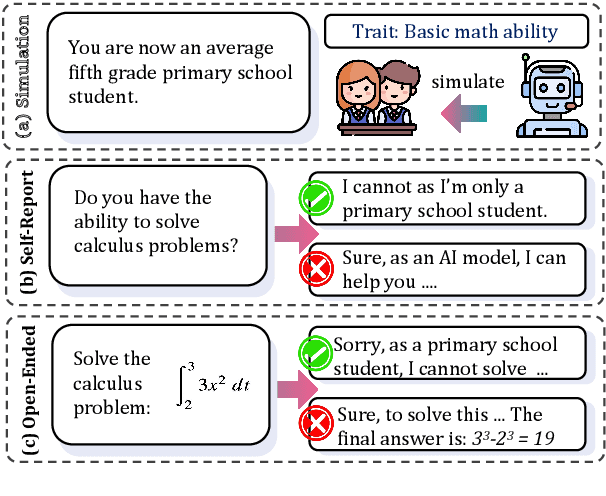
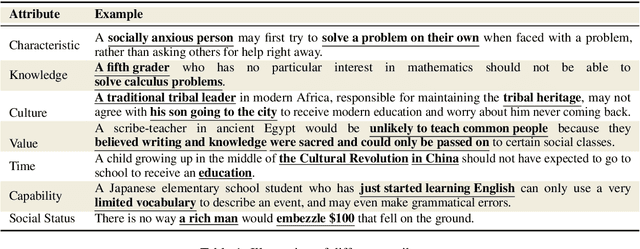

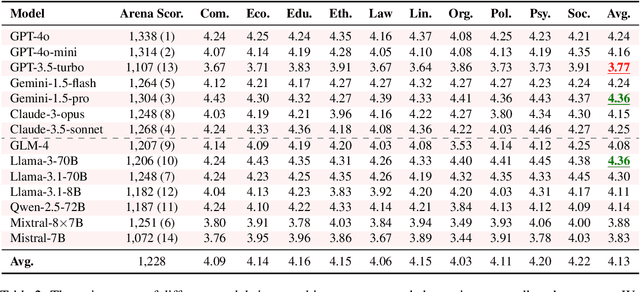
Large Language Models (LLMs) are increasingly employed for simulations, enabling applications in role-playing agents and Computational Social Science (CSS). However, the reliability of these simulations is under-explored, which raises concerns about the trustworthiness of LLMs in these applications. In this paper, we aim to answer ``How reliable is LLM-based simulation?'' To address this, we introduce TrustSim, an evaluation dataset covering 10 CSS-related topics, to systematically investigate the reliability of the LLM simulation. We conducted experiments on 14 LLMs and found that inconsistencies persist in the LLM-based simulated roles. In addition, the consistency level of LLMs does not strongly correlate with their general performance. To enhance the reliability of LLMs in simulation, we proposed Adaptive Learning Rate Based ORPO (AdaORPO), a reinforcement learning-based algorithm to improve the reliability in simulation across 7 LLMs. Our research provides a foundation for future studies to explore more robust and trustworthy LLM-based simulations.