 Add to Chrome
 Add to Firefox
 Add to Edge
AI4AI-Bench: Benchmarking LLM Agents in Algorithmic Design for Recursive Self-Improvement
Aug 20, 2026
Recursive self-improvement (RSI) asks whether an AI system can improve the process that produces AI systems, so that the next system inherits the improvement. That process is the training algorithm: a better objective or update rule improves the compute\mbox{-}capability exchange rate for every subsequent run, including the one that produces the next agent. Whether RSI is feasible therefore turns on whether an agent can design training algorithms. No benchmark isolates that ability: existing suites are won by collecting data or by tuning hyperparameters, and none tells a change to how a run is executed apart from a change to how the model learns. We present AI4AI\mbox{-}Bench, 10 frozen research repositories spanning 10 training algorithm families. In each task, an agent has 4 hours on one B300 to rewrite the training algorithm; its code is then rerun from scratch for up to 12 hours and scored by a fixed evaluator hidden from the agent, against the repository's original algorithm under the same procedure. Because the 10 metrics are incommensurable, every task is mapped onto one scale on which $0$ is an uninformative model, $0.1$ is the algorithm the repository ships, and $1.0$ is the task optimum. Across 29 configurations of 6 systems on all 10 tasks the mean score is $0.166$, and the best system reaches $0.250$: even the strongest closes under a fifth of the distance between the algorithm that was already there and the optimum. The submissions show where that distance went: most never change how the model learns at all, and the minority that do average $0.226$ against $0.126$ for the rest. More reasoning effort mostly buys the willingness to go there, taking that minority from $8\%$ of submissions to $64\%$ and the mean score from $0.094$ to $0.196$. We release the task suite, the evaluators and every scored submission, so that the measurement can be repeated as these systems change.

Agogic: Performance-Timed Music Tokens for LLM-Native Text-to-Symbolic-Music Generation
Aug 04, 2026Text-to-music language models begin with a choice usually made by default: how to tokenize music. Normally entangled with backbone, data, and recipe, its effect has never been measured in isolation. We fix pretrained Qwen3.5 (0.8B-27B), data, budget, and decoding, and swap only the representation across seven tokenizations, anchoring texture metrics to each representation's model-free ceiling. The ordering is clean and surprising: representation, not model size, is the binding variable for distributional fidelity. Scaling the backbone 34x barely moves Frechet Music Distance (FMD), whereas switching representation halves it. PMT, a performance-resolution stream we release (10 ms timing, per-note velocity, multi-track texture; 609 symbols), reaches FMD 159 at 0.8B against 272-286 for beat grids (1.7-1.8x lower, up to 2.8x elsewhere; non-overlapping bootstrap CIs), so a 0.8B performance-resolution model beats a 27B beat grid. It reappears on a 26M from-scratch backbone and a second performance-resolution tokenizer: a property of the class, not one lucky vocabulary. Nor is it a finer-lattice artifact: snapping PMT's onsets to the beat grids' resolution still leaves it 67-129 FMD ahead of both (n=500). The effect is distributional; whether it is audible is a separate question, left open by our probe, with a human study pre-registered. Native caption adherence is weak but separable: a lightweight decode-time constraint doubles instrument-F1 (.28 to .60) and Correct-Key (.16 to .35) at no distributional cost. We release the harness, 25+ checkpoints, two corpora (86.6k aligned across caption/MIDI/ABC/audio; 6.25M captioned, the largest for music), and an imprinting diagnostic: published text-to-MIDI systems reproduce their training distribution near-invariant to the caption (72% vs. 71% chord-time on disjoint domains). The field's next representation claim can now be measured, not asserted.
Relit-LiVE: Relight Video by Jointly Learning Environment Video
May 07, 2026Recent advances have shown that large-scale video diffusion models can be repurposed as neural renderers by first decomposing videos into intrinsic scene representations and then performing forward rendering under novel illumination. While promising, this paradigm fundamentally relies on accurate intrinsic decomposition, which remains highly unreliable for real-world videos and often leads to distorted appearances, broken materials, and accumulated temporal artifacts during relighting. In this work, we present Relit-LiVE, a novel video relighting framework that produces physically consistent, temporally stable results without requiring prior knowledge of camera pose. Our key insight is to explicitly introduce raw reference images into the rendering process, enabling the model to recover critical scene cues that are inevitably lost or corrupted in intrinsic representations. Furthermore, we propose a novel environment video prediction formulation that simultaneously generates relit videos and per-frame environment maps aligned with each camera viewpoint in a single diffusion process. This joint prediction enforces strong geometric-illumination alignment and naturally supports dynamic lighting and camera motion, significantly improving physical consistency in video relighting while easing the requirement of known per-frame camera pose. Extensive experiments demonstrate that Relit-LiVE consistently outperforms state-of-the-art video relighting and neural rendering methods across synthetic and real-world benchmarks. Beyond relighting, our framework naturally supports a wide range of downstream applications, including scene-level rendering, material editing, object insertion, and streaming video relighting. The Project is available at https://github.com/zhuxing0/Relit-LiVE.
AdapShot: Adaptive Many-Shot In-Context Learning with Semantic-Aware KV Cache Reuse
May 05, 2026Many-Shot In-Context Learning (ICL) has emerged as a promising paradigm, leveraging extensive examples to unlock the reasoning potential of Large Language Models (LLMs). However, existing methods typically rely on a predetermined, fixed number of shots. This static approach often fails to adapt to the varying difficulty of different queries, leading to either insufficient context or interference from noise. Furthermore, the prohibitive computational and memory costs of long contexts severely limit Many-Shot's feasibility. To address the above limitations, we propose AdapShot, which dynamically optimizes shot counts and leverages KV cache reuse for efficient inference. Specifically, we design a probe-based evaluation mechanism that utilizes output entropy to determine the optimal number of shots. To bypass the redundant prefilling computation during both the probing and inference phases, we incorporate a semantics-aware KV cache reuse strategy. Within this reuse strategy, to address positional encoding incompatibilities, we introduce a decoupling and re-encoding method that enables the flexible reordering of cached key-value pairs. Extensive experiments demonstrate that AdapShot achieves an average performance gain of around 10% and a 4.64x speedup compared to state-of-the-art DBSA.
CAP: Controllable Alignment Prompting for Unlearning in LLMs
Apr 23, 2026Large language models (LLMs) trained on unfiltered corpora inherently risk retaining sensitive information, necessitating selective knowledge unlearning for regulatory compliance and ethical safety. However, existing parameter-modifying methods face fundamental limitations: high computational costs, uncontrollable forgetting boundaries, and strict dependency on model weight access. These constraints render them impractical for closed-source models, yet current non-invasive alternatives remain unsystematic and reliant on empirical experience. To address these challenges, we propose the Controllable Alignment Prompting for Unlearning (CAP) framework, an end-to-end prompt-driven unlearning paradigm. CAP decouples unlearning into a learnable prompt optimization process via reinforcement learning, where a prompt generator collaborates with the LLM to suppress target knowledge while preserving general capabilities selectively. This approach enables reversible knowledge restoration through prompt revocation. Extensive experiments demonstrate that CAP achieves precise, controllable unlearning without updating model parameters, establishing a dynamic alignment mechanism that overcomes the transferability limitations of prior methods.
Benchmarking PhD-Level Coding in 3D Geometric Computer Vision
Mar 31, 2026AI-assisted coding has rapidly reshaped software practice and research workflows, yet today's models still struggle to produce correct code for complex 3D geometric vision. If models could reliably write such code, the research of our community would change substantially. To measure progress toward that goal, we introduce GeoCodeBench, a PhD-level benchmark that evaluates coding for 3D vision. Each problem is a fill-in-the-function implementation task curated from representative papers at recent venues: we first let a tool propose candidate functions from official repositories, then perform careful human screening to select core 3D geometric components. For every target, we generate diverse, edge-case unit tests, enabling fully automatic, reproducible scoring. We evaluate eight representative open- and closed-source models to reflect the current ecosystem. The best model, GPT-5, attains only 36.6% pass rate, revealing a large gap between current capabilities and dependable 3D scientific coding. GeoCodeBench organizes tasks into a two-level hierarchy: General 3D capability (geometric transformations and mechanics/optics formulation) and Research capability (novel algorithm implementation and geometric logic routing). Scores are positively correlated across these axes, but research-oriented tasks are markedly harder. Context ablations further show that "more paper text" is not always better: cutting off at the Method section statistically outperforms full-paper inputs, highlighting unresolved challenges in long-context scientific comprehension. Together, these findings position GeoCodeBench as a rigorous testbed for advancing from generic coding to trustworthy 3D geometric vision coding.
PAM: A Pose-Appearance-Motion Engine for Sim-to-Real HOI Video Generation
Mar 23, 2026Hand-object interaction (HOI) reconstruction and synthesis are becoming central to embodied AI and AR/VR. Yet, despite rapid progress, existing HOI generation research remains fragmented across three disjoint tracks: (1) pose-only synthesis that predicts MANO trajectories without producing pixels; (2) single-image HOI generation that hallucinates appearance from masks or 2D cues but lacks dynamics; and (3) video generation methods that require both the entire pose sequence and the ground-truth first frame as inputs, preventing true sim-to-real deployment. Inspired by the philosophy of Joo et al. (2018), we think that HOI generation requires a unified engine that brings together pose, appearance, and motion within one coherent framework. Thus we introduce PAM: a Pose-Appearance-Motion Engine for controllable HOI video generation. The performance of our engine is validated by: (1) On DexYCB, we obtain an FVD of 29.13 (vs. 38.83 for InterDyn), and MPJPE of 19.37 mm (vs. 30.05 mm for CosHand), while generating higher-resolution 480x720 videos compared to 256x256 and 256x384 baselines. (2) On OAKINK2, our full multi-condition model improves FVD from 68.76 to 46.31. (3) An ablation over input conditions on DexYCB shows that combining depth, segmentation, and keypoints consistently yields the best results. (4) For a downstream hand pose estimation task using SimpleHand, augmenting training with 3,400 synthetic videos (207k frames) allows a model trained on only 50% of the real data plus our synthetic data to match the 100% real baseline.
Impromptu VLA: Open Weights and Open Data for Driving Vision-Language-Action Models
May 29, 2025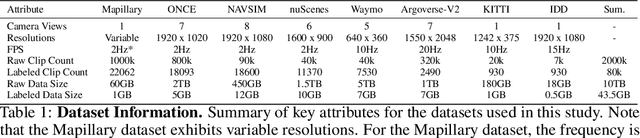
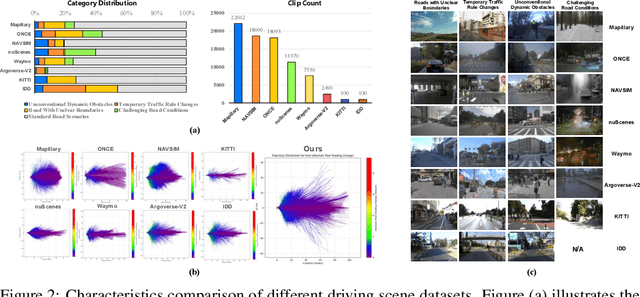
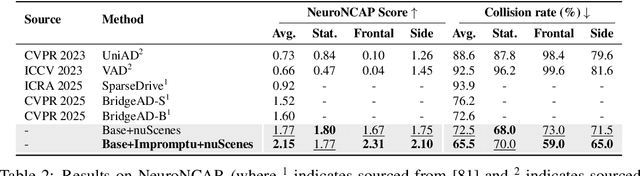
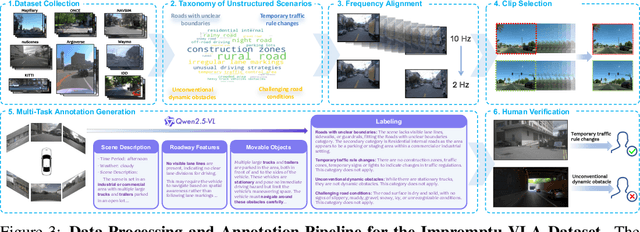
Vision-Language-Action (VLA) models for autonomous driving show promise but falter in unstructured corner case scenarios, largely due to a scarcity of targeted benchmarks. To address this, we introduce Impromptu VLA. Our core contribution is the Impromptu VLA Dataset: over 80,000 meticulously curated video clips, distilled from over 2M source clips sourced from 8 open-source large-scale datasets. This dataset is built upon our novel taxonomy of four challenging unstructured categories and features rich, planning-oriented question-answering annotations and action trajectories. Crucially, experiments demonstrate that VLAs trained with our dataset achieve substantial performance gains on established benchmarks--improving closed-loop NeuroNCAP scores and collision rates, and reaching near state-of-the-art L2 accuracy in open-loop nuScenes trajectory prediction. Furthermore, our Q&A suite serves as an effective diagnostic, revealing clear VLM improvements in perception, prediction, and planning. Our code, data and models are available at https://github.com/ahydchh/Impromptu-VLA.
FB-4D: Spatial-Temporal Coherent Dynamic 3D Content Generation with Feature Banks
Mar 26, 2025With the rapid advancements in diffusion models and 3D generation techniques, dynamic 3D content generation has become a crucial research area. However, achieving high-fidelity 4D (dynamic 3D) generation with strong spatial-temporal consistency remains a challenging task. Inspired by recent findings that pretrained diffusion features capture rich correspondences, we propose FB-4D, a novel 4D generation framework that integrates a Feature Bank mechanism to enhance both spatial and temporal consistency in generated frames. In FB-4D, we store features extracted from previous frames and fuse them into the process of generating subsequent frames, ensuring consistent characteristics across both time and multiple views. To ensure a compact representation, the Feature Bank is updated by a proposed dynamic merging mechanism. Leveraging this Feature Bank, we demonstrate for the first time that generating additional reference sequences through multiple autoregressive iterations can continuously improve generation performance. Experimental results show that FB-4D significantly outperforms existing methods in terms of rendering quality, spatial-temporal consistency, and robustness. It surpasses all multi-view generation tuning-free approaches by a large margin and achieves performance on par with training-based methods.
PartRM: Modeling Part-Level Dynamics with Large Cross-State Reconstruction Model
Mar 25, 2025As interest grows in world models that predict future states from current observations and actions, accurately modeling part-level dynamics has become increasingly relevant for various applications. Existing approaches, such as Puppet-Master, rely on fine-tuning large-scale pre-trained video diffusion models, which are impractical for real-world use due to the limitations of 2D video representation and slow processing times. To overcome these challenges, we present PartRM, a novel 4D reconstruction framework that simultaneously models appearance, geometry, and part-level motion from multi-view images of a static object. PartRM builds upon large 3D Gaussian reconstruction models, leveraging their extensive knowledge of appearance and geometry in static objects. To address data scarcity in 4D, we introduce the PartDrag-4D dataset, providing multi-view observations of part-level dynamics across over 20,000 states. We enhance the model's understanding of interaction conditions with a multi-scale drag embedding module that captures dynamics at varying granularities. To prevent catastrophic forgetting during fine-tuning, we implement a two-stage training process that focuses sequentially on motion and appearance learning. Experimental results show that PartRM establishes a new state-of-the-art in part-level motion learning and can be applied in manipulation tasks in robotics. Our code, data, and models are publicly available to facilitate future research.