 Add to Chrome
 Add to Firefox
 Add to Edge
eMoT: evolving Memory-of-Thought via Symbolic Anchoring and Memory Corrosion
Jun 01, 2026
While Large Language Models (LLMs) achieve impressive performance on multi-step reasoning tasks, their reliability is persistently hindered by critical limitations such as unconstrained hallucinations and poor numerical computation. Fundamentally, these issues arise because standard models treat reasoning as a transient, one-off generation process rather than retaining and refining successful procedural logic. To address these challenges, we propose eMoT (evolving Memory-of-Thought), a unified framework that stabilizes multi-step reasoning by treating reasoning trajectories as dynamic, evolving memories rather than static templates. The framework primarily consists of three interconnected modules: (i) a memory corrosion mechanism that reinforces high-utility reasoning structures while gradually decaying less frequent ones; (ii) a symbolic anchoring engine that utilizes Python for deterministic computation, much like a human uses a calculator; and (iii) a consistency-driven refinement process that aligns neural inference with symbolic outcomes, reducing the accumulation of logical discrepancies. Across multiple reasoning benchmarks, eMoT improves accuracy and solution consistency over standard Chain-of-Thought and structured reasoning baselines.On the traditional task Game of 24, eMoT achieves 100% accuracy, surpassing the baseline by up to 17.6%. Evaluations on mathematical task GSM8K, ASDiv, SVAMP, and MGSM further show consistent gains in multi-step mathematical reasoning. In our evaluation, we achieve superior performance despite utilizing a lightweight backbone model with constrained baseline capabilities. Compared to alternative methods that rely on massively scaled models, our results demonstrate that the performance gains are fundamentally driven by the eMoT framework's reasoning control rather than sheer model size.

AdapShot: Adaptive Many-Shot In-Context Learning with Semantic-Aware KV Cache Reuse
May 05, 2026Many-Shot In-Context Learning (ICL) has emerged as a promising paradigm, leveraging extensive examples to unlock the reasoning potential of Large Language Models (LLMs). However, existing methods typically rely on a predetermined, fixed number of shots. This static approach often fails to adapt to the varying difficulty of different queries, leading to either insufficient context or interference from noise. Furthermore, the prohibitive computational and memory costs of long contexts severely limit Many-Shot's feasibility. To address the above limitations, we propose AdapShot, which dynamically optimizes shot counts and leverages KV cache reuse for efficient inference. Specifically, we design a probe-based evaluation mechanism that utilizes output entropy to determine the optimal number of shots. To bypass the redundant prefilling computation during both the probing and inference phases, we incorporate a semantics-aware KV cache reuse strategy. Within this reuse strategy, to address positional encoding incompatibilities, we introduce a decoupling and re-encoding method that enables the flexible reordering of cached key-value pairs. Extensive experiments demonstrate that AdapShot achieves an average performance gain of around 10% and a 4.64x speedup compared to state-of-the-art DBSA.
From Similarity to Structure: Training-free LLM Context Compression with Hybrid Graph Priors
Apr 25, 2026Long-context large language models remain computationally expensive to run and often fail to reliably process very long inputs, which makes context compression an important component of many systems. Existing compression approaches typically rely on trained compressors, dense retrieval-style selection, or heuristic trimming, and they often struggle to jointly preserve task relevance, topic coverage, and cross-sentence coherence under a strict token budget. To address this, we propose a training-free and model-agnostic compression framework that selects a compact set of sentences guided by structural graph priors. Our method constructs a sparse hybrid sentence graph that combines mutual k-NN semantic edges with short-range sequential edges, extracts a topic skeleton via clustering, and ranks sentences using an interpretable score that integrates task relevance, cluster representativeness, bridge centrality, and a cycle coverage cue. A budgeted greedy selection with redundancy suppression then produces a readable compressed context in original order. Experimental results on four datasets show that our approach is competitive with strong extractive and abstractive baselines, demonstrating larger gains on long-document benchmarks.
CAP: Controllable Alignment Prompting for Unlearning in LLMs
Apr 23, 2026Large language models (LLMs) trained on unfiltered corpora inherently risk retaining sensitive information, necessitating selective knowledge unlearning for regulatory compliance and ethical safety. However, existing parameter-modifying methods face fundamental limitations: high computational costs, uncontrollable forgetting boundaries, and strict dependency on model weight access. These constraints render them impractical for closed-source models, yet current non-invasive alternatives remain unsystematic and reliant on empirical experience. To address these challenges, we propose the Controllable Alignment Prompting for Unlearning (CAP) framework, an end-to-end prompt-driven unlearning paradigm. CAP decouples unlearning into a learnable prompt optimization process via reinforcement learning, where a prompt generator collaborates with the LLM to suppress target knowledge while preserving general capabilities selectively. This approach enables reversible knowledge restoration through prompt revocation. Extensive experiments demonstrate that CAP achieves precise, controllable unlearning without updating model parameters, establishing a dynamic alignment mechanism that overcomes the transferability limitations of prior methods.
DASH-KV: Accelerating Long-Context LLM Inference via Asymmetric KV Cache Hashing
Apr 22, 2026The quadratic computational complexity of the standard attention mechanism constitutes a fundamental bottleneck for large language models in long-context inference. While existing KV cache compression methods alleviate memory pressure, they often sacrifice generation quality and fail to address the high overhead of floating-point arithmetic. This paper introduces DASH-KV, an innovative acceleration framework that reformulates attention as approximate nearest-neighbor search via asymmetric deep hashing. Under this paradigm, we design an asymmetric encoding architecture that differentially maps queries and keys to account for their distinctions in precision and reuse characteristics. To balance efficiency and accuracy, we further introduce a dynamic mixed-precision mechanism that adaptively retains full-precision computation for critical tokens. Extensive experiments on LongBench demonstrate that DASH-KV significantly outperforms state-of-the-art baseline methods while matching the performance of full attention, all while reducing inference complexity from O(N^2) to linear O(N). The code is available at https://github.com/Zhihan-Zh/DASH-KV
ALTER: Asymmetric LoRA for Token-Entropy-Guided Unlearning of LLMs
Mar 02, 2026Large language models (LLMs) have advanced to encompass extensive knowledge across diverse domains. Yet controlling what a LLMs should not know is important for ensuring alignment and thus safe use. However, effective unlearning in LLMs is difficult due to the fuzzy boundary between knowledge retention and forgetting. This challenge is exacerbated by entangled parameter spaces from continuous multi-domain training, often resulting in collateral damage, especially under aggressive unlearning strategies. Furthermore, the computational overhead required to optimize State-of-the-Art (SOTA) models with billions of parameters poses an additional barrier. In this work, we present ALTER, a lightweight unlearning framework for LLMs to address both the challenges of knowledge entanglement and unlearning efficiency. ALTER operates through two phases: (I) high entropy tokens are captured and learned via the shared A matrix in LoRA, followed by (II) an asymmetric LoRA architecture that achieves a specified forgetting objective by parameter isolation and unlearning tokens within the target subdomains. Serving as a new research direction for achieving unlearning via token-level isolation in the asymmetric framework. ALTER achieves SOTA performance on TOFU, WMDP, and MUSE benchmarks with over 95% forget quality and shows minimal side effects through preserving foundational tokens. By decoupling unlearning from LLMs' billion-scale parameters, this framework delivers excellent efficiency while preserving over 90% of model utility, exceeding baseline preservation rates of 47.8-83.6%.
Noise-Robustness Through Noise: Asymmetric LoRA Adaption with Poisoning Expert
May 29, 2025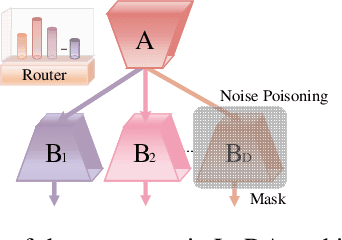
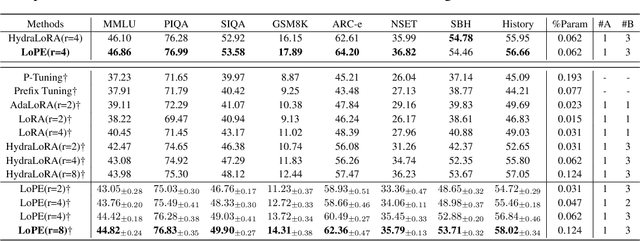
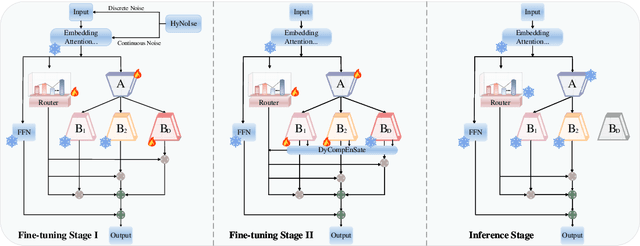
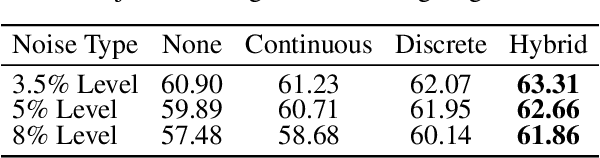
Current parameter-efficient fine-tuning methods for adapting pre-trained language models to downstream tasks are susceptible to interference from noisy data. Conventional noise-handling approaches either rely on laborious data pre-processing or employ model architecture modifications prone to error accumulation. In contrast to existing noise-process paradigms, we propose a noise-robust adaptation method via asymmetric LoRA poisoning experts (LoPE), a novel framework that enhances model robustness to noise only with generated noisy data. Drawing inspiration from the mixture-of-experts architecture, LoPE strategically integrates a dedicated poisoning expert in an asymmetric LoRA configuration. Through a two-stage paradigm, LoPE performs noise injection on the poisoning expert during fine-tuning to enhance its noise discrimination and processing ability. During inference, we selectively mask the dedicated poisoning expert to leverage purified knowledge acquired by normal experts for noise-robust output. Extensive experiments demonstrate that LoPE achieves strong performance and robustness purely through the low-cost noise injection, which completely eliminates the requirement of data cleaning.
HASH-RAG: Bridging Deep Hashing with Retriever for Efficient, Fine Retrieval and Augmented Generation
May 22, 2025Retrieval-Augmented Generation (RAG) encounters efficiency challenges when scaling to massive knowledge bases while preserving contextual relevance. We propose Hash-RAG, a framework that integrates deep hashing techniques with systematic optimizations to address these limitations. Our queries directly learn binary hash codes from knowledgebase code, eliminating intermediate feature extraction steps, and significantly reducing storage and computational overhead. Building upon this hash-based efficient retrieval framework, we establish the foundation for fine-grained chunking. Consequently, we design a Prompt-Guided Chunk-to-Context (PGCC) module that leverages retrieved hash-indexed propositions and their original document segments through prompt engineering to enhance the LLM's contextual awareness. Experimental evaluations on NQ, TriviaQA, and HotpotQA datasets demonstrate that our approach achieves a 90% reduction in retrieval time compared to conventional methods while maintaining considerate recall performance. Additionally, The proposed system outperforms retrieval/non-retrieval baselines by 1.4-4.3% in EM scores.
Accelerating Adaptive Retrieval Augmented Generation via Instruction-Driven Representation Reduction of Retrieval Overlaps
May 19, 2025
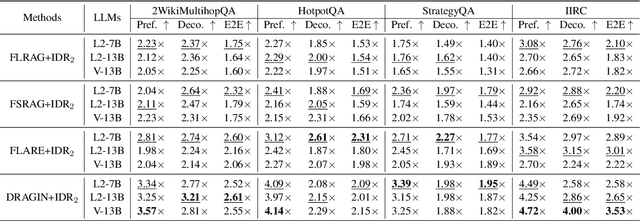
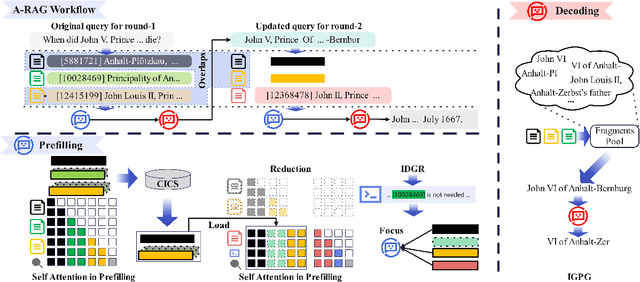
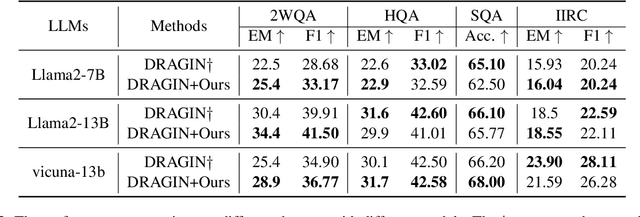
Retrieval-augmented generation (RAG) has emerged as a pivotal method for expanding the knowledge of large language models. To handle complex queries more effectively, researchers developed Adaptive-RAG (A-RAG) to enhance the generated quality through multiple interactions with external knowledge bases. Despite its effectiveness, A-RAG exacerbates the pre-existing efficiency challenges inherent in RAG, which are attributable to its reliance on multiple iterations of generation. Existing A-RAG approaches process all retrieved contents from scratch. However, they ignore the situation where there is a significant overlap in the content of the retrieval results across rounds. The overlapping content is redundantly represented, which leads to a large proportion of repeated computations, thus affecting the overall efficiency. To address this issue, this paper introduces a model-agnostic approach that can be generally applied to A-RAG methods, which is dedicated to reducing the redundant representation process caused by the overlapping of retrieval results. Specifically, we use cache access and parallel generation to speed up the prefilling and decoding stages respectively. Additionally, we also propose an instruction-driven module to further guide the model to more effectively attend to each part of the content in a more suitable way for LLMs. Experiments show that our approach achieves 2.79 and 2.33 times significant acceleration on average for prefilling and decoding respectively while maintaining equal generation quality.
Incrementally Learning Multiple Diverse Data Domains via Multi-Source Dynamic Expansion Model
Jan 15, 2025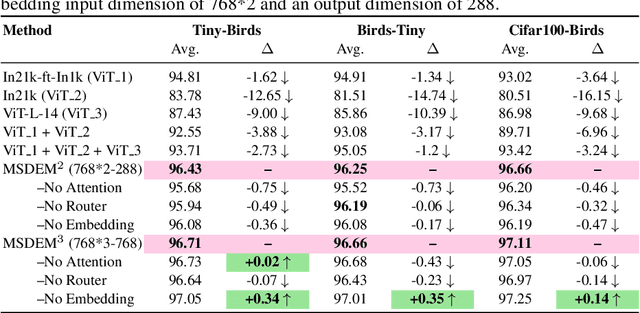
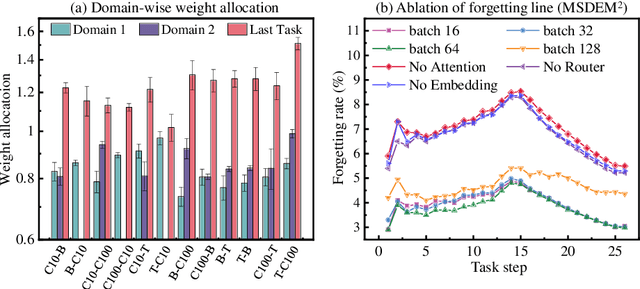
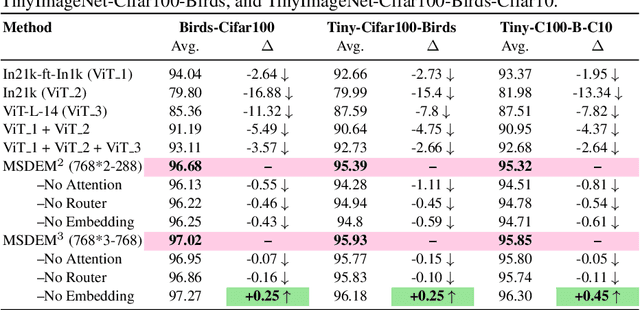
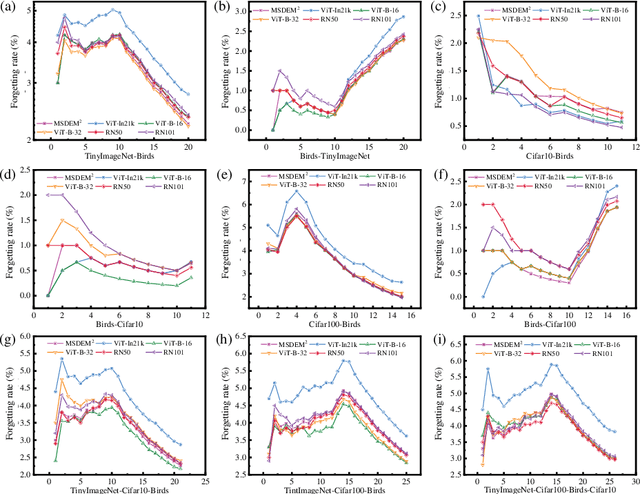
Continual Learning seeks to develop a model capable of incrementally assimilating new information while retaining prior knowledge. However, current research predominantly addresses a straightforward learning context, wherein all data samples originate from a singular data domain. This paper shifts focus to a more complex and realistic learning environment, characterized by data samples sourced from multiple distinct domains. We tackle this intricate learning challenge by introducing a novel methodology, termed the Multi-Source Dynamic Expansion Model (MSDEM), which leverages various pre-trained models as backbones and progressively establishes new experts based on them to adapt to emerging tasks. Additionally, we propose an innovative dynamic expandable attention mechanism designed to selectively harness knowledge from multiple backbones, thereby accelerating the new task learning. Moreover, we introduce a dynamic graph weight router that strategically reuses all previously acquired parameters and representations for new task learning, maximizing the positive knowledge transfer effect, which further improves generalization performance. We conduct a comprehensive series of experiments, and the empirical findings indicate that our proposed approach achieves state-of-the-art performance.