 Add to Chrome
 Add to Firefox
 Add to Edge
Agreement-Based Audio-Visual Segmentation:Champion Report for the MeViS-Audio Track in the 8th LSVOS Challenge
Aug 10, 2026
The MeViS-Audio track asks a system to segment the objects described by a spoken motion expression throughout a video and to return empty masks when the described target is absent. We present a simple staged solution. Qwen3-ASR first converts speech into text. Several video mask tracks are then produced with complementary grounding and segmentation models. Instead of trusting a single prediction, we select the track that has the highest average mask agreement with the other candidates. A small set of explicit direction, count, and plural rules corrects queries that require more than ordinary single-object tracking. Finally, a video-level classifier combines visual, audio-visual, and within-video query scores to decide whether any target is present. The submitted system obtains 0.5952 J &F, 0.7931 no-target accuracy, 0.9205 target accuracy, and a final score of 0.769589. The challenge organizers notified our team that this result ranked first in the track.

Higher-Order Geometric Updates for Levenberg-Marquardt Method via Riemann Normal Coordinates
Jul 08, 2026Nonlinear least-squares optimization is central to regression, physics-informed neural networks, and other machine-learning tasks. Such problems have a natural geometric interpretation, model predictions form a manifold in data space, while the chosen parameterization can introduce parameter-effects curvature that becomes a dominant source of nonlinearity. This exposes a limitation of the Levenberg-Marquardt (LM) method, its tangent-space step is applied as a straight update in parameter coordinates. Geodesic acceleration gives a second-order correction, but its removal of parameter-effect curvature is exact only in the infinitesimal-step limit. We propose a Riemann-normal-coordinate Levenberg-Marquardt method (RNC-LM) to improve this consistency for finite optimization steps. By reformulating the geodesic equation, RNC-LM extends geodesic acceleration to arbitrary-order corrections and constructs finite-step updates with progressively higher reparameterization consistency. A line search along the resulting RNC curve controls the traveled distance while keeping the cost close to standard LM. The method eliminates the tangential component of residual acceleration order by order in a moving tangent frame, making the actual objective reduction more consistent with the linear model prediction of LM. On classical nonlinear least-squares benchmarks, RNC-LM improves convergence and robustness in curved valleys and rank-deficient problems. On a reaction-diffusion PINN failure-mode benchmark, it reduces the relative L2 error to the order of 1e-3 and recovers a physically meaningful solution. On a large-scale machine-learning potential-energy-surface fitting task, it achieves a 34-fold speedup over standard LM.
Impromptu VLA: Open Weights and Open Data for Driving Vision-Language-Action Models
May 29, 2025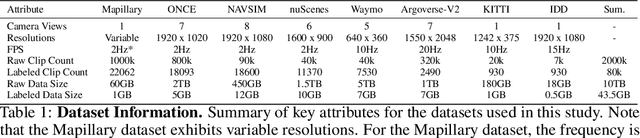
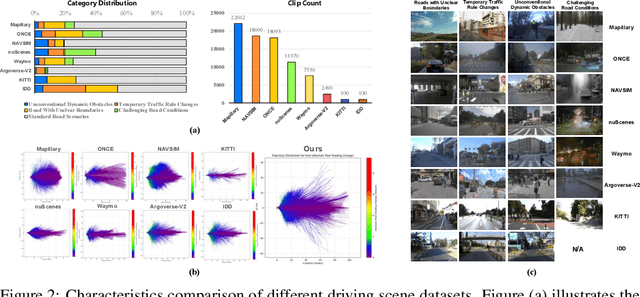
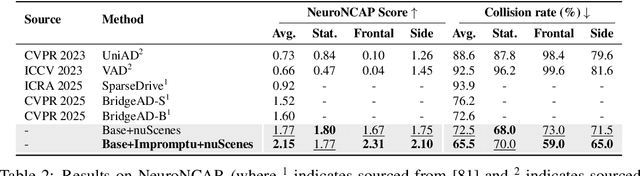
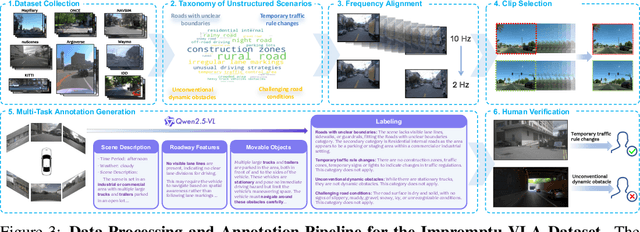
Vision-Language-Action (VLA) models for autonomous driving show promise but falter in unstructured corner case scenarios, largely due to a scarcity of targeted benchmarks. To address this, we introduce Impromptu VLA. Our core contribution is the Impromptu VLA Dataset: over 80,000 meticulously curated video clips, distilled from over 2M source clips sourced from 8 open-source large-scale datasets. This dataset is built upon our novel taxonomy of four challenging unstructured categories and features rich, planning-oriented question-answering annotations and action trajectories. Crucially, experiments demonstrate that VLAs trained with our dataset achieve substantial performance gains on established benchmarks--improving closed-loop NeuroNCAP scores and collision rates, and reaching near state-of-the-art L2 accuracy in open-loop nuScenes trajectory prediction. Furthermore, our Q&A suite serves as an effective diagnostic, revealing clear VLM improvements in perception, prediction, and planning. Our code, data and models are available at https://github.com/ahydchh/Impromptu-VLA.