 Add to Chrome
 Add to Firefox
 Add to Edge
PAM: A Pose-Appearance-Motion Engine for Sim-to-Real HOI Video Generation
Mar 23, 2026
Hand-object interaction (HOI) reconstruction and synthesis are becoming central to embodied AI and AR/VR. Yet, despite rapid progress, existing HOI generation research remains fragmented across three disjoint tracks: (1) pose-only synthesis that predicts MANO trajectories without producing pixels; (2) single-image HOI generation that hallucinates appearance from masks or 2D cues but lacks dynamics; and (3) video generation methods that require both the entire pose sequence and the ground-truth first frame as inputs, preventing true sim-to-real deployment. Inspired by the philosophy of Joo et al. (2018), we think that HOI generation requires a unified engine that brings together pose, appearance, and motion within one coherent framework. Thus we introduce PAM: a Pose-Appearance-Motion Engine for controllable HOI video generation. The performance of our engine is validated by: (1) On DexYCB, we obtain an FVD of 29.13 (vs. 38.83 for InterDyn), and MPJPE of 19.37 mm (vs. 30.05 mm for CosHand), while generating higher-resolution 480x720 videos compared to 256x256 and 256x384 baselines. (2) On OAKINK2, our full multi-condition model improves FVD from 68.76 to 46.31. (3) An ablation over input conditions on DexYCB shows that combining depth, segmentation, and keypoints consistently yields the best results. (4) For a downstream hand pose estimation task using SimpleHand, augmenting training with 3,400 synthetic videos (207k frames) allows a model trained on only 50% of the real data plus our synthetic data to match the 100% real baseline.

Mem4Nav: Boosting Vision-and-Language Navigation in Urban Environments with a Hierarchical Spatial-Cognition Long-Short Memory System
Jun 24, 2025Vision-and-Language Navigation (VLN) in large-scale urban environments requires embodied agents to ground linguistic instructions in complex scenes and recall relevant experiences over extended time horizons. Prior modular pipelines offer interpretability but lack unified memory, while end-to-end (M)LLM agents excel at fusing vision and language yet remain constrained by fixed context windows and implicit spatial reasoning. We introduce \textbf{Mem4Nav}, a hierarchical spatial-cognition long-short memory system that can augment any VLN backbone. Mem4Nav fuses a sparse octree for fine-grained voxel indexing with a semantic topology graph for high-level landmark connectivity, storing both in trainable memory tokens embedded via a reversible Transformer. Long-term memory (LTM) compresses and retains historical observations at both octree and graph nodes, while short-term memory (STM) caches recent multimodal entries in relative coordinates for real-time obstacle avoidance and local planning. At each step, STM retrieval sharply prunes dynamic context, and, when deeper history is needed, LTM tokens are decoded losslessly to reconstruct past embeddings. Evaluated on Touchdown and Map2Seq across three backbones (modular, state-of-the-art VLN with prompt-based LLM, and state-of-the-art VLN with strided-attention MLLM), Mem4Nav yields 7-13 pp gains in Task Completion, sufficient SPD reduction, and >10 pp nDTW improvement. Ablations confirm the indispensability of both the hierarchical map and dual memory modules. Our codes are open-sourced via https://github.com/tsinghua-fib-lab/Mem4Nav.
Impromptu VLA: Open Weights and Open Data for Driving Vision-Language-Action Models
May 29, 2025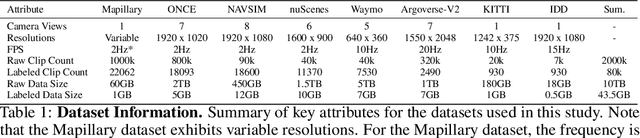
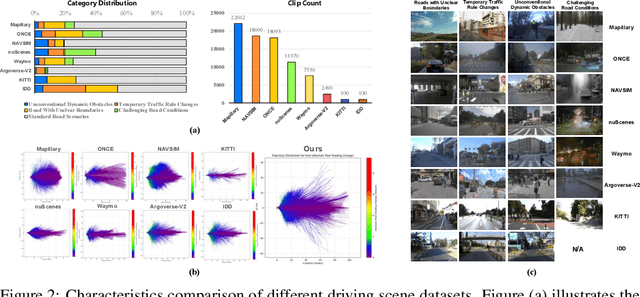
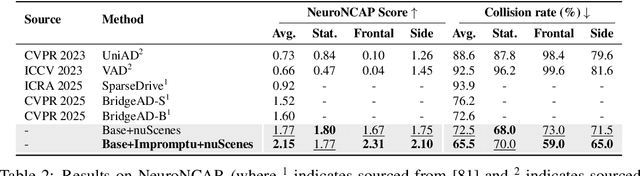
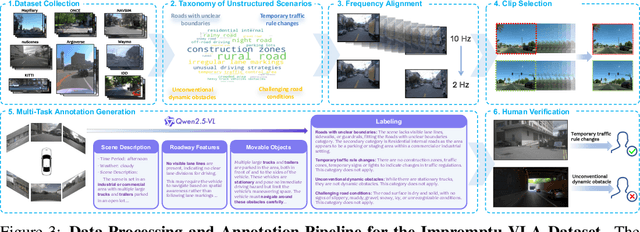
Vision-Language-Action (VLA) models for autonomous driving show promise but falter in unstructured corner case scenarios, largely due to a scarcity of targeted benchmarks. To address this, we introduce Impromptu VLA. Our core contribution is the Impromptu VLA Dataset: over 80,000 meticulously curated video clips, distilled from over 2M source clips sourced from 8 open-source large-scale datasets. This dataset is built upon our novel taxonomy of four challenging unstructured categories and features rich, planning-oriented question-answering annotations and action trajectories. Crucially, experiments demonstrate that VLAs trained with our dataset achieve substantial performance gains on established benchmarks--improving closed-loop NeuroNCAP scores and collision rates, and reaching near state-of-the-art L2 accuracy in open-loop nuScenes trajectory prediction. Furthermore, our Q&A suite serves as an effective diagnostic, revealing clear VLM improvements in perception, prediction, and planning. Our code, data and models are available at https://github.com/ahydchh/Impromptu-VLA.