 Add to Chrome
 Add to Firefox
 Add to Edge
Monocular Avatar Reconstruction via Cascaded Diffusion Priors and UV-Space Differentiable Shading
Jun 26, 2026
Reconstructing high-fidelity, relightable 3D avatars from a single in-the-wild image is a challenging ill-posed problem, primarily hindered by the scarcity of high-quality PBR data and the complexity of disentangling illumination from intrinsic materials. In this paper, we present a data-efficient framework that leverages the robust priors of a unified pre-trained diffusion backbone to sequentially address texture completion, delighting, and material decomposition. Unlike existing methods that rely on fragmented pipelines or extensive proprietary datasets, we utilize cascaded Low-Rank Adaptations (LoRAs) to adapt the strong generative prior of the diffusion model for each sub-task in UV space. Specifically, we first employ an Inpainting LoRA to complete missing UV textures caused by occlusion, leveraging the model's semantic understanding to generate semantically and photometrically coherent details. Subsequently, a Light-Homogenization LoRA and a novel Cross-Intrinsic Attention mechanism are introduced to remove baked-in lighting and collaboratively synthesize pixel-aligned PBR maps (Albedo, Normal, Roughness, Specular, and Displacement). To ensure physical plausibility, we impose a UV-space differentiable BRDF shading loss during the decomposition stage, forcing the generative process to adhere to the rendering equation without the artifacts typical of rasterization-based supervision. Extensive experiments demonstrate that our method, trained on fewer than 100 real 3D scans, generates comprehensive, 4K-resolution PBR assets with superior realism and generalization compared to state-of-the-art methods, and all training code and model weights will be released upon acceptance.

Relit-LiVE: Relight Video by Jointly Learning Environment Video
May 07, 2026Recent advances have shown that large-scale video diffusion models can be repurposed as neural renderers by first decomposing videos into intrinsic scene representations and then performing forward rendering under novel illumination. While promising, this paradigm fundamentally relies on accurate intrinsic decomposition, which remains highly unreliable for real-world videos and often leads to distorted appearances, broken materials, and accumulated temporal artifacts during relighting. In this work, we present Relit-LiVE, a novel video relighting framework that produces physically consistent, temporally stable results without requiring prior knowledge of camera pose. Our key insight is to explicitly introduce raw reference images into the rendering process, enabling the model to recover critical scene cues that are inevitably lost or corrupted in intrinsic representations. Furthermore, we propose a novel environment video prediction formulation that simultaneously generates relit videos and per-frame environment maps aligned with each camera viewpoint in a single diffusion process. This joint prediction enforces strong geometric-illumination alignment and naturally supports dynamic lighting and camera motion, significantly improving physical consistency in video relighting while easing the requirement of known per-frame camera pose. Extensive experiments demonstrate that Relit-LiVE consistently outperforms state-of-the-art video relighting and neural rendering methods across synthetic and real-world benchmarks. Beyond relighting, our framework naturally supports a wide range of downstream applications, including scene-level rendering, material editing, object insertion, and streaming video relighting. The Project is available at https://github.com/zhuxing0/Relit-LiVE.
Light of Normals: Unified Feature Representation for Universal Photometric Stereo
Jun 24, 2025
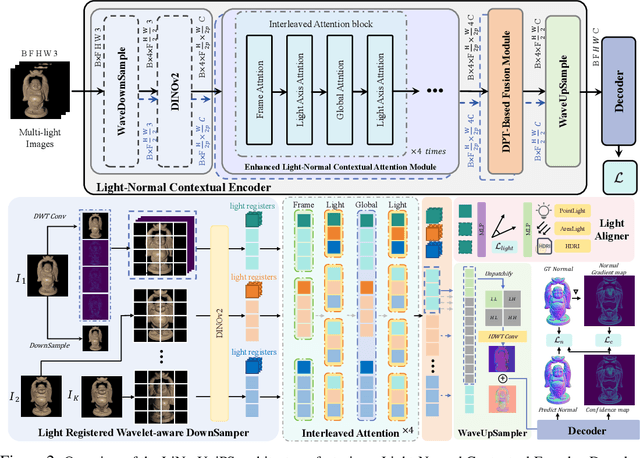
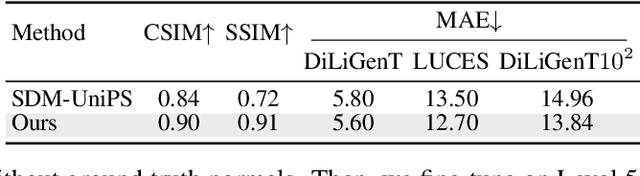

Universal photometric stereo (PS) aims to recover high-quality surface normals from objects under arbitrary lighting conditions without relying on specific illumination models. Despite recent advances such as SDM-UniPS and Uni MS-PS, two fundamental challenges persist: 1) the deep coupling between varying illumination and surface normal features, where ambiguity in observed intensity makes it difficult to determine whether brightness variations stem from lighting changes or surface orientation; and 2) the preservation of high-frequency geometric details in complex surfaces, where intricate geometries create self-shadowing, inter-reflections, and subtle normal variations that conventional feature processing operations struggle to capture accurately.
Post-Training Quantization for Video Matting
Jun 12, 2025Video matting is crucial for applications such as film production and virtual reality, yet deploying its computationally intensive models on resource-constrained devices presents challenges. Quantization is a key technique for model compression and acceleration. As an efficient approach, Post-Training Quantization (PTQ) is still in its nascent stages for video matting, facing significant hurdles in maintaining accuracy and temporal coherence. To address these challenges, this paper proposes a novel and general PTQ framework specifically designed for video matting models, marking, to the best of our knowledge, the first systematic attempt in this domain. Our contributions include: (1) A two-stage PTQ strategy that combines block-reconstruction-based optimization for fast, stable initial quantization and local dependency capture, followed by a global calibration of quantization parameters to minimize accuracy loss. (2) A Statistically-Driven Global Affine Calibration (GAC) method that enables the network to compensate for cumulative statistical distortions arising from factors such as neglected BN layer effects, even reducing the error of existing PTQ methods on video matting tasks up to 20%. (3) An Optical Flow Assistance (OFA) component that leverages temporal and semantic priors from frames to guide the PTQ process, enhancing the model's ability to distinguish moving foregrounds in complex scenes and ultimately achieving near full-precision performance even under ultra-low-bit quantization. Comprehensive quantitative and visual results show that our PTQ4VM achieves the state-of-the-art accuracy performance across different bit-widths compared to the existing quantization methods. We highlight that the 4-bit PTQ4VM even achieves performance close to the full-precision counterpart while enjoying 8x FLOP savings.