 Add to Chrome
 Add to Firefox
 Add to Edge
Dexora: Open-source VLA for High-DoF Bimanual Dexterity
May 18, 2026
Vision-Language-Action (VLA) models have recently become a central direction in embodied AI, but current systems are restricted to either dual-gripper control or single-arm dexterous hand manipulation. While low-dimensional gripper control can often be handled with simpler methods, high-dimensional dexterous hand control benefits greatly from full end-to-end VLA learning. In this work, we introduce Dexora, the first open-source VLA system that natively targets dual-arm, dual-hand high-DoF manipulation. We design a hybrid teleoperation pipeline that decouples gross arm kinematics (captured with a custom exoskeleton backpack) from fine finger motion (markerless hand tracking via Apple Vision Pro), and that drives both a physical dual-arm dual-hand platform and an identical MuJoCo digital twin. Using that interface, we assemble a large training corpus: an embodiment-matched synthetic corpus (100K simulated trajectories, 6.5M frames) and a real-world dataset of 10K teleoperated episodes (2.92M frames). To mitigate noisy teleoperation demonstrations, we propose a data-quality-aware training recipe: an offline discriminator provides clip-level weights for diffusion-transformer policy training, down-weighting low-quality demonstrations. Empirically, Dexora outperforms competitive VLA baselines on both basic and dexterous benchmarks (e.g., average dexterous success 66.7% vs. 51.7%), attains 90% success on basic tasks, and shows robust out-of-distribution and cross-embodiment generalization. Ablations confirm the importance of real data and the discriminator for dexterity.

Unified Map Prior Encoder for Mapping and Planning
May 04, 2026Online mapping and end-to-end (E2E) planning in autonomous driving remain largely sensor-centric, leaving rich map priors, including HD/SD vector maps, rasterized SD maps, and satellite imagery, underused because of heterogeneity, pose drift, and inconsistent availability at test time. We present UMPE, a Unified Map Prior Encoder that can ingest any subset of four priors and fuse them with BEV features for both mapping and planning. UMPE has two branches. The vector encoder pre-aligns HD/SD polylines with a frame-wise SE(2) correction, encodes points via multi-frequency sinusoidal features, and produces polyline tokens with confidence scores. BEV queries then apply cross-attention with confidence bias, followed by normalized channel-wise gating to avoid length imbalance and softly down-weight uncertain sources. The raster encoder shares a ResNet-18 backbone conditioned by FiLM with scaling and shift at every stage, performs SE(2) micro-alignment, and injects priors through zero-initialized residual fusion, so the network starts from a do-no-harm baseline and learns to add only useful prior evidence. A vector-then-raster fusion order reflects the inductive bias of geometry first, appearance second. On nuScenes mapping, UMPE lifts MapTRv2 from 61.5 to 67.4 mAP (+5.9) and MapQR from 66.4 to 71.7 mAP (+5.3). On Argoverse2, UMPE adds +4.1 mAP over strong baselines. UMPE is compositional: when trained with all priors, it outperforms single-prior models even when only one prior is available at test time, demonstrating powerset robustness. For E2E planning with the VAD backbone on nuScenes, UMPE reduces trajectory error from 0.72 to 0.42 m L2 on average (-0.30 m) and collision rate from 0.22% to 0.12% (-0.10%), surpassing recent prior-injection methods. These results show that a unified, alignment-aware treatment of heterogeneous map priors yields better mapping and better planning.
GraphiContact: Pose-aware Human-Scene Robust Contact Perception for Interactive Systems
Mar 19, 2026Monocular vertex-level human-scene contact prediction is a fundamental capability for interactive systems such as assistive monitoring, embodied AI, and rehabilitation analysis. In this work, we study this task jointly with single-image 3D human mesh reconstruction, using reconstructed body geometry as a scaffold for contact reasoning. Existing approaches either focus on contact prediction without sufficiently exploiting explicit 3D human priors, or emphasize pose/mesh reconstruction without directly optimizing robust vertex-level contact inference under occlusion and perceptual noise. To address this gap, we propose GraphiContact, a pose-aware framework that transfers complementary human priors from two pretrained Transformer encoders and predicts per-vertex human-scene contact on the reconstructed mesh. To improve robustness in real-world scenarios, we further introduce a Single-Image Multi-Infer Uncertainty (SIMU) training strategy with token-level adaptive routing, which simulates occlusion and noisy observations during training while preserving efficient single-branch inference at test time. Experiments on five benchmark datasets show that GraphiContact achieves consistent gains on both contact prediction and 3D human reconstruction. Our code, based on the GraphiContact method, provides comprehensive 3D human reconstruction and interaction analysis, and will be publicly available at https://github.com/Aveiro-Lin/GraphiContact.
UniUncer: Unified Dynamic Static Uncertainty for End to End Driving
Mar 08, 2026End-to-end (E2E) driving has become a cornerstone of both industry deployment and academic research, offering a single learnable pipeline that maps multi-sensor inputs to actions while avoiding hand-engineered modules. However, the reliability of such pipelines strongly depends on how well they handle uncertainty: sensors are noisy, semantics can be ambiguous, and interaction with other road users is inherently stochastic. Uncertainty also appears in multiple forms: classification vs. localization, and, crucially, in both static map elements and dynamic agents. Existing E2E approaches model only static-map uncertainty, leaving planning vulnerable to overconfident and unreliable inputs. We present UniUncer, the first lightweight, unified uncertainty framework that jointly estimates and uses uncertainty for both static and dynamic scene elements inside an E2E planner. Concretely: (1) we convert deterministic heads to probabilistic Laplace regressors that output per-vertex location and scale for vectorized static and dynamic entities; (2) we introduce an uncertainty-fusion module that encodes these parameters and injects them into object/map queries to form uncertainty-aware queries; and (3) we design an uncertainty-aware gate that adaptively modulates reliance on historical inputs (ego status or temporal perception queries) based on current uncertainty levels. The design adds minimal overhead and drops throughput by only $\sim$0.5 FPS while remaining plug-and-play for common E2E backbones. On nuScenes (open-loop), UniUncer reduces average L2 trajectory error by 7\%. On NavsimV2 (pseudo closed-loop), it improves overall EPDMS by 10.8\% and notable stage two gains in challenging, interaction-heavy scenes. Ablations confirm that dynamic-agent uncertainty and the uncertainty-aware gate are both necessary.
RoboChemist: Long-Horizon and Safety-Compliant Robotic Chemical Experimentation
Sep 10, 2025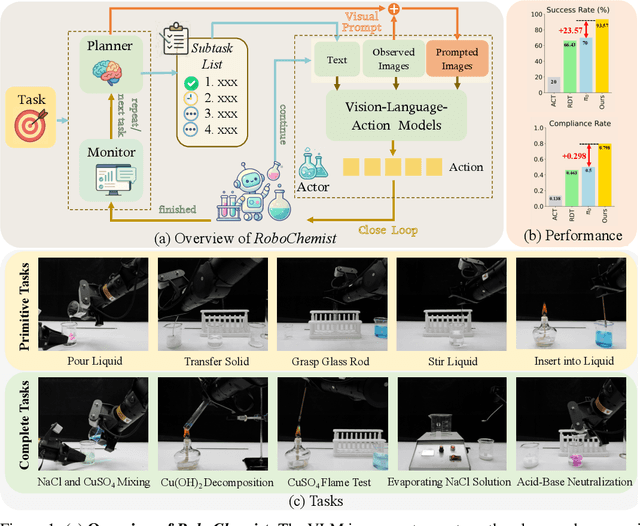
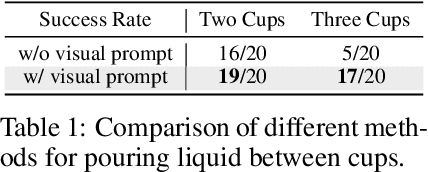
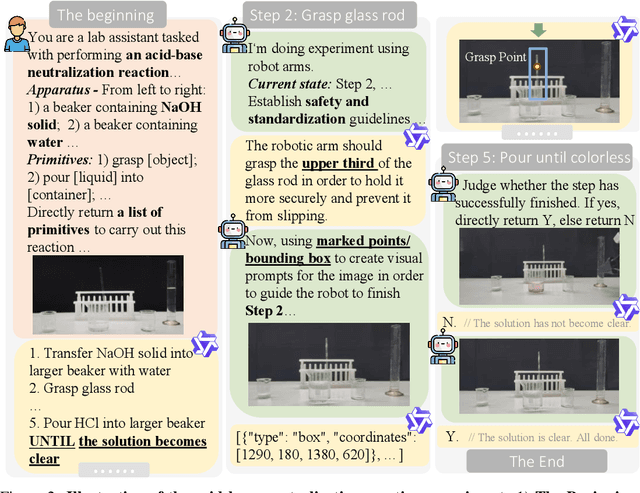

Robotic chemists promise to both liberate human experts from repetitive tasks and accelerate scientific discovery, yet remain in their infancy. Chemical experiments involve long-horizon procedures over hazardous and deformable substances, where success requires not only task completion but also strict compliance with experimental norms. To address these challenges, we propose \textit{RoboChemist}, a dual-loop framework that integrates Vision-Language Models (VLMs) with Vision-Language-Action (VLA) models. Unlike prior VLM-based systems (e.g., VoxPoser, ReKep) that rely on depth perception and struggle with transparent labware, and existing VLA systems (e.g., RDT, pi0) that lack semantic-level feedback for complex tasks, our method leverages a VLM to serve as (1) a planner to decompose tasks into primitive actions, (2) a visual prompt generator to guide VLA models, and (3) a monitor to assess task success and regulatory compliance. Notably, we introduce a VLA interface that accepts image-based visual targets from the VLM, enabling precise, goal-conditioned control. Our system successfully executes both primitive actions and complete multi-step chemistry protocols. Results show 23.57% higher average success rate and a 0.298 average increase in compliance rate over state-of-the-art VLA baselines, while also demonstrating strong generalization to objects and tasks.
TA-VLA: Elucidating the Design Space of Torque-aware Vision-Language-Action Models
Sep 09, 2025Many robotic manipulation tasks require sensing and responding to force signals such as torque to assess whether the task has been successfully completed and to enable closed-loop control. However, current Vision-Language-Action (VLA) models lack the ability to integrate such subtle physical feedback. In this work, we explore Torque-aware VLA models, aiming to bridge this gap by systematically studying the design space for incorporating torque signals into existing VLA architectures. We identify and evaluate several strategies, leading to three key findings. First, introducing torque adapters into the decoder consistently outperforms inserting them into the encoder.Third, inspired by joint prediction and planning paradigms in autonomous driving, we propose predicting torque as an auxiliary output, which further improves performance. This strategy encourages the model to build a physically grounded internal representation of interaction dynamics. Extensive quantitative and qualitative experiments across contact-rich manipulation benchmarks validate our findings.
GaussianArt: Unified Modeling of Geometry and Motion for Articulated Objects
Aug 20, 2025Reconstructing articulated objects is essential for building digital twins of interactive environments. However, prior methods typically decouple geometry and motion by first reconstructing object shape in distinct states and then estimating articulation through post-hoc alignment. This separation complicates the reconstruction pipeline and restricts scalability, especially for objects with complex, multi-part articulation. We introduce a unified representation that jointly models geometry and motion using articulated 3D Gaussians. This formulation improves robustness in motion decomposition and supports articulated objects with up to 20 parts, significantly outperforming prior approaches that often struggle beyond 2--3 parts due to brittle initialization. To systematically assess scalability and generalization, we propose MPArt-90, a new benchmark consisting of 90 articulated objects across 20 categories, each with diverse part counts and motion configurations. Extensive experiments show that our method consistently achieves superior accuracy in part-level geometry reconstruction and motion estimation across a broad range of object types. We further demonstrate applicability to downstream tasks such as robotic simulation and human-scene interaction modeling, highlighting the potential of unified articulated representations in scalable physical modeling.
Reusing Attention for One-stage Lane Topology Understanding
Jul 23, 2025Understanding lane toplogy relationships accurately is critical for safe autonomous driving. However, existing two-stage methods suffer from inefficiencies due to error propagations and increased computational overheads. To address these challenges, we propose a one-stage architecture that simultaneously predicts traffic elements, lane centerlines and topology relationship, improving both the accuracy and inference speed of lane topology understanding for autonomous driving. Our key innovation lies in reusing intermediate attention resources within distinct transformer decoders. This approach effectively leverages the inherent relational knowledge within the element detection module to enable the modeling of topology relationships among traffic elements and lanes without requiring additional computationally expensive graph networks. Furthermore, we are the first to demonstrate that knowledge can be distilled from models that utilize standard definition (SD) maps to those operates without using SD maps, enabling superior performance even in the absence of SD maps. Extensive experiments on the OpenLane-V2 dataset show that our approach outperforms baseline methods in both accuracy and efficiency, achieving superior results in lane detection, traffic element identification, and topology reasoning. Our code is available at https://github.com/Yang-Li-2000/one-stage.git.
Morpheus: A Neural-driven Animatronic Face with Hybrid Actuation and Diverse Emotion Control
Jul 22, 2025Previous animatronic faces struggle to express emotions effectively due to hardware and software limitations. On the hardware side, earlier approaches either use rigid-driven mechanisms, which provide precise control but are difficult to design within constrained spaces, or tendon-driven mechanisms, which are more space-efficient but challenging to control. In contrast, we propose a hybrid actuation approach that combines the best of both worlds. The eyes and mouth-key areas for emotional expression-are controlled using rigid mechanisms for precise movement, while the nose and cheek, which convey subtle facial microexpressions, are driven by strings. This design allows us to build a compact yet versatile hardware platform capable of expressing a wide range of emotions. On the algorithmic side, our method introduces a self-modeling network that maps motor actions to facial landmarks, allowing us to automatically establish the relationship between blendshape coefficients for different facial expressions and the corresponding motor control signals through gradient backpropagation. We then train a neural network to map speech input to corresponding blendshape controls. With our method, we can generate distinct emotional expressions such as happiness, fear, disgust, and anger, from any given sentence, each with nuanced, emotion-specific control signals-a feature that has not been demonstrated in earlier systems. We release the hardware design and code at https://github.com/ZZongzheng0918/Morpheus-Hardware and https://github.com/ZZongzheng0918/Morpheus-Software.
DiffVLA: Vision-Language Guided Diffusion Planning for Autonomous Driving
May 26, 2025Research interest in end-to-end autonomous driving has surged owing to its fully differentiable design integrating modular tasks, i.e. perception, prediction and planing, which enables optimization in pursuit of the ultimate goal. Despite the great potential of the end-to-end paradigm, existing methods suffer from several aspects including expensive BEV (bird's eye view) computation, action diversity, and sub-optimal decision in complex real-world scenarios. To address these challenges, we propose a novel hybrid sparse-dense diffusion policy, empowered by a Vision-Language Model (VLM), called Diff-VLA. We explore the sparse diffusion representation for efficient multi-modal driving behavior. Moreover, we rethink the effectiveness of VLM driving decision and improve the trajectory generation guidance through deep interaction across agent, map instances and VLM output. Our method shows superior performance in Autonomous Grand Challenge 2025 which contains challenging real and reactive synthetic scenarios. Our methods achieves 45.0 PDMS.