 Add to Chrome
 Add to Firefox
 Add to Edge
AdapShot: Adaptive Many-Shot In-Context Learning with Semantic-Aware KV Cache Reuse
May 05, 2026
Many-Shot In-Context Learning (ICL) has emerged as a promising paradigm, leveraging extensive examples to unlock the reasoning potential of Large Language Models (LLMs). However, existing methods typically rely on a predetermined, fixed number of shots. This static approach often fails to adapt to the varying difficulty of different queries, leading to either insufficient context or interference from noise. Furthermore, the prohibitive computational and memory costs of long contexts severely limit Many-Shot's feasibility. To address the above limitations, we propose AdapShot, which dynamically optimizes shot counts and leverages KV cache reuse for efficient inference. Specifically, we design a probe-based evaluation mechanism that utilizes output entropy to determine the optimal number of shots. To bypass the redundant prefilling computation during both the probing and inference phases, we incorporate a semantics-aware KV cache reuse strategy. Within this reuse strategy, to address positional encoding incompatibilities, we introduce a decoupling and re-encoding method that enables the flexible reordering of cached key-value pairs. Extensive experiments demonstrate that AdapShot achieves an average performance gain of around 10% and a 4.64x speedup compared to state-of-the-art DBSA.

PET Image Reconstruction with Multiple Kernels and Multiple Kernel Space Regularizers
Mar 04, 2021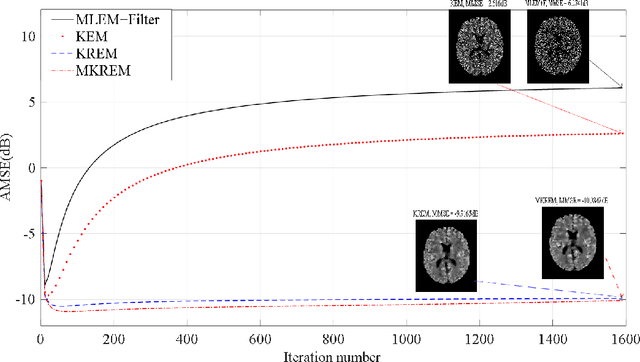
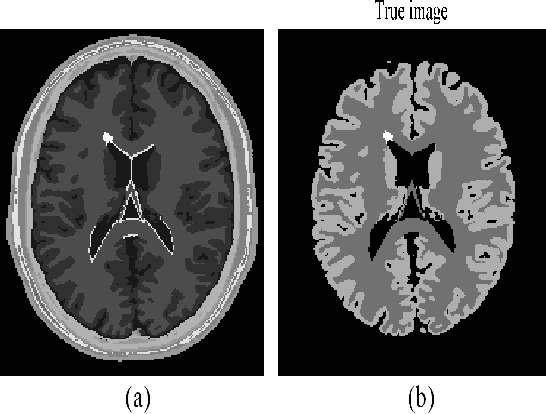
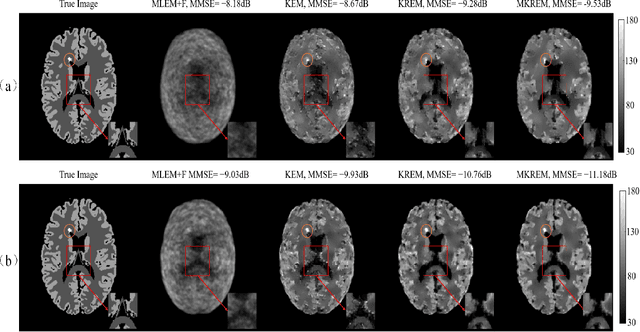
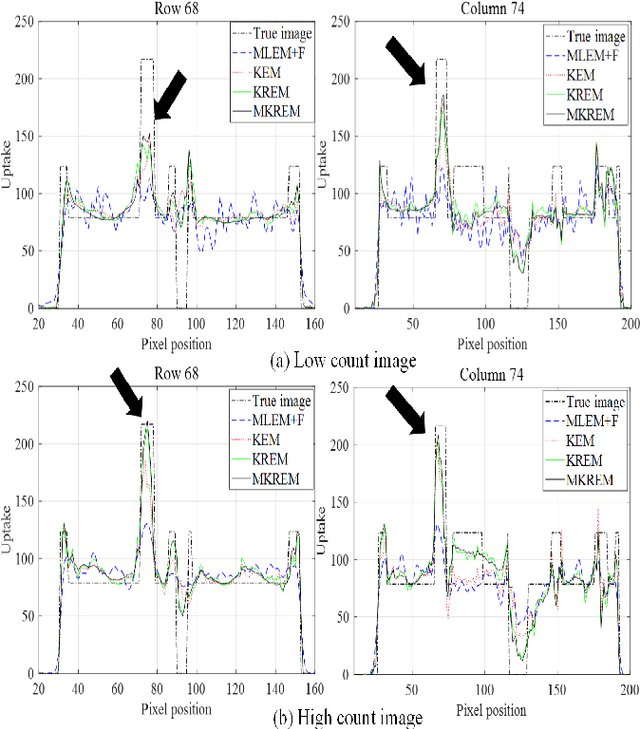
Kernelized maximum-likelihood (ML) expectation maximization (EM) methods have recently gained prominence in PET image reconstruction, outperforming many previous state-of-the-art methods. But they are not immune to the problems of non-kernelized MLEM methods in potentially large reconstruction error and high sensitivity to iteration number. This paper demonstrates these problems by theoretical reasoning and experiment results, and provides a novel solution to solve these problems. The solution is a regularized kernelized MLEM with multiple kernel matrices and multiple kernel space regularizers that can be tailored for different applications. To reduce the reconstruction error and the sensitivity to iteration number, we present a general class of multi-kernel matrices and two regularizers consisting of kernel image dictionary and kernel image Laplacian quatradic, and use them to derive the single-kernel regularized EM and multi-kernel regularized EM algorithms for PET image reconstruction. These new algorithms are derived using the technical tools of multi-kernel combination in machine learning, image dictionary learning in sparse coding, and graph Laplcian quadratic in graph signal processing. Extensive tests and comparisons on the simulated and in vivo data are presented to validate and evaluate the new algorithms, and demonstrate their superior performance and advantages over the kernelized MLEM and other conventional methods.