 Add to Chrome
 Add to Firefox
 Add to Edge
DREAM-Chunk: Reactive Action Chunking with Latent World Model
Jun 17, 2026
Action chunking has become a common interface for vision-language-action (VLA) models, enabling low-frequency policy inference to drive high-frequency robot execution. However, once an action chunk is committed, its open-loop execution can be brittle under stochastic dynamics, hardware execution errors, and partial observability. We propose DREAM-Chunk, a test-time scaling method that augments chunking-based policies with a lightweight latent world model, without requiring additional policy fine-tuning. At test time, DREAM-Chunk samples multiple candidate action chunks, rolls out their predicted latent futures, and selects actions from the chunk whose predicted state best matches the observed rollout. In this way, DREAM-Chunk uses additional test-time computation to cover multiple plausible stochastic futures and improve reactivity during long-horizon chunk execution. On the Kinetix benchmark, DREAM-Chunk improves robustness under increasing action noise and benefits from larger candidate sample sizes, especially when demonstrations contain corrective behaviors. We further validate DREAM-Chunk on four manipulation tasks across two robot platforms and two VLA policies under various sources of stochasticity. Across simulation and hardware experiments, DREAM-Chunk improves the robustness of action-chunking policies in stochastic dynamics.

MMAE: A Massive Multitask Audio Editing Benchmark
Jun 05, 2026We introduce MMAE, a Massive Multitask Audio Editing benchmark, serving as the first comprehensive evaluation testbed designed for general-purpose instruction-based audio editing. Spurred by the shift toward intelligent creation, interactive editing has rapidly expanded from visual domains, pioneered by models like Nano-banana 2 for images and Gemini-Omni for video, into audio. However, the current evaluation infrastructure lags severely, remaining highly fragmented and restricted to specific subdomains or basic operations. Unlike existing benchmarks that are limited in scope, MMAE extends to a broad spectrum of real-world scenarios, encompassing 7 distinct audio modalities, including sound, speech, music, and their mixtures. Furthermore, we establish a comprehensive taxonomy spanning 6 levels of task complexity, from basic modifications to multi-hop reasoning and multi-round editing, 2 levels of granularity, and 8 distinct operation types. Meticulously curated through human-agent collaboration, MMAE comprises 2,000 high-fidelity samples paired with a pioneering rubric-based evaluation framework. By decomposing free-form tasks into 17,741 verifiable criteria, this robust rubric-based paradigm enables a precise, multi-dimensional assessment of both instruction following and context consistency. Our extensive evaluation of leading models reveals that current systems remain far from achieving reliable edits. Strikingly, the Exact Match Rate (EMR) consistently falls below 5% and plummets to an absolute 0% in complex, mixed-modality tasks, exposing critical bottlenecks in precise execution and structural robustness. We hope MMAE will serve as a catalyst for future advances in the intelligent creation community, providing a clear diagnostic roadmap and establishing a standardized, long-lasting evaluation paradigm for next-generation audio editing systems.
WavTTS: Towards High-Quality Zero-Shot TTS via Direct Raw Waveform Modeling
Jun 02, 2026Recently, diffusion models operating on VAE latents or mel-spectrograms have become the dominant paradigm for zero-shot TTS. Although these compressed representations improve generation efficiency, they inevitably suffer from information loss and non-end-to-end training. Theoretically, directly modeling raw waveforms circumvents these issues; however, this direction remains underexplored and is often deemed difficult due to the extremely long sequence length of audio signals. To overcome this, we propose WavTTS, the first raw waveform generative TTS model that substantially narrows the gap with latent-space generative models. Built upon the flow matching with Diffusion Transformer (DiT), WavTTS directly models speech waveforms via a simple patchification strategy, while integrating multi-scale mel-spectrogram supervision to provide perceptual guidance during training. Furthermore, we investigate the impact of prediction targets and noise scheduling in waveform diffusion, and develop an effective schedule design to improve generation quality. Evaluations on open-source benchmarks demonstrate that WavTTS closely approaches the performance of current state-of-the-art latent generative zero-shot TTS models, while substantially outperforming previous end-to-end speech generation models. Our findings demonstrate the feasibility of scaling diffusion-based TTS directly in the waveform space, opening a new direction for end-to-end speech generation.
WavCube: Unifying Speech Representation for Understanding and Generation via Semantic-Acoustic Joint Modeling
May 07, 2026Integrating speech understanding and generation is a pivotal step toward building unified speech models. However, the different representations required for these two tasks currently pose significant compatibility challenges. Typically, semantics-oriented features are learned from self-supervised learning (SSL), and acoustic-oriented features from reconstruction. Such fragmented representations hinder the realization of truly unified speech systems. We present WavCube, a compact continuous latent derived from an SSL speech encoder that simultaneously supports speech understanding, reconstruction, and generation. WavCube employs a two-stage training scheme. Stage 1 trains a semantic bottleneck to filter off-manifold redundancy that makes raw SSL features intractable for diffusion. Stage 2 injects fine-grained acoustic details via end-to-end reconstruction, while a semantic anchoring loss ensures the representation remains grounded within its original semantic manifold. Comprehensive experiments show that WavCube closely approaches WavLM performance on SUPERB despite an 8x dimensional compression, attains reconstruction quality on par with existing acoustic representations, delivers state-of-the-art zero-shot TTS performance with markedly faster training convergence, and excels in speech enhancement, separation, and voice conversion tasks on the SUPERB-SG benchmark. Systematic ablations reveal that WavCube's two-stage recipe resolves two intrinsic flaws of SSL features for generative modeling, paving the way for future unified speech systems. Codes and checkpoints are available at https://github.com/yanghaha0908/WavCube.
X-VC: Zero-shot Streaming Voice Conversion in Codec Space
Apr 14, 2026Zero-shot voice conversion (VC) aims to convert a source utterance into the voice of an unseen target speaker while preserving its linguistic content. Although recent systems have improved conversion quality, building zero-shot VC systems for interactive scenarios remains challenging because high-fidelity speaker transfer and low-latency streaming inference are difficult to achieve simultaneously. In this work, we present X-VC, a zero-shot streaming VC system that performs one-step conversion in the latent space of a pretrained neural codec. X-VC uses a dual-conditioning acoustic converter that jointly models source codec latents and frame-level acoustic conditions derived from target reference speech, while injecting utterance-level target speaker information through adaptive normalization. To reduce the mismatch between training and inference, we train the model with generated paired data and a role-assignment strategy that combines standard, reconstruction, and reversed modes. For streaming inference, we further adopt a chunkwise inference scheme with overlap smoothing that is aligned with the segment-based training paradigm of the codec. Experiments on Seed-TTS-Eval show that X-VC achieves the best streaming WER in both English and Chinese, strong speaker similarity in same-language and cross-lingual settings, and substantially lower offline real-time factor than the compared baselines. These results suggest that codec-space one-step conversion is a practical approach for building high-quality low-latency zero-shot VC systems. Audio samples are available at https://x-vc.github.io. Our code and checkpoints will also be released.
SoulX-Duplug: Plug-and-Play Streaming State Prediction Module for Realtime Full-Duplex Speech Conversation
Mar 16, 2026Recent advances in spoken dialogue systems have brought increased attention to human-like full-duplex voice interactions. However, our comprehensive review of this field reveals several challenges, including the difficulty in obtaining training data, catastrophic forgetting, and limited scalability. In this work, we propose SoulX-Duplug, a plug-and-play streaming state prediction module for full-duplex spoken dialogue systems. By jointly performing streaming ASR, SoulX-Duplug explicitly leverages textual information to identify user intent, effectively serving as a semantic VAD. To promote fair evaluation, we introduce SoulX-Duplug-Eval, extending widely used benchmarks with improved bilingual coverage. Experimental results show that SoulX-Duplug enables low-latency streaming dialogue state control, and the system built upon it outperforms existing full-duplex models in overall turn management and latency performance. We have open-sourced SoulX-Duplug and SoulX-Duplug-Eval.
Modular Safety Guardrails Are Necessary for Foundation-Model-Enabled Robots in the Real World
Feb 03, 2026The integration of foundation models (FMs) into robotics has accelerated real-world deployment, while introducing new safety challenges arising from open-ended semantic reasoning and embodied physical action. These challenges require safety notions beyond physical constraint satisfaction. In this paper, we characterize FM-enabled robot safety along three dimensions: action safety (physical feasibility and constraint compliance), decision safety (semantic and contextual appropriateness), and human-centered safety (conformance to human intent, norms, and expectations). We argue that existing approaches, including static verification, monolithic controllers, and end-to-end learned policies, are insufficient in settings where tasks, environments, and human expectations are open-ended, long-tailed, and subject to adaptation over time. To address this gap, we propose modular safety guardrails, consisting of monitoring (evaluation) and intervention layers, as an architectural foundation for comprehensive safety across the autonomy stack. Beyond modularity, we highlight possible cross-layer co-design opportunities through representation alignment and conservatism allocation to enable faster, less conservative, and more effective safety enforcement. We call on the community to explore richer guardrail modules and principled co-design strategies to advance safe real-world physical AI deployment.
SLAM-LLM: A Modular, Open-Source Multimodal Large Language Model Framework and Best Practice for Speech, Language, Audio and Music Processing
Jan 14, 2026The recent surge in open-source Multimodal Large Language Models (MLLM) frameworks, such as LLaVA, provides a convenient kickoff for artificial intelligence developers and researchers. However, most of the MLLM frameworks take vision as the main input modality, and provide limited in-depth support for the modality of speech, audio, and music. This situation hinders the development of audio-language models, and forces researchers to spend a lot of effort on code writing and hyperparameter tuning. We present SLAM-LLM, an open-source deep learning framework designed to train customized MLLMs, focused on speech, language, audio, and music processing. SLAM-LLM provides a modular configuration of different encoders, projectors, LLMs, and parameter-efficient fine-tuning plugins. SLAM-LLM also includes detailed training and inference recipes for mainstream tasks, along with high-performance checkpoints like LLM-based Automatic Speech Recognition (ASR), Automated Audio Captioning (AAC), and Music Captioning (MC). Some of these recipes have already reached or are nearing state-of-the-art performance, and some relevant techniques have also been accepted by academic papers. We hope SLAM-LLM will accelerate iteration, development, data engineering, and model training for researchers. We are committed to continually pushing forward audio-based MLLMs through this open-source framework, and call on the community to contribute to the LLM-based speech, audio and music processing.
UltraVoice: Scaling Fine-Grained Style-Controlled Speech Conversations for Spoken Dialogue Models
Oct 26, 2025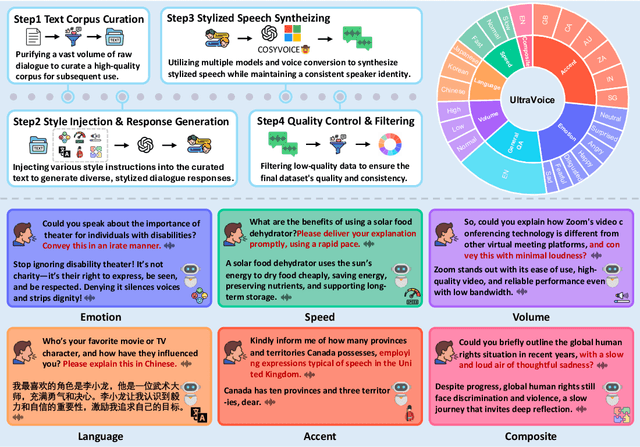
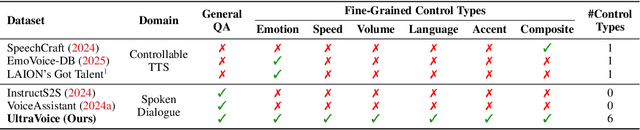
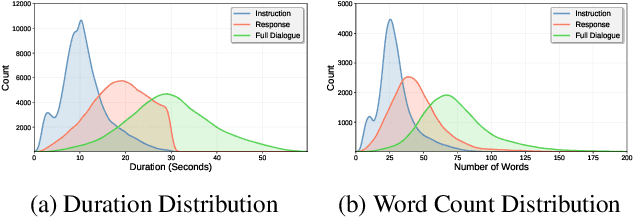
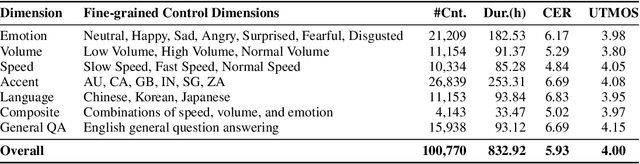
Spoken dialogue models currently lack the ability for fine-grained speech style control, a critical capability for human-like interaction that is often overlooked in favor of purely functional capabilities like reasoning and question answering. To address this limitation, we introduce UltraVoice, the first large-scale speech dialogue dataset engineered for multiple fine-grained speech style control. Encompassing over 830 hours of speech dialogues, UltraVoice provides instructions across six key speech stylistic dimensions: emotion, speed, volume, accent, language, and composite styles. Fine-tuning leading models such as SLAM-Omni and VocalNet on UltraVoice significantly enhances their fine-grained speech stylistic controllability without degrading core conversational abilities. Specifically, our fine-tuned models achieve improvements of 29.12-42.33% in Mean Opinion Score (MOS) and 14.61-40.09 percentage points in Instruction Following Rate (IFR) on multi-dimensional control tasks designed in the UltraVoice. Moreover, on the URO-Bench benchmark, our fine-tuned models demonstrate substantial gains in core understanding, reasoning, and conversational abilities, with average improvements of +10.84% on the Basic setting and +7.87% on the Pro setting. Furthermore, the dataset's utility extends to training controllable Text-to-Speech (TTS) models, underscoring its high quality and broad applicability for expressive speech synthesis. The complete dataset and model checkpoints are available at: https://github.com/bigai-nlco/UltraVoice.
MeanAudio: Fast and Faithful Text-to-Audio Generation with Mean Flows
Aug 08, 2025Recent developments in diffusion- and flow- based models have significantly advanced Text-to-Audio Generation (TTA). While achieving great synthesis quality and controllability, current TTA systems still suffer from slow inference speed, which significantly limits their practical applicability. This paper presents MeanAudio, a novel MeanFlow-based model tailored for fast and faithful text-to-audio generation. Built on a Flux-style latent transformer, MeanAudio regresses the average velocity field during training, enabling fast generation by mapping directly from the start to the endpoint of the flow trajectory. By incorporating classifier-free guidance (CFG) into the training target, MeanAudio incurs no additional cost in the guided sampling process. To further stabilize training, we propose an instantaneous-to-mean curriculum with flow field mix-up, which encourages the model to first learn the foundational instantaneous dynamics, and then gradually adapt to mean flows. This strategy proves critical for enhancing training efficiency and generation quality. Experimental results demonstrate that MeanAudio achieves state-of-the-art performance in single-step audio generation. Specifically, it achieves a real time factor (RTF) of 0.013 on a single NVIDIA RTX 3090, yielding a 100x speedup over SOTA diffusion-based TTA systems. Moreover, MeanAudio also demonstrates strong performance in multi-step generation, enabling smooth and coherent transitions across successive synthesis steps.