 Add to Chrome
 Add to Firefox
 Add to Edge
SafeCap: Improving LVLM Safety with Image Captioning Reinforcement Learning
Aug 11, 2026
Large vision-language models (LVLMs) remain vulnerable to jailbreak attacks that exploit visual inputs to bypass safety alignment inherited from their language backbones. We propose SafeCap, a reinforcement-learning framework that aligns LVLMs through learned self-captioning. SafeCap trains a policy model to first generate a safety-relevant image caption and then produce a final answer; the caption is further optimized by whether it enables a frozen LLM to reach a safety-aligned decision. This caption-mediated objective encourages the policy to expose visual cues relevant to safe response generation rather than relying solely on direct refusal supervision. Across five multimodal safety benchmarks and six vision-utility benchmarks, SafeCap substantially improves aggregate safety performance under its intended DirectCap protocol, with gains of 3.7-19.0 points in safety average across four model settings while maintaining comparable or improved vision utility. Under controlled comparisons on matched backbones and data, SafeCap outperforms safety SFT, DPO, and SafeGRPO, demonstrating the effectiveness of caption-mediated reinforcement learning for multimodal safety alignment.

Right Makes Might: Aligning Verified Hidden States Empowers RL Reasoning
Jun 02, 2026Reinforcement Learning from Verifiable Rewards (RLVR) has become the dominant approach for improving mathematical reasoning in large language models, yet current methods reduce each correct rollout to a single reward bit, ignoring the geometric structure shared among their hidden states. Investigating this structure, we find that at the anchor token (the position immediately before the answer marker), correct rollouts converge naturally because they must produce the same answer (cosine similarity ~0.84), yet each retains residual variance from its unique reasoning path. Encouraging full alignment at this point pushes the model to extract a unified "correct decision" representation, reducing sensitivity to which reasoning path was taken. Based on this observation, we propose Hidden-Align, an auxiliary loss function that aligns the last-layer hidden states of correct rollouts at the anchor token during RL training, with zero overhead in both training and inference. On eight mathematical reasoning benchmarks, Hidden-Align improves average pass@1 over the DAPO baseline by 3.8, 6.2, and 5.4 percentage points on Qwen3-1.7B, 4B, and 14B respectively, with consistent pass@k gains across all three scales, supported by ablations on loss type, anchor position, layer depth, and loss weight.
Evaluation is All You Need: Strategic Overclaiming of LLM Reasoning Capabilities Through Evaluation Design
Jun 05, 2025Reasoning models represented by the Deepseek-R1-Distill series have been widely adopted by the open-source community due to their strong performance in mathematics, science, programming, and other domains. However, our study reveals that their benchmark evaluation results are subject to significant fluctuations caused by various factors. Subtle differences in evaluation conditions can lead to substantial variations in results. Similar phenomena are observed in other open-source inference models fine-tuned based on the Deepseek-R1-Distill series, as well as in the QwQ-32B model, making their claimed performance improvements difficult to reproduce reliably. Therefore, we advocate for the establishment of a more rigorous paradigm for model performance evaluation and present our empirical assessments of the Deepseek-R1-Distill series models.
TinyR1-32B-Preview: Boosting Accuracy with Branch-Merge Distillation
Mar 06, 2025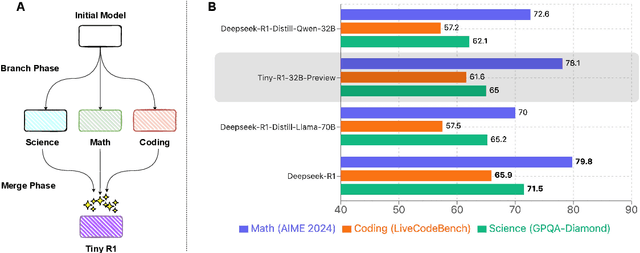
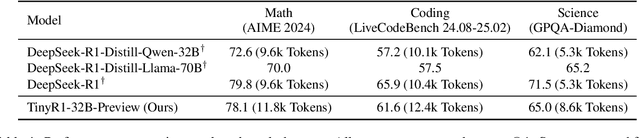
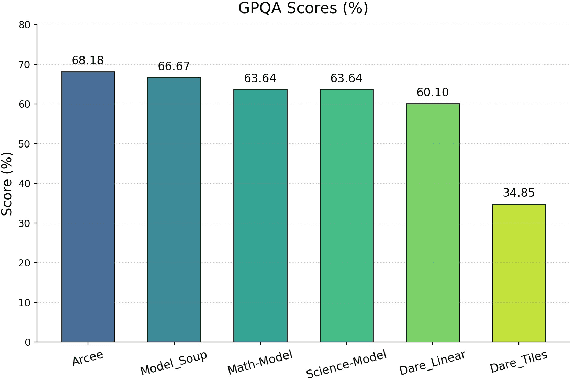
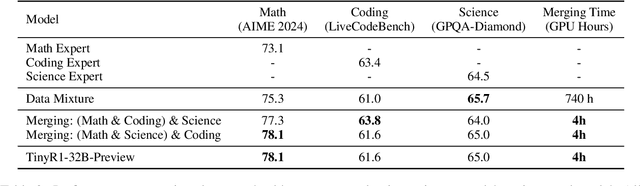
The challenge of reducing the size of Large Language Models (LLMs) while maintaining their performance has gained significant attention. However, existing methods, such as model distillation and transfer learning, often fail to achieve high accuracy. To address this limitation, we introduce the Branch-Merge distillation approach, which enhances model compression through two phases: (1) the Branch Phase, where knowledge from a large teacher model is \textit{selectively distilled} into specialized student models via domain-specific supervised fine-tuning (SFT); And (2) the Merge Phase, where these student models are merged to enable cross-domain knowledge transfer and improve generalization. We validate our distillation approach using DeepSeek-R1 as the teacher and DeepSeek-R1-Distill-Qwen-32B as the student. The resulting merged model, TinyR1-32B-Preview, outperforms its counterpart DeepSeek-R1-Distill-Qwen-32B across multiple benchmarks, including Mathematics (+5.5 points), Coding (+4.4 points) and Science (+2.9 points), while achieving near-equal performance to DeepSeek-R1 on AIME 2024. The Branch-Merge distillation approach provides a scalable solution for creating smaller, high-performing LLMs with reduced computational cost and time.