 Add to Chrome
 Add to Firefox
 Add to Edge
Relating-Up: Advancing Graph Neural Networks through Inter-Graph Relationships
May 07, 2024
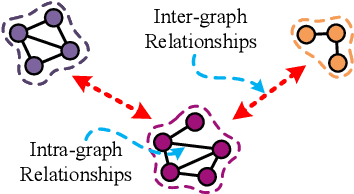


Graph Neural Networks (GNNs) have excelled in learning from graph-structured data, especially in understanding the relationships within a single graph, i.e., intra-graph relationships. Despite their successes, GNNs are limited by neglecting the context of relationships across graphs, i.e., inter-graph relationships. Recognizing the potential to extend this capability, we introduce Relating-Up, a plug-and-play module that enhances GNNs by exploiting inter-graph relationships. This module incorporates a relation-aware encoder and a feedback training strategy. The former enables GNNs to capture relationships across graphs, enriching relation-aware graph representation through collective context. The latter utilizes a feedback loop mechanism for the recursively refinement of these representations, leveraging insights from refining inter-graph dynamics to conduct feedback loop. The synergy between these two innovations results in a robust and versatile module. Relating-Up enhances the expressiveness of GNNs, enabling them to encapsulate a wider spectrum of graph relationships with greater precision. Our evaluations across 16 benchmark datasets demonstrate that integrating Relating-Up into GNN architectures substantially improves performance, positioning Relating-Up as a formidable choice for a broad spectrum of graph representation learning tasks.

LingML: Linguistic-Informed Machine Learning for Enhanced Fake News Detection
May 07, 2024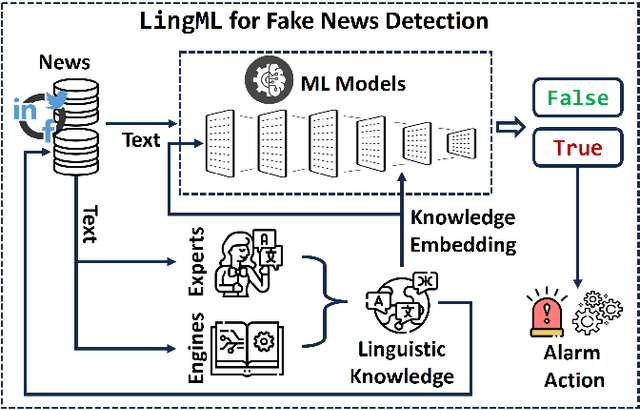
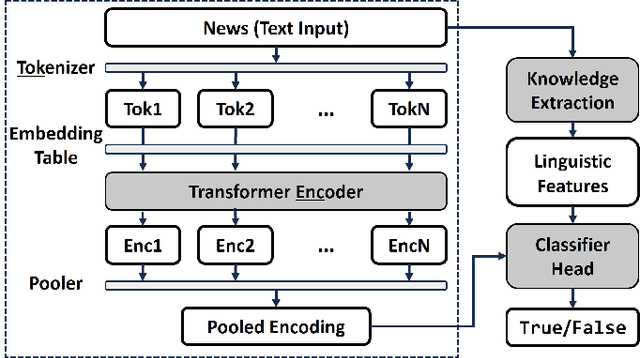
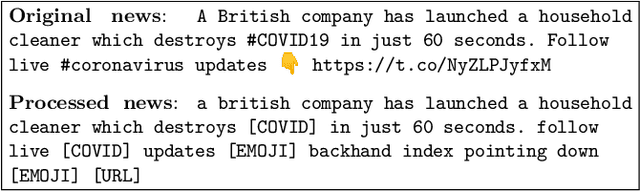
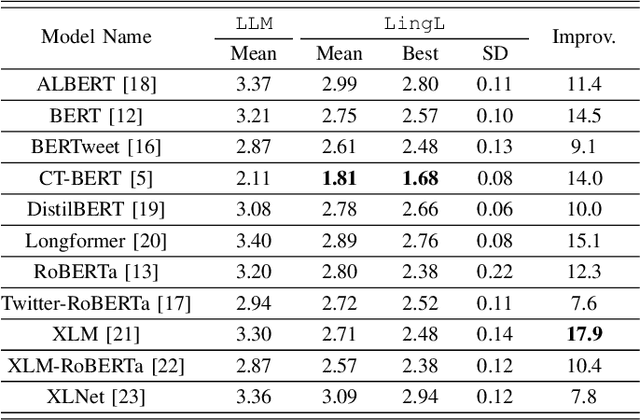
Nowadays, Information spreads at an unprecedented pace in social media and discerning truth from misinformation and fake news has become an acute societal challenge. Machine learning (ML) models have been employed to identify fake news but are far from perfect with challenging problems like limited accuracy, interpretability, and generalizability. In this paper, we enhance ML-based solutions with linguistics input and we propose LingML, linguistic-informed ML, for fake news detection. We conducted an experimental study with a popular dataset on fake news during the pandemic. The experiment results show that our proposed solution is highly effective. There are fewer than two errors out of every ten attempts with only linguistic input used in ML and the knowledge is highly explainable. When linguistics input is integrated with advanced large-scale ML models for natural language processing, our solution outperforms existing ones with 1.8% average error rate. LingML creates a new path with linguistics to push the frontier of effective and efficient fake news detection. It also sheds light on real-world multi-disciplinary applications requiring both ML and domain expertise to achieve optimal performance.
LVOS: A Benchmark for Large-scale Long-term Video Object Segmentation
May 01, 2024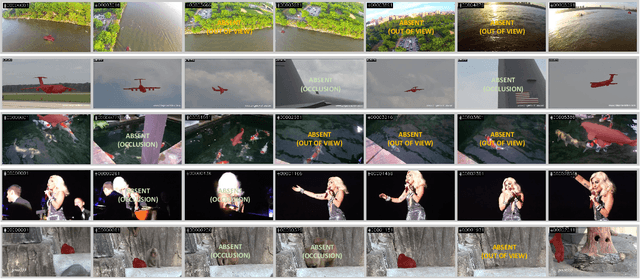
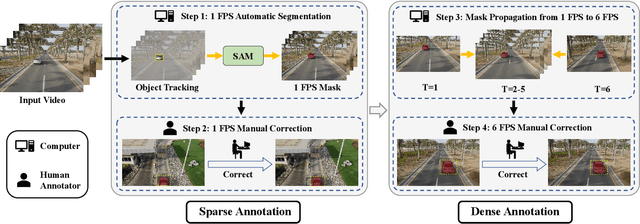
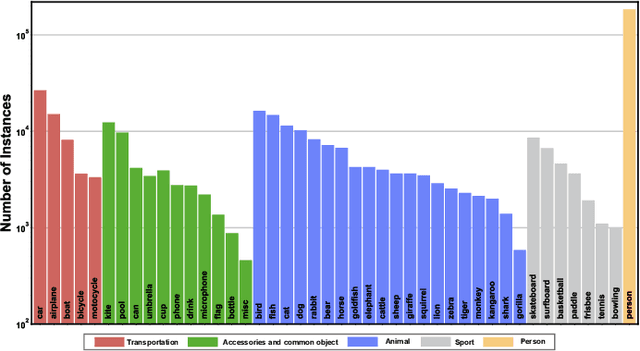
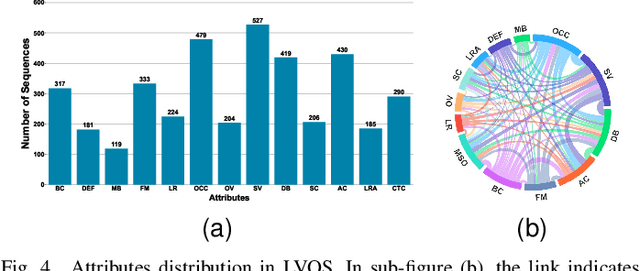
Video object segmentation (VOS) aims to distinguish and track target objects in a video. Despite the excellent performance achieved by off-the-shell VOS models, existing VOS benchmarks mainly focus on short-term videos lasting about 5 seconds, where objects remain visible most of the time. However, these benchmarks poorly represent practical applications, and the absence of long-term datasets restricts further investigation of VOS in realistic scenarios. Thus, we propose a novel benchmark named LVOS, comprising 720 videos with 296,401 frames and 407,945 high-quality annotations. Videos in LVOS last 1.14 minutes on average, approximately 5 times longer than videos in existing datasets. Each video includes various attributes, especially challenges deriving from the wild, such as long-term reappearing and cross-temporal similar objects. Compared to previous benchmarks, our LVOS better reflects VOS models' performance in real scenarios. Based on LVOS, we evaluate 20 existing VOS models under 4 different settings and conduct a comprehensive analysis. On LVOS, these models suffer a large performance drop, highlighting the challenge of achieving precise tracking and segmentation in real-world scenarios. Attribute-based analysis indicates that key factor to accuracy decline is the increased video length, emphasizing LVOS's crucial role. We hope our LVOS can advance development of VOS in real scenes. Data and code are available at https://lingyihongfd.github.io/lvos.github.io/.
SLAM for Indoor Mapping of Wide Area Construction Environments
Apr 26, 2024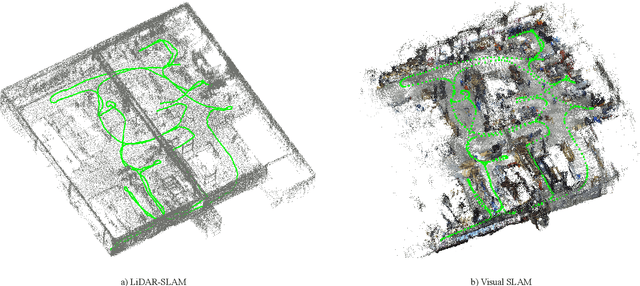
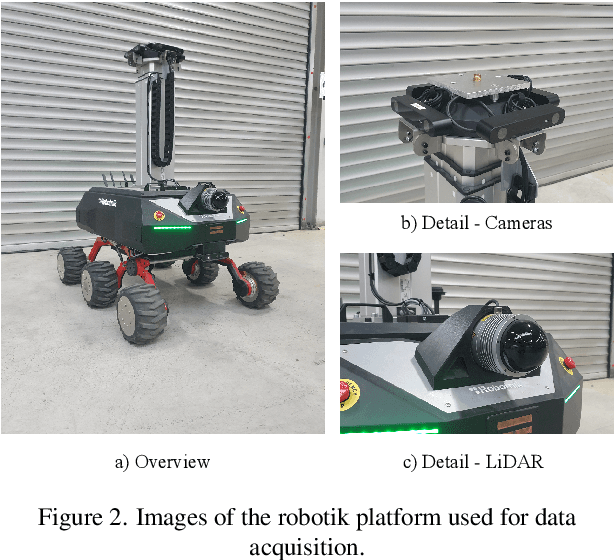
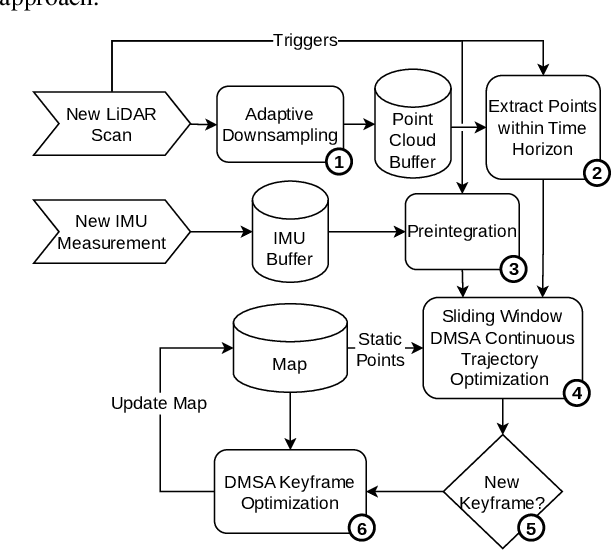
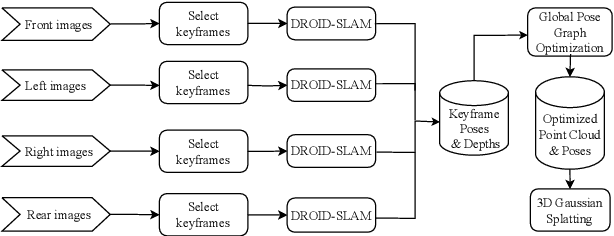
Simultaneous localization and mapping (SLAM), i.e., the reconstruction of the environment represented by a (3D) map and the concurrent pose estimation, has made astonishing progress. Meanwhile, large scale applications aiming at the data collection in complex environments like factory halls or construction sites are becoming feasible. However, in contrast to small scale scenarios with building interiors separated to single rooms, shop floors or construction areas require measures at larger distances in potentially texture less areas under difficult illumination. Pose estimation is further aggravated since no GNSS measures are available as it is usual for such indoor applications. In our work, we realize data collection in a large factory hall by a robot system equipped with four stereo cameras as well as a 3D laser scanner. We apply our state-of-the-art LiDAR and visual SLAM approaches and discuss the respective pros and cons of the different sensor types for trajectory estimation and dense map generation in such an environment. Additionally, dense and accurate depth maps are generated by 3D Gaussian splatting, which we plan to use in the context of our project aiming on the automatic construction and site monitoring.
ORBIT: Oak Ridge Base Foundation Model for Earth System Predictability
Apr 23, 2024Earth system predictability is challenged by the complexity of environmental dynamics and the multitude of variables involved. Current AI foundation models, although advanced by leveraging large and heterogeneous data, are often constrained by their size and data integration, limiting their effectiveness in addressing the full range of Earth system prediction challenges. To overcome these limitations, we introduce the Oak Ridge Base Foundation Model for Earth System Predictability (ORBIT), an advanced vision-transformer model that scales up to 113 billion parameters using a novel hybrid tensor-data orthogonal parallelism technique. As the largest model of its kind, ORBIT surpasses the current climate AI foundation model size by a thousandfold. Performance scaling tests conducted on the Frontier supercomputer have demonstrated that ORBIT achieves 230 to 707 PFLOPS, with scaling efficiency maintained at 78% to 96% across 24,576 AMD GPUs. These breakthroughs establish new advances in AI-driven climate modeling and demonstrate promise to significantly improve the Earth system predictability.
Multi-view X-ray Image Synthesis with Multiple Domain Disentanglement from CT Scans
Apr 18, 2024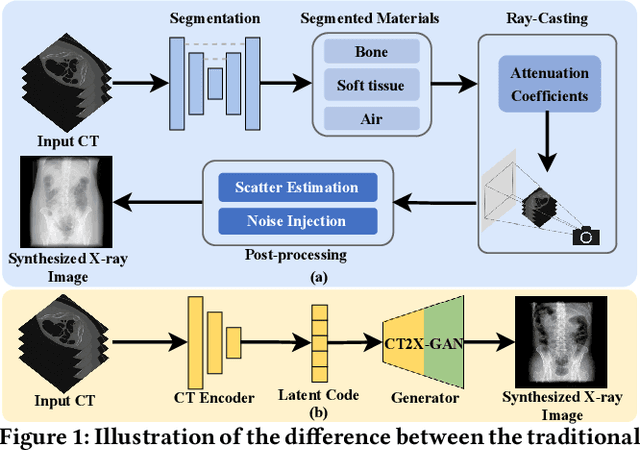
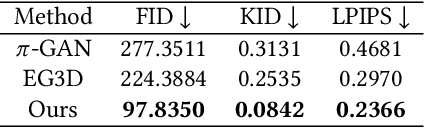
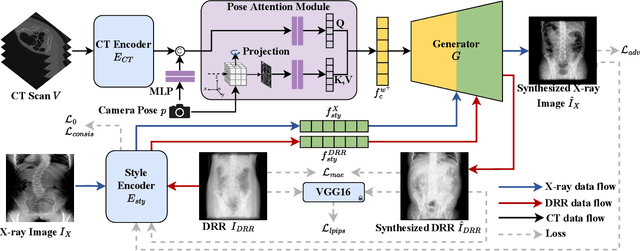
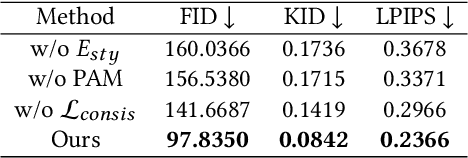
X-ray images play a vital role in the intraoperative processes due to their high resolution and fast imaging speed and greatly promote the subsequent segmentation, registration and reconstruction. However, over-dosed X-rays superimpose potential risks to human health to some extent. Data-driven algorithms from volume scans to X-ray images are restricted by the scarcity of paired X-ray and volume data. Existing methods are mainly realized by modelling the whole X-ray imaging procedure. In this study, we propose a learning-based approach termed CT2X-GAN to synthesize the X-ray images in an end-to-end manner using the content and style disentanglement from three different image domains. Our method decouples the anatomical structure information from CT scans and style information from unpaired real X-ray images/ digital reconstructed radiography (DRR) images via a series of decoupling encoders. Additionally, we introduce a novel consistency regularization term to improve the stylistic resemblance between synthesized X-ray images and real X-ray images. Meanwhile, we also impose a supervised process by computing the similarity of computed real DRR and synthesized DRR images. We further develop a pose attention module to fully strengthen the comprehensive information in the decoupled content code from CT scans, facilitating high-quality multi-view image synthesis in the lower 2D space. Extensive experiments were conducted on the publicly available CTSpine1K dataset and achieved 97.8350, 0.0842 and 3.0938 in terms of FID, KID and defined user-scored X-ray similarity, respectively. In comparison with 3D-aware methods ($\pi$-GAN, EG3D), CT2X-GAN is superior in improving the synthesis quality and realistic to the real X-ray images.
Data-free Knowledge Distillation for Fine-grained Visual Categorization
Apr 18, 2024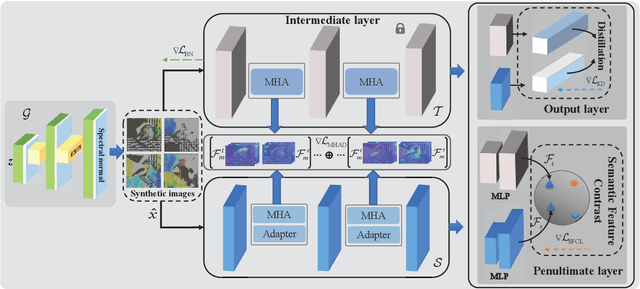
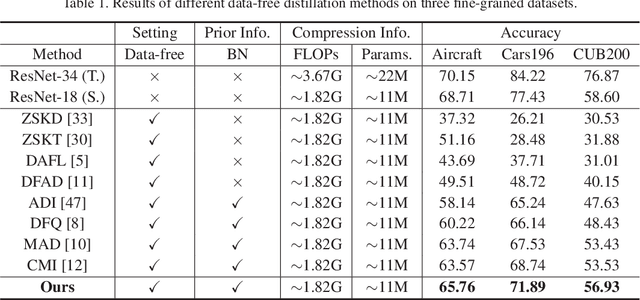
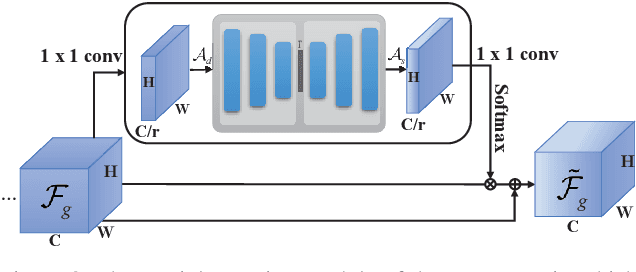
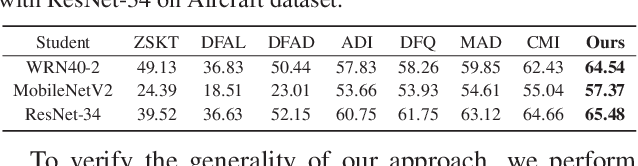
Data-free knowledge distillation (DFKD) is a promising approach for addressing issues related to model compression, security privacy, and transmission restrictions. Although the existing methods exploiting DFKD have achieved inspiring achievements in coarse-grained classification, in practical applications involving fine-grained classification tasks that require more detailed distinctions between similar categories, sub-optimal results are obtained. To address this issue, we propose an approach called DFKD-FGVC that extends DFKD to fine-grained visual categorization~(FGVC) tasks. Our approach utilizes an adversarial distillation framework with attention generator, mixed high-order attention distillation, and semantic feature contrast learning. Specifically, we introduce a spatial-wise attention mechanism to the generator to synthesize fine-grained images with more details of discriminative parts. We also utilize the mixed high-order attention mechanism to capture complex interactions among parts and the subtle differences among discriminative features of the fine-grained categories, paying attention to both local features and semantic context relationships. Moreover, we leverage the teacher and student models of the distillation framework to contrast high-level semantic feature maps in the hyperspace, comparing variances of different categories. We evaluate our approach on three widely-used FGVC benchmarks (Aircraft, Cars196, and CUB200) and demonstrate its superior performance.
GeoReF: Geometric Alignment Across Shape Variation for Category-level Object Pose Refinement
Apr 17, 2024Object pose refinement is essential for robust object pose estimation. Previous work has made significant progress towards instance-level object pose refinement. Yet, category-level pose refinement is a more challenging problem due to large shape variations within a category and the discrepancies between the target object and the shape prior. To address these challenges, we introduce a novel architecture for category-level object pose refinement. Our approach integrates an HS-layer and learnable affine transformations, which aims to enhance the extraction and alignment of geometric information. Additionally, we introduce a cross-cloud transformation mechanism that efficiently merges diverse data sources. Finally, we push the limits of our model by incorporating the shape prior information for translation and size error prediction. We conducted extensive experiments to demonstrate the effectiveness of the proposed framework. Through extensive quantitative experiments, we demonstrate significant improvement over the baseline method by a large margin across all metrics.
DetCLIPv3: Towards Versatile Generative Open-vocabulary Object Detection
Apr 14, 2024
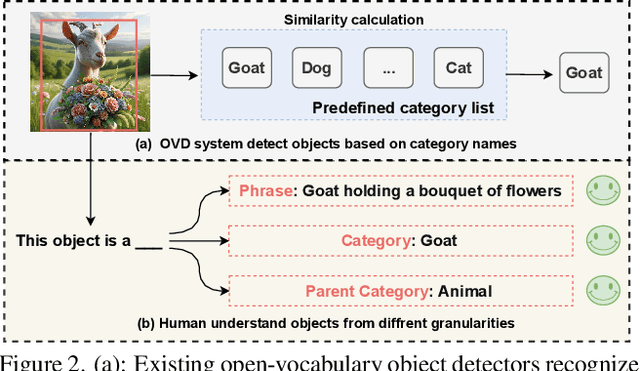
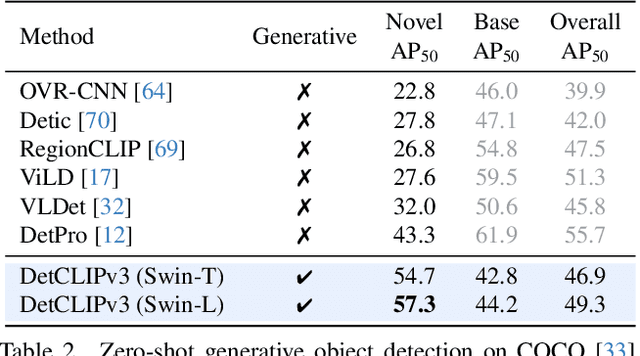

Existing open-vocabulary object detectors typically require a predefined set of categories from users, significantly confining their application scenarios. In this paper, we introduce DetCLIPv3, a high-performing detector that excels not only at both open-vocabulary object detection, but also generating hierarchical labels for detected objects. DetCLIPv3 is characterized by three core designs: 1. Versatile model architecture: we derive a robust open-set detection framework which is further empowered with generation ability via the integration of a caption head. 2. High information density data: we develop an auto-annotation pipeline leveraging visual large language model to refine captions for large-scale image-text pairs, providing rich, multi-granular object labels to enhance the training. 3. Efficient training strategy: we employ a pre-training stage with low-resolution inputs that enables the object captioner to efficiently learn a broad spectrum of visual concepts from extensive image-text paired data. This is followed by a fine-tuning stage that leverages a small number of high-resolution samples to further enhance detection performance. With these effective designs, DetCLIPv3 demonstrates superior open-vocabulary detection performance, \eg, our Swin-T backbone model achieves a notable 47.0 zero-shot fixed AP on the LVIS minival benchmark, outperforming GLIPv2, GroundingDINO, and DetCLIPv2 by 18.0/19.6/6.6 AP, respectively. DetCLIPv3 also achieves a state-of-the-art 19.7 AP in dense captioning task on VG dataset, showcasing its strong generative capability.
Fast Gradient Computation for Gromov-Wasserstein Distance
Apr 13, 2024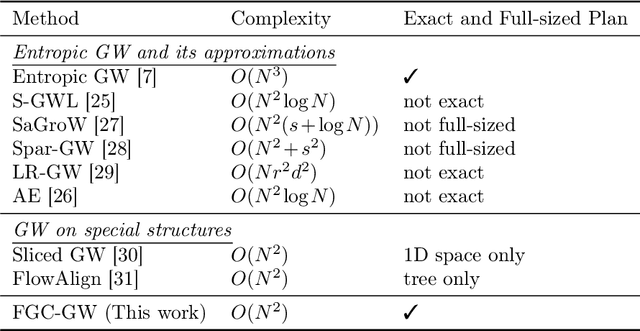
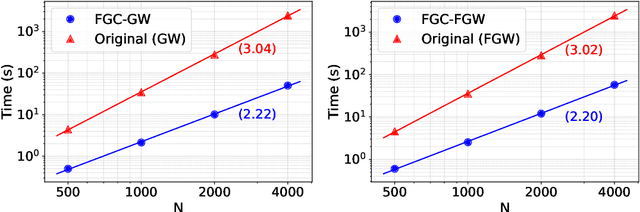
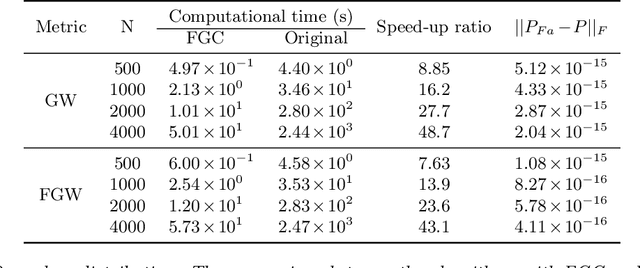
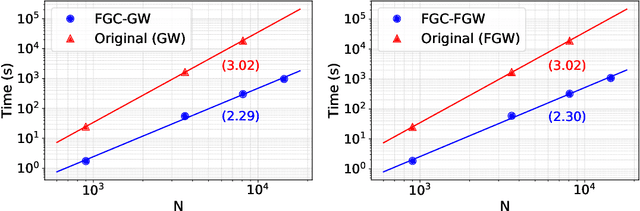
The Gromov-Wasserstein distance is a notable extension of optimal transport. In contrast to the classic Wasserstein distance, it solves a quadratic assignment problem that minimizes the pair-wise distance distortion under the transportation of distributions and thus could apply to distributions in different spaces. These properties make Gromov-Wasserstein widely applicable to many fields, such as computer graphics and machine learning. However, the computation of the Gromov-Wasserstein distance and transport plan is expensive. The well-known Entropic Gromov-Wasserstein approach has a cubic complexity since the matrix multiplication operations need to be repeated in computing the gradient of Gromov-Wasserstein loss. This becomes a key bottleneck of the method. Currently, existing methods accelerate the computation focus on sampling and approximation, which leads to low accuracy or incomplete transport plan. In this work, we propose a novel method to accelerate accurate gradient computation by dynamic programming techniques, reducing the complexity from cubic to quadratic. In this way, the original computational bottleneck is broken and the new entropic solution can be obtained with total quadratic time, which is almost optimal complexity. Furthermore, it can be extended to some variants easily. Extensive experiments validate the efficiency and effectiveness of our method.