 Add to Chrome
 Add to Firefox
 Add to Edge
Deep Joint CSI Feedback and Multiuser Precoding for MIMO OFDM Systems
Apr 25, 2024
The design of precoding plays a crucial role in achieving a high downlink sum-rate in multiuser multiple-input multiple-output (MIMO) orthogonal frequency-division multiplexing (OFDM) systems. In this correspondence, we propose a deep learning based joint CSI feedback and multiuser precoding method in frequency division duplex systems, aiming at maximizing the downlink sum-rate performance in an end-to-end manner. Specifically, the eigenvectors of the CSI matrix are compressed using deep joint source-channel coding techniques. This compression method enhances the resilience of the feedback CSI information against degradation in the feedback channel. A joint multiuser precoding module and a power allocation module are designed to adjust the precoding direction and the precoding power for users based on the feedback CSI information. Experimental results demonstrate that the downlink sum-rate can be significantly improved by using the proposed method, especially in scenarios with low signal-to-noise ratio and low feedback overhead.

Simultaneous Estimation of Shape and Force along Highly Deformable Surgical Manipulators Using Sparse FBG Measurement
Apr 25, 2024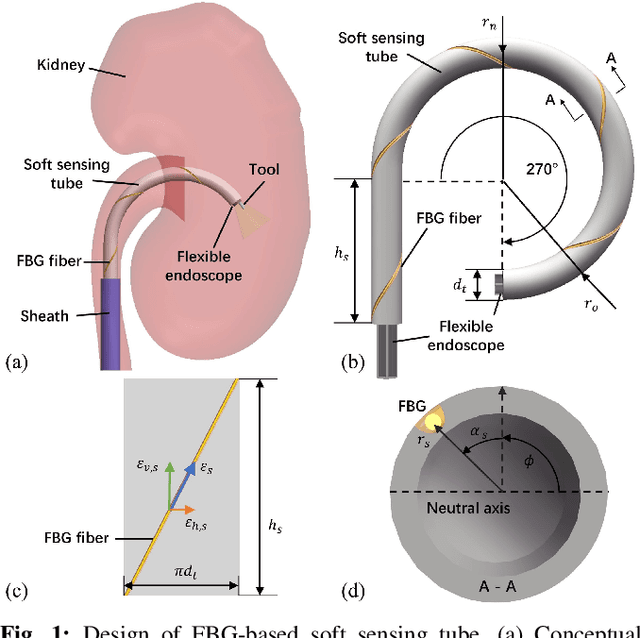
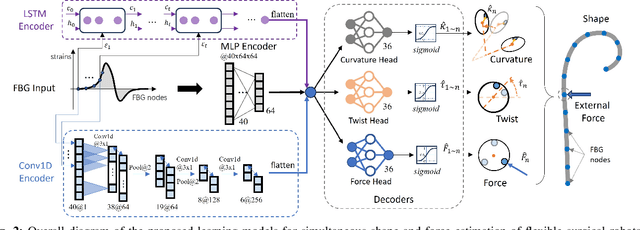
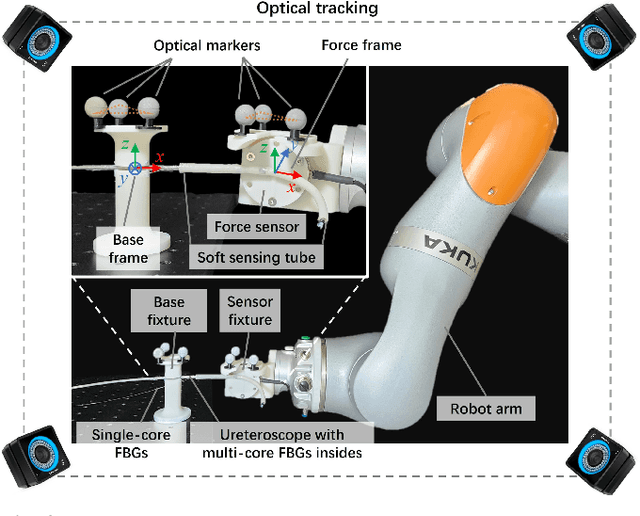
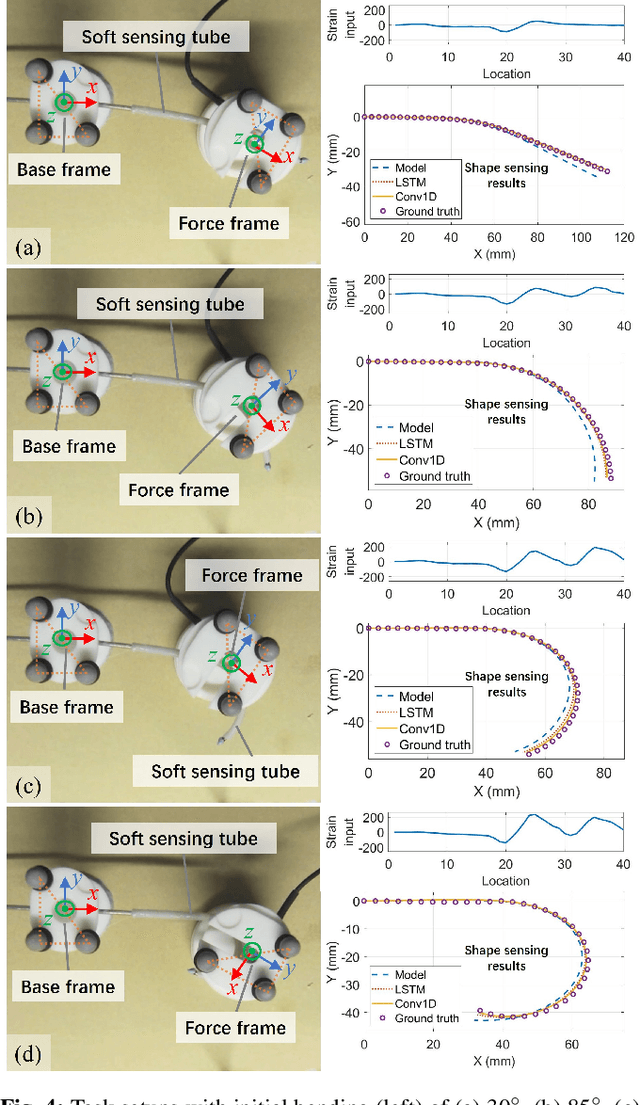
Recently, fiber optic sensors such as fiber Bragg gratings (FBGs) have been widely investigated for shape reconstruction and force estimation of flexible surgical robots. However, most existing approaches need precise model parameters of FBGs inside the fiber and their alignments with the flexible robots for accurate sensing results. Another challenge lies in online acquiring external forces at arbitrary locations along the flexible robots, which is highly required when with large deflections in robotic surgery. In this paper, we propose a novel data-driven paradigm for simultaneous estimation of shape and force along highly deformable flexible robots by using sparse strain measurement from a single-core FBG fiber. A thin-walled soft sensing tube helically embedded with FBG sensors is designed for a robotic-assisted flexible ureteroscope with large deflection up to 270 degrees and a bend radius under 10 mm. We introduce and study three learning models by incorporating spatial strain encoders, and compare their performances in both free space and constrained environments with contact forces at different locations. The experimental results in terms of dynamic shape-force sensing accuracy demonstrate the effectiveness and superiority of the proposed methods.
Beyond ESM2: Graph-Enhanced Protein Sequence Modeling with Efficient Clustering
Apr 24, 2024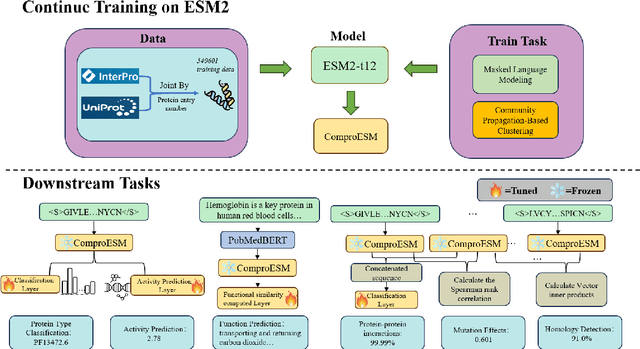


Proteins are essential to life's processes, underpinning evolution and diversity. Advances in sequencing technology have revealed millions of proteins, underscoring the need for sophisticated pre-trained protein models for biological analysis and AI development. Facebook's ESM2, the most advanced protein language model to date, leverages a masked prediction task for unsupervised learning, crafting amino acid representations with notable biochemical accuracy. Yet, it lacks in delivering functional protein insights, signaling an opportunity for enhancing representation quality.Our study addresses this gap by incorporating protein family classification into ESM2's training.This approach, augmented with Community Propagation-Based Clustering Algorithm, improves global protein representations, while a contextual prediction task fine-tunes local amino acid accuracy. Significantly, our model achieved state-of-the-art results in several downstream experiments, demonstrating the power of combining global and local methodologies to substantially boost protein representation quality.
ControlTraj: Controllable Trajectory Generation with Topology-Constrained Diffusion Model
Apr 23, 2024Generating trajectory data is among promising solutions to addressing privacy concerns, collection costs, and proprietary restrictions usually associated with human mobility analyses. However, existing trajectory generation methods are still in their infancy due to the inherent diversity and unpredictability of human activities, grappling with issues such as fidelity, flexibility, and generalizability. To overcome these obstacles, we propose ControlTraj, a Controllable Trajectory generation framework with the topology-constrained diffusion model. Distinct from prior approaches, ControlTraj utilizes a diffusion model to generate high-fidelity trajectories while integrating the structural constraints of road network topology to guide the geographical outcomes. Specifically, we develop a novel road segment autoencoder to extract fine-grained road segment embedding. The encoded features, along with trip attributes, are subsequently merged into the proposed geographic denoising UNet architecture, named GeoUNet, to synthesize geographic trajectories from white noise. Through experimentation across three real-world data settings, ControlTraj demonstrates its ability to produce human-directed, high-fidelity trajectory generation with adaptability to unexplored geographical contexts.
Towards Robust Trajectory Representations: Isolating Environmental Confounders with Causal Learning
Apr 22, 2024


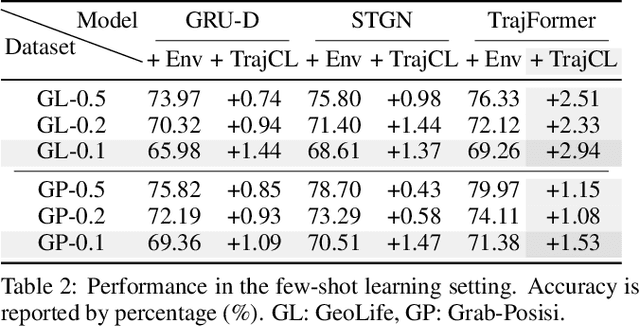
Trajectory modeling refers to characterizing human movement behavior, serving as a pivotal step in understanding mobility patterns. Nevertheless, existing studies typically ignore the confounding effects of geospatial context, leading to the acquisition of spurious correlations and limited generalization capabilities. To bridge this gap, we initially formulate a Structural Causal Model (SCM) to decipher the trajectory representation learning process from a causal perspective. Building upon the SCM, we further present a Trajectory modeling framework (TrajCL) based on Causal Learning, which leverages the backdoor adjustment theory as an intervention tool to eliminate the spurious correlations between geospatial context and trajectories. Extensive experiments on two real-world datasets verify that TrajCL markedly enhances performance in trajectory classification tasks while showcasing superior generalization and interpretability.
decoupleQ: Towards 2-bit Post-Training Uniform Quantization via decoupling Parameters into Integer and Floating Points
Apr 19, 2024

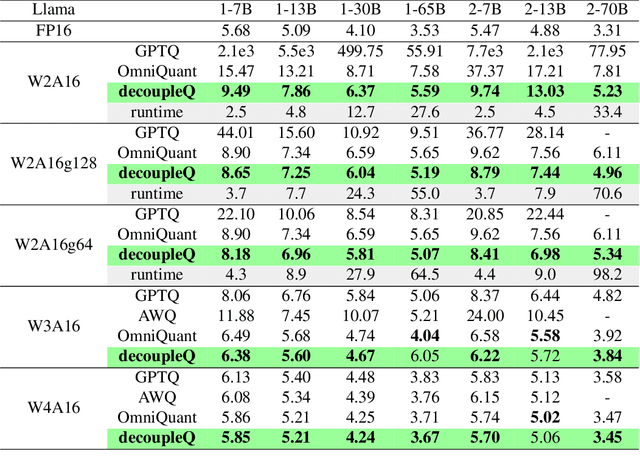

Quantization emerges as one of the most promising compression technologies for deploying efficient large models for various real time application in recent years. Considering that the storage and IO of weights take up the vast majority of the overhead inside a large model, weight only quantization can lead to large gains. However, existing quantization schemes suffer from significant accuracy degradation at very low bits, or require some additional computational overhead when deployed, making it difficult to be applied to large-scale applications in industry. In this paper, we propose decoupleQ, achieving a substantial increase in model accuracy, especially at very low bits. decoupleQ abandons the traditional heuristic quantization paradigm and decouples the model parameters into integer and floating-point parts, thus transforming the quantization problem into a traditional mathematical optimization problem with constraints, which is then solved alternatively by off-the-shelf optimization methods. Quantization via decoupleQ is linear and uniform, making it hardware-friendlier than non-uniform counterpart, and enabling the idea to be migrated to high-bit quantization to enhance its robustness. Our method has achieved well on-line accuracy near fp16/bf16 on the 2-bit quantization of large speech models in ByteDance. The code is available at https://github.com/bytedance/decoupleQ
Graph Neural Networks for Wireless Networks: Graph Representation, Architecture and Evaluation
Apr 18, 2024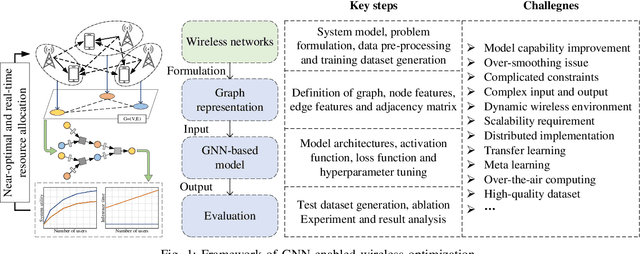
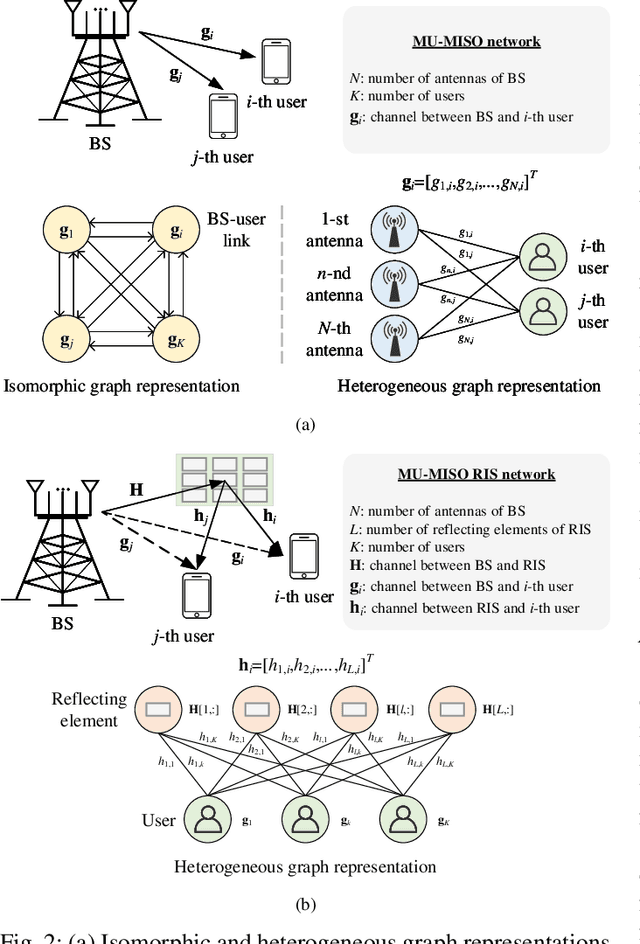
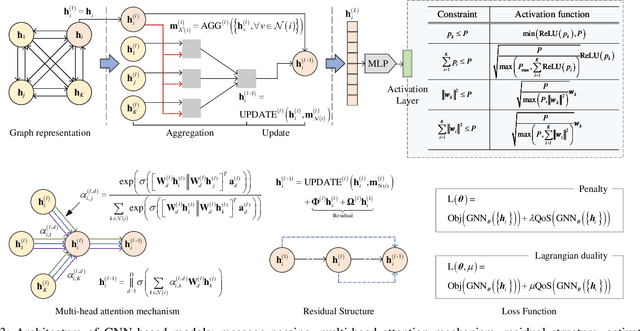
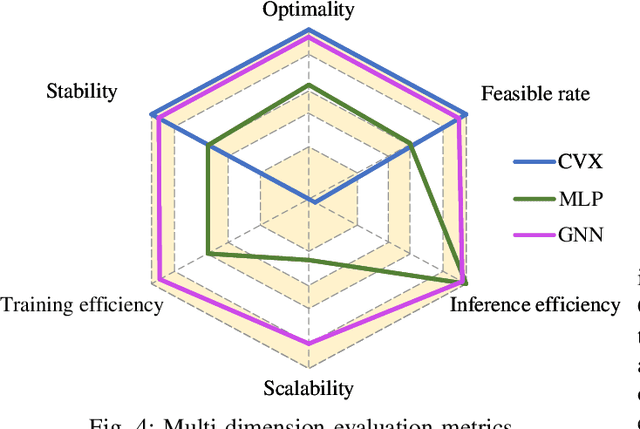
Graph neural networks (GNNs) have been regarded as the basic model to facilitate deep learning (DL) to revolutionize resource allocation in wireless networks. GNN-based models are shown to be able to learn the structural information about graphs representing the wireless networks to adapt to the time-varying channel state information and dynamics of network topology. This article aims to provide a comprehensive overview of applying GNNs to optimize wireless networks via answering three fundamental questions, i.e., how to input the wireless network data into GNNs, how to improve the performance of GNNs, and how to evaluate GNNs. Particularly, two graph representations are given to transform wireless network parameters into graph-structured data. Then, we focus on the architecture design of the GNN-based models via introducing the basic message passing as well as model improvement methods including multi-head attention mechanism and residual structure. At last, we give task-oriented evaluation metrics for DL-enabled wireless resource allocation. We also highlight certain challenges and potential research directions for the application of GNNs in wireless networks.
Adaptive Catalyst Discovery Using Multicriteria Bayesian Optimization with Representation Learning
Apr 18, 2024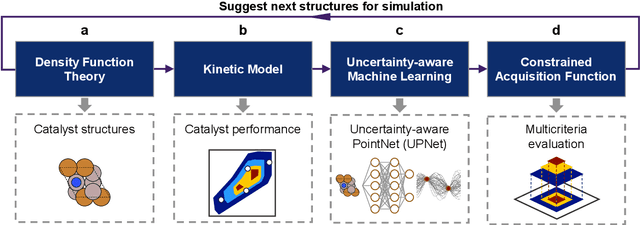
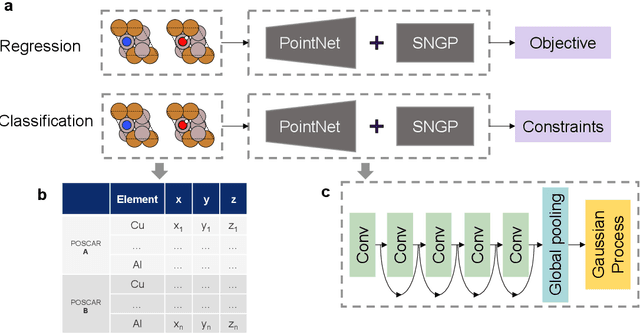
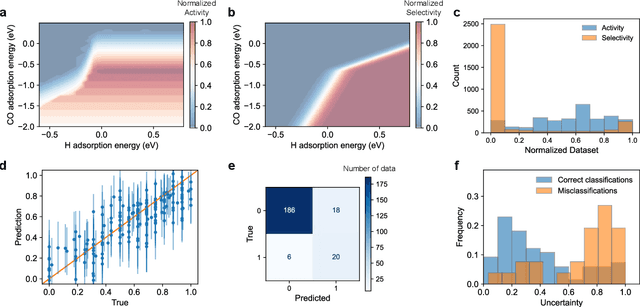
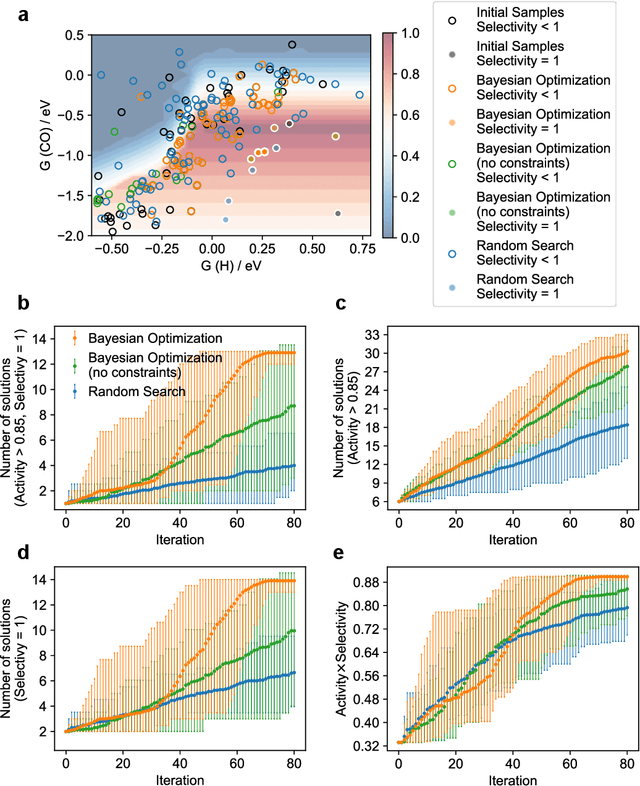
High-performance catalysts are crucial for sustainable energy conversion and human health. However, the discovery of catalysts faces challenges due to the absence of efficient approaches to navigating vast and high-dimensional structure and composition spaces. In this study, we propose a high-throughput computational catalyst screening approach integrating density functional theory (DFT) and Bayesian Optimization (BO). Within the BO framework, we propose an uncertainty-aware atomistic machine learning model, UPNet, which enables automated representation learning directly from high-dimensional catalyst structures and achieves principled uncertainty quantification. Utilizing a constrained expected improvement acquisition function, our BO framework simultaneously considers multiple evaluation criteria. Using the proposed methods, we explore catalyst discovery for the CO2 reduction reaction. The results demonstrate that our approach achieves high prediction accuracy, facilitates interpretable feature extraction, and enables multicriteria design optimization, leading to significant reduction of computing power and time (10x reduction of required DFT calculations) in high-performance catalyst discovery.
Octopus v3: Technical Report for On-device Sub-billion Multimodal AI Agent
Apr 18, 2024A multimodal AI agent is characterized by its ability to process and learn from various types of data, including natural language, visual, and audio inputs, to inform its actions. Despite advancements in large language models that incorporate visual data, such as GPT-4V, effectively translating image-based data into actionable outcomes for AI agents continues to be challenging. In this paper, we introduce a multimodal model that incorporates the concept of functional token specifically designed for AI agent applications. To ensure compatibility with edge devices, our model is optimized to a compact size of less than 1B parameters. Like GPT-4, our model can process both English and Chinese. We demonstrate that this model is capable of operating efficiently on a wide range of edge devices, including as constrained as a Raspberry Pi.
Engineering software 2.0 by interpolating neural networks: unifying training, solving, and calibration
Apr 16, 2024The evolution of artificial intelligence (AI) and neural network theories has revolutionized the way software is programmed, shifting from a hard-coded series of codes to a vast neural network. However, this transition in engineering software has faced challenges such as data scarcity, multi-modality of data, low model accuracy, and slow inference. Here, we propose a new network based on interpolation theories and tensor decomposition, the interpolating neural network (INN). Instead of interpolating training data, a common notion in computer science, INN interpolates interpolation points in the physical space whose coordinates and values are trainable. It can also extrapolate if the interpolation points reside outside of the range of training data and the interpolation functions have a larger support domain. INN features orders of magnitude fewer trainable parameters, faster training, a smaller memory footprint, and higher model accuracy compared to feed-forward neural networks (FFNN) or physics-informed neural networks (PINN). INN is poised to usher in Engineering Software 2.0, a unified neural network that spans various domains of space, time, parameters, and initial/boundary conditions. This has previously been computationally prohibitive due to the exponentially growing number of trainable parameters, easily exceeding the parameter size of ChatGPT, which is over 1 trillion. INN addresses this challenge by leveraging tensor decomposition and tensor product, with adaptable network architecture.