 Add to Chrome
 Add to Firefox
 Add to Edge
In-situ process monitoring for defect detection in wire-arc additive manufacturing: an agentic AI approach
Apr 10, 2026
AI agents are being increasingly deployed across a wide range of real-world applications. In this paper, we propose an agentic AI framework for in-situ process monitoring for defect detection in wire-arc additive manufacturing (WAAM). The autonomous agent leverages a WAAM process monitoring dataset and a trained classification tool to build AI agents and uses a large language model (LLM) for in-situ process monitoring decision-making for defect detection. A processing agent is developed based on welder process signals, such as current and voltage, and a monitoring agent is developed based on acoustic data collected during the process. Both agents are tasked with identifying porosity defects from processing and monitoring signals, respectively. Ground truth X-ray computed tomography (XCT) data are used to develop classification tools for both the processing and monitoring agents. Furthermore, a multi-agent framework is demonstrated in which the processing and monitoring agents are orchestrated together for parallel decision-making on the given task of defect classification. Evaluation metrics are proposed to determine the efficacy of both individual agents, the combined single-agent, and the coordinated multi-agent system. The multi-agent configuration outperforms all individual-agent counterparts, achieving a decision accuracy of 91.6% and an F1 score of 0.821 on decided runs, across 15 independent runs, and a reasoning quality score of 3.74 out of 5. These in-situ process monitoring agents hold significant potential for autonomous real-time process monitoring and control toward building qualified parts for WAAM and other additive manufacturing processes.

Engineering software 2.0 by interpolating neural networks: unifying training, solving, and calibration
Apr 16, 2024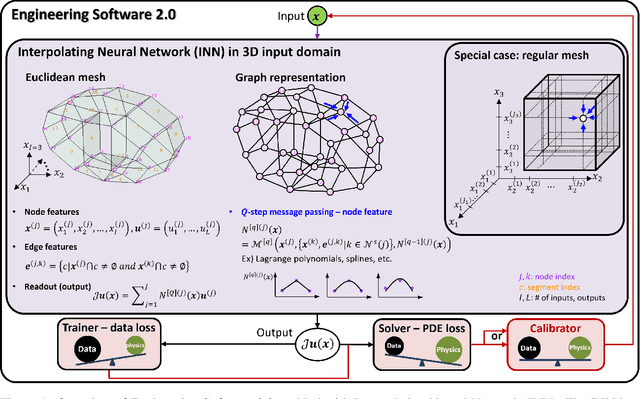

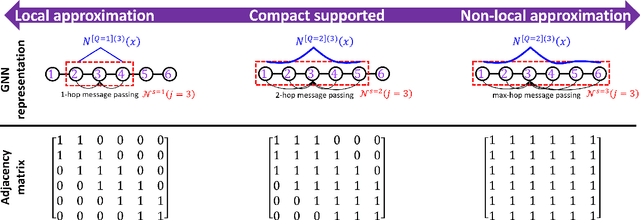

The evolution of artificial intelligence (AI) and neural network theories has revolutionized the way software is programmed, shifting from a hard-coded series of codes to a vast neural network. However, this transition in engineering software has faced challenges such as data scarcity, multi-modality of data, low model accuracy, and slow inference. Here, we propose a new network based on interpolation theories and tensor decomposition, the interpolating neural network (INN). Instead of interpolating training data, a common notion in computer science, INN interpolates interpolation points in the physical space whose coordinates and values are trainable. It can also extrapolate if the interpolation points reside outside of the range of training data and the interpolation functions have a larger support domain. INN features orders of magnitude fewer trainable parameters, faster training, a smaller memory footprint, and higher model accuracy compared to feed-forward neural networks (FFNN) or physics-informed neural networks (PINN). INN is poised to usher in Engineering Software 2.0, a unified neural network that spans various domains of space, time, parameters, and initial/boundary conditions. This has previously been computationally prohibitive due to the exponentially growing number of trainable parameters, easily exceeding the parameter size of ChatGPT, which is over 1 trillion. INN addresses this challenge by leveraging tensor decomposition and tensor product, with adaptable network architecture.
Statistical Parameterized Physics-Based Machine Learning Digital Twin Models for Laser Powder Bed Fusion Process
Nov 14, 2023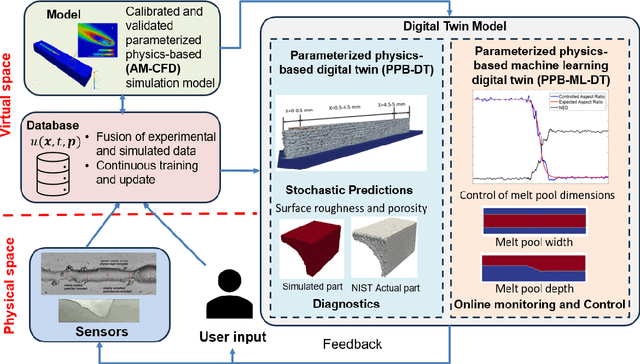
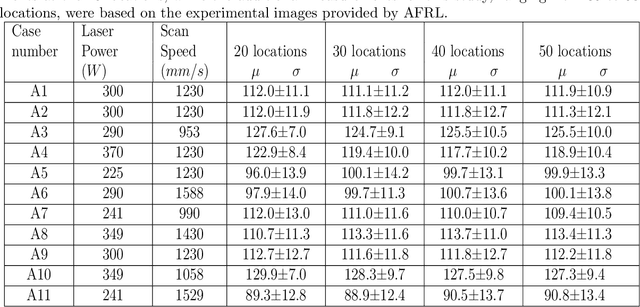
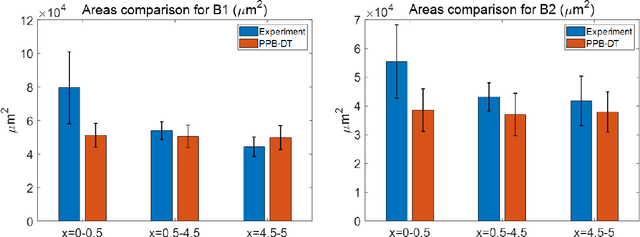
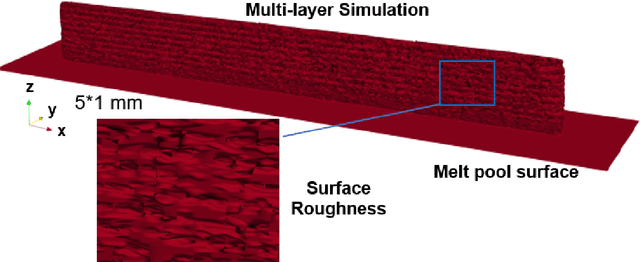
A digital twin (DT) is a virtual representation of physical process, products and/or systems that requires a high-fidelity computational model for continuous update through the integration of sensor data and user input. In the context of laser powder bed fusion (LPBF) additive manufacturing, a digital twin of the manufacturing process can offer predictions for the produced parts, diagnostics for manufacturing defects, as well as control capabilities. This paper introduces a parameterized physics-based digital twin (PPB-DT) for the statistical predictions of LPBF metal additive manufacturing process. We accomplish this by creating a high-fidelity computational model that accurately represents the melt pool phenomena and subsequently calibrating and validating it through controlled experiments. In PPB-DT, a mechanistic reduced-order method-driven stochastic calibration process is introduced, which enables the statistical predictions of the melt pool geometries and the identification of defects such as lack-of-fusion porosity and surface roughness, specifically for diagnostic applications. Leveraging data derived from this physics-based model and experiments, we have trained a machine learning-based digital twin (PPB-ML-DT) model for predicting, monitoring, and controlling melt pool geometries. These proposed digital twin models can be employed for predictions, control, optimization, and quality assurance within the LPBF process, ultimately expediting product development and certification in LPBF-based metal additive manufacturing.