 Add to Chrome
 Add to Firefox
 Add to Edge
Empowering Polymeric Materials Discovery by Artificial Intelligence
Jun 18, 2026
Polymeric materials underpin modern technologies spanning energy storage, microelectronics, healthcare and sustainable manufacturing. Yet their rational design remains exceptionally challenging because material performance emerges from complex interactions among molecular composition, chain architecture, processing history and hierarchical structural evolution across multiple length and time scales. Consequently, polymer research has long relied on labor-intensive experimentation and fragmented modeling approaches, limiting both mechanistic understanding and innovation efficiency. Recent advances in data infrastructure, machine learning, large artificial intelligence (AI) models and laboratory automation are beginning to reshape this landscape. Rather than functioning as isolated tools, polymer databases, predictive models, AI agents and automated laboratories are increasingly converging into interconnected discovery ecosystems. As a result, the central challenge is shifting from improving predictive accuracy alone to enabling reliable decision-making, adaptive learning and seamless integration across computation, experimentation and scientific reasoning. We argue that polymer science is entering an era of autonomous discovery, in which data, simulation, reasoning and experimentation operate within self-improving feedback loops that continuously generate hypotheses, design materials, execute experiments and refine predictive models. By unifying molecular design, process optimization, experimental validation and industrial translation, such autonomous ecosystems establish a more predictive, reproducible and scalable paradigm for polymer innovation, fundamentally transforming how polymer research is conducted.

Adaptive Catalyst Discovery Using Multicriteria Bayesian Optimization with Representation Learning
Apr 18, 2024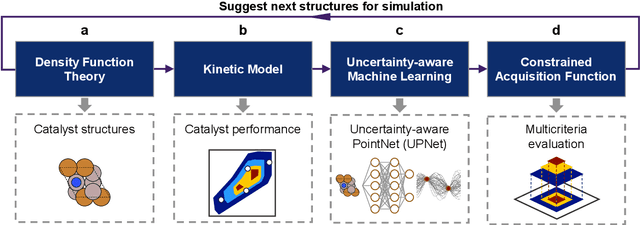
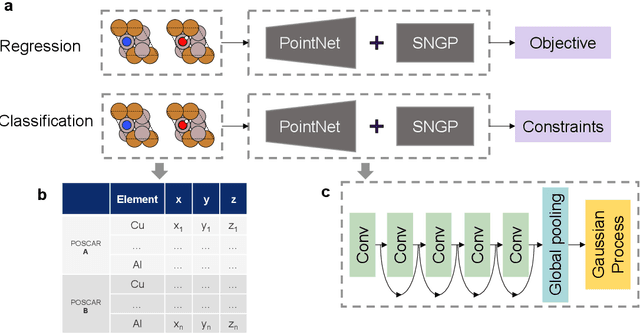
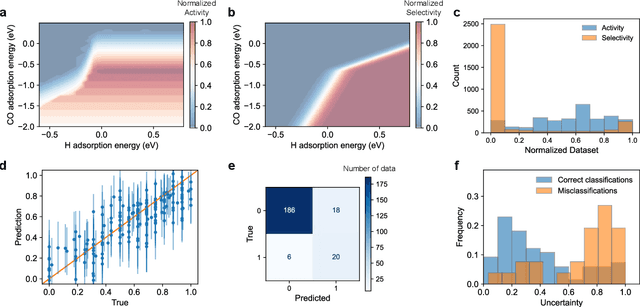
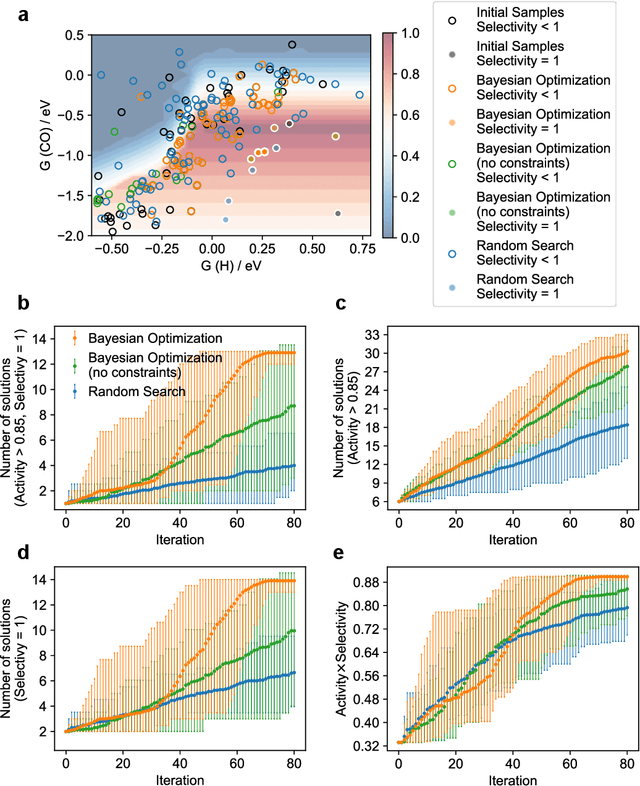
High-performance catalysts are crucial for sustainable energy conversion and human health. However, the discovery of catalysts faces challenges due to the absence of efficient approaches to navigating vast and high-dimensional structure and composition spaces. In this study, we propose a high-throughput computational catalyst screening approach integrating density functional theory (DFT) and Bayesian Optimization (BO). Within the BO framework, we propose an uncertainty-aware atomistic machine learning model, UPNet, which enables automated representation learning directly from high-dimensional catalyst structures and achieves principled uncertainty quantification. Utilizing a constrained expected improvement acquisition function, our BO framework simultaneously considers multiple evaluation criteria. Using the proposed methods, we explore catalyst discovery for the CO2 reduction reaction. The results demonstrate that our approach achieves high prediction accuracy, facilitates interpretable feature extraction, and enables multicriteria design optimization, leading to significant reduction of computing power and time (10x reduction of required DFT calculations) in high-performance catalyst discovery.