 Add to Chrome
 Add to Firefox
 Add to Edge
DiffATS: Diffusion in Aligned Tensor Space
May 10, 2026
Direct diffusion modeling of high-resolution spatiotemporal fields is computationally challenging. Parameter-efficient primitives address this by representing high-dimensional data with a compact set of parameters. In this paper, we construct data-dependent tensor primitives without pretrained compression autoencoders. Our construction starts from Tucker decomposition, which captures low-rank multilinear structure through a core tensor and mode-wise factors. However, Tucker factors are non-unique: the same tensor can be represented by different rotated factors, which complicates generative modeling. We address this issue with orthogonal Procrustes (OP) alignment. Specifically, we select medoid anchor matrices from the data and align the factor matrices to resolve the gauge ambiguity. This yields matrix Grassmannian primitives and tensor Grassmannian primitives that are compact, data-adaptive, and directly decodable by explicit multilinear reconstruction. Theoretically, we prove that the proposed primitive maps are homeomorphisms between low-rank tensors and their corresponding primitive spaces, certifying that the representations are non-degenerate and topologically faithful. Building on these primitives, we propose *Diffusion in Aligned Tensor Space* (DiffATS), a generative framework that trains diffusion models directly on aligned tensor primitives. Across images, videos, and PDE solutions, DiffATS achieves strong unconditional and conditional generation performance while compressing original data by $3.9\times$ to $210\times$, without relying on any pretrained deep compression autoencoders.

Bayesian Interpolating Neural Network (B-INN): a scalable and reliable Bayesian model for large-scale physical systems
Jan 30, 2026Neural networks and machine learning models for uncertainty quantification suffer from limited scalability and poor reliability compared to their deterministic counterparts. In industry-scale active learning settings, where generating a single high-fidelity simulation may require days or weeks of computation and produce data volumes on the order of gigabytes, they quickly become impractical. This paper proposes a scalable and reliable Bayesian surrogate model, termed the Bayesian Interpolating Neural Network (B-INN). The B-INN combines high-order interpolation theory with tensor decomposition and alternating direction algorithm to enable effective dimensionality reduction without compromising predictive accuracy. We theoretically show that the function space of a B-INN is a subset of that of Gaussian processes, while its Bayesian inference exhibits linear complexity, $\mathcal{O}(N)$, with respect to the number of training samples. Numerical experiments demonstrate that B-INNs can be from 20 times to 10,000 times faster with a robust uncertainty estimation compared to Bayesian neural networks and Gaussian processes. These capabilities make B-INN a practical foundation for uncertainty-driven active learning in large-scale industrial simulations, where computational efficiency and robust uncertainty calibration are paramount.
Engineering software 2.0 by interpolating neural networks: unifying training, solving, and calibration
Apr 16, 2024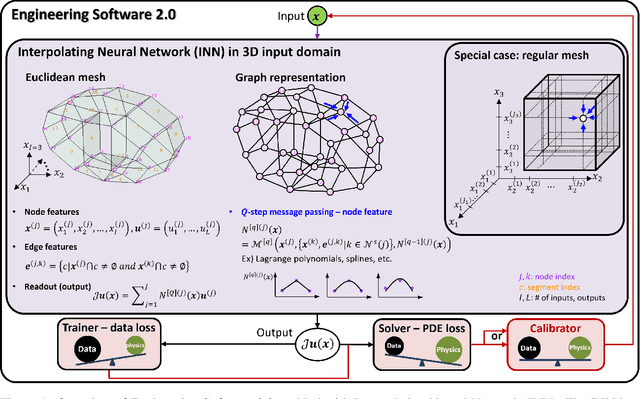

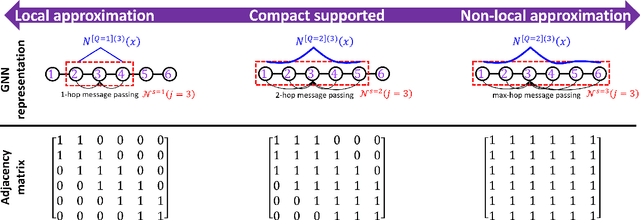

The evolution of artificial intelligence (AI) and neural network theories has revolutionized the way software is programmed, shifting from a hard-coded series of codes to a vast neural network. However, this transition in engineering software has faced challenges such as data scarcity, multi-modality of data, low model accuracy, and slow inference. Here, we propose a new network based on interpolation theories and tensor decomposition, the interpolating neural network (INN). Instead of interpolating training data, a common notion in computer science, INN interpolates interpolation points in the physical space whose coordinates and values are trainable. It can also extrapolate if the interpolation points reside outside of the range of training data and the interpolation functions have a larger support domain. INN features orders of magnitude fewer trainable parameters, faster training, a smaller memory footprint, and higher model accuracy compared to feed-forward neural networks (FFNN) or physics-informed neural networks (PINN). INN is poised to usher in Engineering Software 2.0, a unified neural network that spans various domains of space, time, parameters, and initial/boundary conditions. This has previously been computationally prohibitive due to the exponentially growing number of trainable parameters, easily exceeding the parameter size of ChatGPT, which is over 1 trillion. INN addresses this challenge by leveraging tensor decomposition and tensor product, with adaptable network architecture.