 Add to Chrome
 Add to Firefox
 Add to Edge
MobiWave: Dispatch-Oriented Graph Wavelets and Drift-Guided Selective Optimization for Autonomous Fleet Rebalancing
Jul 27, 2026
Autonomous fleets enable mobility platforms to coordinate idle vehicles directly, making fleet-wide rebalancing possible. However, two obstacles limit reliable deployment: overlapping regional and local traffic patterns can hide roads that remain useful for dispatch, and mobility drift can make a trained policy unreliable. Existing spatial aggregation mixes these patterns, while updating all parameters from limited recent data is costly and can damage stable knowledge. We propose \name, a framework that connects a dispatch-oriented multi-scale graph wavelet module with Drift-Guided Layer-Selective Optimization (DGLS). The first module addresses the representation challenge by separating graph-frequency patterns and weighting each scale according to its value for demand prediction and feasible rebalancing. DGLS addresses the adaptation challenge by measuring Dispatch-weighted Spectral Drift, selecting affected layers within a resource budget, and separating short shocks from persistent changes through a drift-aware fast--slow update. Candidate validation further rejects updates that fail to improve held-out dispatch reward without worsening monitored service or safety constraints. Experiments on both real-world datasets and simluated environments demonstrate the effectiveness of \name\ in comparing with state-of-the-art methods. The source code and datasets are available at https://anonymous.4open.science/r/MobiWave-40F8/.

InsTraj: Instructing Diffusion Models with Travel Intentions to Generate Real-world Trajectories
Apr 05, 2026The generation of realistic and controllable GPS trajectories is a fundamental task for applications in urban planning, mobility simulation, and privacy-preserving data sharing. However, existing methods face a two-fold challenge: they lack the deep semantic understanding to interpret complex user travel intent, and struggle to handle complex constraints while maintaining the realistic diversity inherent in human behavior. To resolve this, we introduce InsTraj, a novel framework that instructs diffusion models to generate high-fidelity trajectories directly from natural language descriptions. Specifically, InsTraj first utilizes a powerful large language model to decipher unstructured travel intentions formed in natural language, thereby creating rich semantic blueprints and bridging the representation gap between intentions and trajectories. Subsequently, we proposed a multimodal trajectory diffusion transformer that can integrate semantic guidance to generate high-fidelity and instruction-faithful trajectories that adhere to fine-grained user intent. Comprehensive experiments on real-world datasets demonstrate that InsTraj significantly outperforms state-of-the-art methods in generating trajectories that are realistic, diverse, and semantically faithful to the input instructions.
GeoRouter: Dynamic Paradigm Routing for Worldwide Image Geolocalization
Mar 25, 2026Worldwide image geolocalization aims to predict precise GPS coordinates for images captured anywhere on Earth, which is challenging due to the large visual and geographic diversity. Recent methods mainly follow two paradigms: retrieval-based approaches that match queries against a reference database, and generation-based approaches that directly predict coordinates using Large Vision-Language Models (LVLMs). However, we observe distinct error profiles between them: retrieval excels at fine-grained instance matching, while generation offers robust semantic reasoning. This complementary heterogeneity suggests that no single paradigm is universally superior. To harness this potential, we propose GeoRouter, a dynamic routing framework that adaptively assigns each query to the optimal paradigm. GeoRouter leverages an LVLM backbone to analyze visual content and provide routing decisions. To optimize GeoRouter, we introduce a distance-aware preference objective that converts the distance gap between paradigms into a continuous supervision signal, explicitly reflecting relative performance differences. Furthermore, we construct GeoRouting, the first large-scale dataset tailored for training routing policies with independent paradigm predictions. Extensive experiments on IM2GPS3k and YFCC4k demonstrate that GeoRouter significantly outperforms state-of-the-art baselines.
Boosting Fine-Grained Urban Flow Inference via Lightweight Architecture and Focalized Optimization
Nov 10, 2025Fine-grained urban flow inference is crucial for urban planning and intelligent transportation systems, enabling precise traffic management and resource allocation. However, the practical deployment of existing methods is hindered by two key challenges: the prohibitive computational cost of over-parameterized models and the suboptimal performance of conventional loss functions on the highly skewed distribution of urban flows. To address these challenges, we propose a unified solution that synergizes architectural efficiency with adaptive optimization. Specifically, we first introduce PLGF, a lightweight yet powerful architecture that employs a Progressive Local-Global Fusion strategy to effectively capture both fine-grained details and global contextual dependencies. Second, we propose DualFocal Loss, a novel function that integrates dual-space supervision with a difficulty-aware focusing mechanism, enabling the model to adaptively concentrate on hard-to-predict regions. Extensive experiments on 4 real-world scenarios validate the effectiveness and scalability of our method. Notably, while achieving state-of-the-art performance, PLGF reduces the model size by up to 97% compared to current high-performing methods. Furthermore, under comparable parameter budgets, our model yields an accuracy improvement of over 10% against strong baselines. The implementation is included in the https://github.com/Yasoz/PLGF.
TimeEmb: A Lightweight Static-Dynamic Disentanglement Framework for Time Series Forecasting
Oct 01, 2025Temporal non-stationarity, the phenomenon that time series distributions change over time, poses fundamental challenges to reliable time series forecasting. Intuitively, the complex time series can be decomposed into two factors, \ie time-invariant and time-varying components, which indicate static and dynamic patterns, respectively. Nonetheless, existing methods often conflate the time-varying and time-invariant components, and jointly learn the combined long-term patterns and short-term fluctuations, leading to suboptimal performance facing distribution shifts. To address this issue, we initiatively propose a lightweight static-dynamic decomposition framework, TimeEmb, for time series forecasting. TimeEmb innovatively separates time series into two complementary components: (1) time-invariant component, captured by a novel global embedding module that learns persistent representations across time series, and (2) time-varying component, processed by an efficient frequency-domain filtering mechanism inspired by full-spectrum analysis in signal processing. Experiments on real-world datasets demonstrate that TimeEmb outperforms state-of-the-art baselines and requires fewer computational resources. We conduct comprehensive quantitative and qualitative analyses to verify the efficacy of static-dynamic disentanglement. This lightweight framework can also improve existing time-series forecasting methods with simple integration. To ease reproducibility, the code is available at https://github.com/showmeon/TimeEmb.
Learning Generalized and Flexible Trajectory Models from Omni-Semantic Supervision
May 23, 2025The widespread adoption of mobile devices and data collection technologies has led to an exponential increase in trajectory data, presenting significant challenges in spatio-temporal data mining, particularly for efficient and accurate trajectory retrieval. However, existing methods for trajectory retrieval face notable limitations, including inefficiencies in large-scale data, lack of support for condition-based queries, and reliance on trajectory similarity measures. To address the above challenges, we propose OmniTraj, a generalized and flexible omni-semantic trajectory retrieval framework that integrates four complementary modalities or semantics -- raw trajectories, topology, road segments, and regions -- into a unified system. Unlike traditional approaches that are limited to computing and processing trajectories as a single modality, OmniTraj designs dedicated encoders for each modality, which are embedded and fused into a shared representation space. This design enables OmniTraj to support accurate and flexible queries based on any individual modality or combination thereof, overcoming the rigidity of traditional similarity-based methods. Extensive experiments on two real-world datasets demonstrate the effectiveness of OmniTraj in handling large-scale data, providing flexible, multi-modality queries, and supporting downstream tasks and applications.
UniTraj: Universal Human Trajectory Modeling from Billion-Scale Worldwide Traces
Nov 06, 2024Human trajectory modeling is essential for deciphering movement patterns and supporting advanced applications across various domains. However, existing methods are often tailored to specific tasks and regions, resulting in limitations related to task specificity, regional dependency, and data quality sensitivity. Addressing these challenges requires a universal human trajectory foundation model capable of generalizing and scaling across diverse tasks and geographic contexts. To this end, we propose UniTraj, a Universal human Trajectory foundation model that is task-adaptive, region-independent, and highly generalizable. To further enhance performance, we construct WorldTrace, the first large-scale, high-quality, globally distributed dataset sourced from open web platforms, encompassing 2.45 million trajectories with billions of points across 70 countries. Through multiple resampling and masking strategies designed for pre-training, UniTraj effectively overcomes geographic and task constraints, adapting to heterogeneous data quality. Extensive experiments across multiple trajectory analysis tasks and real-world datasets demonstrate that UniTraj consistently outperforms existing approaches in terms of scalability and adaptability. These results underscore the potential of UniTraj as a versatile, robust solution for a wide range of trajectory analysis applications, with WorldTrace serving as an ideal but non-exclusive foundation for training.
Large Language Model Empowered Embedding Generator for Sequential Recommendation
Sep 30, 2024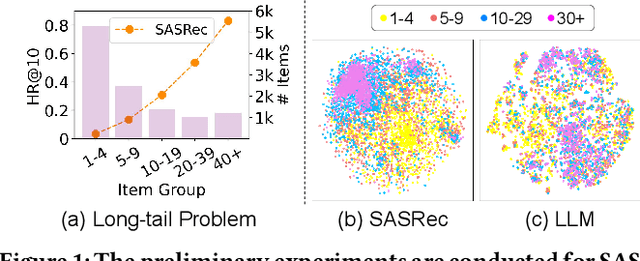
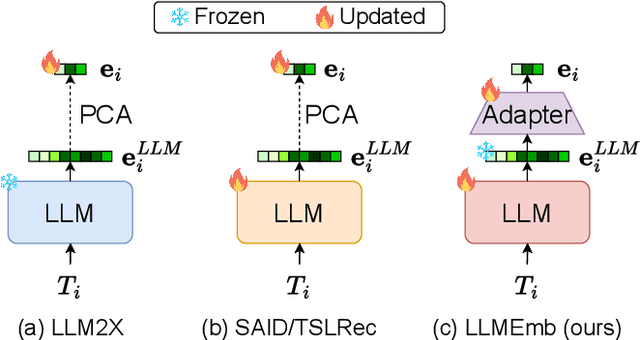
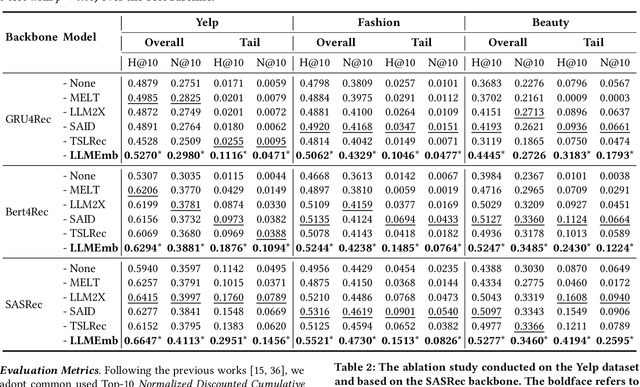
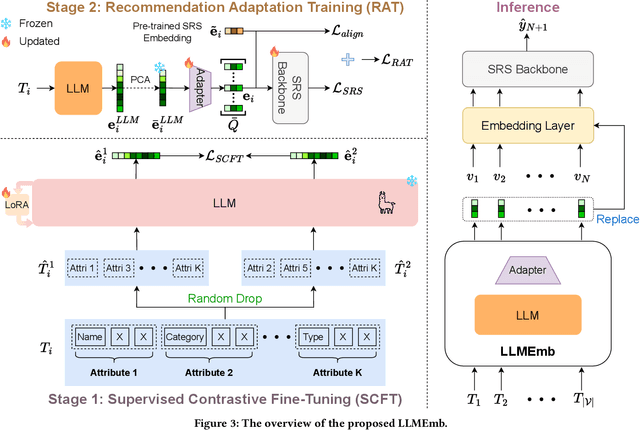
Sequential Recommender Systems (SRS) are extensively applied across various domains to predict users' next interaction by modeling their interaction sequences. However, these systems typically grapple with the long-tail problem, where they struggle to recommend items that are less popular. This challenge results in a decline in user discovery and reduced earnings for vendors, negatively impacting the system as a whole. Large Language Model (LLM) has the potential to understand the semantic connections between items, regardless of their popularity, positioning them as a viable solution to this dilemma. In our paper, we present LLMEmb, an innovative technique that harnesses LLM to create item embeddings that bolster the performance of SRS. To align the capabilities of general-purpose LLM with the needs of the recommendation domain, we introduce a method called Supervised Contrastive Fine-Tuning (SCFT). This method involves attribute-level data augmentation and a custom contrastive loss designed to tailor LLM for enhanced recommendation performance. Moreover, we highlight the necessity of incorporating collaborative filtering signals into LLM-generated embeddings and propose Recommendation Adaptation Training (RAT) for this purpose. RAT refines the embeddings to be optimally suited for SRS. The embeddings derived from LLMEmb can be easily integrated with any SRS model, showcasing its practical utility. Extensive experimentation on three real-world datasets has shown that LLMEmb significantly improves upon current methods when applied across different SRS models.
ControlTraj: Controllable Trajectory Generation with Topology-Constrained Diffusion Model
Apr 23, 2024Generating trajectory data is among promising solutions to addressing privacy concerns, collection costs, and proprietary restrictions usually associated with human mobility analyses. However, existing trajectory generation methods are still in their infancy due to the inherent diversity and unpredictability of human activities, grappling with issues such as fidelity, flexibility, and generalizability. To overcome these obstacles, we propose ControlTraj, a Controllable Trajectory generation framework with the topology-constrained diffusion model. Distinct from prior approaches, ControlTraj utilizes a diffusion model to generate high-fidelity trajectories while integrating the structural constraints of road network topology to guide the geographical outcomes. Specifically, we develop a novel road segment autoencoder to extract fine-grained road segment embedding. The encoded features, along with trip attributes, are subsequently merged into the proposed geographic denoising UNet architecture, named GeoUNet, to synthesize geographic trajectories from white noise. Through experimentation across three real-world data settings, ControlTraj demonstrates its ability to produce human-directed, high-fidelity trajectory generation with adaptability to unexplored geographical contexts.
Towards Robust Trajectory Representations: Isolating Environmental Confounders with Causal Learning
Apr 22, 2024


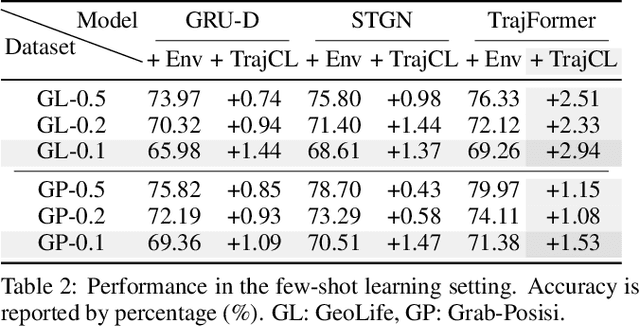
Trajectory modeling refers to characterizing human movement behavior, serving as a pivotal step in understanding mobility patterns. Nevertheless, existing studies typically ignore the confounding effects of geospatial context, leading to the acquisition of spurious correlations and limited generalization capabilities. To bridge this gap, we initially formulate a Structural Causal Model (SCM) to decipher the trajectory representation learning process from a causal perspective. Building upon the SCM, we further present a Trajectory modeling framework (TrajCL) based on Causal Learning, which leverages the backdoor adjustment theory as an intervention tool to eliminate the spurious correlations between geospatial context and trajectories. Extensive experiments on two real-world datasets verify that TrajCL markedly enhances performance in trajectory classification tasks while showcasing superior generalization and interpretability.