 Add to Chrome
 Add to Firefox
 Add to Edge
Chemically Meaningful Textualization Enables Explainable Validation of Metal-Organic Frameworks by Large Language Models
Aug 11, 2026
Computation-ready metal-organic framework (MOF) databases are essential for high-throughput screening, yet many reported crystal structures remain chemically unreasonable or disordered, compromising simulation fidelity. Existing validation approaches can identify non-computation-ready structures, but they often rely on heuristic rules, license requirement, or offer limited interpretability. Here, we show that large language models (LLMs) can serve as interpretable validators of MOF structures when crystallographic information is transformed into chemically meaningful text. By benchmarking nine descriptors, we find that successful LLM-based validation depends not on the amount of structural information alone, but on whether local coordination, framework connectivity, and chemical context are organized into a linguistically learnable representation. Fine-tuned LLMs using specialized descriptors (mof2text) achieve performance comparable to graph-based models in identifying unreasonable MOFs. Importantly, these models extend beyond black-box classification by generating diagnostic rationales for likely error sources, including abnormal bonding, connectivity, and charge states, as well as error-category predictions for annotated datasets. This work establishes chemically informed textualization as the key step that transforms LLMs from generic text models into practical and explainable tools for curating MOF databases.

Adaptive Catalyst Discovery Using Multicriteria Bayesian Optimization with Representation Learning
Apr 18, 2024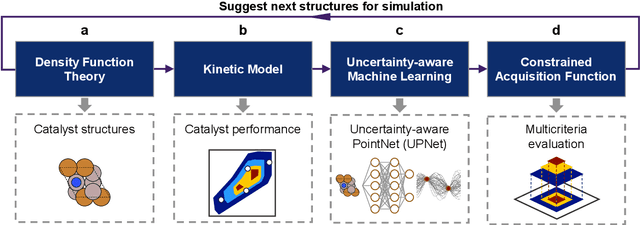
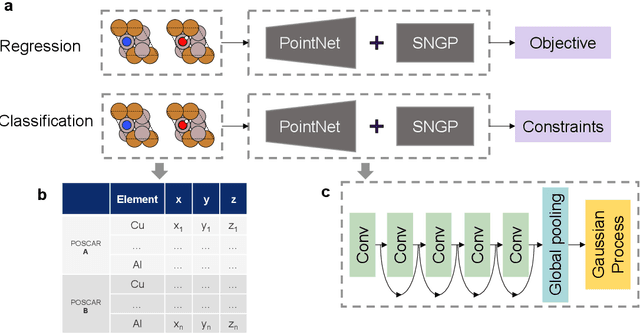
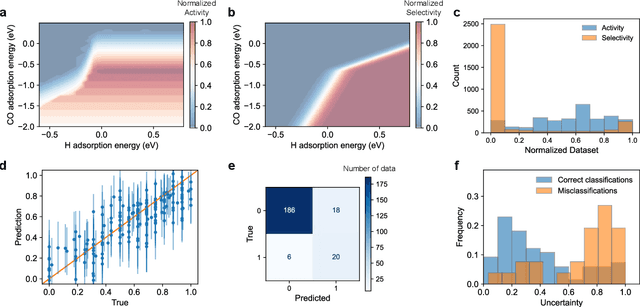
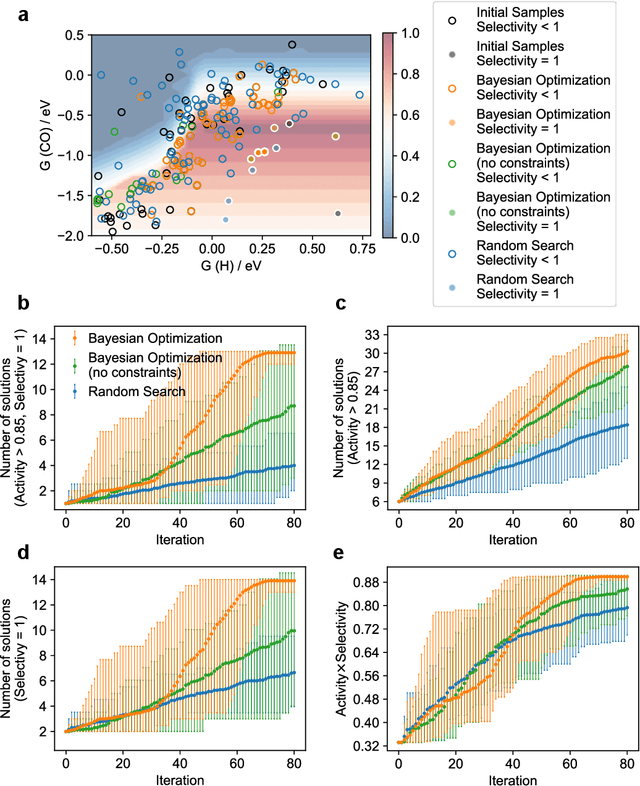
High-performance catalysts are crucial for sustainable energy conversion and human health. However, the discovery of catalysts faces challenges due to the absence of efficient approaches to navigating vast and high-dimensional structure and composition spaces. In this study, we propose a high-throughput computational catalyst screening approach integrating density functional theory (DFT) and Bayesian Optimization (BO). Within the BO framework, we propose an uncertainty-aware atomistic machine learning model, UPNet, which enables automated representation learning directly from high-dimensional catalyst structures and achieves principled uncertainty quantification. Utilizing a constrained expected improvement acquisition function, our BO framework simultaneously considers multiple evaluation criteria. Using the proposed methods, we explore catalyst discovery for the CO2 reduction reaction. The results demonstrate that our approach achieves high prediction accuracy, facilitates interpretable feature extraction, and enables multicriteria design optimization, leading to significant reduction of computing power and time (10x reduction of required DFT calculations) in high-performance catalyst discovery.