 Add to Chrome
 Add to Firefox
 Add to Edge
TempoVLA: Learning Speed-Controllable Vision-Language-Action Policies
Jun 04, 2026
Robot manipulation alternates between low-risk transit phases that call for fast execution and high-risk contact stages that demand slow, precise motion. Yet existing Vision-Language-Action models (VLAs) only inherit a single fixed speed from training demonstrations. Prior efforts to accelerate VLAs through model compression, KV-cache reuse, or reinforcement learning only shift the policy from one fixed speed to another, and leave deceleration almost unexplored. We observe that the magnitude of each predicted action already governs how fast the robot moves, opening a direct route to controllable execution speed. We turn this observation into TempoVLA, a single VLA whose execution speed is controlled by an explicit condition. TempoVLA combines two coupled components. (1) A data-side Variable-Speed Trajectory Augmentation (VSTA) that re-times demonstration to any target speed by merging or splitting actions while preserving its motion semantics. (2) A model-side conditioning mechanism that feeds the speed to the policy. Statistics show that VSTA reaches the requested speed with negligible motion error. Experiments in simulation and on real-world tasks demonstrate that TempoVLA achieves flexible speed control in both directions, while VSTA additionally boosts the default $1\times$ performance via better data utilization. Furthermore, by cooperating with a large multimodal model, TempoVLA realizes dynamic speed control, accelerating through low-risk phases and decelerating for high-risk ones.

Re-M3Dr: Rebalanced MultiModal Mean Deviation Regression
May 26, 2026Mean Deviation (MD) is a critical metric for assessing visual field loss in ophthalmology. While previous work has focused solely on predicting MD from Optical Coherence Tomography (OCT), it is intuitive to assume that combining OCT with another imaging of fundus photography (FP) could improve performance, as two ophthalmic medical imaging provide complementary information. This is particularly expected when sophisticated multi-objective optimization is applied, as documented in common multimodal classification. Surprisingly, our investigations reveal that multimodal fusion in this medical imaging scenario performs worse than unimodal model. Through detailed analysis, we identify the root cause as a coupled imbalance between data distribution and modality learning conflict. This imbalance distorts the optimization landscape, leading to unstable training. To address this challenge, we propose the method of Rebalanced MultiModal Mean Deviation Regression (Re-M3Dr), a novel multimodal regression framework. We enhance unimodal representation through adaptive margin based supervised contrastive learning. Then, our framework stabilizes the joint optimization with the sharpness-aware gradient modulation. Experimental results on both public and private clinical datasets show average 29\% reduction in MSE compared to SOTA multimodal learning methods, demonstrating the superiority of Re-M3Dr. The code is available in the supplementary materials.
Qwen-Image-2.0 Technical Report
May 11, 2026We present Qwen-Image-2.0, an omni-capable image generation foundation model that unifies high-fidelity generation and precise image editing within a single framework. Despite recent progress, existing models still struggle with ultra-long text rendering, multilingual typography, high-resolution photorealism, robust instruction following, and efficient deployment, especially in text-rich and compositionally complex scenarios. Qwen-Image-2.0 addresses these challenges by coupling Qwen3-VL as the condition encoder with a Multimodal Diffusion Transformer for joint condition-target modeling, supported by large-scale data curation and a customized multi-stage training pipeline. This enables strong multimodal understanding while preserving flexible generation and editing capabilities. The model supports instructions of up to 1K tokens for generating text-rich content such as slides, posters, infographics, and comics, while significantly improving multilingual text fidelity and typography. It also enhances photorealistic generation with richer details, more realistic textures, and coherent lighting, and follows complex prompts more reliably across diverse styles. Extensive human evaluations show that Qwen-Image-2.0 substantially outperforms previous Qwen-Image models in both generation and editing, marking a step toward more general, reliable, and practical image generation foundation models.
Moaw: Unleashing Motion Awareness for Video Diffusion Models
Jan 19, 2026Video diffusion models, trained on large-scale datasets, naturally capture correspondences of shared features across frames. Recent works have exploited this property for tasks such as optical flow prediction and tracking in a zero-shot setting. Motivated by these findings, we investigate whether supervised training can more fully harness the tracking capability of video diffusion models. To this end, we propose Moaw, a framework that unleashes motion awareness for video diffusion models and leverages it to facilitate motion transfer. Specifically, we train a diffusion model for motion perception, shifting its modality from image-to-video generation to video-to-dense-tracking. We then construct a motion-labeled dataset to identify features that encode the strongest motion information, and inject them into a structurally identical video generation model. Owing to the homogeneity between the two networks, these features can be naturally adapted in a zero-shot manner, enabling motion transfer without additional adapters. Our work provides a new paradigm for bridging generative modeling and motion understanding, paving the way for more unified and controllable video learning frameworks.
FaTRQ: Tiered Residual Quantization for LLM Vector Search in Far-Memory-Aware ANNS Systems
Jan 15, 2026Approximate Nearest-Neighbor Search (ANNS) is a key technique in retrieval-augmented generation (RAG), enabling rapid identification of the most relevant high-dimensional embeddings from massive vector databases. Modern ANNS engines accelerate this process using prebuilt indexes and store compressed vector-quantized representations in fast memory. However, they still rely on a costly second-pass refinement stage that reads full-precision vectors from slower storage like SSDs. For modern text and multimodal embeddings, these reads now dominate the latency of the entire query. We propose FaTRQ, a far-memory-aware refinement system using tiered memory that eliminates the need to fetch full vectors from storage. It introduces a progressive distance estimator that refines coarse scores using compact residuals streamed from far memory. Refinement stops early once a candidate is provably outside the top-k. To support this, we propose tiered residual quantization, which encodes residuals as ternary values stored efficiently in far memory. A custom accelerator is deployed in a CXL Type-2 device to perform low-latency refinement locally. Together, FaTRQ improves the storage efficiency by 2.4$\times$ and improves the throughput by up to 9$ \times$ than SOTA GPU ANNS system.
Physics-Aware Robotic Palletization with Online Masking Inference
Feb 19, 2025The efficient planning of stacking boxes, especially in the online setting where the sequence of item arrivals is unpredictable, remains a critical challenge in modern warehouse and logistics management. Existing solutions often address box size variations, but overlook their intrinsic and physical properties, such as density and rigidity, which are crucial for real-world applications. We use reinforcement learning (RL) to solve this problem by employing action space masking to direct the RL policy toward valid actions. Unlike previous methods that rely on heuristic stability assessments which are difficult to assess in physical scenarios, our framework utilizes online learning to dynamically train the action space mask, eliminating the need for manual heuristic design. Extensive experiments demonstrate that our proposed method outperforms existing state-of-the-arts. Furthermore, we deploy our learned task planner in a real-world robotic palletizer, validating its practical applicability in operational settings.
Predictive Lagrangian Optimization for Constrained Reinforcement Learning
Jan 25, 2025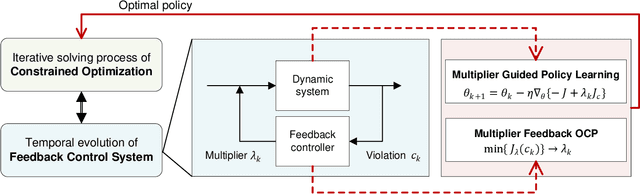
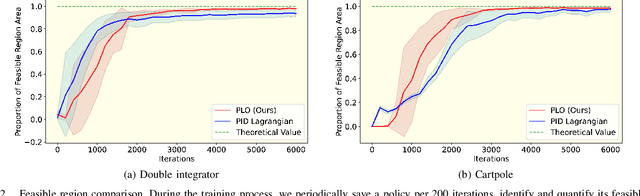
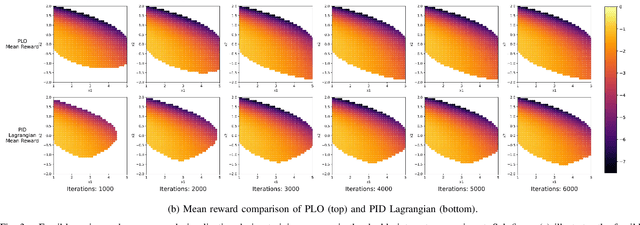
Constrained optimization is popularly seen in reinforcement learning for addressing complex control tasks. From the perspective of dynamic system, iteratively solving a constrained optimization problem can be framed as the temporal evolution of a feedback control system. Classical constrained optimization methods, such as penalty and Lagrangian approaches, inherently use proportional and integral feedback controllers. In this paper, we propose a more generic equivalence framework to build the connection between constrained optimization and feedback control system, for the purpose of developing more effective constrained RL algorithms. Firstly, we define that each step of the system evolution determines the Lagrange multiplier by solving a multiplier feedback optimal control problem (MFOCP). In this problem, the control input is multiplier, the state is policy parameters, the dynamics is described by policy gradient descent, and the objective is to minimize constraint violations. Then, we introduce a multiplier guided policy learning (MGPL) module to perform policy parameters updating. And we prove that the resulting optimal policy, achieved through alternating MFOCP and MGPL, aligns with the solution of the primal constrained RL problem, thereby establishing our equivalence framework. Furthermore, we point out that the existing PID Lagrangian is merely one special case within our framework that utilizes a PID controller. We also accommodate the integration of other various feedback controllers, thereby facilitating the development of new algorithms. As a representative, we employ model predictive control (MPC) as the feedback controller and consequently propose a new algorithm called predictive Lagrangian optimization (PLO). Numerical experiments demonstrate its superiority over the PID Lagrangian method, achieving a larger feasible region up to 7.2% and a comparable average reward.
Fine-grained graph representation learning for heterogeneous mobile networks with attentive fusion and contrastive learning
Dec 10, 2024


AI becomes increasingly vital for telecom industry, as the burgeoning complexity of upcoming mobile communication networks places immense pressure on network operators. While there is a growing consensus that intelligent network self-driving holds the key, it heavily relies on expert experience and knowledge extracted from network data. In an effort to facilitate convenient analytics and utilization of wireless big data, we introduce the concept of knowledge graphs into the field of mobile networks, giving rise to what we term as wireless data knowledge graphs (WDKGs). However, the heterogeneous and dynamic nature of communication networks renders manual WDKG construction both prohibitively costly and error-prone, presenting a fundamental challenge. In this context, we propose an unsupervised data-and-model driven graph structure learning (DMGSL) framework, aimed at automating WDKG refinement and updating. Tackling WDKG heterogeneity involves stratifying the network into homogeneous layers and refining it at a finer granularity. Furthermore, to capture WDKG dynamics effectively, we segment the network into static snapshots based on the coherence time and harness the power of recurrent neural networks to incorporate historical information. Extensive experiments conducted on the established WDKG demonstrate the superiority of the DMGSL over the baselines, particularly in terms of node classification accuracy.
SBoRA: Low-Rank Adaptation with Regional Weight Updates
Jul 10, 2024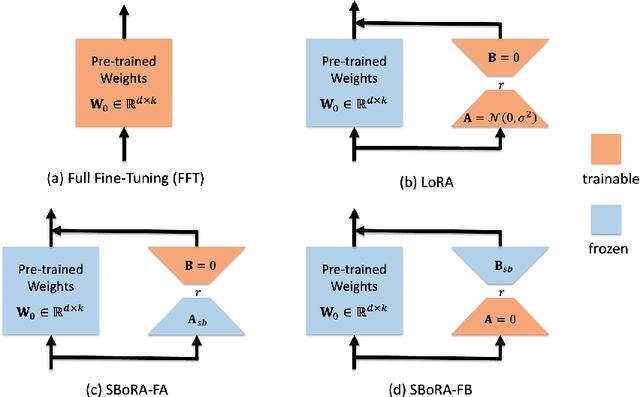

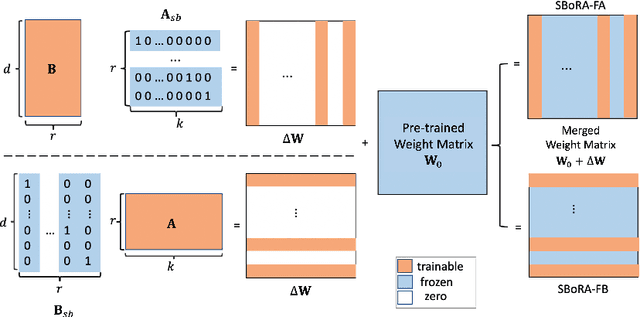

This paper introduces Standard Basis LoRA (SBoRA), a novel parameter-efficient fine-tuning approach for Large Language Models that builds upon the pioneering works of Low-Rank Adaptation (LoRA) and Orthogonal Adaptation. SBoRA further reduces the computational and memory requirements of LoRA while enhancing learning performance. By leveraging orthogonal standard basis vectors to initialize one of the low-rank matrices, either A or B, SBoRA enables regional weight updates and memory-efficient fine-tuning. This approach gives rise to two variants, SBoRA-FA and SBoRA-FB, where only one of the matrices is updated, resulting in a sparse update matrix with a majority of zero rows or columns. Consequently, the majority of the fine-tuned model's weights remain unchanged from the pre-trained weights. This characteristic of SBoRA, wherein regional weight updates occur, is reminiscent of the modular organization of the human brain, which efficiently adapts to new tasks. Our empirical results demonstrate the superiority of SBoRA-FA over LoRA in various fine-tuning tasks, including commonsense reasoning and arithmetic reasoning. Furthermore, we evaluate the effectiveness of QSBoRA on quantized LLaMA models of varying scales, highlighting its potential for efficient adaptation to new tasks. Code is available at https://github.com/cityuhkai/SBoRA
Spatial-Temporal Attention Model for Traffic State Estimation with Sparse Internet of Vehicles
Jul 10, 2024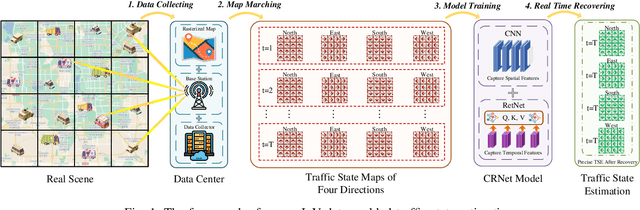
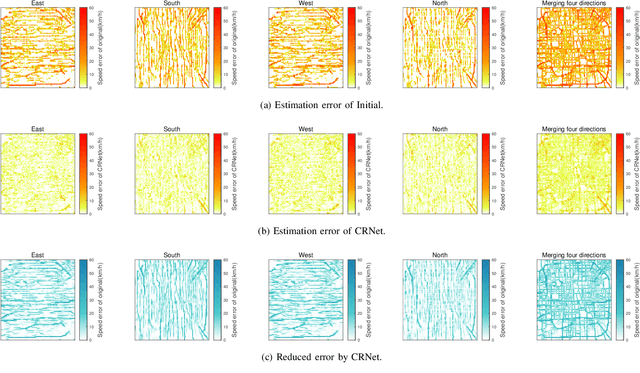
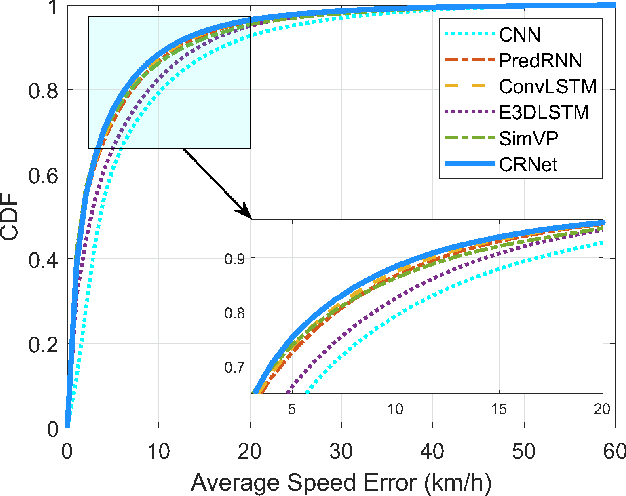

The growing number of connected vehicles offers an opportunity to leverage internet of vehicles (IoV) data for traffic state estimation (TSE) which plays a crucial role in intelligent transportation systems (ITS). By utilizing only a portion of IoV data instead of the entire dataset, the significant overheads associated with collecting and processing large amounts of data can be avoided. In this paper, we introduce a novel framework that utilizes sparse IoV data to achieve cost-effective TSE. Particularly, we propose a novel spatial-temporal attention model called the convolutional retentive network (CRNet) to improve the TSE accuracy by mining spatial-temporal traffic state correlations. The model employs the convolutional neural network (CNN) for spatial correlation aggregation and the retentive network (RetNet) based on the attention mechanism to extract temporal correlations. Extensive simulations on a real-world IoV dataset validate the advantage of the proposed TSE approach in achieving accurate TSE using sparse IoV data, demonstrating its cost effectiveness and practicality for real-world applications.