 Add to Chrome
 Add to Firefox
 Add to Edge
Leveraging Large Vision Model for Multi-UAV Co-perception in Low-Altitude Wireless Networks
Mar 13, 2026
Multi-uncrewed aerial vehicle (UAV) cooperative perception has emerged as a promising paradigm for diverse low-altitude economy applications, where complementary multi-view observations are leveraged to enhance perception performance via wireless communications. However, the massive visual data generated by multiple UAVs poses significant challenges in terms of communication latency and resource efficiency. To address these challenges, this paper proposes a communication-efficient cooperative perception framework, termed Base-Station-Helped UAV (BHU), which reduces communication overhead while enhancing perception performance. Specifically, we employ a Top-K selection mechanism to identify the most informative pixels from UAV-captured RGB images, enabling sparsified visual transmission with reduced data volume and latency. The sparsified images are transmitted to a ground server via multi-user MIMO (MU-MIMO), where a Swin-large-based MaskDINO encoder extracts bird's-eye-view (BEV) features and performs cooperative feature fusion for ground vehicle perception. Furthermore, we develop a diffusion model-based deep reinforcement learning (DRL) algorithm to jointly select cooperative UAVs, sparsification ratios, and precoding matrices, achieving a balance between communication efficiency and perception utility. Simulation results on the Air-Co-Pred dataset demonstrate that, compared with traditional CNN-based BEV fusion baselines, the proposed BHU framework improves perception performance by over 5% while reducing communication overhead by 85%, providing an effective solution for multi-UAV cooperative perception under resource-constrained wireless environments.

Riemannian Manifold Optimization for Advanced Wireless Communications: Fundamentals and Applications
Feb 09, 2026Next-generation wireless communications promise transformative technologies such as massive multiple-input multiple-output (MIMO), reconfigurable intelligent surfaces (RIS), integrated sensing and communication (ISAC), and fluid antenna systems (FAS). However, deploying these technologies is hindered by large-scale optimization problems with nonconvex constraints. Conventional Euclidean-space methods rely on approximations or relaxations, which degrade performance and incur substantial computational costs. Riemannian manifold optimization (RMO) offers a powerful alternative that directly operates on the manifold defined by the geometric constraints. This approach inherently satisfies the constraints at every optimization step, thereby avoiding the performance degradation and substantial computational costs. In this paper, we first elaborate on the principles of RMO, including the fundamental concepts, tools, and methods, emphasizing its effectiveness for nonconvex problems. We then introduce its applications in advanced wireless communications, showing how constrained problems are reformulated on their natural manifolds and solved using tailored RMO algorithms. Furthermore, we present a case study on secure beamforming in an FAS-assisted non-orthogonal multiple access (NOMA) system, demonstrating RMO's superiority over conventional methods in terms of both performance and computational efficiency.
Wireless Context Engineering for Efficient Mobile Agentic AI and Edge General Intelligence
Feb 07, 2026Future wireless networks demand increasingly powerful intelligence to support sensing, communication, and autonomous decision-making. While scaling laws suggest improving performance by enlarging model capacity, practical edge deployments are fundamentally constrained by latency, energy, and memory, making unlimited model scaling infeasible. This creates a critical need to maximize the utility of limited inference-time inputs by filtering redundant observations and focusing on high-impact data. In large language models and generative artificial intelligence (AI), context engineering has emerged as a key paradigm to guide inference by selectively structuring and injecting task-relevant information. Inspired by this success, we extend context engineering to wireless systems, providing a systematic way to enhance edge AI performance without increasing model complexity. In dynamic environments, for example, beam prediction can benefit from augmenting instantaneous channel measurements with contextual cues such as user mobility trends or environment-aware propagation priors. We formally introduce wireless context engineering and propose a Wireless Context Communication Framework (WCCF) to adaptively orchestrate wireless context under inference-time constraints. This work provides researchers with a foundational perspective and practical design dimensions to manage the wireless context of wireless edge intelligence. An ISAC-enabled beam prediction case study illustrates the effectiveness of the proposed paradigm under constrained sensing budgets.
Decentralization of Generative AI via Mixture of Experts for Wireless Networks: A Comprehensive Survey
Apr 28, 2025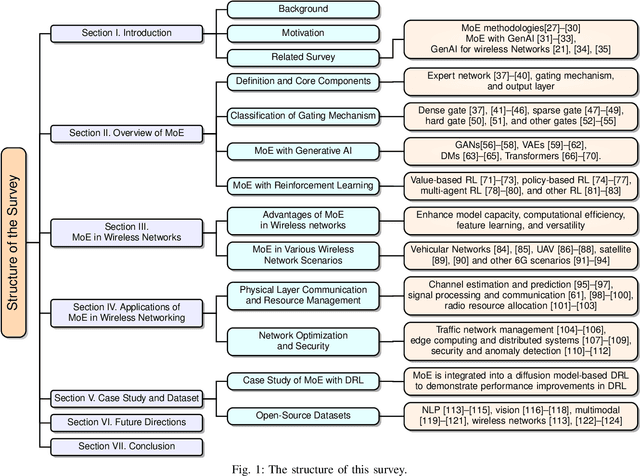
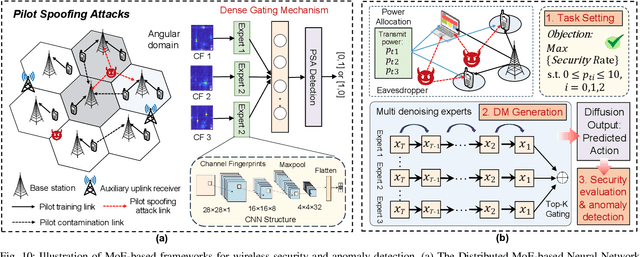
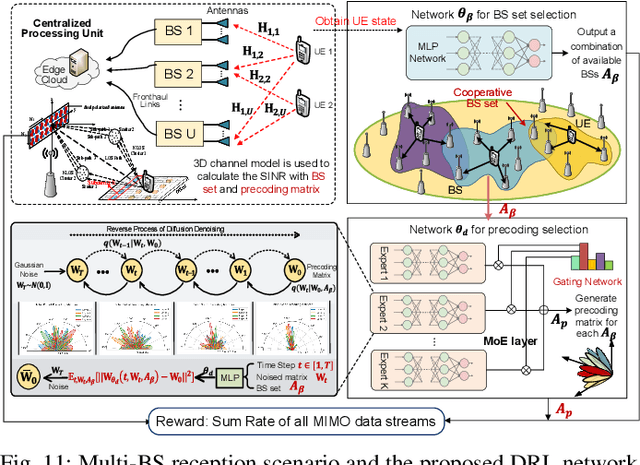
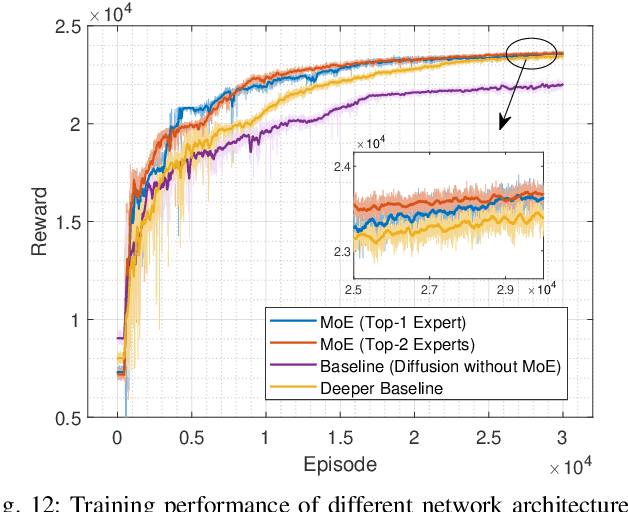
Mixture of Experts (MoE) has emerged as a promising paradigm for scaling model capacity while preserving computational efficiency, particularly in large-scale machine learning architectures such as large language models (LLMs). Recent advances in MoE have facilitated its adoption in wireless networks to address the increasing complexity and heterogeneity of modern communication systems. This paper presents a comprehensive survey of the MoE framework in wireless networks, highlighting its potential in optimizing resource efficiency, improving scalability, and enhancing adaptability across diverse network tasks. We first introduce the fundamental concepts of MoE, including various gating mechanisms and the integration with generative AI (GenAI) and reinforcement learning (RL). Subsequently, we discuss the extensive applications of MoE across critical wireless communication scenarios, such as vehicular networks, unmanned aerial vehicles (UAVs), satellite communications, heterogeneous networks, integrated sensing and communication (ISAC), and mobile edge networks. Furthermore, key applications in channel prediction, physical layer signal processing, radio resource management, network optimization, and security are thoroughly examined. Additionally, we present a detailed overview of open-source datasets that are widely used in MoE-based models to support diverse machine learning tasks. Finally, this survey identifies crucial future research directions for MoE, emphasizing the importance of advanced training techniques, resource-aware gating strategies, and deeper integration with emerging 6G technologies.
Spatial-Temporal Generative AI for Traffic Flow Estimation with Sparse Data of Connected Vehicles
Jul 10, 2024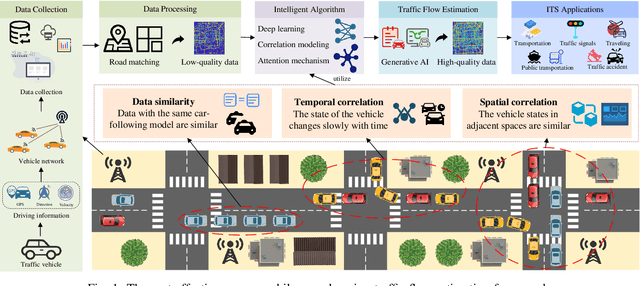
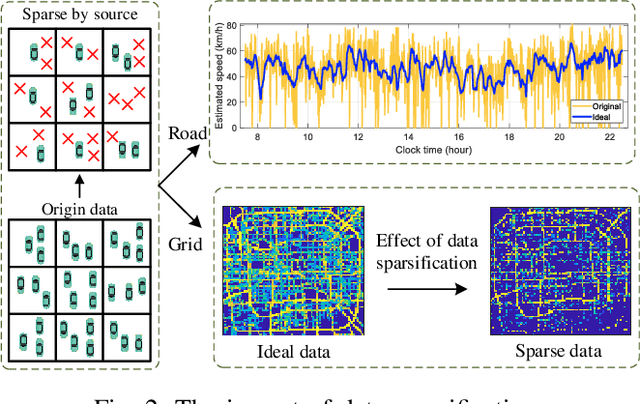
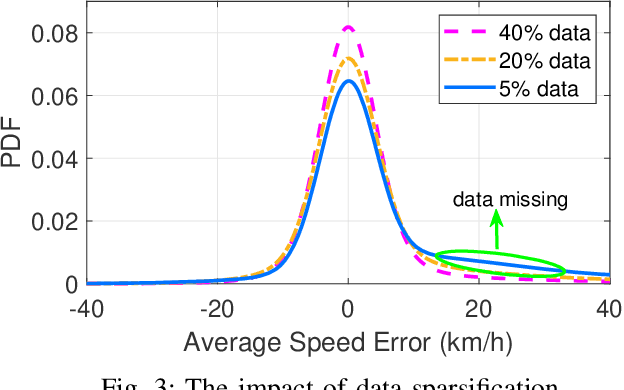
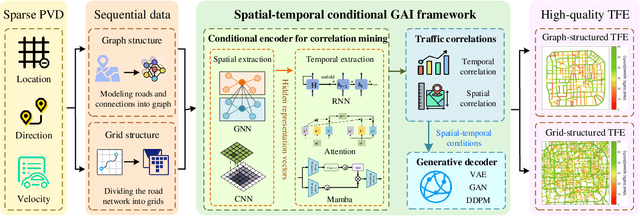
Traffic flow estimation (TFE) is crucial for intelligent transportation systems. Traditional TFE methods rely on extensive road sensor networks and typically incur significant costs. Sparse mobile crowdsensing enables a cost-effective alternative by utilizing sparsely distributed probe vehicle data (PVD) provided by connected vehicles. However, as pointed out by the central limit theorem, the sparsification of PVD leads to the degradation of TFE accuracy. In response, this paper introduces a novel and cost-effective TFE framework that leverages sparse PVD and improves accuracy by applying the spatial-temporal generative artificial intelligence (GAI) framework. Within this framework, the conditional encoder mines spatial-temporal correlations in the initial TFE results derived from averaging vehicle speeds of each region, and the generative decoder generates high-quality and accurate TFE outputs. Additionally, the design of the spatial-temporal neural network is discussed, which is the backbone of the conditional encoder for effectively capturing spatial-temporal correlations. The effectiveness of the proposed TFE approach is demonstrated through evaluations based on real-world connected vehicle data. The experimental results affirm the feasibility of our sparse PVD-based TFE framework and highlight the significant role of the spatial-temporal GAI framework in enhancing the accuracy of TFE.
Coverage Analysis of Downlink Transmission in Multi-Connectivity Cellular V2X Networks
May 27, 2024


With the increasing of connected vehicles in the fifth-generation mobile communication networks (5G) and beyond 5G (B5G), ensuring the reliable and high-speed cellular vehicle-to-everything (C-V2X) communication has posed significant challenges due to the high mobility of vehicles. For improving the network performance and reliability, multi-connectivity technology has emerged as a crucial transmission mode for C-V2X in the 5G era. To this end, this paper proposes a framework for analyzing the performance of multi-connectivity in C-V2X downlink transmission, with a focus on the performance indicators of joint distance distribution and coverage probability. Specifically, we first derive the joint distance distribution of multi-connectivity. By leveraging the tools of stochastic geometry, we then obtain the analytical expressions of coverage probability based on the previous results for general multi-connectivity cases in C-V2X. Subsequently, we evaluate the effect of path loss exponent and downlink base station density on coverage probability based on the proposed analytical framework. Finally, extensive Monte Carlo simulations are conducted to validate the effectiveness of the proposed analytical framework and the simulation results reveal that multi-connectivity technology can significantly enhance the coverage probability in C-V2X.
* 6 pagers, 5 figures. arXiv admin note: substantial text overlap with arXiv:2404.17823
Performance Analysis for Downlink Transmission in Multi-Connectivity Cellular V2X Networks
Apr 27, 2024


With the ever-increasing number of connected vehicles in the fifth-generation mobile communication networks (5G) and beyond 5G (B5G), ensuring the reliability and high-speed demand of cellular vehicle-to-everything (C-V2X) communication in scenarios where vehicles are moving at high speeds poses a significant challenge.Recently, multi-connectivity technology has become a promising network access paradigm for improving network performance and reliability for C-V2X in the 5G and B5G era. To this end, this paper proposes an analytical framework for the performance of downlink in multi-connectivity C-V2X networks. Specifically, by modeling the vehicles and base stations as one-dimensional Poisson point processes, we first derive and analyze the joint distance distribution of multi-connectivity. Then through leveraging the tools of stochastic geometry, the coverage probability and spectral efficiency are obtained based on the previous results for general multi-connectivity cases in C-V2X. Additionally, we evaluate the effect of path loss exponent and the density of downlink base station on system performance indicators. We demonstrate through extensive Monte Carlo simulations that multi-connectivity technology can effectively enhance network performance in C-V2X. Our findings have important implications for the research and application of multi-connectivity C-V2X in the 5G and B5G era.
Spectral Efficiency Analysis of Uplink-Downlink Decoupled Access in C-V2X Networks
Dec 12, 2022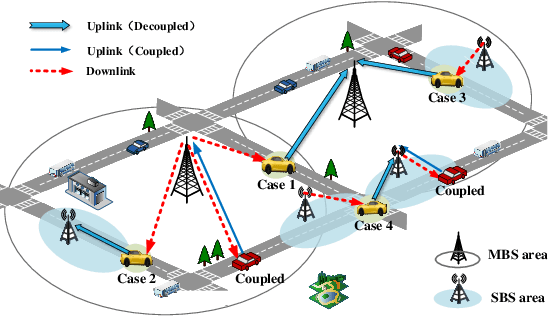
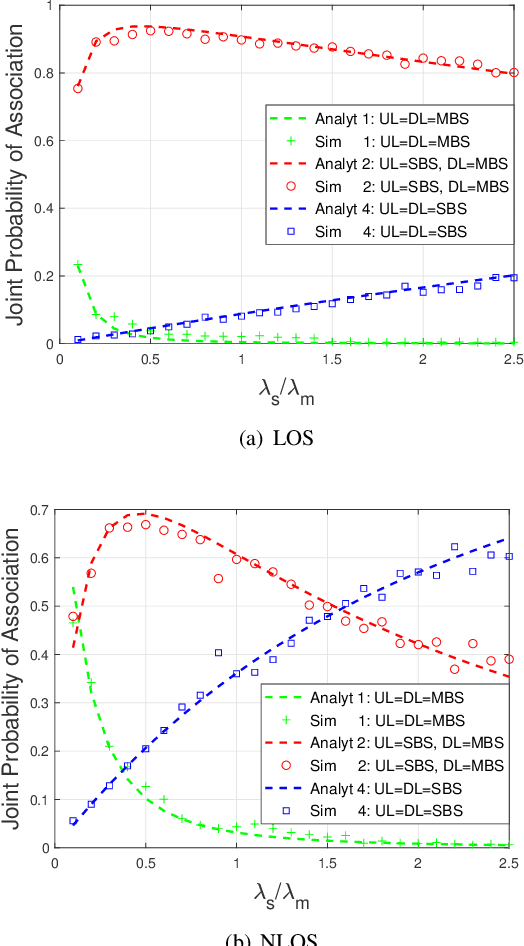
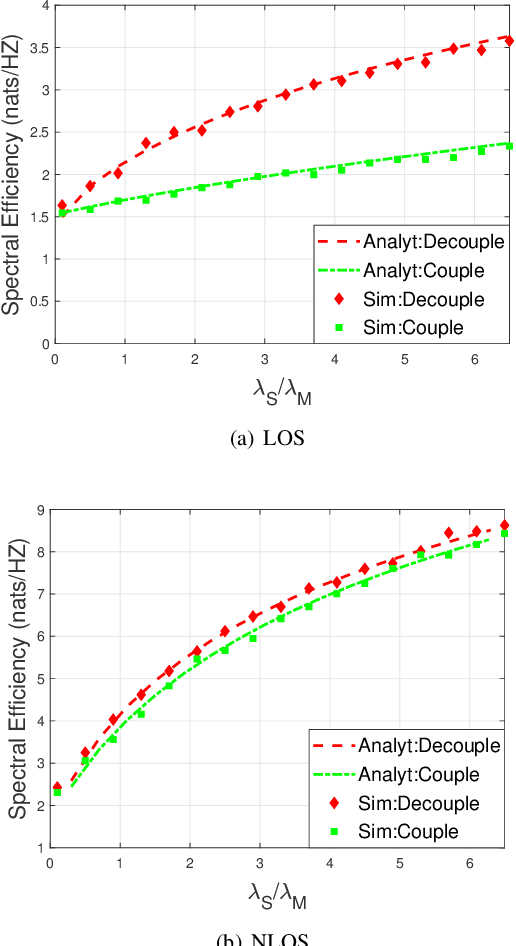
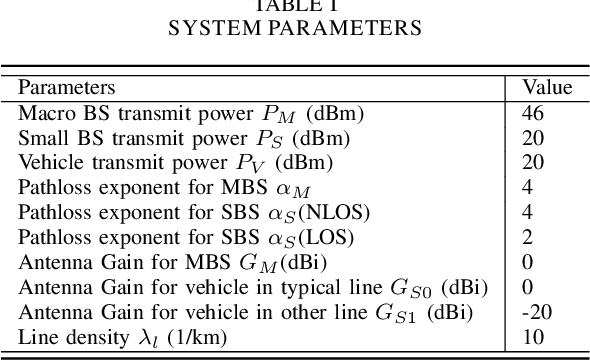
The uplink (UL)/downlink (DL) decoupled access has been emerging as a novel access architecture to improve the performance gains in cellular networks. In this paper, we investigate the UL/DL decoupled access performance in cellular vehicle-to-everything (C-V2X). We propose a unified analytical framework for the UL/DL decoupled access in C-V2X from the perspective of spectral efficiency (SE). By modeling the UL/DL decoupled access C-V2X as a Cox process and leveraging the stochastic geometry, we obtain the joint association probability, the UL/DL distance distributions to serving base stations and the SE for the UL/DL decoupled access in C-V2X networks with different association cases. We conduct extensive Monte Carlo simulations to verify the accuracy of the proposed unified analytical framework, and the results show a better system average SE of UL/DL decoupled access in C-V2X.