 Add to Chrome
 Add to Firefox
 Add to Edge
Towards Unified Song Generation and Singing Voice Conversion with Accompaniment Co-Generation
Jun 05, 2026
While song generation and singing voice conversion (SVC) have evolved significantly, they have long been developed isolated: the former lacks zero-shot speaker cloning, while the latter overlooks vocal-accompaniment synergy. To bridge this gap, we propose UniSinger, the first end-to-end framework unifying speaker cloning song generation and accompaniment co-generation SVC. Building on the multimodal diffusion transformer, we construct a unified speaker embedding space transferring speaker representation from SVC to song generation, endowing fine-grained cross-task timbre control. To mitigate multi-task optimization conflicts, we design a curriculum learning strategy using task-specific modality masking to guide the model to gradually master the generative mechanisms among semantic content, vocal timbre, and accompaniment. Experiments show state-of-the-art performance on both tasks and realizes complementary benefits, offering new possibilities for intelligent music production.

ShotCrop$^3$: Cropping Human-Centric Images into Cinematic Triple-Shot Compositions
Jun 04, 2026Prior work on aesthetic composition typically produces a single aesthetically pleasing crop, overlooking the narrative value of composing multiple shots from one scene. In practice, multi-shot composition is critical for downstream creative workflows: commercial posters often require multiple crops with different emphases (e.g., context, subject, and emotion/product details) to present key story beats. Therefore, we propose \textbf{Triple-Shot Compositions (TSC)}, a composition task that generates a three-shot set -- establishing, medium, and close-up -- from a single human-centric image, each paired with a brief shot description to support visual narration. To learn TSC with limited expert annotations, we introduce \textbf{ShotCrop} which undergoes a three-stage training process: it first applies Chain-of-Thought supervised fine-tuning to establish basic reasoning and aesthetic shot-cropping skills, then performs semi-supervised fine-tuning with high-confidence pseudo labels to further enhance aesthetic capability, and is finally optimized with Group Relative Policy Optimization for \textbf{ShotCrop} (GRPO-S) using a composite reward tailored for it. Specifically, our pseudo-labeling strategy combines MLLM-based scoring, aesthetic assessment, and CLIP similarity to retain high-confidence training signals. In addition, we present TSC-Bench, a benchmark of 1.2k expert-annotated test cases. Notably, ShotCrop achieves an average improvement of \textbf{2.82} times over GPT-5 in shot localization accuracy.
UniSonate: A Unified Model for Speech, Music, and Sound Effect Generation with Text Instructions
Apr 24, 2026Generative audio modeling has largely been fragmented into specialized tasks, text-to-speech (TTS), text-to-music (TTM), and text-to-audio (TTA), each operating under heterogeneous control paradigms. Unifying these modalities remains a fundamental challenge due to the intrinsic dissonance between structured semantic representations (speech/music) and unstructured acoustic textures (sound effects). In this paper, we introduce UniSonate, a unified flow-matching framework capable of synthesizing speech, music, and sound effects through a standardized, reference-free natural language instruction interface. To reconcile structural disparities, we propose a novel dynamic token injection mechanism that projects unstructured environmental sounds into a structured temporal latent space, enabling precise duration control within a phoneme-driven Multimodal Diffusion Transformer (MM-DiT). Coupled with a multi-stage curriculum learning strategy, this approach effectively mitigates cross-modal optimization conflicts. Extensive experiments demonstrate that UniSonate achieves state-of-the-art performance in instruction-based TTS (WER 1.47%) and TTM (SongEval Coherence 3.18), while maintaining competitive fidelity in TTA. Crucially, we observe positive transfer, where joint training on diverse audio data significantly enhances structural coherence and prosodic expressiveness compared to single-task baselines. Audio samples are available at https://qiangchunyu.github.io/UniSonate/.
One-shot learning for the complex dynamical behaviors of weakly nonlinear forced oscillators
Apr 16, 2026Extrapolative prediction of complex nonlinear dynamics remains a central challenge in engineering. This study proposes a one-shot learning method to identify global frequency-response curves from a single excitation time history by learning governing equations. We introduce MEv-SINDy (Multi-frequency Evolutionary Sparse Identification of Nonlinear Dynamics) to infer the governing equations of non-autonomous and multi-frequency systems. The methodology leverages the Generalized Harmonic Balance (GHB) method to decompose complex forced responses into a set of slow-varying evolution equations. We validated the capabilities of MEv-SINDy on two critical Micro-Electro-Mechanical Systems (MEMS). These applications include a nonlinear beam resonator and a MEMS micromirror. Our results show that the model trained on a single point accurately predicts softening/hardening effects and jump phenomena across a wide range of excitation levels. This approach significantly reduces the data acquisition burden for the characterization and design of nonlinear microsystems.
V-CAST: Video Curvature-Aware Spatio-Temporal Pruning for Efficient Video Large Language Models
Mar 29, 2026Video large language models (VideoLLMs) show strong capability in video understanding, yet long-context inference is still dominated by massive redundant visual tokens in the prefill stage. We revisit token compression for VideoLLMs under a tight budget and identify a key bottleneck, namely insufficient spatio-temporal information coverage. Existing methods often introduce discontinuous coverage through coarse per-frame allocation or scene segmentation, and token merging can further misalign spatio-temporal coordinates under MRoPE-style discrete (t,h,w) bindings. To address these issues, we propose V-CAST (Video Curvature-Aware Spatio-Temporal Pruning), a training-free, plug-and-play pruning policy for long-context video inference. V-CAST casts token compression as a trajectory approximation problem and introduces a curvature-guided temporal allocation module that routes per-frame token budgets to semantic turns and event boundaries. It further adopts a dual-anchor spatial selection mechanism that preserves high-entropy visual evidence without attention intervention, while keeping retained tokens at their original coordinates to maintain positional alignment. Extensive experiments across multiple VideoLLMs of different architectures and scales demonstrate that V-CAST achieves 98.6% of the original performance, outperforms the second-best method by +1.1% on average, and reduces peak memory and total latency to 86.7% and 86.4% of vanilla Qwen3-VL-8B-Instruct.
EcoAlign: An Economically Rational Framework for Efficient LVLM Alignment
Nov 14, 2025Large Vision-Language Models (LVLMs) exhibit powerful reasoning capabilities but suffer sophisticated jailbreak vulnerabilities. Fundamentally, aligning LVLMs is not just a safety challenge but a problem of economic efficiency. Current alignment methods struggle with the trade-off between safety, utility, and operational costs. Critically, a focus solely on final outputs (process-blindness) wastes significant computational budget on unsafe deliberation. This flaw allows harmful reasoning to be disguised with benign justifications, thereby circumventing simple additive safety scores. To address this, we propose EcoAlign, an inference-time framework that reframes alignment as an economically rational search by treating the LVLM as a boundedly rational agent. EcoAlign incrementally expands a thought graph and scores actions using a forward-looking function (analogous to net present value) that dynamically weighs expected safety, utility, and cost against the remaining budget. To prevent deception, path safety is enforced via the weakest-link principle. Extensive experiments across 3 closed-source and 2 open-source models on 6 datasets show that EcoAlign matches or surpasses state-of-the-art safety and utility at a lower computational cost, thereby offering a principled, economical pathway to robust LVLM alignment.
Mining Platoon Patterns from Traffic Videos
Dec 28, 2024Discovering co-movement patterns from urban-scale video data sources has emerged as an attractive topic. This task aims to identify groups of objects that travel together along a common route, which offers effective support for government agencies in enhancing smart city management. However, the previous work has made a strong assumption on the accuracy of recovered trajectories from videos and their co-movement pattern definition requires the group of objects to appear across consecutive cameras along the common route. In practice, this often leads to missing patterns if a vehicle is not correctly identified from a certain camera due to object occlusion or vehicle mis-matching. To address this challenge, we propose a relaxed definition of co-movement patterns from video data, which removes the consecutiveness requirement in the common route and accommodates a certain number of missing captured cameras for objects within the group. Moreover, a novel enumeration framework called MaxGrowth is developed to efficiently retrieve the relaxed patterns. Unlike previous filter-and-refine frameworks comprising both candidate enumeration and subsequent candidate verification procedures, MaxGrowth incurs no verification cost for the candidate patterns. It treats the co-movement pattern as an equivalent sequence of clusters, enumerating candidates with increasing sequence length while avoiding the generation of any false positives. Additionally, we also propose two effective pruning rules to efficiently filter the non-maximal patterns. Extensive experiments are conducted to validate the efficiency of MaxGrowth and the quality of its generated co-movement patterns. Our MaxGrowth runs up to two orders of magnitude faster than the baseline algorithm. It also demonstrates high accuracy in real video dataset when the trajectory recovery algorithm is not perfect.
CLDG: Contrastive Learning on Dynamic Graphs
Dec 19, 2024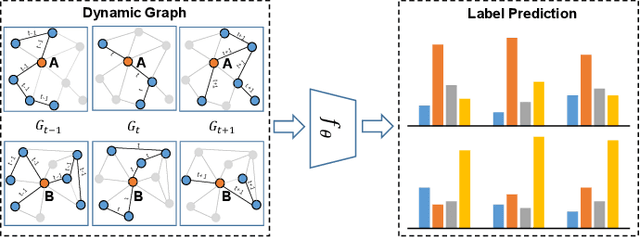

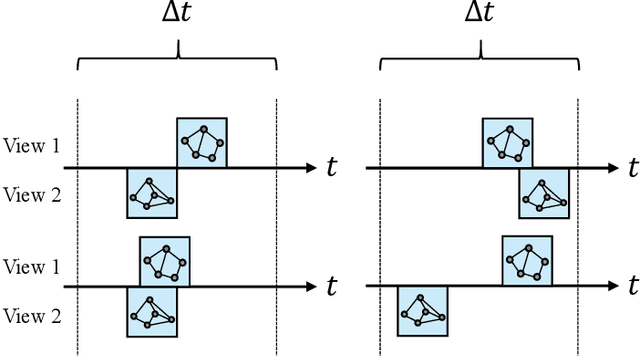
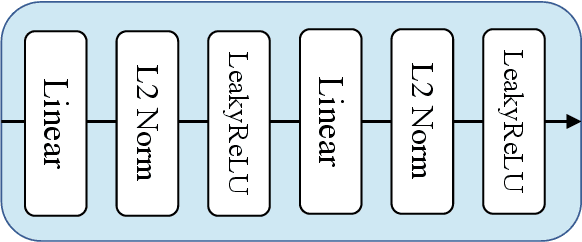
The graph with complex annotations is the most potent data type, whose constantly evolving motivates further exploration of the unsupervised dynamic graph representation. One of the representative paradigms is graph contrastive learning. It constructs self-supervised signals by maximizing the mutual information between the statistic graph's augmentation views. However, the semantics and labels may change within the augmentation process, causing a significant performance drop in downstream tasks. This drawback becomes greatly magnified on dynamic graphs. To address this problem, we designed a simple yet effective framework named CLDG. Firstly, we elaborate that dynamic graphs have temporal translation invariance at different levels. Then, we proposed a sampling layer to extract the temporally-persistent signals. It will encourage the node to maintain consistent local and global representations, i.e., temporal translation invariance under the timespan views. The extensive experiments demonstrate the effectiveness and efficiency of the method on seven datasets by outperforming eight unsupervised state-of-the-art baselines and showing competitiveness against four semi-supervised methods. Compared with the existing dynamic graph method, the number of model parameters and training time is reduced by an average of 2,001.86 times and 130.31 times on seven datasets, respectively.
Timely reliable Bayesian decision-making enabled using memristors
Dec 07, 2024Brains perform timely reliable decision-making by Bayes theorem. Bayes theorem quantifies events as probabilities and, through probability rules, renders the decisions. Learning from this, applying Bayes theorem in practical problems can visualize the potential risks and decision confidence, thereby enabling efficient user-scene interactions. However, given the probabilistic nature, implementing Bayes theorem with the conventional deterministic computing can inevitably induce excessive computational cost and decision latency. Herein, we propose a probabilistic computing approach using memristors to implement Bayes theorem. We integrate volatile memristors with Boolean logics and, by exploiting the volatile stochastic switching of the memristors, realize Boolean operations with statistical probabilities and correlations, key for enabling Bayes theorem. To practically demonstrate the effectiveness of our memristor-enabled Bayes theorem approach in user-scene interactions, we design lightweight Bayesian inference and fusion operators using our probabilistic logics and apply the operators in road scene parsing for self-driving, including route planning and obstacle detection. The results show that our operators can achieve reliable decisions at a rate over 2,500 frames per second, outperforming human decision-making and the existing driving assistance systems.
Beyond Gait: Learning Knee Angle for Seamless Prosthesis Control in Multiple Scenarios
Apr 10, 2024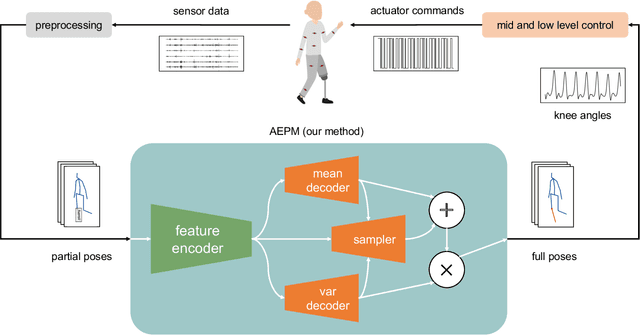

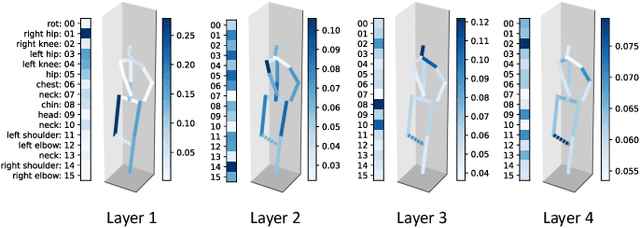
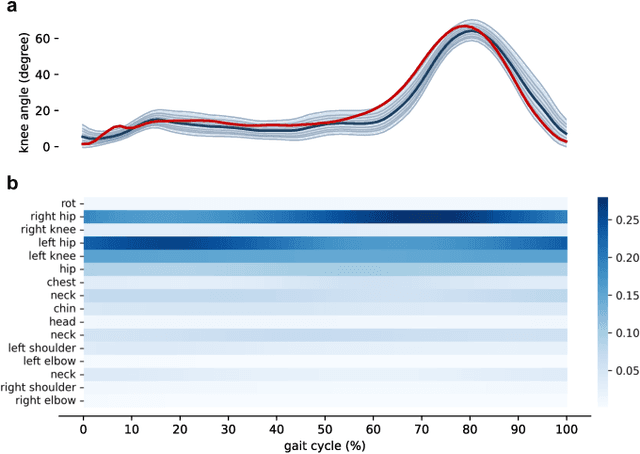
Deep learning models have become a powerful tool in knee angle estimation for lower limb prostheses, owing to their adaptability across various gait phases and locomotion modes. Current methods utilize Multi-Layer Perceptrons (MLP), Long-Short Term Memory Networks (LSTM), and Convolutional Neural Networks (CNN), predominantly analyzing motion information from the thigh. Contrary to these approaches, our study introduces a holistic perspective by integrating whole-body movements as inputs. We propose a transformer-based probabilistic framework, termed the Angle Estimation Probabilistic Model (AEPM), that offers precise angle estimations across extensive scenarios beyond walking. AEPM achieves an overall RMSE of 6.70 degrees, with an RMSE of 3.45 degrees in walking scenarios. Compared to the state of the art, AEPM has improved the prediction accuracy for walking by 11.31%. Our method can achieve seamless adaptation between different locomotion modes. Also, this model can be utilized to analyze the synergy between the knee and other joints. We reveal that the whole body movement has valuable information for knee movement, which can provide insights into designing sensors for prostheses. The code is available at https://github.com/penway/Beyond-Gait-AEPM.